



Education Journalist | Study Abroad Lead
Parallelepiped is a three-dimensional figure. It is a six sided parallelogram. It relates to a parallelogram in the same way that a cube relates to a square. The four ideas of Euclidean geometry are defined as follows: parallelogram and square in two dimensions, parallelepiped and cube in three dimensions. A parallelepiped is a three-dimensional convex form with flat sides and straight edges (i.e. a polyhedron). A zonohedron is also a parallelepiped. A zonohedron is a shape with point symmetry on each face. Cubes, cuboids, and parallelepipeds are three-dimensional polyhedra that are closely related.
Read More: Math Formulas
Key Terms: Parallelepiped, Parallelogram, Zonohedron, Cube, Cuboid, Surface Area, Volume
What is a Parallelepiped?
[Click Here for Sample Questions]
Parallelepiped is a three-dimensional shape with six faces, all of which are parallelogram-shaped. It is made up of six faces, eight vertices, and twelve edges. The parallelepiped's edges can be divided into three (3) sets of four (4) edges, with each set having parallel and equal length edges. A parallelepiped is a specific case of a cube, cuboid, and rhomboid. A cube is a parallelepiped with square sides on all sides. A cuboid and a rhomboid, on the other hand, are parallelepipeds with rectangle and rhombus-shaped faces.
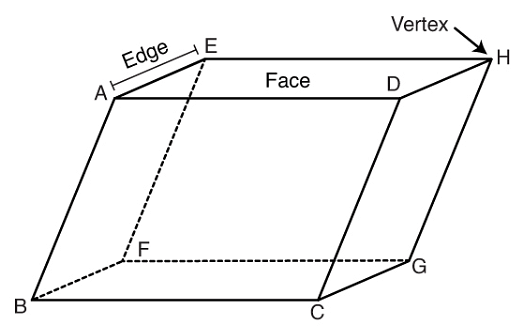
Parallelepiped
It comes from a Greek term that means 'an object with a parallel plane.' It is essentially made up of six parallelogram sides that form a three-dimensional figure or a Prism with a parallelogram foundation. It's a polyhedron, which is made up of three pairs of parallel faces that are connected together to form a three-dimensional object with six faces. Its three special cases are the cube, cuboid, and rhomboid. All of the faces of the rectangular parallelepiped are rectangular.
Read Also:
Properties of Parallelepiped
[Click Here for Sample Questions]
The basis planes of the prism might be any of the three pairs of parallel sides. A parallelepiped is made up of three sets of four parallel edges, each having equal length edges. Linear transformations of a cube produce parallelepipeds. A parallelepiped is a zonohedron because each face has point symmetry. Each face is a mirror image of the opposing face when viewed from the outside. The faces are chiral in general, but not parallelepiped. Some of the important properties of parallelepiped are as follows:
- A parallelepiped is a three-dimensional shape.
- It has a total of six faces.
- There are 12 edges and 8 vertices on it.
- The faces of parallelepiped are parallelograms.
- It is a prism with a base that is a parallelogram.
- Each face appears to be a mirror image of the other.
- The face diagonal is the diagonal of each face.
- The body diagonal is the diagonal of the parallelepiped's 3-D body.
Surface Area of Parallelepiped
[Click Here for Sample Questions]
Parallelepiped's surface area is defined as the entire area covered by all of the parallelepiped's surfaces. A parallelepiped's surface area is measured in square units, such as in2, cm2, m2, ft2, yd2 and so on.
Lateral Surface Area
A parallelepiped's lateral surface area is defined as the area of the parallelepiped's lateral or side faces. We need to find the sum of the area covered by the four side faces to calculate the LSA of a parallelepiped.
L.S.A. = Perimeter of base × height
LSA of Parallelepiped = P × H
Total Surface Area
The area of all the parallelepiped's faces is defined as the total surface area of the parallelepiped. To determine the TSA of a parallelepiped, add the area covered by each of the six faces.
T.S.A. = L.S.A. + 2 (base area)
TSA of Parallelepiped = LSA + 2 × B = (P × H) + (2 × B)
where,
- B = Base area
- H = Height of parallelepiped
- P = Perimeter of base
Types of Parallelepiped
[Click Here for Sample Questions]
Parallelepipeds are divided into two categories:
- Cube
- Cuboid
Cube
The cube is a parallelepiped with square faces on all six sides. Dice, ice cubes, Rubik's cubes, and other similar objects are examples. Allow 'a' units on each side of the cube. Then,
- The volume of cuboid = Area of Bottom face (Square) × Height
= (a × a) × (a)
= a3 units
- L.S.A. = Perimeter of base (Square) × Height
= (4a) × (a)
= 4a2 units
- T.S.A. = L.S.A. + 2(Base area)
= (4a2)+ 2(a2)
= 6a2 units
Cuboid
Cuboid is a parallelepiped with rectangular faces on all six sides. It is a three-dimensional construction in the shape of a box. For instance, a match-stick box, a duster, bricks, an instrument box, and so on. Let l, b, and h represent the cuboid's length, breadth, and height, respectively. Then,
- Volume of cuboid = Area of Bottom face (Rectangular) × Height
= (l × b) × (h)
= l × b × h
- L.S.A. = Perimeter of base (Rectangle) × Height
= 2 (l + b) × (h)
= 2 (l + b) h
L.S.A. of the cuboid can also be assumed as an area of four walls of a cuboidal room.
- T.S.A. = L.S.A. + 2 (Base area)
= 2 (l + b) h + 2 (lb)
= 2 (lb + bh + lh)
Read Also:
| Related Topics | ||
|---|---|---|
| Vector Formula | Surface Areas and Volume | Angle Between Two Vectors |
Volume of Parallelepiped
[Click Here for Sample Questions]
The space occupied by a parallelepiped in a three-dimensional plane is defined as its volume. A parallelepiped's volume is measured in cubic units such as in3, cm3, m3, ft3, yd3 and so on.
The base area and height can be used to compute the volume of a parallelepiped. The formula for calculating a parallelepiped's volume is as follows:
V = B × H
where,
- B = Base area
- H = Height of parallelepiped
Read Also:
Rectangular Parallelepiped
[Click Here for Sample Questions]
Rectangular parallelepiped is defined as a parallelepiped with all six faces forming a rectangular shape. It is a three-dimensional construction in the shape of a box. All of the parallel edges are of the same length. The prism's base is rectangular in shape in this case. The shoe box, which has a rectangular shape, is a popular example that you can see in real life. The volume of rectangular parallelepiped is given by;
Volume = Surface Area × Height
Things to Remember
- The area of the parallelepiped's base multiplied by its height equals the volume of the parallelepiped. Any of the parallelepiped's six faces can serve as its basis.
- A zonohedron is a shape with point symmetry on each face.
- All parallelepipeds are not cuboids, but all cuboids are parallelepipeds.
- The parallelepiped's edges can be divided into three (3) sets of four (4) edges, with each set having parallel and equal length edges.
- A zonohedron is also a parallelepiped.
Sample Questions
Ques. What is the formula of parallelepiped? (2 Marks)
Ans. The formulas for parallelepiped are:
- LSA of parallelepiped = P × H.
- TSA of parallelepiped = (P × H) + (2 × B)
- Volume of parallelepiped = B × H.
Ques. What is a parallelepiped in maths? (2 Marks)
Ans. A parallelepiped is a three-dimensional shape made up of six parallelograms in geometry (the term rhomboid is also sometimes used with this meaning). It relates to a parallelogram in the same way that a cube relates to a square.
Ques. What is meant by rectangular parallelepiped? (1 Mark)
Ans. A rectangular parallelepiped is a six-faced polyhedron, commonly known as a hexahedron, with each face being a parallelogram.
Ques. The base face of a parallelepiped has opposite sides measuring 5 inches and 10 inches. The height of the parallelepiped is 4 inches. Find the cost of painting its walls from outside at a cost of INR 1.5 per square inch. (3 Marks)
Ans. We need to find the lateral surface area first, therefore;
LSA = Perimeter of base × height
LSA = 2 (5 + 10) × 6
LSA = 180 sq.inch
Cost of painting = Lateral surface area × cost per square inch
Cost of painting the walls = 180 × 1.5 = Rs.270
Ques. What is the difference between parallelogram and parallelepiped? (2 Marks)
Ans. A parallelogram is a convex quadrilateral in which each pair of opposite edges is parallel and equal in length, whereas a parallelepiped is a solid figure with six faces, all parallelograms, and all opposite faces are comparable and parallel.
Ques. What are the properties of a parallelepiped? (3 Marks)
Ans. The properties of a parallelepiped are given below:
- It is a solid three-dimensional figure.
- You can look at any three faces at the same time.
- It contains three sets of four parallel edges, with each set's edges measuring the same length.
- Face diagonal refers to the diagonal of each face.
Ques. What are symmetric matrices? (2 Marks)
Ans. A symmetric matrix is a square matrix that is identical to its transpose in linear algebra. Only square matrices can be symmetric since equal matrices have equal dimensions.
Ques. What is right parallelepiped? (2 Marks)
Ans. The lateral edges of a right parallelepiped are perpendicular to the bases of the parallelepiped. An oblique parallelepiped is a parallelepiped with lateral edges that are not perpendicular to its bases. A parallelepiped is a right rectangular prism if all of its faces are rectangles.
For Latest Updates on Upcoming Board Exams, Click Here: https://t.me/class_10_12_board_updates
Check More:



Comments