



Phenotype is defined as a collection of the observable characteristics or attributes of a living organism. In biology, the term phenotype describes several characteristics and behaviors which mainly include the physical appearances of an organism as a result of the interaction of genes and varied environmental factors.
- The term applies to an organism's traits such as its behavior, morphology, physical traits, shape and structure, physiological and biochemical processes.
- Phenotype is a set of characteristics that defines an organism.
- There are several factors that influence the phenotype of an organism.
- These include the expression of an organism's genetic code, also known as genotype, and environmental factors such as humidity, temperature, nutrition, and the health of a living being.
| Table of Content |
Key words: Phenotype, Recombinant Phenotype, Genotype, Phenotypic Ratio, Gene, Recombination, Allele, RNA, Humidity, Temperature, Nutrition
Read More: Enterobius vermicularis life cycle
Phenotype Definition
[Click Here for Sample Questions]
Phenotype is a collection of the observable and measurable characteristics of a living organism which is the result of the interaction of genes, environmental factors, and other varying factors.
- The term phenotype does not just describe the morphology of the organism but also the gives details of the structures of RNA and proteins that are genetically coded in the system of the organism.
- This is also known as the molecular phenotype.
- The word phenotype is derived from the Greek word faino- 'showing', and túpos 'type'.
- Some examples of phenotypes are blue eye trait (for eye color character), five-petalled trait (for flower character), long-tail trait (for tail character), brown skin trait (for skin color character), size of a bird's beak, the sound of your voice, height, etc.
The video below explains this:
Phenotype Detailed Video Explanation:
Phenotype
Phenotypic Variation
[Click Here for Sample Questions]
Phenotypic variation is an important aspect or of prior importance for the evolution by the natural selection of organisms. Natural selection is the reproduction and survival of individuals due to differences in phenotype.
- There are several variations in the population of organisms.
- The phenotype, which is the characteristic that directly interacts with the environment is the part natural selection acts upon.
- However, the genetic or heritable part of phenotype which provides an upper hand in the reproduction of phenotype may become more in the population.
- There would have been no chances for evolution by natural selection without phenotypic variation.
- The relationship between genotype and phenotype is visualised by:
genotype(G) + environment(E) → phenotype(P)
- Another way to express this relationship is provided below:
genotype(G) + environment(E) + genotype and environment interactions(GE) → phenotype(P)

Phenotypic Variation
Also read:
| Related Articles | ||
|---|---|---|
| Genetics and Laws of Inheritance | Mendelian Inheritance | Chromosomal Theory of Inheritance |
| DNA Packaging | DNA Fingerprinting | Human Genome Project |
Expression of Phenotype
[Click Here for Sample Questions]
The phenotype is influenced by a number of factors including environmental and genetic variations. When a pair of alleles describing a particular character or trait consists of the same genes like ZZ or zz, they are known homozygous, whereas the pair of alleles describing a particular trait consist of different genes like Aa or aA, they are known as heterozygous.
- The dominant trait is expressed when the zygotes have the presence of a dominant allele, but in the case of the absence of a dominant allele, the trait is not expressed in the phenotype.
- This follows the Mendelian principle of inheritance and is a case of complete dominance.
- In case of incomplete dominance the pair of alleles, or genes combine in a way so that neither of the traits dominates the other.
- In incomplete dominance the dominant allele gets partially expressed, the resulting trait will be the intermediate of both the alleles.
- Therefore, the heterozygous offspring will have a phenotype that is intermediary to the phenotypes of the parent alleles.
The phenotype can also be influenced by environmental factors like temperature, moisture, and other variations which in turn affect the physical appearance of the organism.
- These variations in phenotype are important as they are responsible for evolution by natural selection.
- Moreover, the different types of genetic codes and other variations in genes explain the varied phenotypes in individuals.
- The phenotype also changes from time to time based on environmental changes.
Recombinant Phenotype
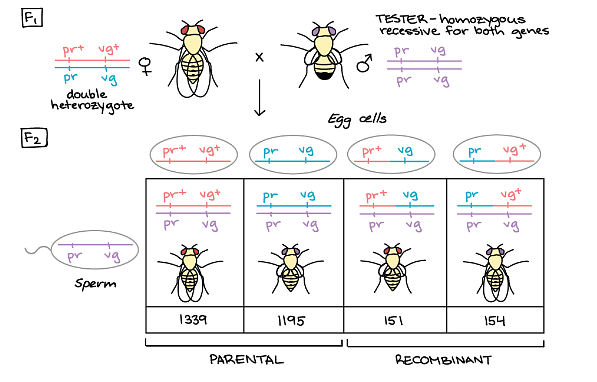
Recombinant phenotypes are defined as the phenotypes of the offspring that are different from the phenotypes of their parent genes.
- These non-parental phenotypes arise during the crossing-over of genes, located on the same chromosome during meiosis.
- When two genes are crossing over, the frequency of recombination depends upon the distance between the genes.
- If the distance between the genes is too large then the frequency of recombination is 50%.
- On the other hand, genes that are closer to each other on the chromosomes, they have a greater tendency and contribution towards crossing-over of the genes.
- Recombinant phenotypes introduces phenotypic variations in the offspring produced by the parent genes or alleles.
- These are the traits that are controlled by two loci.
- Parental phenotypes are the phenotypes that are formed on the production of offspring that have a similar phenotype to that of the phenotypes of the parent genes.
- They are widely different from the recombinant phenotype.
Recombinant Phenotype
Extreme Phenotype
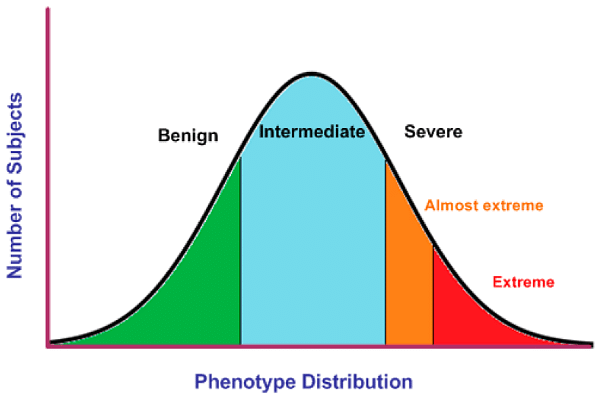
Extreme phenotype is formed when two-parent alleles come together and form a phenotype that is higher or greater than the phenotype of the parent alleles.
- The formation of extreme phenotypes is known as transgressive segregation.
- It is observed in segregative hybrid populations as compared to the phenotypes in parent alleles.
- These extreme phenotypes can either benefit or reduce the overall fitness of the phenotype.
Extreme phenotype
Phenotypic Ratio
[Click Here for Sample Questions]
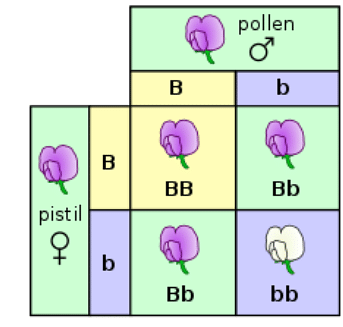
A phenotypic ratio is a quantitative relation between the phenotypes showing the number of times the frequency of one phenotype correlates with another.
- Punnett square method is used widely when the information about the genes of a generation of an organisms is required.
- A Punnett square is used to display all the allelic combinations and possibilities that are used to determine a particular trait in the test cross.
- The phenotypic ratio can be easily determined from the test cross.
- In this principle, an uppercase letter is used to describe a dominant trait whereas a lowercase letter describes a recessive trait.

Phenotypic Ratio
Read More about Non-mendelian inheritance
Difference between Phenotype and Genotype
[Click Here for Sample Questions]
In biology, genetics includes terms like genotype and phenotype which describe the traits, physical appearances, and behaviors of an organism.
- The genotype of an organism is the set of genes that define the characteristics or behavior of an organism.
- Specifically, genotype contributes to the phenotype.
- The phenotype of an organism is mostly determined by the genotype.
- In a pair of genes relating to a particular trait, there are two types of alleles, namely, dominant and recessive.
- The dominant trait is expressed in organism while the recessive remains unexpressed.
-
The phenotype of an organism will include the traits of the dominant allele or the expressed gene.
There are many complex traits in human beings where most of the observable traits do not follow the Mendelian pattern. Such complex traits are skin color, hair, height, and other observable traits arising due to the interaction of multiple alleles, such as polygenic inheritance.

Difference between Phenotype and Genotype
Things to Remember
- Phenotype is defined as a collection of the observable characteristics or traits in an organism in the field of genetics.
- The phenotype does not just describe the morphology of the organism but also the structures of RNA and proteins.
- The genotype of an organism is the set of genes that define the characteristics or behavior of an organism.
- Genotype contributes to make a phenotype of an organism.
- A phenotypic ratio is a quantitative relation between the phenotypes showing the number of times the frequency of one phenotype correlates with another.
- Punnett Square method is used comonly to obtain a phenotypic ratio.
- The phenotype of an organism is influenced by a number of factors including environmental and genetic variations.
Read More:
Sample Questions
Ques: A test is performed to know whether the given plant is homozygous dominant or heterozygous. Name the test and phenotypic ratio of this test for a monohybrid cross. [1 marks]
Ans: A test cross is performed to know whether the given plant is homozygous dominant or heterozygous and the phenotypic ratio of the test cross for a monohybrid cross is 1:1.
Ques: Name the phenomena that occur when homologous chromosomes do not separate during meiosis. [1 mark]
Ans: The phenomenon that occurs when homologous chromosomes do not separate during meiosis is known as non-disjunction.
Ques: What is a test cross? [1 mark]
Ans: A test cross is a kind of cross between the dominant phenotype and a homozygous recessive individual where the offspring's genotype for a particular trait is determined.
Ques: The map distance between a certain organism's genes A and B are 4 units, between B and C is 5 units, and between C and D is 8 units. Which one of the gene pairs will show more recombination frequency? Give reasons. [2 marks]
Ans: Here, C and D will show maximum gene recombination frequency since genes that are linked more closely have the least frequency of recombination and those who are located at distance far enough are said to be unlinked genes that have less probability to be inteherited together to the next generation.
Ques: In Mendel's breeding experiment on garden peas, the offspring of the F2 generation are obtained in the ratio of 25% pure yellow pod, 50% hybrid green pods, and 25% green pods. State (i) which pod color is dominant, (ii) The Phenotypes of the individuals of the F1 generation, (iii) Workout the cross. [4 marks]
Ans: i. In Mendel's breeding experiment on garden peas, the green pod color is dominant in the offspring of the F2 generation.
- Green pod color is the phenotype of the individuals of the F1 generation.
- The cross is shown as –

The phenotypic ratio is 3:1
The genotypic ratio is 1:2:1
Ques: A smooth seeded and red-flowered pea plant (SsRr) is crossed with a smooth seeded and white-flowered pea plant (Ssrr). Determine the phenotypic and genotypic ratio in F1 progeny? [3 marks]
Ans: When a cross is done between smooth seeded and red-flowered pea plant (SsRr) along with a smooth seeded and white-flowered pea plant (Ssrr) then
Dominant - smooth seeded and red flowers,
Recessive - wrinkled seeds and white flowers
| SR | Sr | sR | sr | |
| Sr | SSRr | SSrr | SsRr | Ssrr |
| sr | SsRr | Ssrr | ssRr | ssrr |
Now, Genotypic ratio = SSRr : SSrr : SsRr : Ssrr : ssRr : ssrr = 1:1:2:2:1:1
Phenotypic ratio =
- Smooth seeded and red flowers = 3
- Wrinkled seeds and red flowers = 1
- Smooth seeded and white flowers = 3
- Wrinkled seeds and white flowers = 1
Therefore, phenotypic ratio = 1 : 3 : 3 : 1
Ques: A dihybrid heterozygous tall and yellow pea plant was crossed with the double recessive plant. (i) What type of cross is this? (ii) Work out the genotype & phenotype of progeny. (iii) What principle of Mendel is illustrated through the result of this cross? [5 marks]
Ans: (i) When a dihybrid heterozygous tall and yellow pea plant was crossed with the double recessive plant, the type of cross is called a dihybrid cross since two characteristics are studied simultaneously.
(ii) The cross is depicted below:
| RY | Ry | rY | ry | |
| ry | RrYy | Rryy | rrYy | rryy |
Genotype: All four combinations appear once, RrYy, Rryy, rrYy, and rryy.
(1: 1: 1: 1)
Phenotypes: Round yellow, round green, wrinkled yellow, wrinkled green.
(1: 1: 1: 1).
(iii) This cross illustrates the independent law of assortment by Mendel. This law states that the inheritance of a certain trait is independent of the inheritance of the other trait. In this case, inheritance of seed shape ( round or wrinkled ) is independent of the inheritance of the other character which is the seed color ( yellow or green )
Ques: What is meant by recombinant phenotype? (3 marks)
Ans: Recombinant phenotypes are the phenotypes of the offspring that are different from the their parent phenotype. These non-parental phenotypes arise during the crossing-over of genes during meiosis. When two genes are crossing over the frequency of recombination depends upon the distance between the genes. If the distance between the genes is too large then the frequency of recombination is 50%. Recombinant phenotypes causes phenotypic variations
For Latest Updates on Upcoming Board Exams, Click Here: https://t.me/class_10_12_board_updates
Do Check Out



Comments