



Content Curator
Plague is an infectious as well as life-threatening disease which is caused by an organism called Yersinia Pestis. Yersinia Pestis is a kind of gram-negative, rod-shaped coccobacillus disease which causes bacterium. Moreover, Plague is a dangerous infection which is transmitted primarily through fleas. There are many symptoms of plague-like weakness, fever, and headache. Plague is spread from person to person. Plague mainly affects the lungs in the human body. Plague is transmitted from one person to another person.
Read Also: Diseases
| Table of Content |
Key terms: Plague, Symptoms of Plague, Fleas, Diagnosis of Plague, Yersinia Pestis, Disease, Bacterium
What is Plague?
[Click Here for Sample Questions]
Plague is caused by an organism which is known as Yersinia Pestis. Yersinia pestis belongs to the coccobacillus family of bacterium which is gram-negative and rod-shaped. In plague, a bacterium is transmitted from rodents to humans by the medium of fleas.
Furthermore, plague is a zoonotic bacterium that is transmitted from animals to humans. Plague is harmful to both animals and human beings. The plague spreads by various modes such as direct contact with people, air(inhalation), water etc.
Read more: Pathogens
When any animals like rats, mice etc. sucked blood from rodents and bite the humans then plague is transmitted to humans. There were many people who died because of the plague in history.
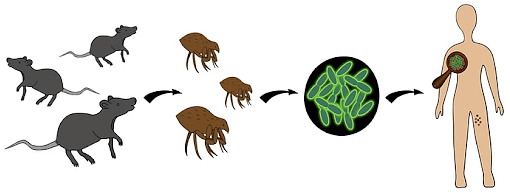
Plague Cycle Diagram
Kinds of Plague
[Click Here for Sample Questions]
There are mainly three types of Plague disease which are discussed below:
-
Bubonic plague disease: Bubonic plague disease is the most basic type of the disease. In this disease, the lymph nodes(buboes) are swallowed in the first week after the person becomes infected. It is transmitted through fleas which consist of bacteria.
The sign and symptoms of bubonic plague disease are mentioned below:
- Headache
- Muscle aches
- Fatigue or malaise
- Sudden fever as well as chills.
- Septicemic plague disease: Septicemic plague disease is the second type of infectious disease which occurs when plague bacteria multiply in a person's bloodstream. At this stage, the cells are almost killed by the bacteria which causes death.

Septicemic Plague Disease Diagram
The sign and symptoms of septicemic plague disease are mentioned below:
- Bleeding from a person’s mouth, nose or rectum
- Fever and chills
- Abdominal pain, vomiting as well as diarrhoea
- Extreme weakness
- Shock
- Blackening and death of tissues in person’s extremities( toes, fingers and nose)
- Pneumonic plague disease: Pneumonic plague disease is the least common type of plague disease but it is more dangerous than others. It spreads from one person to another person via cough droplets. It mostly has a bad impact on the lungs. Also, the symptoms of this disease can be seen after a few hours of infection.

Pneumonic Plague Disease Diagram
The sign and symptoms of pneumonic plague disease are mentioned below:
- Difficulty in breathing
- High fever
- Headache
- Weakness
- Chest pain
- Cough and bloody mucus(sputum)
- Nausea as well as vomiting
Read more: Typhoid
Symptoms of Plague
[Click Here for Sample Questions]
There are many signs and symptoms which indicate that a person is suffering from the plague. Also, the symptoms differ by type as well as the days of infection. Some of the major symptoms are listed below:
- General weakness
- Fever
- Diarrhoea
- Vomiting sensation
- Difficulty in breathing
- Nausea
- Frequent headache
- Swelling in the joints
- Seizures
- Chest pain with severe cough
- Pain in the muscles
- Pain in the abdomen region of the human body’
Read more: Pneumonia
Reasons of Plague
[Click Here for Sample Questions]
There are many reasons behind the widespread plague disease in various areas. Some of the major causes are mentioned below:
- Vector-borne transmission: Plague is carried by insects or animals such as rats, rodents, squirrels etc. which are infected by it i.e. medium of fleas.
- Droplet contact: It is caused by coughing and sneezing on another person.
- Direct physical contact: In this state, plague is caused by touching an infected person which includes sexual contact also.
- Indirect contact: In indirect contact, plague is mainly caused by touching a contaminated surface such as soil.
- Airborne transmission: Plague is caused when microorganisms can remain in the air for a long time.
- Faecal oral transmission: Plague is mainly caused by contaminated food or water sources.
Read more: Vector-Borne Disease
Diagnosis of Plague
[Click Here for Sample Questions]
Plague is diagnosed by simply taking the blood samples. In blood samples, doctors try to find out the presence of bacteria in the human body But, for different plague types different blood tests are taken by the doctor such as:
- A simple blood test is taken by the doctor which indicates whether the person is suffering from septicemic plague or not.
- For bubonic plague, a doctor uses a needle to take a sample of the fluid in a person's swollen lymph nodes.
- For pneumonic plague, laboratory testing takes place where doctors either take blood samples or samples from swollen lymph nodes to check the presence of bacteria in the human body. This clinical process is also called bronchoscopy.
Read more: Common Cold
Treatment for the Plague
[Click Here for Sample Questions]
Plague is a serious and life-threatening disease which needs urgent care and treatment. If the proper care and treatment are not provided then it leads to the death of any person. But, plague is a treatable disease when it is caught and treated at an earlier state.
- The most common method to treat the plague is by using antibiotics such as gentamicin or ciprofloxacin.
- A person who is suffering from pneumonic plague must be isolated from other people to avoid transmission.
Read more: Principles of Treatment
Things to Remember
- Plague is an ancient infectious disease which is caused by an organism called yersinia pestis.
- Plague is treated by using antibiotics.
- Pneumonic plague disease is the most dangerous disease and is least common among people.
- Plague is transmitted from one person to another person by means of touching, sneezing and coughing etc.
- Plague is usually transmitted from rodents to humans and usually affects the lungs.
- Plague can be identified by taking a blood sample of the person.
Sample Questions
Ques. What is Bronchoscopy?[ 2 marks]
Ans. Bronchoscopy is referred to as a clinical process in which doctors check the lungs and air passage in the human body. Plague usually affects the lungs in the human body so bronchoscopy is used to detect the presence of bacteria in the human body. In bronchoscopy, a thin tube(known as bronchoscope) is passed through the patient's nose or mouth and down to the throat and into the lungs.
Ques. Write down the risk factors of plague?[ 2 marks]
Ans. In most cases, being at risk of contracting the plague is relatively rare. But, there are some factors which increase the risk of plague. These factors are mentioned below:
- By living in the rural and semi-rural areas which are extremely agricultural.
- Living in the homes with high exposure to rodents or fleas which may be infected with plague
- By making direct contact with the person who contracted the plague.
Ques. What are the most common ways to prevent plague?[ 3 marks]
Ans. There are many prevention methods which are used to prevent plague. Some of the prevention are discussed below:
- Try to avoid direct contact with the person who is suspected to expose the plague bacteria.
- Try to recognize the signs and symptoms of each kind of plague in order to get treated as soon as possible.
- Always wear insect repellants either natural or chemical while going outside.
- By using flea control products, protect any outdoor pet from fleas.
- Try to avoid keeping piles or debris like rocks, firewoods etc.
- Try to keep the recent population under control in your home as well as workplace.
- Do not allow pets to freely go outside or sleep in your bed if you are living in a high-risk area.
- Reach the doctor as soon as possible if you think you are exposed to infected rodents or fleas.
Ques. What is the black death?[2 marks]
Ans. Plague disease is known as the black death. There are many people around 50 million who have lost their lives due to plague disease during the 14th century in Europe. Also, the bubonic plague disease is one of the most disastrous diseases in the history of the world which killed around 75 to 200 million people.
Ques. What are the antibiotics used to treat plague?[2 marks]
Ans. Antibiotics are the most common and effective way to treat plague. There are lots of antibiotics which are effective in the treatment of plague disease. Some of the antibiotics are mentioned below:
- Gentamicin
- Streptomycin
- Aminoglycosides
- Doxycycline
- Fluoroquinolone
- Ciprofloxacin
- Tetracyclines and many more.
Ques. What do you mean by pneumonic plague disease?[ 2 marks]
Ans. Pneumonic plague disease is the least common type of plague disease but it is more harmful than the other two kinds of plague disease. If the bacteria spreads and first infects the lungs then it comes under the category of pneumonic plague disease. If this plague disease is left untreated then it can be fatal. Pneumonic plague disease is the only type of plague disease which can be transmitted from one person to another person. The common signs of pneumonic plague disease are:
- Fever
- Cough
- chest pain
- difficulty in breathing
- headache etc.
Ques. What are the symptoms of Septicemic plague disease?[ 2 marks]
Ans. The septicemic plague disease is the secondary form of plague disease. It is caused when the bacteria directly enters the bloodstream of the human body and multiplies there. The sign and symptoms of septicemic plague disease are listed below:
- Abdominal pain
- Diarrhoea
- Vomiting
- Fever
- Physical weakness
- Shock
- Blackening as well as the death of tissue(gangrene) in extremities, especially in fingers, toes and nose etc.
Ques. Write down the causes of plague disease?[2 marks]
Ans. The most common causes of the plague are mentioned below:
- Direct physical contact
- Indirect contact
- Vector-borne transmission
- Faecal oral transmission
- Airborne transmission
- Droplet contact
Ques: What are infectious diseases? Give some examples. [3 marks]
Ans: Infectious diseases are the types of diseases that are caused by pathogenic organisms like bacteria, viruses, parasites, and fungi. These diseases are generally caused when a microorganism seizes the body cell and releases some sort of toxins inside the body. Infectious diseases can be communicable or non-communicable.
For example Common cold, influenza, AIDS, dengue fever, Kala-azar
Ques: What are the symptoms of infectious diseases? [3 marks]
Ans: The symptoms are as follows:
The symptoms of infectious diseases are based on the site and the type of pathogens that affect the body.
The viruses generally target specific cells, for example, the rabies virus affects the nervous system, and some viruses cause muscle aches, warts, runny nose and so on.
A person who is affected by a bacterial infection will experience such symptoms: heat, pain, fever, fever, swelling in the lymph gland and so on.
Check-Out:



Comments