



Content Curator
Plant differentiation is the process in which the cells of the root, apical meristems, cambium, and the shoot are matured to undergo certain functions. The process of development involves two steps basically i.e. growth and differentiation. The process of development of a mature plant from its zygote (fertilised egg) form follows specific and sequential events. The course of formation of a complex body organisation produces roots, branches, leaves, fruits, flowers and seeds, and later they die.
| Table of Content |
Key Takeaways: Differentiation, Developmental, Growth Phase, Vascular, Parenchyma Cells
What is Differentiation?
[Click Here for Sample Questions]
The process in which the cells of the root, apical meristems, cambium, and the shoot are matured to undergo certain functions is called plant differentiation. A plant cell has to undergo many structural changes. It includes the formation of tracheary elements in a plant; also a loss of protoplasm can be witnessed. They possess very strong, elastic, lingo-cellulosic secondary cell walls to retain water to extreme conditions as well.
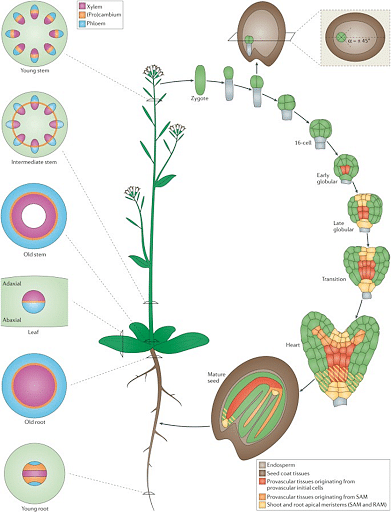
Differentiation in Plants
Differentiation takes place multiple times during the formation of a multicellular organism as it changes from a simple Zygote to a complex system of tissue and cell type. It is the process in which one cell type of cell changes to another, more distinctively to a more specialized type.
The important advantage of cell differentiation is that cells become more efficient at a certain task, maintain energy because they have to perform that one task, and have to do that task at a faster rate.
Several functions of differentiation are managed by hormones like Auxin, which plays an effective role in the differentiation of vessel components. Auxin released by the young leaves and apical meristem above the wound induces Parenchyma cells. Parenchyma cells regenerate the damaged vascular tissues.
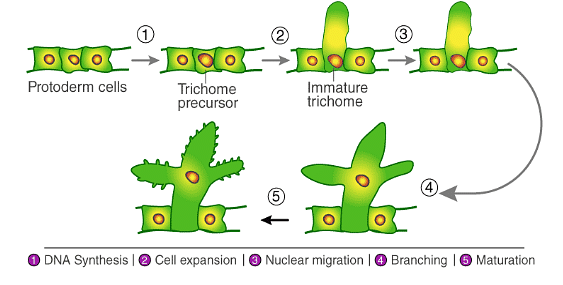
Cell Differentiation Stages
Read More:
| Related Articles | ||
|---|---|---|
| Transpiration | Photosynthesis and Respiration | Tissues |
Types of Differentiation
[Click Here for Sample Questions]
There are two types of differentiation-
Dedifferentiation Process: An interesting phenomenon about plants is the living differentiated cells that with time lose the capacity to divide can regenerate the ability of division under specific conditions. This phenomenon is termed as dedifferentiation.

Dedifferentiation in Plants
For example, the formation of meristems includes the interfascicular cambium and cork cambium from fully differentiated parenchyma cells. Similarly, normal cells of the human body dedifferentiate resulting in the formation of tumor cells.
Redifferentiation Process: A dedifferentiated plant cell in the process loses the capacity to divide another time and becomes mature; it is called the Redifferentiation process. While in this process, the cells are matured in sequence to perform some distinctive functions.
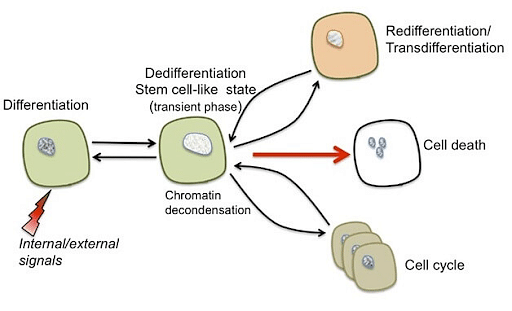
Redifferentiation Process
Examples of redifferentiation that can be included are the formations of cork, secondary phloem, secondary xylem, secondary cortex, and many more.
Read More:
Developmental Phase
[Click Here for Sample Questions]
Generally most plants keep growing throughout their life; they mature through a combination process of cell growth and cell division (mitosis). The development phase comprises changes that every organism has to go through throughout its life. In plants, this development process starts with the germination of the seed and it ends with senescence. This process includes steps like:
- Cell division
- Elongation of cell
- Differentiation cell
- Maturation
Cell division takes place in the meristematic tissue of plants thereafter the elongation process takes place. After which the cell engages in the differentiation process and develops into a mature cell which again undergoes aging and finally dies. The development process is the combination of both intrinsic factors and extrinsic factors as well. The intrinsic factor includes genetic and chemical factors whereas extrinsic factors are the basic components of nature that includes sunlight, minerals, nutrients, water, etc.
Read Also:
| Relevant Articles | ||
|---|---|---|
Growth Phase
[Click Here for Sample Questions]
Growth phase of a plant is a simultaneous process that are generally classified into various types and stages-
- Primary and Secondary Growth: Primary growth is stated as the increase in the length of the plant body due to mitotic division of meristematic cells present at the root and shoot apex. The secondary growth defines the increase in the diameter of the plant body due to secondary meristems.
- Unlimited Growth: This stage is also known as the intermediate type of growth. In this stage, the root and the shoot system of plants keeps growing continuously from its germination stage to its death and sometimes this might vary for its lifespan of the plant.

Growth Phase in Plants
- Limited Growth: The leaves, flowers and fruit cease to grow after obtaining a certain size. This is called a ‘limited’ as well as ‘determinate’ type of growth.
- Vegetative Growth: The early growth stage of plants that produces branches, leaves, and stems but does not bear flowers is called ‘vegetative growth.
- Reproductive Growth: After the plant undergoes the vegetative growth phase, it starts to bear a flower which is also known as the reproductive part of the plant. This is known as reproductive growth.
Read more:
| Relevant Topics | ||
|---|---|---|
Things to Remember
- The general process of development of a plant includes two steps basically i.e, growth and differentiation.
- The course of formation of a complex body organisation of a plant involves the production of roots, branches, leaves, fruits, flowers and seeds, and later they die.
- The cells of the root, apical meristems, cambium, and the shoot are matured to undergo distinct functions and this process is termed plant differentiation.
- Differentiation takes place multiple times during the formation of a multicellular organism as it changes from a simple Zygote to a complex system of tissue and cell type.
- Differentiation is of two types- dedifferentiation and redifferentiation.
- The process of development includes four phases i.e, Cell division, Elongation of the cell, Differentiation of cell, Maturation.
- Growth phase of a plant is a continuous process involving various steps are Primary and Secondary Growth, Unlimited Growth, Limited Growth, Vegetative Growth, Reproductive Growth
Sample Questions
Ques: What do you mean by differentiation in biological terms? [1 marks]
Ans: Differentiation means the process in which one cell type of cell changes to another, more distinctively to a more specialized type.
Ques: What is meant by differentiation in animal cells? [2 marks]
Ans: In case of multicellular organisms, in the formation of new cell types, cell differentiation plays a significant role in its developmental process. The process of development involves the diversification and specialization of various tissue structures of embryonic cells, and this phenomenon is also called embryonic differentiation. However, the differentiation of cells are inclusively based on intrinsic and extrinsic properties as well.
Ques: Name some plant growth regulators and their functions involved. [2 marks]
Ans:
- Growth promoters: Auxins, cytokinin gibberellin
- Functions of growth promoters are seed germination, fruiting and flowering,root formation, and cell division.
- Growth inhibitor: abscisic acid and ethylene.
- Functions of growth inhibitors help in the aging process and induce dormancy of seeds.
Ques: What are the two types of differentiation? [1 marks]
Ans: The two types of differentiation are dedifferentiation and redifferentiation
Ques: explain briefly the developmental process of plants? [4 marks]
Ans: Development process is the combination of both intrinsic factors and extrinsic factors as well. The intrinsic factor includes genetic and chemical factors whereas extrinsic factors are the basic components of nature that include sunlight, minerals, nutrients, water, etc. In plants, this development process starts with the germination of the seed and ends with senescence. This process includes steps like:
- Cell division
- Elongation of cell
- Differentiation cell
- Maturation
Cell division takes place in the meristematic tissue of plants thereafter the elongation process takes place. After which the cell engages in the differentiation process and develops into a mature cell which again undergoes aging and finally dies.
Ques: The cells of the root, apical meristems, cambium, and the shoot are matured to undergo distinct functions and this process is termed as ______________. [1 marks]
1.Redifferentiation
2.Dedifferentiation
3.Plant differentiation
>4.Growth phase
Ans: 3. Plant differentiation
Ques: Give some examples of the redifferentiation phase. [1 marks]
Ans: Examples of redifferentiation that can be included are the formations of cork, secondary phloem, secondary xylem, secondary cortex, etc.
Ques. Define Redifferentiation Process. [2 marks]
Ans. A dedifferentiated plant cell in the process loses the capacity to divide another time and becomes mature; it is called the Redifferentiation process. While in this process, the cells are matured in sequence to perform some distinctive functions.
Check-Out:



Comments