



Content Writer
Polysaccharides are one of the most common types of biomolecules comprising long carbohydrate molecules made up of numerous smaller monosaccharides.
- Carbohydrates are composed of two basic compounds, namely aldehydes and ketones.
- These biomolecules are composed of monosaccharides bound together by glycosidic linkages.
- Some important functions of polysaccharides include energy storage and as components of important molecules like DNA and RNA.
- The complicated bio-macromolecules serve as a source of energy in animal cells and a structural component in plant cells.
- Based on the monosaccharide type, it might be a homopolysaccharide or a heteropolysaccharide.
- It can react with water using amylase enzymes as a catalyst.
- Starch, Cellulose or Glycogen are some common examples of polysaccharides.
Key Terms: Polysaccharides, Monosaccharides, Disaccharides, Starch, Cellulose, Glycosidic Bonds, Monomers, Biomolecules, Carbohydrates, Enzymes, Structure of Polysaccharides
What are Polysaccharides?
[Click Here for Sample Questions]
Polysaccharides, also known as polycarbohydrates, are a type of carbohydrate that is made up of smaller units called monosaccharides or monomers. They sometimes contain disaccharides as their fundamental unit and are also known as glycan.
- They are amorphous or even insoluble in water.
- Cellulose, starch, glycogen and chitin are the most common polysaccharides found in food.
- It is the most abundant hydrocarbons present in our food.
- The general formula of a compound is Cx(H2O)y, where x is the number of carbon atoms (usually between 200 and 2500).
- It can form a straight chain of monosaccharides called linear polysaccharides or be branched to form branched polysaccharides.
- This type of polymer contains more than 10 monosaccharide units, and oligosaccharides contain polysaccharides with 3 to 10 monosaccharides.
Read More:
| Chapter Related Concepts | ||
|---|---|---|
| Carbohydrate Metabolism | Vitamins | |
| Cellulose | Fats and Oils | Sucrose |
Structure of Polysaccharides
[Click Here for Sample Questions]
Most polysaccharides are created by the same fundamental mechanism, which involves the formation of glycosidic linkages between monosaccharides. For example, an oxygen molecule connects two carbon rings in these glycosidic linkages.
- The bond is produced when a group of hydroxyls is removed from one molecule's carbon, and the hydrogen is removed from another monosaccharide's hydroxyl group.
- The process is a dehydration reaction because two hydrogens and one oxygen molecule are released.
- The structure of the joined molecules determines the architectures and qualities of the resultant polysaccharide.
- For example, a polysaccharide utilised for power storage will provide simple monosaccharides to the component.
- It is used to support a lengthy chain of monosaccharides forming fibrous structures.

Structure of Polysaccharides
Characteristics of Polysaccharides
[Click Here for Sample Questions]
The characteristics of polysaccharides based on their structure are as follows:
- Desiccation does not cause polysaccharides to form crystals.
- The biomolecule does not have a sweet flavour.
- Water cannot infiltrate the molecules because of numerous hydrogen bonds, making them hydrophobic.
- They are osmotically inactive and compact inside the cells. Many are water-insoluble.
- Polysaccharides are composed of hydrogen, carbon and oxygen, where the ratio of hydrogen to oxygen is 2:1.
- They are carbohydrates with a molecular weight comparatively higher than other compounds.
- It is also possible to extract a white powder from it.
Functions of Polysaccharides
[Click Here for Sample Questions]
Some important functions of polysaccharides are as follows:
- Polysaccharides serve as energy storage in living organisms.
- The monomers allow for variations in the concentration gradient, affecting the cell's water and nutrients absorption.
- Several polysaccharides generate glycolipids and glycoproteins by covalently bonding with proteins and lipids.
- These glycoproteins and glycolipids are utilised to transmit information between and inside cells.
- They provide a source of stability for the cells.
- Plants' cell structures are composed of polysaccharide cellulose, supporting the plant's cell wall.
- In addition, chitin is an essential component of the extracellular matrix surrounding insect and fungi cells.
Types of Polysaccharides
[Click Here for Sample Questions]
Polysaccharides are categorised into two main types depending upon the type of monomer present in the molecule:
Homopolysaccharides
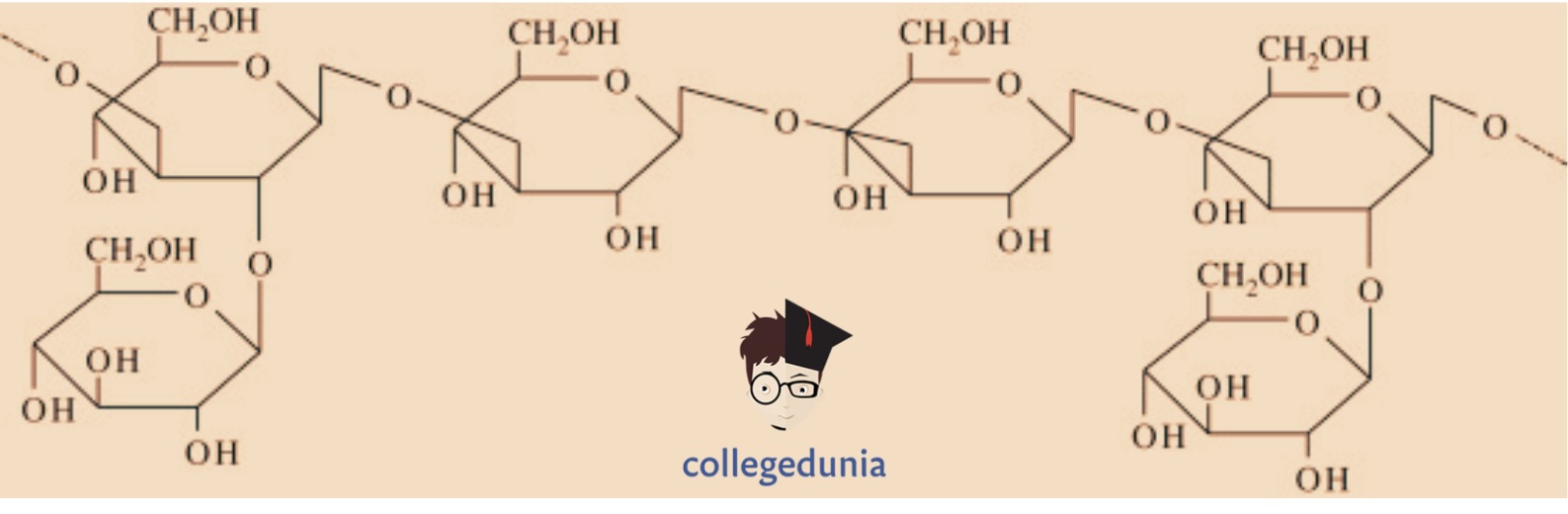
Homopolysaccharides are polysaccharides that are composed of just one type of monomer repeating unit. Cellulose, Chitin, Starch (Amylose and Amylopectin), Glycogen, and Xylans are common examples of this category of compound. Some common types of homopolysaccharides include
Cellulose
Cellulose is a linear, non-branched polymer of glucose units linked by beta 1-4 links. Anselme Payen, a French scientist, found it. It is a basic structural component of the plant cell wall.
- Cellulose is one of the most prevalent organic substances in the biosphere.
- However, even though cellulose is present in the human diet, it is indigestible because it lacks the enzymes necessary to hydrolyze it.
Starch
Starch is made up of alpha-linkages that connect repeating units of D-glucose. It contains a combination of amylose (15-20%) and amylopectin (80-85 per cent).
- The enzyme amylase is responsible for the breakdown of starch.
- It's found in humans and animals, explaining why they can digest starch so quickly.
Homopolysaccharides
Heteropolysaccharides
Heteropolysaccharides are composed of two or more repeating monomer units of various sorts. Glycosaminoglycans, Agarose, and Peptidoglycans are examples of this compound. Most heteropolysaccharides are naturally linked to peptides, proteins, and lipids.
Glycosaminoglycans (GAGs)
Glycosaminoglycans (GAGs) are unbranched, negatively charged heteropolysaccharides. They consist of disaccharide repeating units that comprise acidic and amino sugars.
- Plants lack GAGs, which are present in mammals and microbes.
- N-acetylglucosamine or N-acetylgalactosamine are the amino sugars found in GAGs.
- In most cases, the acidic sugar is uronic acid (like glucuronic acid).
Peptidoglycans
Peptidoglycans is a beta-1,4-glycosidic heteropolymer made up of alternating units of N-acetylglucosamine (NAG) and N-acetylmuramic acids (NAM). They make up 40-90% of the dry weight of gram-positive bacteria's cell walls, but they make up just 10% of the dry weight of gram-negative bacteria's cell walls.

Types of Polysaccharides
Read More:
Things to Remember
- Polysaccharides are a carbohydrate that is made up of several different molecules.
- They include starch, glycogen, and cellulose, among many other important biomolecules.
- These monomers are water-insoluble and hydrophobic.
- There are two types of polysaccharides: homopolysaccharides and heteropolysaccharides.
- They are made up of a lengthy chain of monosaccharides.
Sample Questions
Ques. What are polysaccharides and what is their role? (3 marks)
Ans. Polysaccharides are a lengthy chain of monosaccharide sugar units. They don't directly use the human body when in chain form, but when broken down into individual monomers. They are cycled through the process of glycolysis and the electron transport chain in order to produce ATP. Polysaccharides provide a source of stability for the cells. Plants' cell structures are composed of polysaccharide cellulose, supporting the plant's cell wall. In addition, chitin is an essential component of the extracellular matrix that surrounds cells in insects and fungus.
Ques. What are the similarities between polysaccharides and monosaccharides? (3 marks)
Ans. The similarities between polysaccharides and monosaccharides are:
- A monosaccharide is a simple sugar with a shorter molecular chain. Polysaccharides are a kind of carbohydrate made up of several different molecules. They consist of long chains of molecules.
- Monosaccharides are broken down more quickly, providing brief bursts of energy, but polysaccharides are broken down more slowly, providing long-term power.
- Both are carbohydrates.
- Both are composed of C, H and O atoms.
Ques. What is the difference between polysaccharides and disaccharides? (3 marks)
Ans. Disaccharides are made up of two simple sugars joined in the same way as sucrose. Polysaccharides are sugars made up of a lengthy chain of monosaccharides. Most of the disaccharides are water-soluble. Polysaccharides do not dissolve in water. Disaccharides taste sweet. Polysaccharides do not taste sweet. Some disaccharides are reducing sugars, whereas some are not. Polysaccharides are non-reducing carbohydrates. Starch, cellulose, chitin and glycogen are among the examples.
Ques. Elaborate the structure of polysaccharides with one example? (4 marks)
Ans. A polysaccharide is a carbohydrate consisting of many monosaccharides bound together by glycosidic linkages. Monosaccharide chains form polysaccharides. As a result, each polysaccharide is made up of many chemical rings. Because a water molecule is generated for every glycosidic link, condensation polymerization builds polysaccharides.
Polysaccharide examples include:
- Both chitin and cellulose are structural polysaccharides made up of thousands of glucose monomers in long threads.
- The essential storage polysaccharides are starch and glycogen.
Ques. What is an indigestible polysaccharide for humans? (3 marks)
Ans. The most common is cellulose. The list goes on and on: wood, paper, cotton, seed husks, and so on. Because humans and most animals lack an enzyme that can break the beta-linkages in cellulose, they cannot digest it. Once humans finish eating, it goes through virtually undamaged. Termites, for example, can digest cellulose because microorganisms that produce the enzyme to digest the cellulose are present in their stomach.
Ques. What distinguishes maltose from a polysaccharide? (5 marks)
Ans. The differences between maltose and polysaccharides are:
- Maltose is a disaccharide of two glucose molecules linked together by a glycosidic bond. Sucrose and lactose are two more disaccharides. Polysaccharides are carbohydrates that contain more than ten monosaccharides bonded together.
- A disaccharide is formed by two monomers. Polysaccharides are composed of many different monomers.
- Disaccharides have unbranched or branched structures that are simple, linear, and unbranched. Polysaccharides have a branching, complicated structure.
- There are two ring structures in disaccharides whereas Polysaccharides have a number of ring structures.
- Starch, for example, is made up of numerous glucose molecules. Amylose and amylopectin are two types of Starch. Glycogen, cellulose, chitin, and other polysaccharides are examples.
Ques. Why is polysaccharide used as a stored fuel? (5 marks)
Ans. Polysaccharide functions largely as an energy storage molecule or fuel for the plant and its seeds. Water does not dissolve such huge, complicated compounds well.
- Glycogen is also created by joining glucose molecules together.
- Animals utilise it, like Starch, to store sugar and give energy.
- Water does not dissolve starches.
- Breaking the alpha-linkages allows them to be digested (glycosidic bonds).
- Amylases are enzymes that help humans and other animals digest carbohydrates.
- The principal sources of starch in the human diet include potatoes, wheat, rice and maize.
- Starch formations are the means through which plants store glucose.
Ques. What are the important applications of cellulose? (3 marks)
Ans. The important applications of Cellulose are:
- Cellulose is used to manufacture cardboard, paperboard, paper and cardstocks, among other things.
- It is used in the manufacturing of electrical insulating paper.
- Cellulose is used in the production of gunpowder and biofuel.
- It is also used in pharmaceuticals as a stabiliser.
Ques. What are the properties of starch? (3 marks)
Ans. The properties of starch are as follows:
- Starch is a tasteless white powder that will not dissolve in cold water, alcohol, or other solvents.
- (C6H10O5)n is the fundamental formula for calculating Starch, where n is the number of glucose molecules in the chain.
- Pyro Dextrins are formed when Starch is broken down by dry heat, responsible for bread browning.
Ques. What are the functions of GAG? (4 marks)
Ans. The important functions of GAGs are:
- Hyaluronic acids are found in the eye's vitreous humour and the synovial fluid (a lubricant fluid present in the body's joints). It also has a role in tumour metastasis, angiogenesis, and blood coagulation throughout development.
- Heparin stops blood from clotting by acting as a natural anticoagulant.
- The eye, cartilage, and bones all contain keratan sulphate. It works as a cushion in joints, absorbing mechanical stresses.
- Chondroitin is a crucial component of cartilage that offers compression resistance.
- Wound repair, blood coagulation control, infection responses, and cardiovascular disorders are all affected by dermatan sulphate.
Ques. What are important properties of peptidoglycans? (3 marks)
Ans. The important properties of Peptidoglycans are:
- Lysozyme, an enzyme, degrades it by hydrolyzing the beta-1,4-linkage between N-acetylglucosamine (NAG) and N-acetylmuramic acids (NAM).
- The use of penicillin can prevent the synthesis of peptidoglycans.
- N-Acetylmuramyl-L-alanine amidases are enzymes that cause peptidoglycans to hydrolyze and their structure to dissolve.
For Latest Updates on Upcoming Board Exams, Click Here: https://t.me/class_10_12_board_updates
Check-Out:



Comments