



R-factors or Resistance factors, are plasmids that allow bacteria to develop resistance to antibiotics. They are usually found as a set of genetic codes that can be transferred from one bacterium cell to another by conjugation or non-conjugation. Many r-factors can be passed from one bacterium to another via bacterial conjugation.
- Plasmid is a ciruclar extra chromosomal DNA in bacteria.
- It can be transferred to another bacterium of any other organism through vector.
- Thus, r factor can be transferred from one organism to another.
| Table of Content |
Key Words: R factor, Resistance, Plasmids, Gene, Transfer, Bacteria, Antibiotic, DNA, Bacterium cell, Bacterial conjugation, Genetic codes, Chromosomal DNA
What are Plasmids?
[Click Here for Sample Questions]
Plasmids are a type of extrachromosomal genetic element present in a wide range of bacteria. They are tiny circular pieces of DNA that replicate independently of bacterial chromosomes. Bacteria, Achaea, and other multicellular organisms are the most common hosts of plasmids.
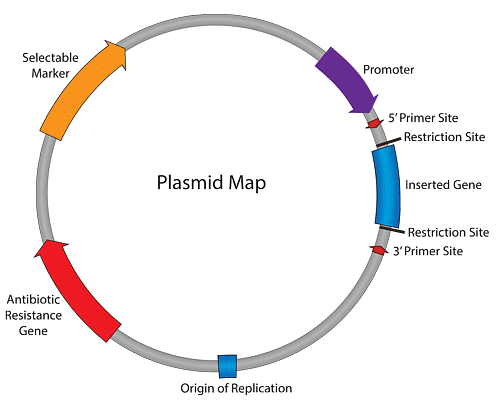
Plasmid Map
The video below explains this:
R Factor Detailed Video Explanation:
Also Read:
| Related Articles | ||
|---|---|---|
| What are Living Organisms Made Up Of? | Difference Between Gram-positive and Gram-negative Bacteria | DNA Cloning |
Types of Plasmids
[Click Here for Sample Questions]
There are various types of Plasmids. Some of them are given below:
R plasmids
It is also known as resistance plasmids, are responsible for drug resistance.
Sex factor plasmids
The cells that have this plasmid are referred to as F+, or male, or the donor cell, whereas the cells that do not contain this plasmid are referred to as "F-," or the receiver cell.
Col-plasmids
It is in charge of producing Bacteriocins.
Heavy metal ion resistant plasmids
These plasmids are in charge of resistance to heavy metal ions to which bacteria may be exposed in the environment.
Catabolic activity plasmids
It is responsible for the breakdown of extremely complex compounds such as hydrocarbons, among others.
Virulence plasmids
It is in charge of producing virulence factors including such adhesive factors, toxin, and so on.
Resistance Plasmids
[Click Here for Sample Questions]
Resistance plasmids are other names for the R-Factor. Antibiotic resistance is encoded by these self-replicating, tiny, circular DNA fragments. Shigella strains become resistant to multiple antibiotics employed during a dysentery epidemic in Japan in 1959, and this was the first time they were identified. The R factor is non-transmissible on its own.
Structure of Resistance Plasmid
[Click Here for Sample Questions]
The structure of a resistance plasmid can be characterised as a circular piece of DNA with a length of 80–95 kb that makes up the majority of R-RTF (Resistance Transfer Factor) molecules. This plasmid is much alike to the F factor and contains several similar kinds of genes.
Resistance Transfer Factor
The R factors differ in terms of size and drug resistance gene content. The R determinant is less than the RTF determinant. Both the RTF and R determinants merge to form a unit, divided on either side by one IS 1 element. The IS 1 elements aid in the transfer of the R determinant between different types of R-RTF units.
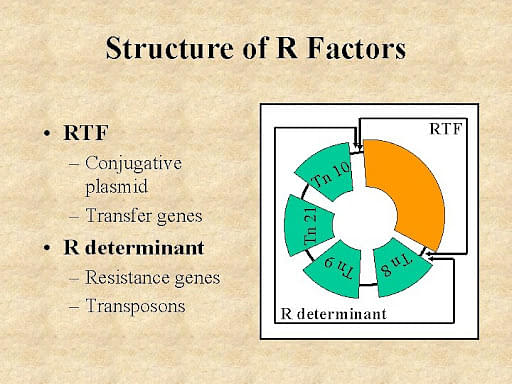
Resistance Transfer Factor
Functions of Resistance Plasmid
[Click Here for Sample Questions]
The functions of resistance plasmid are as follows:
- Resistance plasmids are critical for the propagation of MDR genes in bacteria.
- They also play a role in the gene carrier for autonomous replication, conjugation, and ampicillin resistance.
- Resistance plasmids carry genes that enable bacteria to produce Pilli while also building resistance to antibiotics.
Horizontal Gene Transfer
[Click Here for Sample Questions]
Bacteria with F-factors can build a sex pilus, which aids Horizontal genetic transformation between the donor and recipient bacteria. Since several R-factors incorporate F-plasmids, antibiotic resistance can spread quickly within a bacterial community. Through transfer , R-factors can also be absorbed by the DNA. They have a gene termed RTF, which stands for Resistance Transfer Factor.
Genes Amplification
[Click Here for Sample Questions]
When low-concentration drugs are employed to inhibit the development of R-factor-containing cells, the cells that sustain develop greater drug resistance. Owing to a duplication of the resistance gene in the R determinant, this occurs. Following R-factor replication, recombination occurs between the daughter strands.
Read More:
| Related Articles | ||
|---|---|---|
| Recombinant DNA Technology | Insertional Inactivation | Unicellular Organisms |
| Bacterial Transformation | Competent cell | Difference between Chromatin and Chromosomes |
Things to Remember
- Resistance factors, or R-factors, are plasmids that permit bacteria to evolve resistance to antibiotics.
- Plasmids are present as tiny circular pieces of DNA that replicate bacterial chromosomes on their own.
- At least one gene is usually always carried by plasmids.
- Most of those genes carried by plasmids are helpful to the host cells.
- The antimicrobial resistance against specific medications is coded by the R factor.
- They frequently do code restrictions for more than one antibiotic, sometimes up to eight distinct resistances.
- Bacteria, Achaea, and other multicellular organisms are the most common hosts of plasmids.
Sample Questions
Ques: What is the role of R plasmids in antibiotic resistance? (2 Marks)
Ans: These plasmids, known as drug-resistance (R) factors, typically also direct the formation of sex pili, which are filamentous appendages on the cell surface. These encourage bacterial conjugation, allowing a copy of the plasmid to be transferred from the resistant organism to one that was previously drug-sensitive.
Ques: What exactly are R factors in plasmids? (2 Marks)
Ans: Plasmids are extrachromosomal genetic element present in bacteria. They are tiny circular DNA that replicate independently of bacterial chromosomes. A plasmid containing genes for antibiotic resistance, allows drug resistance to be transferred between bacteria. Resistance factors, or R-factors, are plasmids that allow bacteria to develop resistance to antibiotics.
Ques: Is it possible to transfer resistance plasmids to other bacteria? (2 Marks)
Ans: Plasmids can be transferred between bacteria. Plasmids usually have mechanisms for transferring the entire plasmid to different bacteria. It implies that by picking up a single plasmid, a bacterium can become resistant to many antibiotics at the same time.
Ques: Antibiotics cause resistance plasmids, right? (2 Marks)
Ans: The transmission of antibiotic resistance genes contained on plasmids is known as plasmid-mediated resistance. Plasmids can be available between bacteria of the same species or between bacteria of different species via conjugation.
Ques: Is it possible for plasmids to replicate on their own?(2 Marks)
Ans: Plasmids are a kind of extrachromosomal genetic element available in a wide range of bacteria. Plasmids are self-replicating plasmids that replicate bacterial chromosomes on their own without any help. They generally sustain few genes, including numerous antibiotic resistance genes. Plasmids are able to pass on from one bacterial cell to another.
Ques: How many genes Plasmids have? (2 Marks)
Ans: At least one gene is usually carried by plasmids. Most of those genes carried by plasmids are helpful to the host cells. It allows them to survive in environments that would otherwise be restricting their expansion. Bacteria, Achaea, and other multicellular organisms are the most common hosts of plasmids.
Ques: What part do R plasmids play in the spread of antibiotic resistance in bacteria? (2 Marks)
Ans: Plasmids frequently include numerous antibiotic resistance genes, which aids in the spread of multidrug resistance (MDR). Antibiotic resistance driven by MDR plasmids significantly limits treatment choices for Gram-negative bacteria infections, primarily driven by the Enterobacteriaceae family.
Ques: How did R factors for multi-drug resistance emerge?(2 Marks)
Ans: Multidrug resistance in bacteria is caused by the accumulation of genes, each of which codes for resistance to a specific agent, on resistance (R) plasmids or transposons, and/or the action of multidrug efflux pumps, each of which may pump out more than one drug type.
For Latest Updates on Upcoming Board Exams, Click Here: https://t.me/class_10_12_board_updates
Check-Out:



Comments