



Education Journalist | Study Abroad Lead
Radon is a chemical element that forms naturally upon the breaking of radioactive elements such as uranium, thorium, or radium. Radon is a rare colourless, odourless, and tasteless noble gas with atomic number 86. It was first discovered in the year 1990 and is represented by the symbol Rn. Radon contains a perfect electronic configuration of eight electrons in the outer shell and thus it is a perfectly stable chemical element.
| Table of Content |
Key Terms: Radon, Electron Configuration, Elements, Melting Point, Noble Gas, Atomic Mass, Oxidation, Phosphorescence, Thorium
What is Radon?
[Click Here for Sample Questions]
Radon is a chemical element and a noble gas. It is rare in nature because its isotopes are all short-lived and its source of origin- radium, is a scarce element. Radon is 7.5 times heavier than air and more than 100 times heavier than hydrogen. This group 18 element was originally called radium emanation.
It is estimated that each square mile of soil to a depth of 6 inches contains approximately 1g of radium which eventually releases radon into the atmosphere.

Radon
Chemical Properties of Radon
[Click Here for Sample Questions]
Some of the important properties of Radon are as follows:
| Symbol | Rn |
| Group | 18 |
| Period | 6 |
| Block | P |
| Atomic Number | 86 |
| State At 20 Degrees Celsius | Gas |
| Electronic Configuration | [Xe] 4f145d106s26p6 |
| Density | 0.009074 |
| Relative Atomic Mass | 222 |
| -71 degrees Celsius (-96 degrees F) | |
| Boiling Point | -62 degrees Celsius (-80 degrees F) |
| Classification | Non-metallic |
| Oxidation States | 0, +2 |
| Natural Occurrence | From decay |
| Discovered By | Friedrich Ernst Dorn in 1990 |
Read More: Classification of Elements and Periodicity in Properties
Physical Properties of Radon
[Click Here for Sample Questions]
The physical properties of Radon are as follows:
- It is an odourless, colourless, and tasteless noble gas.
- It is the heaviest of gases and has a melting point of -71 degrees Celsius and a boiling point of -61 degrees Celsius.
- On cooling it below its freezing point it displays a phosphorescence. The phosphorescence turns yellow as the temperature is lowered. It becomes orange-red at the temperature of liquid air.
- It is extremely hazardous to human health.
- It is chemically not very reactive and sparingly soluble in water.
Applications of Radon Gas
[Click Here for Sample Questions]
The major uses of Radon are:
- It is used in geological research for tracking air masses.
- Due to its ability to emit alpha rays and radioactive polonium rays, radon can also be used in radiotherapy for treating cancer.
- Change in radon concentration also helps predict the occurrence of earthquakes.
- It is also used for treating damaged cells.
Read More: The P-Block Elements
Side Effects of Radon
[Click Here for Sample Questions]
The small amount of radon present in the atmosphere is not very harmful, however, exposure to a large amount of radon can cause some serious health issues such as-
- It causes lung cancer. When you inhale radon it gets into the lining of your lungs and gives off radiation. With time it damages the cells present there and causes lung cancer.
- Radon is the second biggest cause of lung cancer after smoking. However, it won’t affect any individual without any direct interaction with it.
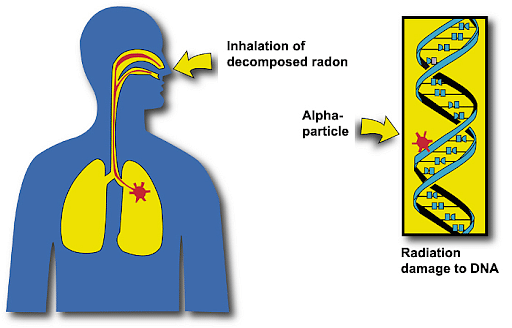
Health Hazards of Radon
Radon: Important Facts
[Click Here for Sample Questions]
- It is Ernest Rutherford who is sometimes credited as the discoverer of radon. He was the one who found out about the alpha particle radiation given off by radon.
- Radon was officially recognized as the 86th element in the year 1923. The IUPAC then chose the name radon from the names radon (Rn), thoron (Tn), and actinon (An). The name Thoron (Tn) and Actinon (An) are assigned as two isotopes of radon. Thoron is Rn-220 and Actinon is Rn-219.
- Radon is listed as the second-highest cause of lung cancer by the U.S environmental protection agency.
Read More: Valence Electrons
Things to Remember
- Radon was discovered in 1900 by German scientist Friedrich E. Dorn.
- Radon atoms possess a particularly stable electronic configuration of eight electrons in the outer shell and thus come under the category of noble or inert gas.
- Naturally, available radon gas is recognized as potentially hazardous for human health and thus direct exposure to the gas should be avoided.
- Radon is 7.5 times heavier than air and more than 100 times heavier than hydrogen.
- Radon is rare in nature as its isotopes are all short-lived and its radium is a scarce element.
- It carries approximately 1000 times the risk of death as many other EPA carcinogens.
Sample Questions
Ques. Why Radon is considered a noble gas? (3 Marks)
Ans. The valence shell configuration of radon is perfectly stable and complete due to which radon is chemically unreactive in nature. And hence known as the noble gas or inert gas.
Ques. List down any three important use of radon. (3 Marks)
Ans. The important uses of radon are:
- Radon is used to track air masses and is thus an important element in geological research.
- It helps to detect natural calamities such as the earthquake as the change in its concentration level can be understood as a sign of warning.
- In the medical industry, radon is used to repair damaged cells and is also sometimes used for the treatment of cancer.
Ques. List down the physical properties of radon gas. (3 Marks)
Ans. The physical properties of Radon are:
- Radon is a tasteless, odourless, and colourless gas and our human eye or nose cannot sense its presence.
- It is highly radioactive and chemically not that reactive in nature.
- It is the densest noble gas and sparingly soluble in water.
Ques. List down any five chemical properties of radon. (5 Marks)
Ans. The chemical properties of radon are:
- Melting and boiling point: Radon has a melting point of -71 degrees Celsius and a boiling point of -61.7 degrees Celsius.
- Electronic configuration: radon has a perfectly stable electronic configuration and hence it falls under the category of noble gas or inert gas.
- Isotopes: at least 34 isotopes of radon are known, however, most of them are unstable except randon-222, the most stable isotope and is called thoron. Another of its isotope is called actinon ( radon 219).
- Block: chemical element radon belongs to the p block in the periodic table.
- Atomic mass: radon has an atomic mass of 222 g.mol-1.
Ques. List down the side effects of radon on human health. (3 Marks)
Ans. A large amount of inhalation of radon gas can cause lung cancer in humans. Radon gas gives off radiation and damages the human cells, causing cancer.
Ques. How is radon gas observed or originated? (3 Marks)
Ans. Radon is formed upon the breakdown of radioactive elements such as the uranium and thorium present in soils and rocks and groundwater. It gets its name from the word radium as it was first detected as an emission from radium during radioactive decay. It was officially discovered in the year 1900 by Friedrich Ernst Dorn.
Ques. Write down scientific applications of Radon. (3 Marks)
Ans. The scientific applications of Radon are:
- Radon is used to track air masses.
- Change in its concentration helps in determining the occurrence of a natural disaster such as an earthquake.
- It is used for industrial radiography and x-ray sources.
Ques. What is radon? Explain in brief. (3 Marks)
Ans. Radon is a by-product of the radioactive decay of radium. It is represented by the symbol Rn and has an atomic number of 86. Its concentration is measured in becquerel (Bq) per cubic meter.
Check-Out:



Comments