



Education Content Expert
Red Cabbage Indicator is a type of pH indicator made from red cabbage leaves. It is commonly used in science experiments and in various applications to test the acidity or alkalinity of a solution.
- It is a purple-coloured solution used to test whether a given substance is an acid or a base.
- It is also referred to as Red Cabbage Juice Indicator.
- Flavin or Anthocyanin is a molecular pigment that is found in red cabbage.
- It is a water-soluble pigment found in apple and plum skins, poppies, cornflowers, poppies, and grapes.
- The purple juice colour changes in response to variations in its hydrogen ion concentration.
Read More: NCERT Solutions for Class 10 Science Acids, Bases and Salts
Key Terms: Red Cabbage Indicator, pH, Red Cabbage, Acids, Bases, pH Indicator, Flavin, Anthocyanin, pH Value
What is Red Cabbage Indicator?
[Click Here for Sample Questions]
Red Cabbage Indicator is an ideal natural pH Indicator used to test the acidity or alkalinity of a solution.
- It contains a pigment molecule called Flavin or Anthocyanin that changes colour depending on the acidity of the solution.
- In order to make the red cabbage indicator, red cabbage leaves are finely chopped and then boiled in water for several minutes.
- The resulting liquid, called a "cabbage juice indicator," can be used to test the pH of a solution.
- One of the advantages of using red cabbage indicator is its wide range of pH detection.
- It can detect pH levels between 4 and 8, making it useful for testing both acidic and basic solutions.
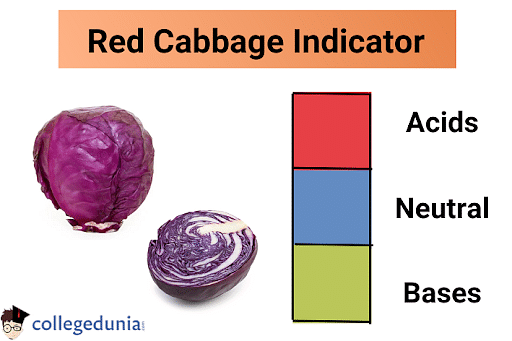
Red Cabbage Indicator
- Additionally, red cabbage indicator is readily available, inexpensive, and easy to make.
- It can be used to test the pH of soil or water samples in agriculture or to monitor pH levels in swimming pools or aquariums.
- It can also be used in the food industry to identify spoilage in food.
- Red cabbage indicator is not as accurate as chemical pH indicators and its color change may not be as clear as chemical indicators.
- It also may not work well in highly concentrated solutions.
Read More:
Red Cabbage Indicator pH Colours
[Click Here for Sample Questions]
Red Cabbage Indicator has a pigment Anthocyanin or Flavin that changes it colors depending on the acidity of the solution. It shows the following changes on reaction with acids and bases:
- Acidic Solutions: It turns red when exposed to extremely acidic liquids.
- Neutral Solutions: It stays purplish only in neutral solutions.
- Basic Solutions: It turns greenish-yellow in basic solutions.
Here are the different pH levels and the colours obtained during the red cabbage indicator test:
| pH | 2 | 4 | 6 | 8 | 10 | 12 |
| Colour | Red | Purple | Violet | Blue | Blue-Green | Greenish Yellow |
Read More: Acids Bases and Salt Revision Notes
Red Cabbage Indicator Experiment
[Click Here for Sample Questions]
Here is an experiment on Red Cabbage Indicatorto determine the acidity, alkalinity and pH levels of various solutions. The experiment can be done in the classroom or at home easily.
Aim
To determine chemicals as Acids or Nases using Red Cabbage Indicator.
Material Required
- Red Cabbage Leaves
- Water
- Stove/Microwave
- Blender/Food Processor
- Funnel
- Clear Glass/Plastic Containers (Test Tubes or Small Cups Work Well)
- Various Household Items such as Lemon Juice, Baking Soda, Vinegar, and Soap.
Procedure
- Chop a few leaves of red cabbage into small pieces and place them in a pot of water.
- Bring the water to a boil and then let it simmer for 10-15 minutes.
- Strain the liquid through a funnel into a container and reserve the liquid. This is the red cabbage indicator.
- Pour some of the red cabbage indicator into each of the clear containers.
- Add a small amount of each household item to test into a different container.
- Observe the color changes in the indicator.
- Lemon juice and vinegar will turn the indicator red or pink, baking soda will turn it blue or green, and soap will turn it purple.
- Record the color changes of the indicator in each container.
- Repeat the experiment with different concentrations of the household items to see how the pH level affects the color of the indicator.
Precautions
- Be careful while blending and chopping the Red Cabbage Leaves.
- Be careful with the handling of test tubes or any glass items.
Read More: Acids Bases and Salt Important Questions
Making Red Cabbage pH Paper
[Click Here for Sample Questions]
Apart from the Red Cabbage Indicator Solution, pH paper strips can also be created using red cabbage. The steps for the same are as follows:
- Use a filter paper or a coffee filter and dip it in the concentrated solution obtained from boiling red cabbage.
- Now, soak it for some time and then take the paper and dry it.
- Once the paper is dried out, cut the paper into small strips and thus can be used for testing the pH of different solutions.
- In order to tets the same, drop the liquid on the test strip and see what colour is obtained.
- The pH paper strip also turns either red or green depending on whether it is acidic or basic.
Red Cabbage Indicator Experiment will not only help one to understand the pH scale but also allows them to relate it to the household items they come across in their daily life. It is important to note that the red cabbage indicator is not as accurate as chemical pH indicators and its color change may not be as clear as chemical indicators, also it may not work well in highly concentrated solutions.
Check More:
Things to Remember
- Red Cabbage Indicator is a purple-coloured solution that is a natural pH Indicator.
- It is used to test whether substances are acid or base and determine their pH level.
- Red Cabbage includes the pigment Flavin or Anthocyanin that changes colour depending on the acidity of the solution.
- Acidic Solution: It turns Red in color in acidic solutions.
- Basic Solution: It turns Greenish Yellow in basic solutions.
- Neutral Solution: It remains purplish or violet in neutral solutions.
- Red Cabbage Indicator is prepared by boiling the chopped red cabbage leaves in water for several minutes.
Sample Questions
Ques. What are the various pH Colors represented by Red Cabbage Indicator? (2 Marks)
Ans. Here are the major colors that are obtained during the red cabbage indicator test at different pH levels:
- pH 2: Red
- pH 4: Purple
- pH 6: Violet
- pH 8: Blue
- pH 10: Blue-Green
- pH 12: Greenish Yellow
Ques. What happens when a Base reacts with a Non-metallic Oxide? What can be inferred about the nature of Non-metal Oxide? (2 Marks)
Ans. Oxides of Non-metals react with bases to form salt and water. For example, the reaction between carbon dioxide and calcium hydroxide. Calcium hydroxide, which is a base, reacts with carbon dioxide to produce salt and water. Hence, oxides of non-metals are acidic in nature.
Ques. What is observed when Carbon Dioxide gas is passed through lime water
(i) For a short duration?
(ii) For a long duration? (3 Marks)
Ans. (i) When CO2 is passed through lime water for a short interval of time, it turns milky due to the formation of insoluble calcium carbonate.
(ii) If CO2 is passed for a long duration through lime water, the white precipitate formed dissolves due to the formation of soluble calcium hydrogen carbonate and the solution becomes clear.
Ques. 2 mL of Sodium Hydroxide solution is added to a few pieces of granulated zinc metal taken in a test tube. When the content is warmed, a gas evolves which is bubbled through a soap solution before testing. Name the gas which will be evolved when the same metal reacts with a dilute solution of a strong acid. (3 Marks)
Ans. It is observed that active metals like zinc react with strong bases like NaOH, KOH, etc. to liberate hydrogen gas and corresponding salt. The evolution of gas is confirmed by the bubble formation in soap solution.
Test to Detect H2 Gas: When a burning matchstick is kept in the mouth of this test tube, a pop sound is heard which confirms the presence of H2 gas. When Zn metal reacts with a dilute solution of strong acid, H2 gas is evolved
Ques. To a solution of Sodium Hydroxide in a test tube, two drops of phenolphthalein are added.
(i) State the colour change observed.
(ii) If dil HCl is added dropwise to the solution, what will be the colour change?
(iii) On adding few drops of NaOH solution to the above mixture the colour of the solution reappears. Why? (3 Marks)
Ans. (i) On adding phenolphthalein to NaOH solution, the colour becomes pink.
(ii) On adding dilute HCl solution dropwise to the same test tube, the pink colour disappears and the solution again becomes colourless.
(iii) On again adding NaOH to the above mixture, pink colour reappears because the medium becomes basic again.
Ques. A cloth strip dipped in onion juice is used for testing a liquid ‘X. The liquid ‘X changes its odour. Which type of an indicator is onion juice? The liquid ‘X turns blue litmus red. List the observations the liquid ‘X will show on reacting with the following :
(a) Zinc Granules
(b) Solid Sodium Carbonate (3 Marks)
Ans. Onion juice is an olfactory indicator. Olfactory indicators give one type of odour in acidic medium and a different odour in basic medium. As the liquid ‘X’ turns blue litmus red, hence it is an acidic solution.
(a) Acids react with active metals such as zinc, magnesium etc. and evolve hydrogen gas, for example,
Zn(s) + dil. H2SO4(aq) \(\to\) ZnSO4H2(g)
(b) Acids react with metal carbonates to give carbon dioxide with brisk effervescence. Thus, it will react with Sodium carbonate as follows:
Na2CO3 + H2SO4 \(\to\) Na2SO4 + CO2 + H2O
Ques. (a) Write the chemical name and formula of Marble.
(b) It has been found that marbles of Taj are getting corroded due to development of industrial areas around it. Explain this fact giving a chemical equation. (3 Marks)
Ans. (a) The chemical formula of marble (Limestone) is CaCO3. Its chemical name is Calcium Carbonate.
(b) Taj Mahal, one of the seven wonders of the world situated at Agra, is continuously losing its luster day by day due to rapid industrialisation which causes acid rain.The sulphuric acid present in the acid rain causes the marble (CaCO3) to be washed off as calcium sulphate (CaSO4), leading to the deterioration of such a splendid piece of architecture.
CaCO3(s) + H2SO4(aq) \(\to\) CaSO4(aq) + H2O (l)+ CO2(g)
Ques. On diluting an acid, it is advised to add acid to water and not water to acid. Explain why it is so advised? Draw a labelled diagram to show the preparation of hydrogen chloride gas in laboratory. (2 Marks)
Ans. Diluting a concentrated acid with water is a highly exothermic process. So, when water is added to concentrated acid, large amounts of heat is liberated which changes some water to steam explosively which can splash the acid and even the glass apparatus may break due to excessive heating.
Ques. State the reason of exhibiting acidic character by dry HCl gas/HCl solution. (3 Marks)
Ans. When HCl gas dissolves in water, it forms hydrochloric acid solution i.e., HCl (aq) which then produces H+(aq) or H3O+(aq) ions.
HCl + H2O \(\to\) H3O+ + Cl–
Due to the presence of H+ or H3O+, HCL gas shows acidic behaviour.
Ques. Complete and balance the following chemical equations :
(i) NaOH(aq) + Zn(s) \(\to\) ?
(ii) CaCO3(s) + H2O(l) + CO2(g) \(\to\) ?
(iii) HCl(aq) + H2O(l) \(\to\) ? (3 Marks)
Ans. The complete chemical reactions are as follows:
(i) 2NaOH (aq) + Zn (s) \(\to\) Na2ZnO2 (aq) + H2 (g)
(ii) CaCO3 (s) + CO2 (g) + H2O \(\to\) Ca(HCO3)2 (aq)
(iii) HCl (aq) + H2O \(\to\) H3O + Cl– (aq)
For Latest Updates on Upcoming Board Exams, Click Here: https://t.me/class_10_12_board_updates
Check More:



Comments