



Education Journalist | Study Abroad Lead
Relation Between Group Velocity and Phase Velocity is that they are proportional to each other. Waves can be in a group that is called wave packets. Group velocity is the velocity with which a wave packet travels. The velocity with which the phase of a wave travels is known as phase velocity
- As the group velocity increases, the phase velocity also increases.
- When phase velocity increases, proportionately group velocity also increases.
Key Terms: Group Velocity, Waves, Packet of Waves, Phase Velocity, Water Waves, Equation, Relation, Frequency, Wavenumber, Dispersive Waves
Relation Between Group Velocity and Phase Velocity
[Click Here for Previous Year Questions]
The group velocity of the group of waves remains directly proportional to the phase velocity of a wave.
- Therefore, both the Group Velocity and the Phase Velocity of the waves have a direct relationship with each other.
- The Group Velocity and the Phase Velocity can be treated as interdependent on each other.
For instance, if the Group Velocity increases, the Phase Velocity shall also increase at the same rate. Whereas, on the other hand, if any of the two types of velocities (the Group Velocity and the Phase Velocity) decreases, then, the same effect shall be seen on the other one as well.
Read More:
Relation Between Group Velocity and Phase Velocity Equation
[Click Here for Sample Questions]
The relation of the Group Velocity and the Phase Velocity can be mathematically denoted as:
\(\begin{array}{l}V_{g}=V_{p}+k\frac{dV_{p}}{dk}\end{array}\)
Where,
- Vp (Phase Velocity)
- Vg (Group Velocity)
- k (Angular wave number)
Group Velocity and Phase Velocity Relation for Dispersive wave and non-dispersive wave
[Click Here for Previous Year Questions]
The following table contains the Group Velocity and Phase Velocity relation for Dispersive Wave Non-dispersive Wave.
| Type | Formula | Condition |
|---|---|---|
| Dispersive wave | \(\begin{array}{l}V_{p}\neq V_{g}\end{array}\) | \(\begin{array}{l}\frac{dV_{p}}{dk}\neq 0\end{array}\) |
| Non-dispersive wave | \(\begin{array}{l}V_{p}= V_{g}\end{array}\) | \(\begin{array}{l}\frac{dV_{p}}{dk}=0\end{array}\) |
What is Group Velocity?
[Click Here for Sample Questions]
Group Velocity refers to the velocity of the group of waves. When an entire envelope of waves moves, rather than a single wave, it forms a packet of waves. The velocity of the movement of this packet is called the Group Velocity.
For instance, the movement of sound waves, the movement of water waves, etc. are a few examples of the packet of waves moving simultaneously. Mathematically, Group Velocity is represented as:
| Vg = δw / δk |
Here,
- Vg represents the Group Velocity,
- δw represents the angular frequency of the Wave,
- δk represents the angular Wavenumber.
| Example 1: What is the product of phase and group velocities given by? Solution: The product of the phase and the group velocities is given by the square of the speed of light. Thus Vp x Vg = c2 is the relation. Example 2: Find the group velocity of a wave with a phase velocity of 60 x 109 (in 106 order). Solution: Phase and Group Velocities are given by Vp x Vg = c2. |
What is Phase Velocity?
[Click Here for Previous Year Questions]
Phase velocity is mainly concerned with the specific properties of a wave. The two significant elements of a wave are the crest and trough. The velocity of any of these components while propagating into space is measured as the Phase Velocity. Since the Phase Velocity is related to a phase of the wave, it heavily depends upon the wavelength and the time period.
Mathematically, the Phase Velocity is represented as,
| Vp = λ / T |
Here,
- Vp represents the Phase Velocity,
- λ (read as lambda) represents the Wavelength,
- T denotes the time period.
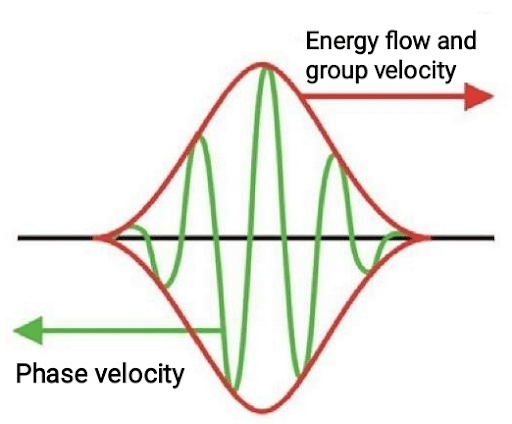
Group Velocity and Phase Velocity
Relation Between Group Velocity And Phase Velocity Equation
[Click Here for Sample Questions]
The group velocity and phase velocity relation can be derived as –
We know that phase velocity is Vp = ω / k
Rewriting the above equation,
⇒ ω = kVp --- (Equation 2)
Differentiating (equation 2) with respect to k we obtain,
⇒ \(\begin{array}{l}\frac{dw}{dk}=v_p+k\frac{dv_p}{dk}\end{array}\) (Equation 3)
Since, Vg = dw/dk,
Therefore, \(\begin{array}{l}v_g=v_p+k\frac{dv_p}{dk}\end{array}\)
Hence, the obtained equation signifies the direct relationship between the Phase Velocity and the Group Velocity.
Also check:
Things to Remember
- Wave, in general, refers to the dynamic disturbances propagated into a medium through another stimulus.
- The packet of waves traverses in space and their velocity is termed as the Group Velocity or the modulation of waves.
- However, the waves also travel in the phase leading to the calculation of Phase Velocity.
- The Phase Velocity is easily impacted by the other associated elements like the wavelength, frequency or the time taken for travel.
- Phase Velocity and group velocity are proportional to each other:
- On an increase in group velocity, the phase velocity also increases.
- On an increase in the phase velocity, the group velocity also increases.
Sample Questions
Ques 1. How does Group Velocity differ from Phase Velocity? (3 Marks)
Ans. Group velocity and Phase Velocity can be understood only in the context of waves. Both are different types of velocity which can be understood as different characteristics of the waves.
When the waves travel in the group or packet, their velocity is called the Group Velocity. Whereas, the movement of the waves in phase is measured in the Phase Velocity. The latter is also influenced by multiple specific factors like a crest or the wavelength of the concerned waves.
Ques 2. Compare the Group Velocity and the Phase Velocity of different elements. Mention which of the both is greater. (5 Marks)
Ans. According to various experiments, the Phase Velocity is mainly greater than the Group Velocity. However, at the same time, the Phase Velocity can be greater than that of the speed of light and at times it can also be less than that. Simultaneously, if we consider the example of the wave propagation in the deep water, then it could be seen that its Phase Velocity is twice that of the Group Velocity.
Another example could be taken in the case of the velocity of the surface particles. Here also, the velocity of the group of waves in the surface water shall be lesser than that of the Phase Velocity. Most of the time, if the propagation of the packet of waves takes place without any disturbances, then the Group Velocity always remains less than that of the Phase Velocity.
Ques 3. What are dispersive and non-dispersive sinusoidal waves? (3 Marks)
Ans. The dispersive and the non – dispersive sinusoidal waves are linked to the concepts of Phase Velocity and Group Velocity, respectively. Dispersion simply refers to the concept that the Phase Velocity of a wave is influenced by the frequency. Therefore, the dispersive waves represent the phenomenon when the waves of different frequencies travel with different speeds and the wave changes its shape, referring to the Phase Velocity. However, if the same medium becomes non – dispersive, then the waves of varying frequencies travel at the same speed, making the wave function remain uniform throughout.
Ques 4. What is dispersive material? What is the reason behind its condition? (3 Marks)
Ans. The dispersive medium is one in which the waves having varying frequencies travel with varying speeds.
The main reason behind this condition is that due to the electromagnetic radiations, the index of refraction becomes dependent on the frequency of the waves, that is, the waves and their velocity gets heavily influenced by their components like frequency.
Ques 5. What is the significance of Group Velocity over the Phase Velocity in terms of matter waves? (2 Marks)
Ans. The Phase Velocity of the matter waves is known for not carrying any influential information with itself. Rather, the significant details like the momentum, velocity, etc. of a matter-wave are mainly understood through the Group Velocity. Therefore, in the case of the matter waves, the Group Velocity is concerned and not the Phase Velocity.
Ques 6. In the context of relativistic free explain the relation between the group and the Phase Velocity. (3 Marks)
Ans. The total relativistic energy and the relativistic momentum of any matter are derived which is known to always remain as equal to that of the Group Velocity of that particular particle.
As a result, it has been found that the space velocity of the photons is equal to that of the speed of light. However, this phenomenon takes place only in the case of relativistic freedom.
Ques 7. What do you understand by the Phase Velocity? Explain with the help of its formula. (3 Marks)
Ans. Phase velocity is highly influenced by the significant elements of a wave, that is the crest and trough. Therefore, the Phase Velocity is mainly concerned with the specific properties of a wave. And the velocity of any of these components while propagating into the space is measured as the Phase Velocity. However, we can mathematically represent the Phase Velocity as Vp = λ / T
- Vp is equal to the Phase Velocity,
- λ is equal to the Wavelength,
- And T is equal to the time period which also positively impacts the Phase Velocity
Ques 8. How can the relation between the Phase Velocity and the Group Velocity be mathematically derived? (5 Marks)
Ans. The relation between the Phase Velocity and the Group Velocity be mathematically derived as the following.
In order to find out the amplitude of wave packet, let us assume,
- ω as the angular velocity given by ω = 2πf
- k as the angular wavenumber given by – k = 2π / λ
- t as time
- x as the position
- Vp (Phase Velocity)
- Vg (the Group Velocity)
Vp = ω / k……. (equation 1)
Rewriting the above equation,
ω = kVp…… (equation 2)
Differentiating (equation 2) with respect to k we obtain,
dw / dk = Vp + k (dVp / dk)……( equation 3)
Since, Vg = dw / dk,
Therefore, Vg = Vp + k (dVp / dk)
Ques 9. Define Group Velocity. (1 mark)
Ans. When an entire envelope of waves moves, rather than a single wave, it forms a packet of waves. The velocity of the movement of this packet is called the Group Velocity.
Ques 10. What is the condition to be satisfied for non-dispersive waves? (1 mark)
Ans. The condition for non dispersive waves is \(\begin{array}{l}\frac{dV_{p}}{dk}=0\end{array}\)
Ques 11. In which medium the phase velocity and group velocity are not equal? (1 mark)
Ans. In a dispersive medium, the group velocity is lesser than the phase velocity.
Ques 12. What is a dispersive medium? Give example. (2 marks)
Ans. A dispersive medium is a medium in which waves of different frequencies travel at varied velocities. For example – water and lenses.
Ques 13. What is a non-dispersive medium? Give example. (2 marks)
Ans. A medium in which the speed of a wave is independent of the frequency of the wave is known as a non-dispersive medium. For example, the air is a non-dispersive medium for sound waves.
Ques 14. What is the relation between phase velocity and speed of light in waveguides? (1 mark)
Ans. The phase velocity in waveguides is always greater than the speed of light. This further implies that the group velocity is small.
Ques 15. If cos \(\theta\) = 2.5, find the phase velocity. (1 mark)
Ans. The phase velocity is given by the equation Vp = c cos θ. By substituting for cos θ = 2.5 and the value of the speed of light, we get the phase velocity as 7.5 x 10⁸ m/s.
Ques 16. What is the wavelength of the wave if the cut-off wavelength and the guided wavelength are 0.5 and 2 units? (2 marks)
Ans. The cut off wavelength and the guided wavelength are related as (1/λ)2 = (1/λc)2 + (1/λg)2.
On substituting for the value of λc = 0.5 and λg = 2,
we get λ = 0.48 units.
Ques 17. What is the product of the phase and the group velocities? (2 marks)
Ans. The product of the phase and the group velocities is given by the square of the speed of the light. Therefore, Vp x Vg = c2.
Ques 18. What is the phase velocity of a wave with group velocity of 6 x 10⁶? (2 marks)
Ans. We know that the phase and the group velocities are related as Vp x Vg = c2.
On substituting the value for Vg = 6 x 10⁶ and the speed of light,
we get Vp = 150 x 108 m/s.
Ques 19. What is the relation between the guided wavelength and the phase constant? (1 mark)
Ans. The guided wavelength and the phase constant are related by the equation 2π/βg = λg,
where βg is the guided phase constant
λg is the guided wavelength.
Ques 20. What is phase velocity? (1 mark)
Ans. The phase velocity is the velocity of a single wave while the group velocity is the velocity of a group of waves.
Do Check Out:



Comments