



Content Curator
"Side-Angle-Side" (SAS) is a method that is widely used in geometry and trigonometry to determine if two triangles are congruent, meaning that they have the same size and shape. In SAS congruence, if two triangles have corresponding sides of equal length and their corresponding included angles are equivalent in measure, then the two triangles are congruent.
- Simply, if the lengths of the sides of two triangles are equal and the measures of the angles between the sides are equal, then it can be said that the two triangles are congruent.
- If the sides and angles of the two triangles are not in corresponding positions, then the two triangles are not congruent.
- The SAS congruence method can be used in several geometric and trigonometric problems, including finding the lengths of sides and angles of triangles, and determining if triangles are similar or congruent.
- For example, assume two triangles with sides of length 3, 4, and 5 and corresponding angles of 30 degrees, 60 degrees, and 90 degrees, then the two triangles are congruent, as per the SAS method.
Read Also: Constructing Triangles Through SSS Congruence
| Table of Content |
Key Terms: Side Angle Side, Triangle, Vertex, Edges, Right-Triangle, Right Angle, Perimeter, Law of Sines, Angles, SAS, Congruence, Pythagorean Triples Formula
What is Side Angle Side?
[Click Here for Sample Questions]
"Side-Angle-Side" (SAS) is a procedure used to determine whether two triangles are congruent, which means that they have the same size and shape. When two sides of a triangle and an angle are already given, the area of the triangle can be calculated by using the sine trigonometric function and the side angle side formula.
The Side Angle Side formula can be represented as:
| Area of a triangle = (1/2) × side1 × side2 × sin (angle included) |
- The SAS congruence method only proves that two triangles are congruent, not that they are similar in nature.
- Triangles can be considered similar if they have the same shape, but not necessarily the same size.
- The SAS congruence method is widely used in mathematics and geometry and is a fundamental concept for understanding the properties of triangles and their relationships to other geometric shapes.
- Apart from the side-angle-side method, there are other methods that help to determine if two triangles are congruent, including "Side-Side-Side" (SSS), "Angle-Angle-Side" (AAS), and "Angle-Side-Angle" (ASA).
- This formula based on the side angle side theorem aids in the calculation of the area of a triangle. In a triangle, the Side Angle Side indicates the two sides and the angle between them.
- For example, assume two triangles ABC and DEF with sides AB = DE, BC = EF, and AC = DF, and angles A = D, B = E, and C = F, then triangle ABC is seen to be congruent to triangle DEF.
Also Check: Right-Angled Triangle Construction
Side Angle Side (SAS) Congruence and Similarity
The term "congruent" refers to figures that are the same in every way, most notably in terms of shape and size. Congruence describes the relationship between two congruent figures. It is not necessary to examine all sides and angles of the two triangles in order to be certain that they are similar. Congruence of triangles applies, if:
- The corresponding angles are all similar.
- The corresponding sides are all similar.
Trigonometric Functions Detailed Video Explanation
Steps to Calculate the Angles of a Triangle
There are three primary steps to calculate the triangle's required angles:
- Step 1: First, By Using the Law of Cosine, we identify the unknown side.
- Step 2: Then, We apply the Law of Sines to determine which of the two angles is the smallest.
- Step 3: After this, the third angle must be determined by adding the three angles to 180 degrees.
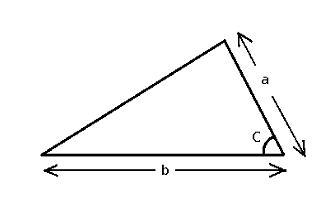
The Side Angle Side formula, as per the diagram above, can be denoted as:
| Area = ab Sin C/2 |
Side Angle Side Formula Derivation
[Click Here for Previous Year Questions]
We are aware that the area of a triangle is = 1/2 × base × height.
Thus, let’s assume a triangle to understand the derivation of the SAS formula:
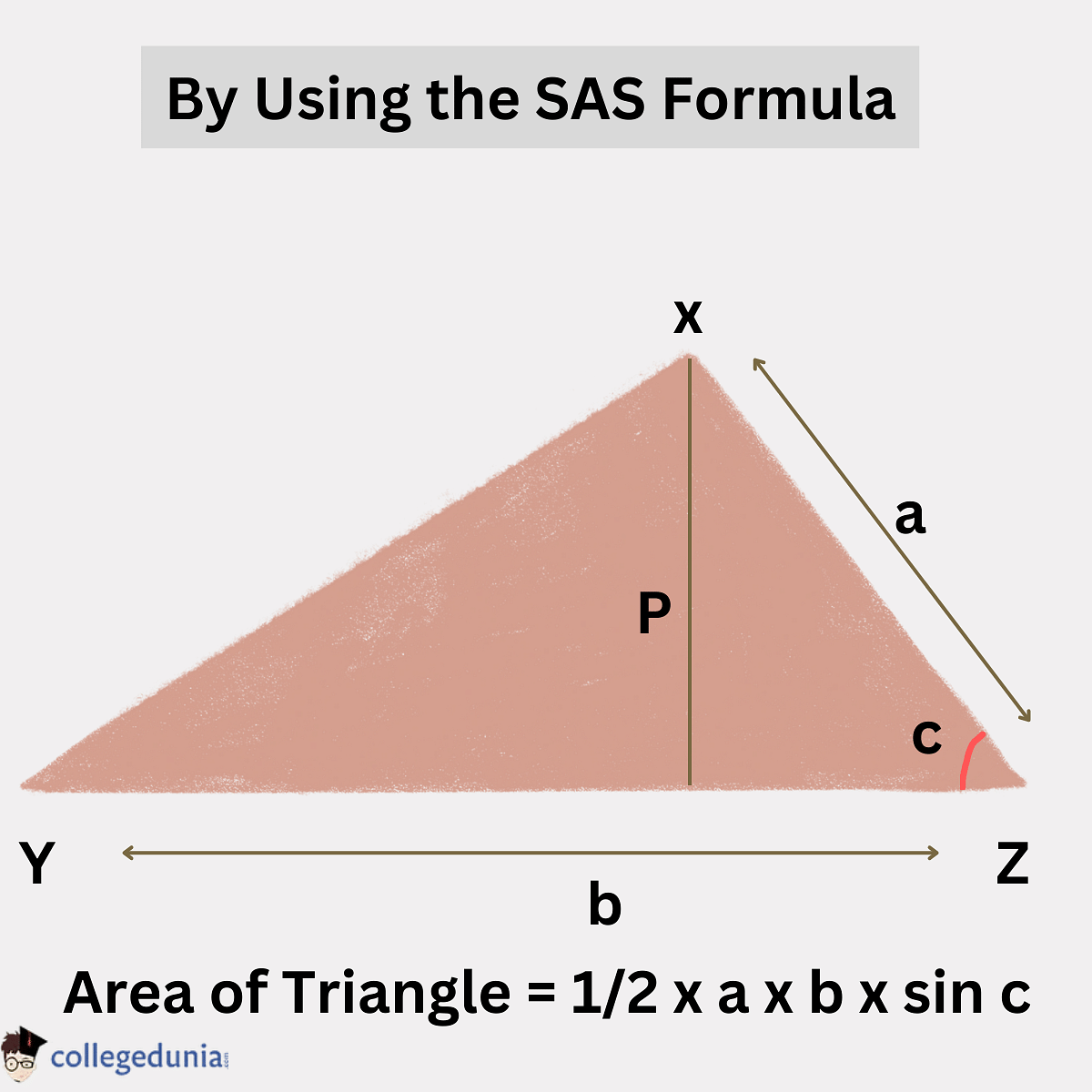
SAS Fomula Derivation
- Step 1: The two sides 'a' and 'b' and the included angle between them is 'c'.
- Step 2: In case a perpendicular 'p' is drawn from X to side YZ, then by applying the trigonometric ratio, we can signify the value of p as, p = a × sin c, assuming p as the height, and applying the formula Sin c = p/a.
- Step 3: It is already known that the area of a triangle = 1/2 × base × height. Now, by replacing the value of base as b and height as p, the area of the triangle is going to be = 1/2 × b × p.
- Step 4: Because p = a × sin c, the formula for the area of the triangle is = ½ × b × a × sin c
Hence, the side angle side formula or the area of the triangle by using the SAS formula is:
⇒ 1/2 × a × b × sin c
Read More:
| Topic-Relevant Concepts | ||
|---|---|---|
| Exterior Angles of a Polygon | 30-60-90 Triangle | Right Angle Triangle Theorem |
| Perimeter of a Triangle | Constructing ASA Triangles | Area of Equilateral Triangle |
Congruence Rules
[Click Here for Sample Questions]
The methods to determine the congruence of triangles include:
- Side-Side-Side (SSS) Congruence: Considering that all three corresponding sides of two triangles have equal lengths, then the two triangles are known to be congruent.
- Angle-Angle-Angle (AAA) Congruence: Considering that all three corresponding angles of two triangles have an equal measure, then the two triangles are known to be congruent.
- Side-Angle-Side (SAS) Congruence: Considering that the two corresponding sides and the included angle of two triangles have equal length and equal measure respectively, then the two triangles are known to be congruent.
- Angle-Side-Angle (ASA) Congruence: If two corresponding angles and the included side of two triangles come with equal measure and equal length both, then the two triangles are congruent.
Determining the Third Side of a Triangle with Perimeter Formula
The perimeter of a shape is always equivalent to the total of its sides. We can calculate the overall length by using this method. Consider a triangle with sides B, C, and D. Now, by using this theorem, the formula will be:
| Perimeter → BCD = BC + BD + CD |
Determining the length of the third side of a triangle is simple if the shape's two sides and perimeter are known.
If an equation only yields an angle of a side length, then the rule of trigonometry ratio can be used to calculate other sides as well. The sine, cos, and tan ratios of a triangle with an angle between two sides are as follows:
- Cos θ = Bottom side length divided by Hypotenuse side length
- Sine θ = Length of the opposite side divided by the length of the hypotenuse side.
- Tan θ = Right-angle side length divided by Base side length.
For Latest Updates on Upcoming Board Exams, Click Here: https://t.me/class_10_12_board_updates
Things to Remember
- If the two sides of one triangle and the angle formed at its vertex are equivalent to the two similar sides and angles formed at the vertex of another triangle, the triangles are congruent, according to the SAS Congruence Criterion.
- A triangle is a polygon consisting of three sides, or edges, and three vertices.
- If the shape and size of two triangles are identical, they are said to be congruent.
- The sign (≅) is used to represent triangle congruence.
- The congruence of triangles can be measured by the following methods, Side-Side-Side (SSS) Congruence, Angle-Angle-Angle (AAA) Congruence, Side-Angle-Side (SAS) Congruence, and Angle-Side-Angle (ASA) Congruence.
Read Also:
Previous Year Questions
- If sec θ = m and tan θ = n ...(KCET 2006)
- If 0 ≤ x ≤ π and +...(KCET 2004)
- If the angle of elevation of a cloud from a point P which is 25 m...(JEE Mains 2019)
- The area of the equilateral triangle, in which three coins...(JEE Advanced 2005)
- In a △ABC, among the following which one is true...(JEE Advanced 2005)
- The value of the expression...(JEE Advanced 1988)
- For what interval of variation of...(UPSEE 2017)
- In a △ABC if the sides are a = 3, b = 5 and c = 4...(BITSAT 2006)
- The center of the circle...(BITSAT 2006)
- The period of the function...(KEAM)
Sample Questions
Ques: State the area of a triangle whose sides are 6 cm and 10 cm and include an angle of 45 degrees. (2 Marks)
Ans: Using the formula: ab Sin C / 2
Area = 6*10* Sin 45o / 2
= 60*0.70 / 2
= 21 cm
Ques: Δ PQR ≅ ΔXYZ by ASA congruence condition. Now, determine the value of x and y. (3 Marks)
Ans: We already know that ΔPQR ≅ ΔXYZ due to ASA congruence.
Therefore ∠Q = ∠Y i.e., x + 15 = 80° and ∠R = ∠Z i.e., 5y + 10 = 30°.
Also, QR = YZ.
Since, x + 15 = 80°
So, x = 80 – 15 = 65°
Also, 5y + 10 = 30°
So, 5y = 30 – 10
Therefore, 5y = 20
⇒ y = 20/5
⇒ y = 4°
Hence, the values of x and y are 65° and 4°.
Ques: Prove that the diagonals of a parallelogram bisect each other. (3 Marks)

Ans: In the above parallelogram JKLM, both the diagonals are intersecting at the point O. Now, we have to prove that JO is equal to OL and KO is equal to OM.
In ΔJOM and ΔKOL,
∠OJM = ∠OLK [JM is parallel to KL, and JL is the transversal]
JM = KL [opposite sides are equal]
∠OMJ = ∠OKL [JM is parallel to KL, and KM is the transversal]
Therefore, ΔJOM and ΔKOL [By Angle-Side-Angle (ASA)]
Therefore, JO = OL and KO = OM [Sides of congruent triangle]
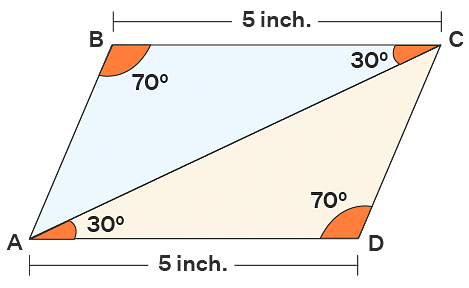
Ques: Parallelogram ABCD is consists of two triangles ΔABC and ΔACD. It is already provided that ∠ABC is 70° and ∠BCA is 30°, which are equivalent to ∠CDA and ∠DAC respectively. Side BC is equal to side AD. Now Can you determine which property should be used to entail whether ΔABC and ΔACD are congruent? (2 Marks)
Ans:
Given,
∠ABC = ∠CDA = 70°
∠BCA = ∠DAC = 30°
Side BC = Side AD.
Hence, by ASA criterion, ΔABC ≅ ΔACD
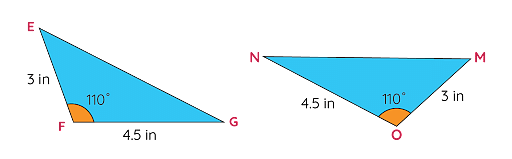
Ques: With the help of a diagram, justify the congruence of triangles. (2 Marks)
Ans: In the above triangles,
EF is equal to MO = 3 in
FG is equal to NO = 4.5 in
∠EFG is equal to ∠MON = 110°
Therefore, ∠ EFG ≅ ∠ MNO (By SAS congruence rule)
Hence, the above triangles are congruent by the SAS rule.
Ques: The line segment AD is the angle bisector of angle A, and the triangle ABC is an isosceles triangle. Now with the help of SAS rules state that ADB and ADC are congruent? (3 Marks)
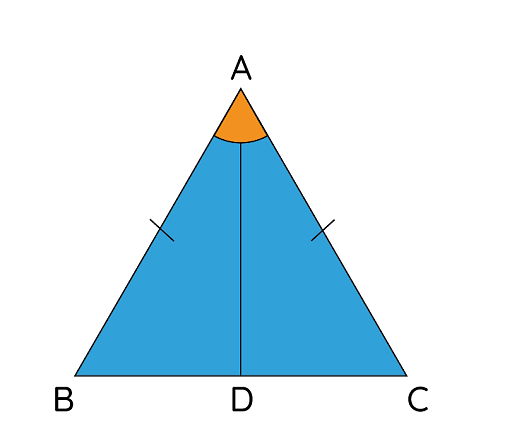
Ans: It can be seen that:
ABC is an isosceles triangle, where AB is equal to AC. Both the triangles ΔADB and ΔADC have AD as a common side.
The angle A is divided into two equal pieces by the line segment AD, which is the angle bisector of angle A. As a result, BAD=CAD.
Therefore, according to the SAS rule, the two triangles are proven congruent.
Hence, ΔADB≅ΔADC.
Ques: In her notebook, Sonia was working on geometrical construction problems. On a page, she drew an isosceles triangle PQR. She labelled L, M, and N as the midpoints of the triangle’s equal sides (PQ and QR), and N as the midpoint of the third side. LN=MN, she asserts. Is she correct? (3 Marks)
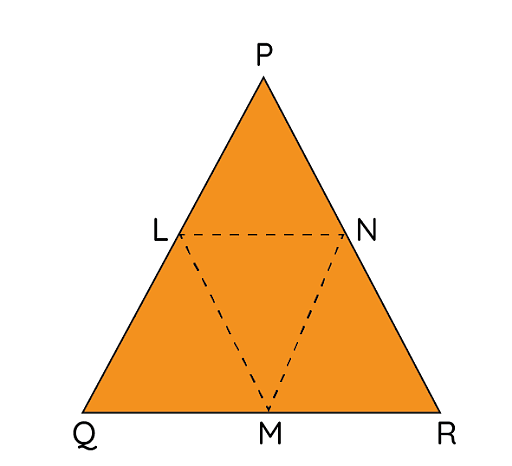
Ans: First we have to prove that ΔLPN ≅ ΔMRN. As We are already aware that ΔPQR is an isosceles triangle and PQ is equal to QR. Angles opposite to equal sides are equal. Thus, ∠QPR = ∠QRP. As L and M are the midpoints of PQ and QR,
PL = LQ = QM = MR = QR/2.
N is the midpoint of PR, therefore, PN is equal to NR.
In ΔLPN and ΔMRN:
- LP = MR
- ∠LPN = ∠MRN
- PN = NR
Therefore, by SAS Criterion of Congruence, ΔLPN ≅ ΔMRN.
As congruent parts of congruent triangles are the same, LN=MN.
Ques: For a triangle, ABC, D and E are two points on AB and AC such that AD = 1/4AB, AE = 1/4AC. If BC = 12 cm then find DE. (2 Marks)
Ans: As per the mid-point theorem XY = BC/2 or 6 cm.
Likewise, in triangle AXY, D and E are mid-points of AX and AY
Hence, as per the mid-point theorem DE = XY/2 = 3 cm.
Ques: If O be the circumcenter of a triangle PQR and angle QOR = 110°, angle OPR = 25°, then determine the angle PRQ. (2 Marks)
Ans: Triangle OPR is an isosceles triangle, therefore angle PRO = 25°
Likewise, triangle OQR is also an isosceles triangle
Hence, angle ORQ = (180° - 110°)/2 = 35°
So, angle PRQ = 35° + 25° = 60°
Ques: Ria wants to determine the value of x in ∠ADC. How does she know that ΔABC ≅ ΔACD by the ASA criterion? Determine the total measure of ∠ADC. (3 marks)
Ans: According to the given figure,
ΔABC ≅ ΔACD, as per the ASA property
Thus, it can be said that:
(i) ∠ABC = ∠ADC
100° = (x + 20)°
x° = 100 – 20 = 80.
(ii) To obtain the total measure of ∠ADC:
∠ADC = (x + 20)°
We are aware that, x = 80.
∠ADC = 80 + 20 = 100
Hence, the value of x = 80 and ∠ADC = 100.
Also Read:



Comments