



Education Journalist | Study Abroad Lead
Simpson's Rule is a formula that has been used to calculate the estimated value of a definite integral. A defined integral is defined by its lower and upper limits. To evaluate a definite integral, we usually integrate it (using integration techniques) and then apply the fundamental theorem of Calculus to apply the limits. However, there are situations when no integration strategy can be used to produce an integral, and there are times when we do not even have a function to integrate; instead, we have some observed values of the function (in the case of experiments). In such cases, Simpson's Rule can be used to estimate the value of the definite integral.
| Table of Content |
Key Terms: Simpson’s Rule, Parabolas, Eclipses, Area, Riemann's Left Sum, Riemann’s Right Sum, Integral, Integration, Area, Trapezoidal Rule
What is Simpson’s Rule?
[Click Here for Sample Questions]
Simpson's Rule is used to approximate the area under the graph of the function f in order to determine the value of a definite integral. Simpson's method calculates the area under a curve by splitting it into parabolas, whereas Riemann Sum calculates the area under a curve by dividing it into rectangles (a definite integral).
Also Read:
| Related Articles | ||
|---|---|---|
| Transversal Lines and angles | Angle between two lines | Quadrilateral angle sum property |
| Properties of triangles | Differentiation and Integration | Zero-Order Reaction |
Simpson's Rule Formula
[Click Here for Sample Questions]
There are several numerical ways for estimating an integral, such as Riemann's left sum, Riemann's right sum, midpoint rule, trapezoidal rule, Simpson's rule, and so on. Simpson's method, on the other hand, gives a more exact approximation of a definite integral. If f(x) = y is distributed equally amongst [a,b], Simpson's rule formula is

In this formula,
- Here, n is an even number which is the number of subintervals that the interval [a, b] should be divided into. (n is usually mentioned in the problem)
- x0 = a and xn = b
- h = (b−a) / n
- x0, x1, ...., xn are the ends of the n subintervals.
Read More: List of Integral Formulas
Simpson's Rule Error Bound
[Click Here for Sample Questions]
Simpson's approach produces merely an approximation of the integral value, not the exact number. As a result, there is always a mistake that may be found using the approach outlined below.
Error bound in Simpson's rule is
\(\frac{M(b-a)^5}{180n^4}\)
where |f(4)(x)| ≤M

Simpson’s Rule Formula
Read More: Definite Integral Formula
Simpson's Rule Derivation
[Click Here for Sample Questions]
By splitting the area under the curve f(x) into parabolas, we may approximate the value of the definite integral ba f(x) dx using Simpson's method. Divide the interval [a, b] into n subintervals [x0, x1], [x1, x2], [x2, x3], ..., [xn-2, xn-1], [xn-1, xn] of width 'h' each, with x0 equalling a and xn equalling b.
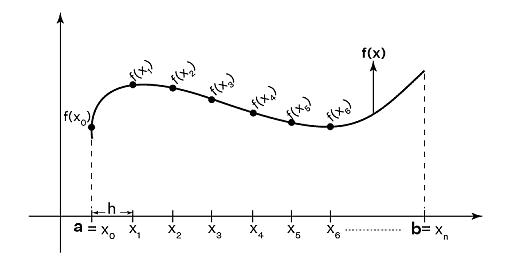
To calculate the area under the curve, assume the next three points are on a parabola. Create a parabola between x0, x1, and x2 to determine the area under the curve between x0 and x2. Of course, none of the three are on the same parabola. Now, plot a graph with approximate values of above given three points.

Now, let us make this parabola symmetric about the y-axis. Then it becomes something like this

Let us assume that the equation of the parabola be y = ax2 + bx + c. Then the area between x0 and x2 is approximated by the definite integral:
Area between x0 and x2

.......(1)
Let us have another observation from the above figure.
f(x0) = a(-h)2 + b(-h) + c = ah2 - bh + c
f(x1) = a(0)2 + b(0) + c = c
f(x2) = a(h)2 + b(h) + c = ah2 + bh + c
f(x0) + 4f(x1) + f(x2) = (ah2 - bh + c) + 4c + (ah2 + bh + c) = 2ah2 + 6c.
Substitute this in (1):
Area between x0 and x2 ≈ h/3 (f(x0) + 4f(x1) + f(x2))
Similarly, we can see that:
Area between x2 and x4 ≈ h/3 (f(x2) + 4f(x3) + f(x4))
Calculating the other areas in a similar way, we get
\(\int_a^b f(x)dx\)
= h/3 (f(x0) + 4f(x1) + f(x2))
+ h/3 (f(x2) + 4f(x3) + f(x4))
+ ...
+ h/3 (f(xn-2) + 4f(xn-1) + f(xn))
≈ (h / 3) [f(x0) + 4f(x1) + 2f(x2)
+ ... + 2f(xn-2) + 4f(xn-1) + f(xn)]
The like terms are combined here.
Hence, we have derived Simpson's rule formula.
Read More: Differentiation and Integration Formula
How to Apply Simpson's Rule?
[Click Here for Sample Questions]
The Trapezoidal rule and Simpson's rule both approximate the same regions, however Simpson's rule is more precise. The following are the ways for determining the intergral ba f(x) dx using Simpson's rule.
- Step 1: From the interval [a, b], get the values of a and b, as well as the value of 'n,' which reflects the number of subintervals.
- Step 2: Using the formula h = (b - a)/n, calculate the width of each subinterval.
- Step 3: Divide the interval [a, b] into 'n' subintervals using the interval width 'h.'
- Step 4: Substitute all of these values into Simpson's rule formula and simplify.
\(\int_a^b f(x) dx\)
≈ (h / 3) [f(x0) + 4f(x1) + 2f(x2)
+ ... + 2f(xn-2) + 4f(xn-1) + f(xn)]
Read More: Relations and Functions
Things to Remember
- Simpson's Rule is a numerical method for approximating the value of a definite integral using quadratic functions.
- When using Simpson's rule, we always divide the interval into an even number of subintervals. This means that 'n' must always be an even integer.
- Simpson's Rule is based on the premise that if you have three points, you can find the a quadratic equation through those points. All subintervals must have the same width.
- Simpson's principles are used by surveyors to calculate the capacity of rescue boats and the quantity of gunk in a ship's storage tanks.
- If a function is particularly oscillatory or has missing derivatives in some areas, the above rule may fail to produce proper conclusions.
- By Simpson's rule: b∫a f(x) dx ≈ (h / 3) [f(x0) + 4f(x1) + 2f(x2) + ... + 2f(xn-2) + 4f(xn-1) + f(xn)]
Also Read:
Sample Questions
Ques. Solve the integral \(\int_0^2 sin \sqrt{x} dx\) using Simpson's rule by taking n = 8. (5 Marks)
Ans. \(\int_0^2 sin \sqrt{x} dx = \int_a^b f(x) dx\)
Comparing both integrals,
[a, b] = [0, 2]
f(x) = sin√x
h = (b – a) / n
= (2 – 0) / 8
=0.25
The sub-intervals are [0, 0.25], [0.25, 0.5], [0.5, 0.75], [0.75, 1], [1, 1.25], [1.25, 1.5], [1.5, 1.75], and [1.75, 2].
By Simpson's rule formula,
\(\int_0^2 f(x) dx\)
≈ (0.25 / 3) x [f(0) + 4f(0.25) + 2f(0.5) + ... + 4f(1.75) + f(2)]
= (0.25 / 3) x (0+1.91770215441681 + 1.29927387816012 + 3.04703992566516 + 1.68294196961579 + 3.59696858641514 + 1.88143866748289 +3.87769904361669 +0.987765945992735)
= 1.52423584761378
Ques. Solve the integral \(\int_0^2 \sqrt{1+e^x} dx\) using Simpson's rule by taking n = 4. (5 Marks)
Ans. \(\int_0^2 \sqrt{1+e^x} dx = \int_a^b f(x) dx\)
When the two integrals are compared,
[a, b] = [0, 2]
f(x) = √1+ex
h = (b – a) / n
= (2− 0) / 4
=0.5
The subintervals calculated are [0, 0.5], [0.5, 1], [1, 1.5], and [1.5, 2].
By Simpson's rule formula,
\(\int_0^2 \sqrt{1+e^x} dx\)
= (0.5 / 3) x [f(0) + 4 f(0.5) + 2 f(1) + 4 f(1.5) + f(2)]
= (0.5 / 3) x (1.414213562 + 6.509957014 + 3.85656937 + 9.36520288 + 2.896386731)
= 4.0070549278
Ques. Solve the integral \(\int_1^2 e^{x^3} dx\) using Simpson's rule by taking n = 4. (5 Marks)
Ans. \(\int_1^2 e^{x^3} dx = \int_a^b f(x) dx\)
When the two integrals are compared,
[a, b] = [0, 2]
\(f(x) = e^{x^3}\)
h = (b – a) / n
= (2− 1) / 4
=0.25
The subintervals calculated are [1, 1.25], [1.25, 1.5], [1.5, 1.75], and [1.75, 2].
By Simpson's rule formula,
\(\int_1^2 f(x) dx\)
= (0.25 / 3) x [f(1) + 4 f(1.25) + 2 f(1.5) + 4 f(1.75) + f(2)]
= (0.25 / 3) x (2.71828182845905 + 28.2027463392796 + 58.4485675624699 + 850.36813958881 + 2980.95798704173)
= 326.724643530062
Ques. Solve the integral \(\int_0^8 \sqrt{x} dx\) using Simpson's rule by taking n = 4. (5 Marks)
Ans. The width of subinterval is

With endpoints xi have coordinates
Xi = {0,2,4,6,8}
The function values at the points xi are
F(x0) = f(0) = √0 = 0
F(x1) = f(2) = √2
F(x2) = f(4) = √4 = 2
F(x3) = f(6) = √6
F(x4) = f(8) = √8 = 2√2
Substituting these values into the Simpson’s rule, we get


The solution of the integral is


The error approximation is

Ques. Solve the integral \(\int_1^2 \frac{dx}{x}\) using Simpson's rule by taking n = 2. (5 Marks)
Ans. For n=2, the Simpson’s rule is

The width of the intervals is

The function values at the points xi are
F(x0) = f(1) = 1 / 1 = 1
F(x1) = f(3 / 2) = 2 / 3
F(x2) = f(2) = 1 / 2
Then,


Ques. For the function f(x), a value table is supplied. Calculate the area under the curve y = f(x) between x = -4 and x = 8 using Simpson's Rule and n = 6 subintervals. (3 Marks)

Ans. For n=6, the Simpson’s rule is

The width of the intervals is

The approximate value of the area falling under the curve is


Ques. Using Simpson's Rule and n = 4 subintervals, find the area underneath the curve y = 3x from x = -2 and x = 2. (5 Marks)

Ans. For n=6, the Simpson’s rule is

The function values at the points xi are
F(x0) = f(-2) = 3-2 = 1 / 9
F(x1) = f(-1) =3-1 = 1 / 3
F(x2) = f(0) = 30 = 1
F(x3) = f(1) = 31 = 3
F(x4) = f(2) = 32 = 9
As Δx = 1, we get


Ques. For the function f(x), a value table is supplied. Calculate the area under the curve y = f(x) between x = 0 and x = 4 using Simpson's Rule and n = 4 subintervals. (3 Marks)

Ans. For n = 4, the Simpson’s rule is

The width of the intervals is

The approximate value of the area falling under the curve is


Ques. Using Simpson's Rule and n = 6 subintervals, find the area underneath the curve y = f(x) from x = -1 and x = 5. (3 Marks)

Ans. For n = 4, the Simpson’s rule is

The function values at the points xi are
F(x0) = f(-1) = 4
F(x1) = f(0) = 3
F(x2) = f(1) = 2
F(x3) = f(2) = 3
F(x4) = f(3) = 6
F(x5) = f(4) = 6
F(x6) = f(5) = 4
As Δx = 1, we get
A = S6 ≈ \(\frac{1}{3} [ 4 + 4.3 + 2.2 + 4.3 + 2.6 + 4.6 +4]\)
\(= \frac{1}{3} [4 + 12 + 4 + 12 + 12 + 24 + 4]\)
\(=\frac{1}{3} . 72 = 24\)
Ques. Evaluate \(\int_0^1 e^x dx\), by Simpson’s ? rule. (5 Marks)
Ans. Divide the range [0, 1] into 6 parts by assuming h = 1/6.
If x0 = 0, then, y0 = e0 = 1.
If x1 = x0 + h = 1/6, then,y1 = e1/6 = 1.18
If x2 = x0 + 2h = 2/6 = 1/3, then, y2 = e1/3 = 1.39
If x3 = x0 + 3h = 3/6 = 1/2, then, y3 = e1/2= 1.64
If x4 = x0 + 4h = 4/6 = 2/3, then, y4 = e2/3 = 1.94
If x5 = x0 + 5h = 5/6 , then, y5 = e5/6 = 2.30
If x6 = x0 + 6h = 6/6 = 1, then, y6 = e1 = 2.71
According to Simpson’s rule;

Then,
\(\int_0^1 e^x dx\) = (1/18) [(1 + 2.71) + 4(1.18 + 1.64 + 2.30) + 2(1.39 + 1.94)]
= (1/18) [3.71 + 20.52 + 6.68]
= 1.71
Ques. Find the answer using Simpson’s rule (3 Marks)

Ans. Using Simpson’s Rule
\(\int y dx\) = (h / 3) x [(y0 + y4) + 4(y1 + y3) + 2(y2)]
= (0.1 / 3) x [(1+0.8604) + 4x(0.9975 + 0.9776) + 2x(0.99)]
= (0.1 / 3) x [(1+0.8604) + 4x(1.9751) + 2x(0.99)]
= 0.39136
Ques. Find the answer of 1/x where x1 = 1 and x2 = 2, h = 0.25, using Simpson’s rule. (3 Marks)
Ans. F(x) = 1 / x
| x | 1 | 1.25 | 1.5 | 1.75 | 2 |
| y | 1 | 0.8 | 0.6667 | 0.5714 | 0.5 |
Using Simpson’s rule
\(\int y dx\) = (h / 3) x [(y0 + y4) + 4(y1 + y3) + 2(y2)]
= (0.25 / 3) x [(1+0.5) + 4x(0.8 + 0.5716) + 2x(0.6667)]
= (0.25 / 3) x [(1+0.5) + 4x(1.3714) + 2x(0.6667)]
= 0.6933
For Latest Updates on Upcoming Board Exams, Click Here: https://t.me/class_10_12_board_updates
Check-Out:



Comments