



Exams Prep Master
A system of Linear Equation with two or three variables can be easily solved by using determinants. It involves the usage of the Cramer's rule to find out the results instead of a graphing calculator. It is quite beneficial if the systems are relatively smaller or when you can use a graphing calculator. In this article, we will further discuss more about the steps to find the solution of a system of linear equations along with some important questions.
| Table of Content |
Key Terms: Determinants, Matrix, Variables, Equation, Coefficient, Linear equation, Cramer's rule
Cramer's Rule
[Click Here for Sample Questions]
Cramer's rule says that if the determinant of a coefficient matrix (let it be |A| ) is not equal to 0, then the solutions to the system of linear equations are:
If the matrix of the system is as follows:

then

If you take note, the solutions are easily obtained by applying the appropriate ratios of determinants of a family of matrices.
Conditions for Cramer's Rule:
- It fails for a system in which D=0 since for D must be in denominator for finding the values and these values will not be defined.
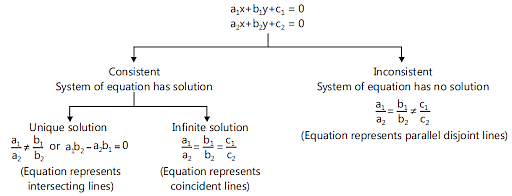
- When D=0 there's two possible solutions; it may either have no solutions or infinite solutions.
- If D≠ 0 we can say it has a unique solution.
Discover about the Chapter video:
Determinants Detailed Video Explanation:
Solving Linear Equations Using Two Variables
[Click Here for Sample Questions]
Suppose the equation is a1x + b1y + c1 = 0 and a2x + b2y + c2 = 0
therefore, x=Δ1Δ,y=Δ2Δor x=b1c2-b2c1a1b2-a2b1;y=a2c1-a1c2a1b2-a2b1
where: Δ1=|b1c1b2c2|,Δ2=|c1a1c2a2|andΔ=|a1b1a2b2|
Solving Linear Equations Using Three Variables
[Click Here for Sample Questions]
Equations with two variables are easier, however adding three variables makes it a lot more complicated.
Say, the matrix is as follows:

finding the determinant is through these steps.
- Write the first two columns again in front of the third column.
- Draw three diagonal lines from the upper left to the lower right and from the lower left to the upper right.

- Multiply the three diagonals and add the products.
- Multiply the other three left to right and add the products.
- Finally, subtract the second sum from the first sum.
(a1b2c3 + b1c2a3 + c1a2b3) – (a3b2c1 + b3c2a1 + c3a2b1)
Now to solve a 3x3 system of equations like
we use Cramer's rule we set up the variables as the following:

a1x+b1y+c1z=d1anda2x+b2y+c2z=d2anda3x+b3y+c3z=d3
To solve this equation we find the determinants:
Δ=|a1b1c1a2b2c2a3b3c3|,Δ1=|d1b1c1d2b2c2d3b3c3|,Δ2=|a1d1c1a2d2c2a3d3c3|,Δ3=|a1b1d1a2b2d2a3b3d3|
Henceforth, the following way is followed to find the solution:

Conditions for Infinite and No Solutions
[Click Here for Sample Questions]
(a) If Δ=0
and
Δ1=Δ2=Δ3=0,
then system of equation may or may not be consistent:
- The system will have infinite solutions and is said to be consistent if the value of x, y and z in terms of t sates the third equation.
- The system will have zero solutions and is inconsistent if the value of x, y and z in terms of t does not sate the third equation.
(b) If d1=d2=d3=0, then the system of linear equations is known as Homogeneous Linear Equations which has at least one solution – (0,0,0)
(c) If the system of homogeneous linear equations has non-zero solutions and Δ = 0, then the system has infinite solutions.
Also Read:
Important Solutions
[Click Here for Sample Questions]
Condition for consistency of three simultaneous linear equations in 2 variables.
a1x+b1y+c1=0
a2x+b2y+c2=0
a3x+b3y+c3=0
These are concurrent if,
|a1b1c1a2b2c2a3b3c3|=0
ax2+2hxy+by2+2gx+2fy+c=0
showcases a pair of straight lines if
abc+2fgh-af2-bg2-ch2=0=ahghbfgfc
c) Equation of a straight line passing through
(x1,y1)&(x2,y2)is|xy1x1y11x2y21|=0.
d) Collinear points of an area of a triangle
The vertices of a triangle
(xr,yr);r=1,2,3is:D=12|x1y11x2y21x3y31|.
Things to Remember
- Linear equations can be solved using determinants with the help of Cramer's rule.
- A System of linear equations can have Unique solutions, Infinite solutions or no solutions.
- Cramer's rule cannot be used if the matrix isn't square or the determinant is 0 of the coefficient matrix.
Sample Questions
Ques: Solve the following equation using Cramer's rule. (4 marks)
x+y+z=9,2x+5y+7z=52,2x+y-z=0.
Ans: Firstly, we find the determinants: Δ,Δ1,Δ2andΔ3
followed by their value, and using Cramer's rule we can find the values of the variables x, y and z.
Δ=|11125721-1|(ApplyingC2→C2-C1andC3→C3-C1)
=>
Δ=|1002352-1-3|=1(-9+5)=-4
=>
Δ1=|911525701-1|(ApplyingC2→C2+C3)
=>
Δ1=9215212700-1=-1108-104=-4;Δ2=191252720-1ApplyingC1→C1+2C3
=>
Δ2=|3911652700-1|=-1(156-144)=-12andΔ3=|1192552210|(applyingC1→C1-2C2)
=>
Δ3=|-119-8552010| (ApplyingC1→C1-2C2)=-1(-52+72)=-20
Using Cramer's rule we have:
x=Δ1Δ=-4-4=1,y=Δ2Δ=-12-4=3andz=Δ3Δ=-20-4=5
x=1,y=3,z=5.
Ques: Solve the following equation: (4 marks)
4x+5+3y+7=-1and6x+5-6y+7=-5
Ans: 1x+5=a and 1y+7=b
Now we find the determinants Δ,Δ1andΔ2
and using Cramer's rule we get x and y.
Δ,1x+5=aand1y+7=b
We get the following two linear equations.
4a+3b=-1 … (i)
And 6a-6b=-5 … (ii);
x|-13-5-6|=y|4-16-5|=1|436-6|⇒a6+15=b-20+6=1-24-18
a21=b-14=1-42⇒a=-12andb=13
a=-12⇒1x+5=-12;⇒2=-x-5⇒x=-7
b=13⇒1y+7=13⇒3=y+7⇒y=-4
Ques: For what value of k will the following system of equations possess nontrivial solutions. Also find all the solutions of the system for that value of k. (4 marks)
x+y-kz=0; 3x-y-2z=0; x-y+2z=0.
Ans: We already know that for a non-trivial solution Δ= 0.
To get the value of k, we can use the invariance property.
⇒|11-k3-1-21-12|=0⇒|20-k+220-41-12|=0[R1→R1+R3,R2→R2-R3]
C2.⇒--1-8-22-k=0⇒2k-12=0⇒k=6
Equating the value of k in the given equations we get:
x+y-6z=0 … (i)
3x-y-2z=0 … (ii)
x-y+2z=0 … (iii)
(i) + (ii)
4x-8z=0
z=x2
Equating the value of z in (i) we get:
x+y-3x=0
y=2x.
Henceforth, when k=6 the solution of the given system of equations is:
x=t,y=2t,z=t2,
t is an imaginary arbitrary number.
Ques: Solve the following equations by matrix inversion. (4 marks)
2x + y + 2z = 0, 2x – y + z = 10, x + 3y – z = 5
Ans: By writing the given equations into the form of AX = D and then multiplying both side by A-1 we will get the required value of x, y and z.
2122-1113-1xyz=0105
AX=D where A is:
[2122-1113-1],X=[xyz],D=[0105]
⇒A-1AX=A-1D⇒X=A-1D (i)
A-1=adjA|A|;|A|=|2122-1113-1|=2(1-3)-1(-2-1)+2(6+1)=13
The Matrix of cofactor|A| is [-2377-4-5324].So,adjA=[-2733-427-5-4];A-1=13[-2733-427-5-4].
and from equation (i)
X=113-2733-427-540105=1130+70+150-40+100-50-20=8513-3013-7013;xyz=8513-3013-7013
⇒x=8513,y=-3013,z=-7013
Ques: Solve the following using Cramer’s Rule. (4 marks)
2x – y = 5
x + y = 4
Ans: Writing in the form of AX = B
2-111xy=54
A=2-111
X=[xy]
B=[54]
D= |A|
=|2-111|
= 2(1) – (-1)1
= 2 + 1
= 3 ≠ 0
The given system therefore has a unique solution
Dx=|5-141|
= 5(1) – (-1)(4)
= 5 + 4
= 9
Dy=|2514|
= 2(4) – 5(1)
= 8 – 5
= 3
Therefore,
x = Dx/D = 9/3 = 3
y = Dy/D = 3/3 = 1
Ques: Solve the following system of equations using Cramer’s rule: (4 marks)
x + y + z =6
y + 3z = 11
x + z =2y or x – 2y + z = 0
Ans: Let's write these in the form of AX=B
[1110131-21][xyz]=[6110]
=>
D=A=1110131-21=11+6-10-3+10-1=7+3-1=9
D is not equal to 0, therefore it has a unique solution.
Dx=|61111130-21|=6(1+6)-1(11-0)+1(-22-0)=42-11-22=9
Dy=|1610113101|=1(11-0)-6(0-3)+1(0-11)=11+18-11=18
Dz=|11601111-20|=1(0+22)-1(0-11)+6(0-1)=22+11-6=27
Thus,
x = Dx/D = 9/9 = 1
y = Dy/D = 18/9 = 2
z = Dz/D = 27/9 = 3
For Latest Updates on Upcoming Board Exams, Click Here: https://t.me/class_10_12_board_updates
Check-Out:



Comments