



Content Writer
The testis, often known as testicles, are male sex glands that are vital to the reproductive system. They are the site of sperm production as well as testosterone production.
- Testosterone is a steroid hormone that regulates a variety of body activities, including sexual desire and sperm production.
- The testis are two oval-shaped organs that are placed in the scrotum.
- The scrotum protrudes from the body.
The testis have evolved to be outside the belly, at least partly because they need to be kept cooler than body temperature to operate properly. Moreover, testes mean the same as testis.
- The anterior pituitary luteinizing hormone regulates the release of testosterone.
- The anterior pituitary follicle-stimulating hormone and gonadal testosterone control the production of sperm.
- They are also popular with the name gonads.
- Eating food rich in antioxidants is considered good for testicular health.
Key Terms: Testis, Testes, Testicles, Scrotum, Tunica Albuginea, Seminiferous Tubules, Leydig Cell, Testosterone, Epididymis, Cowper’s Gland, Testosterone, Spermatogenesis, Hormones, Sperm, Anterior Pituitary
Anatomy of Testis
[Click Here for Sample Questions]
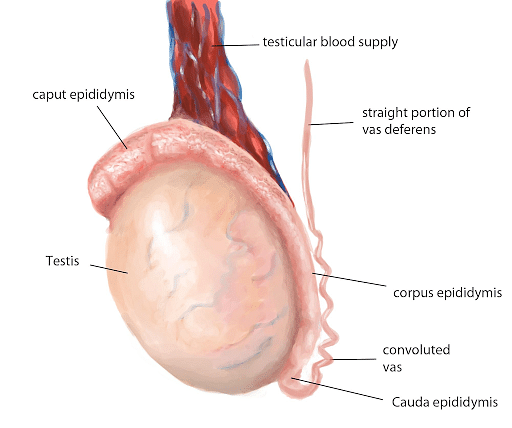
Testis, also known as testicles or testes, is an oval egg-like structure found in men. It is responsible for producing sperm, which is a male sex cell, as well as a sex hormone, testosterone.
- Each normal testis weighs about 25 grams or 0.875 ounces.
- It measures four to five centimetres in length and two to three centimetres in diameter.
- The tunica albuginea is a fibrous capsule that surrounds each testis.
- It is partitioned into 200 to 400 wedge-shaped lobes or parts by fibrous tissue from the tunica albuginea.
The mediastinum testis is formed when the partition between both lobes and the seminiferous tubules converges in one location towards the anal side of each testis.
- Each lobe contains three to ten coiled tubules known as seminiferous tubules, which create sperm cells.
Also Read:
| Related Articles | ||
|---|---|---|
| Menstrual Cycle | Estrogen Hormone | Female Reproductive System |
| Luteinizing Hormone | Binomial Nomenclature | Taxonomy |
Structure of Testis
[Click Here for Sample Questions]
The structure of the testis consists of three layers, including tunica vaginalis, tunica vasculosa, and tunica albuginea. Within the duct system, tubules are lined with a layer of cells called germ cells.
- Germ cells are developed into mature spermatozoa.
- Sertoli cells (supporting cells) and Leydig (intestinal) cells are all found in the testes.
- They are also known as testosterone-producing cells.
Like granulosa cells in the ovary, Sertoli cells are interspersed between germinal epithelial cells within the seminiferous tubule and move to the foetal testes from the embryonic yolk sac.
- The Leydig cell is similar to the hormone-secreting interstitial cells of the ovary.
- It is found beneath the tunica albuginea, between the septal walls, and in the tubules.
- Leydig cells have an uneven form and frequently have several nuclei.
- Fat droplets, pigment granules, and the crystalline structure are typically found in these cells.
The number and appearance of these cells vary widely between animal species, and blood, lymphatic arteries, and nerve fibres surround them. The presence or absence of genes on the y chromosome determined the embryonic development of indifferent gonads into either testes or ovaries in ancient times.

Testis
Location of Testis
[Click Here for Sample Questions]
The testis is important for the production and storage of sperm until they reach the maturation stage of ejaculation. They are also responsible for sex drive, development of muscle, fertility and bone mass.
- The testes are located under the penis, which is enclosed in a pouch of skin called the scrotum.
- One testicle is located on the right side, and the other testicle is located on the left side.
- They are connected by a cord called spermatic cord inside your body.
- Each cord consists of blood vessels and nerves.
- It also contains vas deferens which help in the movement of sperm to the penis so that it can leave your body in semen.
Function of Testis
[Click Here for Sample Questions]
The testis serve two main purposes which are as follows:
Testosterone
The testes' primary purpose is to create testosterone. Testosterone is a steroid hormone that has a role in male sexual differentiation. It's crucial for fetal development.
- It also controls the growth of basic and secondary sexual traits, including penis size and chest hair.
- Furthermore, testosterone is involved in a puberty growth spurt, bone and muscular growth, and the creation of blood cells in males.
Creation of Sperm
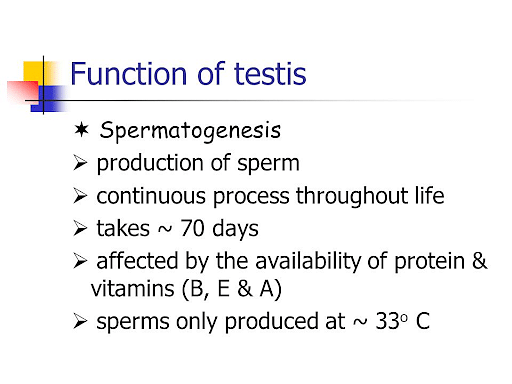
The testes' second purpose is to create sperm. The network of seminiferous tubules that make up a substantial section of the testicles is where sperm develop.
- Women have a finite number of germ cells that can transform into eggs throughout their lives.
- Men can produce millions upon millions of sperm every day.
- After then, the sperm must mature for several months before they may be used during ejaculation.
- This maturation begins in the testes but occurs primarily within the epididymis.
What is Spermatogenesis?
[Click Here for Sample Questions]
Spermatogenesis is the process of production of male gametes, often known as sperm in the testes. Each sperm (haploid, containing a single copy of each chromosome) is used in this process.
- Meiosis is a biological process in which a cell's genome is replicated and divided twice to produce four haploid gametes.
- Following many steps, this process proceeds in the seminiferous tubules of the testes.
- The maturation process continues in the epididymis, where they are released as semen and glandular secretions.
- This process begins throughout puberty and continues till the person dies.
- The actions of Leydig cells, the brain, and the pituitary gland are responsible for the entire process of spermatogenesis in males.
- With ageing, the amount of these sperms decreases, eventually leading to sterility.

Medical Conditions affecting Testis
[Click Here for Sample Questions]
Medical Conditions affecting Testis is not necessarily considered as hazardous as long as the testes spend most of their time in the scrotum. Some conditions affecting testis are as follows:
Testicular Torsion
When the testicle twists inside the scrotum and cuts off the blood supply, this is known as testicular torsion. Pain and swelling of the scrotum are symptoms of testicular torsion, which should be reported to a doctor immediately.
- Torsion of the testes is uncommon and usually treated by orchiopexy.
Varicocele
Another disorder that affects the testes is varicocele. It is characterized by aberrant dilatation or enlargement of the testicular blood arteries and abnormally twisted vessels.
- Varicocele affects up to 15% of men in the general population and more than a third of men with primary infertility.
- It is most commonly discovered at puberty or later, and it is considered that they do not develop until puberty.
- They are more common on the left side of the body than on the right due to anatomical variances.
Orchitis
Orchitis is a condition in which the testes become inflamed. It is frequently a reaction to infection. The sexually transmitted illnesses of chlamydia and gonorrhoea are the most common causes of this in young, sexually active adults.
- Other bacteria and viruses may be to blame in men of different ages.
- While orchitis can be unpleasant, unlike testicular torsion, it usually develops gradually rather than suddenly.
Testicular Cancer
Thousands of men in the United States are diagnosed with testicular cancer each year. Fortunately, it is extremely treatable and has a low mortality rate. Testicular cancer, unlike many other malignancies, is more likely to strike young males.
- Treatment has the potential to have a big influence on fertility and quality of life.
- As a result, it's critical to talk about your alternatives with a doctor who is well-versed in the disease.
Tests used for detecting Medical Conditions
[Click Here for Sample Questions]
The most common method for examining the testes is ultrasound. This test employs sound waves to examine the testes inside the scrotum for any abnormalities.
- It can also be used to see if the blood flow is regular and healthy.
- Ultrasound is used to diagnose testicular torsion, testicular cancer, and varicocele, among other testicular health issues.
- It's not an invasive procedure, and it shouldn't hurt.
If a man is concerned about his fertility and his testicles are largely in his abdomen, orchiopexy surgery can be used to transfer the testicles into the scrotum permanently.
- The testes can also be screened using magnetic resonance imaging (MRI).
- It allows for imaging of the abdomen; it is the test of choice for diagnosing cryptorchidism in both children and adults.
Scrotal MRI can also be used to describe different forms of testicular lesions, including testicular cancer. It may be beneficial in some cases of testicular injuries or urgent issues.
Things to Remember
- Testis produce roughly 200 million sperm every day in human testicles.
- The human testicle is the organ in the human body that possesses the most protein diversity of any other organ.
- They are not identical; one testis is always smaller than the other.
- They are kept at a temperature two degrees lower than the body's core temperature since they are located outside the body.
- This hormone is essential for the development and manifestation of secondary sexual traits in boys.
- Testosterone is produced by the testis.
- Chemotherapy and other medicines inhibit the hormone (endocrine) system from triggering testosterone production in the testes.
Also Read:
Sample Questions
Ques: What exactly is a testis? (2 marks)
Ans: A single testicle is referred to as a testis in medical terms. Testes are the plural form of the testis. The testes are male reproductive organs that produce sperm, sperm, and testosterone. The scrotum houses the testes, which are sometimes known as balls, nuts, rocks, stones, or bollocks.
Ques: How can you know if you have testicular cancer? (2 marks)
Ans: The emergence of a firm, painless lump in the testicle is the earliest symptom of testicular cancer. A testicular lump, on the other hand, is usually not malignant. Any lump or change in the appearance or feel of the testicles should be evaluated by a doctor. If more testing is required, an in-office ultrasound can be used to determine this.
Ques: What is the purpose of the testis? (2 marks)
Ans: Testicles' primary function is to create sperm. Sperms are also stored in the testis. The testis' primary purpose is to create testosterone and other male hormones known as androgens. The male hormone testosterone is responsible for the changes that happen during puberty.
Ques: What is the epididymis, and what does it do? (2 marks)
Ans: The epididymis is a long, coiled tube that connects the testes to the vas deferens and transfers sperm from the testes to the vas deferens. The caput (head), corpus (body), and cauda (tail) are the three sections of the epididymis (tail). Sperm mature and obtain the capacity to swim as they go through the various regions of the epididymis.
Ques: What are vas deferens and Cowper's gland? (3 marks)
Ans: The ductus deferens, commonly known as the vas deferens, is a fibromuscular tube that acts as a testis excretory duct and is relatively close to the epididymis. The ductus is responsible for transferring sperm cells from each epididymis to the ipsilateral ejaculatory duct and is 30-45 cm long.
- Cowper's glands are pea-sized glands found in the male reproductive system below the prostate gland.
- Prior to ejaculation, they create a thick, clear mucus that drains into the spongy urethra.
Ques: In human testes, write the location and functions of the following? (2 marks)
(a) Sertoli cells
(b) Leydig cells
Ans: (a) Sertoli cell location is within the lining of the testis's seminiferous tubule. Sertoli cells have a specific function. They feed the sperm cells that are still growing.
(b) Leydig cell location Between the seminiferous tubules, in the interstitial gaps. Leydig cells have a specific function. It produces androgens, such as testosterone, and secretes them.
Ques: Explain the epididymis' involvement in male fertility? (2 marks)
Ans: It is located on the posterior surface of each testis and is where spermatozoa develop motility and the ability to fertilize the egg. The surface of sperm is altered in response to epididymis secretions, which are necessary for fertilization of an egg.
Ques: What are the disorders that affect the testis? (2 marks)
Ans: The disorders that affect the testis are as follows:
- Klinefelter Syndrome
- Hypogonadism
- Infertility
- Testicular Tosrsion
- Testicular Cancer
- Cryptorchidism
- Spermatocele
Ques: How can we keep testicles healthy? (3 marks)
Ans: The ways to keep testis healthy are as follows:
- Indulge in the practice of safe sex.
- Wear athletic protection while involved in vigorous activities.
- Keep hygienic and clean
- Regularly check your testicles
Ques: What are the three layers involved in tunica vaginalis? (3 marks)
Ans: The three layers involved in tunica vaginalis are as follows:
- Visceral Layer: Visceral layer is responsible for surrounding the tunica albuginea which shields the seminiferous tubules.
- Cavum Vaginale: Cavum Vaginale is basically an empty space between the outermost layer of the tunica vaginalis and visceral layer.
- Parietal Layer: Parietal Layer is a type of protective layer that surrounds the entire testicular structure.
Ques: What is Torsioned Testicles? (2 marks)
Ans: Torsioned testicles is a a disorder in which the spermatic cord twists and causes blood to flow to the scrotum. The restricted blood flow resulting from twisted testicles frequently produces abrupt pain and edema. Although it can happen at any age, it is most frequent in boys between the ages of 12 and 18.
For Latest Updates on Upcoming Board Exams, Click Here: https://t.me/class_10_12_board_updates
Check-Out:



Comments