



Education Journalist | Study Abroad Lead
Transduction is generally referred to as the network of the genes involved in the transduction of light signals. Microbiology is the branch that deals with microorganisms. This includes a great variety of living organisms that are invisible to the naked eye, mainly bacteria and fungi. These microorganisms despite being tiny in size, form the basis of all life on the earth. This transduction microbiology is a part of the bacterial recombination and reproduction in Bacteria. This process occurs in three main ways. The transformation, transduction, and finally conjugation. In this article, we will dive deep into the definition and types of transduction microbiology.
TOC:| Table of Content |
Key Takeaways: Transduction, Bacteriophage, Microbiology of Bacteria, Bacterial Recombination, DNA, DNA fragment, Bacterium
What is transduction Microbiology?
[Click Here for Sample Questions]
Transduction was first discovered in 1952 by Joshua Lederberg and Norton Zinder. It is defined as Genetic recombination in which a DNA fragment is transferred from one bacterium to another by a bacteriophage. In the other words, transduction can also be defined as the transfer of the genetic material from one cell to another cell by a bacteriophage is.

3D Animation of the Transduction Process
A bacteriophage is a virus that infects a certain type of bacteria and replicates within them. They are also called bacteria eaters. This was first described by Fredrick twort in 1915. This replication mainly depends on the Lytic or the Lysogenic cycle. All bacteriophages can be transducers but not all bacteria are irreducible.
Also Read:
Lytic replication
[Click Here for Sample Questions]
The lytic replication acts in the following way:
- Firstly, the bacterial cell is infected by the bacteriophage.
- This bacteriophage virus uses the host machinery that makes many copies either directly by the lytic cycle or otherwise, it first gets incorporated into the bacterial genome by the lysogenic cycle.
- The lytic cycle and lysogenic cycles are different cycles.
- At the time of joining of the bacteriophages, the bacterial genome also gets packed by mistake in the viral side along with the viral genome.
- In the lysogenic cycle, at the time of excision of prophage, a few parts of the bacterial genome will go inside the assembled viral head together with the viral genome.
- As soon as these viruses infect another bacterial cell, the viral DNA and the donor DNA will be injected into the host cell.
- The DNA of the bacteria will either form plasmids or get inserted into the recipient DNA if it is homologous to the genome of the recipient.
- It may also be inserted with the prophage if it is a temperate phage. So, the final structure of the bacteria depends on the portion of bacterial DNA, bacteriophages nature.
Types of Transductions
[Click Here for Sample Questions]
Transduction is common in both phages namely the virulent and temperate phages. These phages are carried out in the lysogenic cycle. During these phases, transduction is classified into two types.
- Generalized Transduction.
- Specialized Transduction.
1. Generalized Transduction
In generalized transduction, a DNA fragment is transferred from one bacterium to another by a lytic bacteriophage that is now carrying donor bacterial DNA due to an error in maturation during the lytic cycle.
- This phage can carry any part of the DNA in the bacteria.
- It can occur both by the lytic or the lysogenic cycles.
- Whenever the virus-containing bacterial DNA infects another cell of bacteria, it will get inserted into the host genome or if it was a plasmid, it will be able to reform the plasmid.
- Its advantage is that it can be replicated immediately.
- In this type, no viral DNA is found.
Generalized Transduction Steps:
The steps of generalized transduction are:
- A lytic bacteriophage adsorbs to a susceptible bacterium.
- The bacteriophage genome enters the bacterium. The genome will enable the bacterium’s metabolic machinery to prepare the bacteriophage components and enzymes.
- Very occasionally, the bacteriophage head will completely assemble around a fragment of the donor bacterium’s nucleoid instead of a phage of the genome.
- The bacteriophages are released.
- The bacteriophage carrying the donor bacterium’s DNA adsorbs to a recipient bacterium.
- The bacteriophage will insert the donor bacterium’s DNA, which it is carrying into the recipient bacterium throughout the process.
- The donor bacterium’s DNA is exchanged with that of the recipient’s DNA in the bacterium.
- The below diagram represents the different steps involved in the generalized transduction process placed in an order.
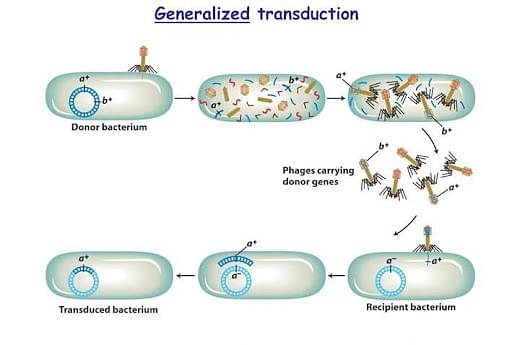
Steps of Generalized Transduction
2. Specialized transduction
In specialized transduction, a DNA fragment is transferred from one bacterium to another by a temperate bacteriophage that is now carrying donor bacterial DNA due to some error in spontaneous induction during the lysogenic lifecycle.
- In specialized transduction, the phage inserts its genome at a specific site.
- It occurs only during the lysogenic cycle.
- This transduction will replicate later despite the generalized transduction which occurs immediately.
- Viral and bacterial DNA were included in this specialized transduction.
- The Lambda variant of the bacteria is one of the best examples of a specialized transducing phage.
Specialized transduction steps:
The steps of specialized transduction are:
- A temperate bacteriophage adsorbs to a susceptible bacterium and injects this genome.
- The bacteriophage will insert its genome into the bacterium’s nucleoid in order to make it a prophage.
- During spontaneous induction, a small piece of the donor bacterium’s DNA is picked up as a part of the phage’s genome in place of some of the phages.
- During the replication of the bacteriophage, a small segment of bacterial DNA will replicate as part of the phage's genome. Now, each phage will carry that segment of bacterial DNA.
- The phage adsorbs to a recipient bacterium and injects its genome.
- The phage genome carrying the donor bacterial DNA inserts into the recipient bacterium and completes the transduction.
- This finally ends the specialized transduction. The below diagram depicts the sequence of steps present in the specialized transduction.

Specialized Transduction
Applications of Transduction
[Click Here for Sample Questions]
The applications of transduction are:
- It is the most important procedure discovered in whole genetic engineering.
- Mapping of bacterial genes: the total amount of the packaged DNA inside the virus head is largely dependent on the size of the head itself.
- Hence, the bacterial genes can be mapped by calculating the frequencies of the transduced bacteria.
- This process mainly contributes to the evolution and increase in genetic diversity.
- This is very important as this allows organisms to adapt to any changes in their own environment.
- This gene recombination also comes under the fundamental cores of the very process of evolution.
- It serves as a key to the Antibodies resistance which is of utmost use these days.
- Transduction is most specifically important as this could explain the mechanism by which the antibodies remain ineffective due to the transfer of the genes among bacteria.
- This also gives major insights into gene therapy.
Things to Remember
- In the case of viruses and bacteria, the transduction occurs through either the lytic cycle or the lysogenic cycle. This depends on the type of the virus itself.
- In the lytic cycle, the virus penetrates through the penetration of the cell membrane.
- In the lysogenic cycle, the DNA replication process is fused with the virus along with the host.
- Transduction, in general, can be considered as the mode of gene transfer between different microorganisms.
- The first bacteriophage infects the donor bacteria and then carries some parts of the donor genome along with it.
- The transfer of DNA takes place in the case of bacteria when the bacteriophage infects a new bacterial cell and then the DNA is transferred into the recipient cell.
- The main difference between the generalized and the specialized transduction is the replication time.
Read More:
Sample Questions
Ques: What is transduction in bacteria? (5 marks)
Ans: Transduction is defined as a mode of genetic transfer from one bacterium to any other bacterium present in its locality, through a virus. This process occurs with no direct contact with the bacteria cells. This genetic recombination in bacteria can take place with these three processes which are transformation, conjugation, and transduction.
In this process, bacteriophages that will infect the bacteria will use the host cells to multiplicate and during the process of assembling them sometimes pack the bacterial DNA with them.
Later, when these viruses infect new bacterial cells, the bacterial genome that they carry may get inserted into the host of the genome. The first bacteriophage infects the donor bacteria and then carries some parts of the donor genome along with it.
In bacteria, this transduction is a part of the reproduction process of the bacteria. This transduction process is the greater category of the study of microbiology.
Ques: Give the applications of transduction in microbiology? (5 marks)
Ans: The applications of transduction in microbiology are:
- The mapping of bacterial genes was the major application of transduction microbiology.
- Transduction microbiology mainly contributes to the evolution and increase in genetic diversity.
- Bacterial genes can be mapped by calculating their frequencies of being transduced and their traces are easily spotted.
- Transduction microbiology serves as a key to the Antibodies resistance which is of utmost use during these days.
- Contribution towards the increase of genetic diversity.
- It involves the research for the evolution of antibodies in the human body and enhances antibody resistance.
Ques: Give the differences between generalized and specialized transduction? (5 marks)
Ans: The differences between generalized and specialized transduction are:
| Generalized transduction | Specialized transduction |
|---|---|
| Generalized transduction is done by the lytic bacteriophages present in the bacteria | Specialized transduction is done by temperate phases. |
| Generalized transduction undergoes a lytic cycle | Specialized transduction undergoes a lysogenic cycle. |
| Bacterial cell lyses quickly. | These bacteria cells take some time to undergo the lytic process. |
| A portion of donor bacterial DNA is enclosed within the viral capsid in case of generalized transduction | Small parts of bacterial DNA remain attached to viral DNA during the detachment from the bacterial chromosome and are packed into new capsids. |
| Viral DNA is not allowed to integrate into the bacterial chromosome. | Bacterial and viral DNA integrates. |
| Bacterial DNA hydrolyses into pieces by the virus. | Bacterial DNA is not hydrolyzed. |
| There is no prophage formation during generalized transduction. | Prophages are formed during specialized transduction. |
Ques: What is generalized transduction in microbiology? (5 marks)
Ans: A DNA fragment is transferred from one bacterium to another by a lytic bacteriophage that is now carrying donor bacterial DNA due to an error in maturation during the lytic cycle.
This process occurs when all the fragments of the donor DNA from any region of chromosomes have a chance to absorb into the transducing bacteriophage then it comes under the generalized transduction.
- This phage can carry out any part of the DNA in the bacteria.
- It can occur both by the lytic or the lysogenic cycles.
- Whenever the virus-containing bacterial DNA infects another cell of bacteria, it will get inserted into the host genome or if it was a plasmid, it will be able to reform the plasmid.
- Its advantage is that it can be replicated immediately.
- In this generalized transduction, no viral DNA is found.
- At first, the bacteriophage infects the donor cell and begins lytic cell.
Ques: What is specialized transduction in microbiology? (5 marks)
Ans: A DNA fragment is transferred from one bacterium to another by a temperate bacteriophage that is now carrying donor bacterial DNA due to some error in spontaneous induction during the lysogenic lifecycle.
This process occurs only with the lysogenic cycle. Also, some of the selected microorganisms transduce with this specialized transduction.
- In specialized transduction, the phage inserts its genome at a specific site.
- It occurs only during the lysogenic cycle.
- This transduction will replicate later despite the generalized transduction which occurs immediately.
- when some lysogenic cells are exposed to certain stimuli like chemicals or UV lights, then it causes induction of virus genome from host cell genome and leads to the beginning of the lytic cycle.
- Viral and bacterial DNA were included in this specialized transduction.
The Lambda variant of the bacteria is one of the best examples of a specialized transducing phage.
Ques: Why can generalized transduction transfer any gene but specialized transduction is restricted to only a small set? (3 marks)
Ans. The main reason is that the amount of the DNA will only govern the viral and other features of the particle formation. Hence the information content of the DNA can not govern viral particle formation.
Any bacterial gene can be included within the latest ones which were the newly formed viruses.
Hence the generalized transduction transfers any type of gene present in the bacterial transduction but not the specialized transduction which is only restricted to only a small set.
Ques: What is the end result of specialized transduction? (3 marks)
Ans: During the specialized transduction, the DNA will integrate into the chromosome of the host cell present in the bacteria. This will lead to the formation of the prophage.
Since the DNA is used as the template at the time of the synthesis stage all copies will be hybrid of viral and bacterial DNA. Hence all the resulting virions will have viral and Bacterial DNA in common.
Ques: What is the pathophysiology of transduction infection? (3 marks)
Ans: A bacterial host cell is infected with either avirulent or a temperate bacteriophage which on engaging within the lytic cycle will lead to replication.
After the completion of the first three steps of the replication, the virus will itself enters into the assembly stage. During this stage, the fully formed virions were formed which will show the viral behaviour of the bacteria.
For Latest Updates on Upcoming Board Exams, Click Here: https://t.me/class_10_12_board_updates
Check-Out:



Comments