



Content Curator
Acetone is a colorless liquid that is used as a solvent along with a cleaning agent in various industries and goods. Acetone, also known as propanone, is highly flammable and can even break down super glues and leave the alcohols denatured. Acetone is a volatile chemical and hence has many properties and uses of it.
| Table of Contents |
Key words: Acetone, Propanone, Application, Uses, Ketone, Chemical Formula
Uses of Acetone
[Click Here for Previous Year Questions]
There are five important uses of acetone in daily life:
- Used in industry - Medical and Pharmaceutical
- Used in cosmetics
- Used in laboratory
- Used in electronics
- Used for domestic purpose
Uses of Acetone in Industries
Acetone is an organic solvent that ensures that tablets as well as liquid medications have the right density.
- Acetone is sometimes also used as an antiseptic.
- Acetone is used in the petroleum sector to improve efficiency of natural gas fuel.
- Acetone is capable of dissolving fats, resins, cellulose ethers, cellulose acetate, nitrocellulose, and other cellulose esters.
- It also helps in protecting marine life in the situation of oil spill by removing the oil from water’s surface.
Learn More About:
| Concepts Related to This Topic | ||
|---|---|---|
| Acetone | Ketone | Polymerisation |
Uses of Acetone in Cosmetics
Acetone is a chemical used to denature alcohol that has been used in cosmetics as well as skin creams.
- Nail paint removers are mainly composed of acetone.
- However, it sometimes causes eye irritation or skin irritation.
- Acetone can be used as sanitiser for beauty products.
Uses of Acetone in Laboratory
Acetone serves as the most important solvent in the laboratory.
- It is used to clean and speed up the drying process of glass apparatus.
- Since, the freezing point of acetone is -80°C, it is extensively used in low-temperature chemical processes.
- Acetone is luminous in UV light and therefore used as a tracer too.
Uses in Electronics
Acetone is a prominent substance that helps in cleaning up of electronic gadgets and equipment.
- It is also used as a solvent in the manufacture of electronic components as well as appliance cleansers.
Uses of Acetone for Domestic Purposes
Acetone helps in removing oil stains or ink stains from walls or other surfaces.
- It is often used as a paint stripper for oil paints, and may also be used as a cleaning agent for painting equipment.
- Acetone is also used for cleaning shoes.

Chemical Composition of Acetone
[Click Here for Sample Questions]
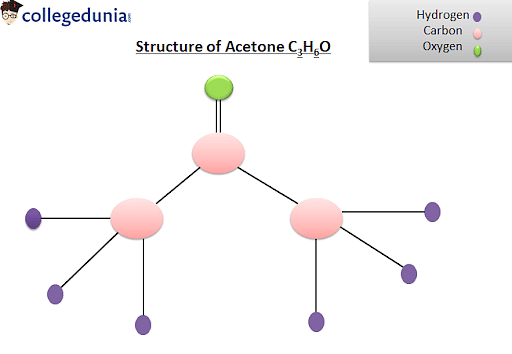
The chemical formula of acetone is CH3COCH3. It is the smallest and simplest ketone member with C3H6O as its condensed formula. Acetone is an organic chemical that contains hydrogen, oxygen and carbon atoms. One can obtain acetone by heating anhydrous calcium acetate in the laboratory.
Storing Acetone
Acetone can prove to be hazardous to life if not handled with care. It must be stored in a jar with a tight lid, away from stoves or heat producing sources as it is a highly flammable liquid. Store it in a fireproof container if the quantity of acetone being dealt with is large. Avoid plastic containers and do not store it near chlorine or bleach.
Also Check:
Things to Remember
- Acetone is a colorless liquid and highly flammable solvent.
- Acetone is the simplest and tiniest of the ketone family.
- Acetone is also known as propanone.
- The chemical formula of acetone is CH3COCH3.
- There are 5 main uses of acetone- in industries, laboratory, cosmetics, electronics and for domestic purposes.
- Acetone should be stored away from stoves and other heat sources.
Sample Questions
Ques: What is acetone's condensed structural formula? (2 marks)
Ans: The chemical formula of acetone is CH3COCH3. It is the smallest and simplest ketone member with C3H6O as its condensed formula. It contains hydrogen, oxygen and carbon atoms.
Ques: Where can we find acetone in our daily lives? (2 marks)
Ans: We can find acetone in respective places such as:
- Nail paint remover
- Cosmetics
- Furniture shops
- Household cleaners
- Medicals and Pharmaceuticals
Ques: Is acetone acidic, basic or a neutral solvent? (1 mark)
Ans: Acetone is a weak acid with a pKa of about 19 on scale. The lower the pKa of an acid, the stronger it is going to be.
Ques: Acetone is primarily used for (1 mark)
a) Liquid nail polish constituent
b) extraction of essential oils
c) A and b both
d) None
Ans: The correct answer is (c), it is used for extraction of essential oils and it is also a constituent of liquid nail polish.
Ques: What is the use of acetone? (4 marks)
Ans: Acetone is used as a chemical solvent which is used in the following five areas of interests in daily life:
- Used in industry - Medical and Pharmaceutical
- Used in cosmetics
- Used in laboratory
- Used in electronics
- Used for domestic purpose
Ques: Describe the physical and chemical properties of acetone. (5 marks)
Ans: Physical Properties: a characteristic of matter which is not associated with a change in its chemical composition.
The physical properties of acetone are:
- The appearance of acetone- colorless liquid
- Taste of acetone- sweet
- Odor of acetone- fruity, irritating
- Solubility of acetone- benzene, methanol, ethanol, diethyl ether, miscible with water, chloroform
Chemical properties: a characteristic of a particular substance that can be observed in a chemical reaction.
The chemical properties of acetone are:
- Molecular weight of acetone – 58.08 g/mol
- Acidity of acetone – 9.2 pKa
- Basicity of acetone – -5.2 for conjugate base
- Refractive Index of acetone – 1.35 nD
Ques: How many functional groups does acetone have? (2 marks)
Ans: Acetone comes under the classification of ketones that contain a carbonyl group bonded to two hydrocarbon groups. It also has a carbonyl group, wherein carbon and oxygen are bonded to each other.
Also check:



Comments