



Content Curator
Virus life cycle is studied to understand the mode of infection, prevention and remedial measures. Viruses are called obligate intracellular parasites because they cannot live without a specific living host cell. Viruses generally gain entry into the host cells and dominate over the host cellular machinery to produce a progeny of its own virus particles. The multiple stages that occur in the virus multiplication inside the host cells are collectively called the “virus life cycle.”
After entering the cell, and taking over the host genome, the virus sheds its proteinaceous capsid, transcribes DNA or RNA, translates its RNA to the virus proteins, replicates its genetic material, assembles the virus particle components and finally liberates from the host cell. Here, the stages involved in the virus life cycle are explained with emphasis on the life cycle.
| Table of Content |
Key Terms: virus, capsid, genome, replication, transcription, virus life cycle, DNA, RNA, adsorption, infections, gene expression
What is Virus?
[Click Here for Sample Questions]
Virus means “poisonous slimy liquid” in Latin. Viruses are ultramicroscopic, very small infection-causing agents that are capable of multiplying only in the protoplasm of living cells of bacteria, mycoplasma, fungi, plants, and animals. A virus is made of the nucleic acid of any one type - DNA or RNA genome, inner to a protein coat known as a capsid. Virus particles cannot live, survive or reproduce outside the cell, protoplasm, or body of the host. Viruses are notoriously known for being the causes of contagion.
All virus particles are made of genetic materials packed inside a protein coat called a capsid. The genetic material present in the virus particle might be single-stranded or double-stranded DNA or RNA. The genome may be linear or circular in shape. Generally, virus particles measure from 20 nanometers (nm) to 400 nm in size.
Reproduction in viruses generally occurs when they are inside the living host cells. They convert host cells into daughter virus-making factories.

Structure of Virus Particle
Read more:
| Related Articles | ||
|---|---|---|
| Infectious Diseases | Viral Diseases | Retrovirus |
| Nipah Symptoms | Dengue | Hepatitis |
Life Cycle of Viruses
[Click Here for Previous Year's Questions]
There are 5 stages in the life cycle of a virus particle as given below:
Attachment or Absorption
In the attachment phase, the attachment proteins present on the upper surface of the virus particle align with specific receptor proteins on the outer surface of the host cells. The virus binding cellular receptors commonly have glycolipids or glycoproteins. The interactions that occur between the specific attachment proteins and cellular receptors determine the pathogenic host range. If the host range is narrow, the virus particles can only infect a very small number of types of cells and vice versa.
Penetration or Entry
In the penetration phase, the virus particle or its genetic material pierces into the cell. Viruses with envelopes mostly enter through the process of fusion with the cell membrane. Sometimes virus particles enter the cells in bulk by a process of bulk transport called endocytosis. Some virus particles inject only their DNA into the cell. Here the capsid remains out of the host cell as a ghost.
Genome Replication and Gene Expression
As it has been discussed earlier, a virus genome is either double, single-stranded DNA or RNA, but never all together. In this phase, the virus genome is replicated, and transcripted and its genes are expressed in making virus proteins. The virus particles will later be assembled into new daughter virus particles. The genetic material required for this purpose is taken from the host cell only. The tools required for the processes of replication and transcription are also taken from the host cell.

Replication of Genetic Material
Assembly
Capsids are the outer coverings of virus particles that are made of proteins. The units of capsids are called capsomeres. Capsids protect the genome of a virus. In this phase, newly formed capsid proteins join together to form capsomers. Capsomeres interact with each other to form a complete capsid. Bacteriophage viruses (head-tail viruses), first assemble an empty capsid, from capsomeres and then take in a virus genome. But, the remaining virus particles form the capsid around the viral genome.
Release
This is the last phase in the life cycle of virus particles. Here, newly formed virus particles are released from the host cell. Different kinds of virus particles are liberated from the host cells in different methods. They are lysis and lysogenesis. Some viruses are liberated by exocytosis in bulk quantities. There are some other virus particles that bud off out of the host plasma membrane.
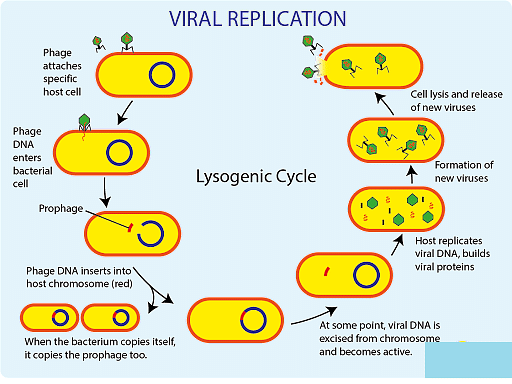
Lysogenic Cycle
Read more:
| Related Articles | ||
|---|---|---|
| Pathogens | Malaria | Filariasis |
| Ascariasis | Typhoid | Pneumonia |
| Common cold | Amoebiasis | Ringworm |
| Vaccines | HIV and AIDS | Plague |
Things to Remember
- Viruses are ultramicroscopic infection-causing agents.
- A virus is made of the nucleic acid of any one type - DNA or RNA genome, inner to a protein coat known as a capsid.
- All virus particles are made of genetic materials packed inside a protein coat called a capsid.
- The genetic material in the virus particle might be single-stranded or double-stranded DNA or RNA.
- Reproduction in viruses generally occurs when they are inside the living host cells.
- There are 5 stages in the life cycle of a virus particle 1) Attachment or Absorption 2) Penetration or Entry 3) Genome Replication and Gene Expression 4) Assembly 5) Release
- The virus binding cellular receptors commonly have glycolipids or glycoproteins.
- The virus genome is replicated, and transcripted and its genes are expressed in making virus proteins.
- Capsids are the outer coverings of virus particles that are made of proteins. The units of capsids are called capsomeres.
Previous Year Questions
Sample Questions
Ques. 1. Retroviruses do not have DNA. However, the DNA material of the infected host cell does possess the virus DNA. How is that possible? [ CBSE 2015] (2 Marks)
Ans. After infecting the host cell, the virus RNA undergoes a process of reverse transcription in the presence of an enzyme called reverse transcriptase as a result of which viral DNA is formed. This DNA then gets incorporated into the infected host DNA material.
Ques. 2. How are oncogenic viruses quite different from proto oncogenes? [CBSE 2016] (2 Marks)
Ans. Oncogenic viruses are cancer-causing viruses or external cancer-causing factors.
Proto-oncogenes are identified in normal cells which when activated (under certain conditions) could lead to the oncogenic transformation of cells or internal cancer-causing factors.
Ques. 3. It is commonly observed that children who suffer from chicken pox in their childhood may not contract the same kind of disease in their adulthood. Explain the reasons and the basis of such immunity in an individual. Name this kind of immunity in nature. (2 Marks)
Ans. After the first infection of chickenpox, a primary response is produced and antibodies are generated against the chickenpox virus particles, subsequently they encounter the same kind of virus particles. It elicits a highly intensified secondary response in the same body. It is due to the memory cells formed during the first infection. This kind of immunity is called active immunity.
Ques. 4. What are the interferons? Mention their role in immunity. (2 Marks)
Ans. Proteins that are secreted by virus-infected cells and which protect uninfected cells from further virus infection are interferons. Interferons are given to cancer patients to destroy tumor cells.
Ques. 5. How do the HIV particles break down the immune system of an AIDS patient? (3 Marks)
Ans. The virus enters macrophage cells. RNA genome in the cells replicates to form a virus DNA with the help of reverse transcriptase enzyme. Virus DNA gets incorporated into the host cells' DNA to produce daughter virus particles or progeny. HIV particles enter into helper ‘T’ lymphocytes and produce many progeny virus particles. Progeny virus particles are released into the blood and attack other helper ‘T’ lymphocytes. This leads to a progressive decrease in the number of helper ‘T’ lymphocytes and the person suffers from infections (due to loss of immunity).
Ques. 6. How does the assembly of virus particles occur in host cells? (3 Marks)
Ans. In virus particles, capsids are the outer coverings of virus particles that are made of proteins. The units of capsids are called capsomeres. Capsids protect the genome of a virus. In this phase, newly formed capsid proteins join together to form capsomers. Capsomeres interact with each other to form a complete capsid. Bacteriophage viruses (head-tail viruses), first assemble an empty capsid, from capsomeres and then take in a virus genome. But, the remaining virus particles form the capsid around the viral genome.
Ques. 7. Name the human cells that act as HIV factories in humans when infected by HIV particles. Explain a chain of events that occur in the infected cell. (3 Marks)
Ans. Macrophages or Helper T-cells act as HIV factories. The virus particle enters macrophages or helper T-cells where the RNA genome of the virus particle replicates to form virus DNA with the help of the enzyme called reverse transcriptase. The virus DNA then gets incorporated into the host cell’s DNA and orders infected cells to produce virus particles. The macrophages continue to produce daughter virus particles. At the same time, the virus particles enter the helper T-cells where it replicates and forms progeny viruses.
Ques. 8. How are virus particles released from infected host cells? (2 Marks)
Ans. This is the last phase in the 5-phase life cycle of virus particles. Here, newly formed virus particles are released from the host cell. Different kinds of virus particles are liberated from the host cells in different methods. They are lysis and lysogenesis. Some viruses are liberated by exocytosis in bulk quantities. There are some other virus particles that bud off out of the host the plasma membrane.
Ques. 9. Name how HIV (Human Immunodeficiency Virus) particles gain entry into the other cells after infecting the human body. Explain the events that occur in these adjacent cells. (5 Marks)
Ans. HIV (Human immunodeficiency virus) particles enter into macrophages after getting entry into the human body. HIV multiplies first in macrophages and then later in helper T cells or lymphocytes.
Events occurring in the human host after the entry of HIV :
(i) After entering the human body cells, the HIV virus particles attack and enter the macrophages in the human body.
(ii) Inside the macrophage cells, the RNA molecule of the virus replicates with the help of an enzyme called reverse transcriptase and gives rise to virus DNA.
(iii) The virus DNA incorporates into the host cell DNA. It uses raw materials in the protoplasm in the infected cell machinery and directs to synthesize virus particles.
(iv) At the same time, HIV can enter the helper T-lymphocytes, and replicate to produce virus progenies.
(v) As a consequence, T-lymphocytes start decreasing in number and the immune response of the person becomes weaker and weaker.
Ques. 10. Name the special cells HIV attacks first when it gains entry into a human body. (2 Marks)
Ans. The special cells HIV attacks first when it gains entry into a human body are called macrophages. Later the human body becomes immunodeficient.
Also Check:



Comments