



Education Content Expert
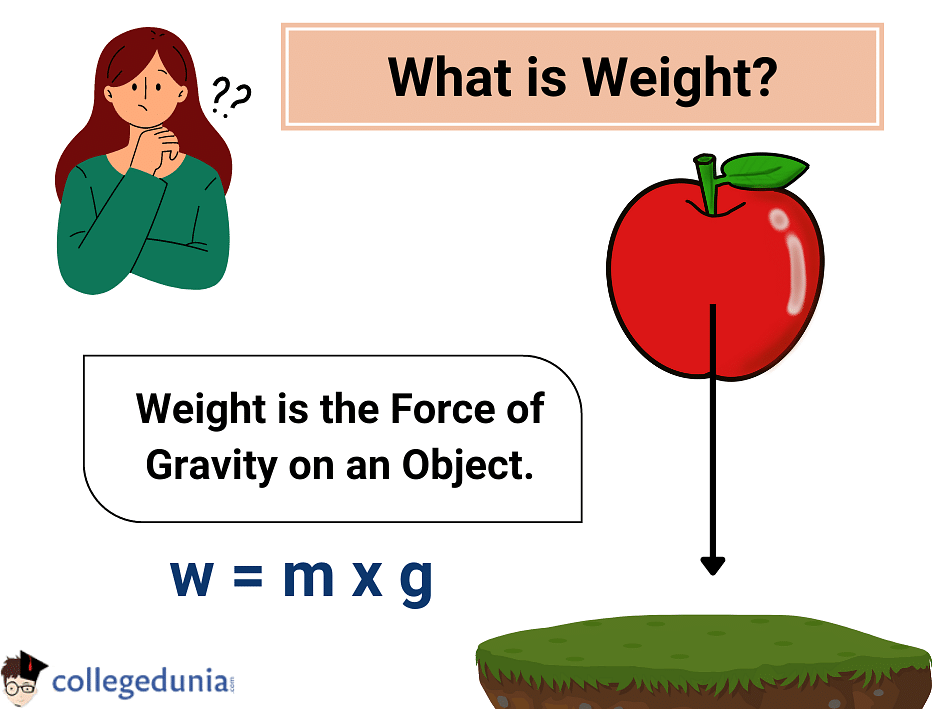
Weight is the measure of the force of gravity acting on an object or a body. It is a force that acts at all times on all objects near Earth.
- The SI unit of weight is Newton (N).
- Generally, weight is used to determine the heaviness of an object and is measured in kilograms (kg).
- It is a vector quantity as it has direction as well as magnitude.
Weight is equal to the product of mass and gravitational force applied. Thus, Weight Formula is given as
| w = mg |
Here, m refers to the mass of an object and g refers to the acceleration due to gravity.
Read More: NCERT Solutions For Class 11 Physics Units and Measurements
Key Terms: Weight, Gravity, Force, Mass, Gravitational Force, Acceleration due to Gravity, Vector, Newton, Weight Formula
What is Weight?
[Click Here for Sample Questions]
Weight of an object is defined as the force of gravity acting on it. In layman’s terms, the weight gives a measure of the heaviness of an object.
- Weight is the product of the mass of the object, and the acceleration due to gravity.
- It fluctuates depending on the measure of gravitational force.
- It can be zero in case of no gravitational force.
- Newton (N) is the SI unit for weight.
- Weight is also measured in kilograms (kg) when used to determine the heaviness of an object.
Read More:
Weight Formula
[Click Here for Previous Years' Questions]
Weight of an object is the product of mass and acceleration due to gravity. Weight Formula is expressed as
| W = mg |
Where
- W: Weight of the object in Newton (N).
- m: Mass of the object in kg
- g: Acceleration due to Gravity. (The value of g on earth is 9.8 m/s2.)
Solved ExampleExample: Calculate the weight of an object on earth whose mass is 25 kg. Solution: Given that
Using the Weight Formula, W = mg W = 25×9.8 = 245 N Thus, the weight of the object is 245 N. |
What is Mass?
[Click Here for Sample Questions]
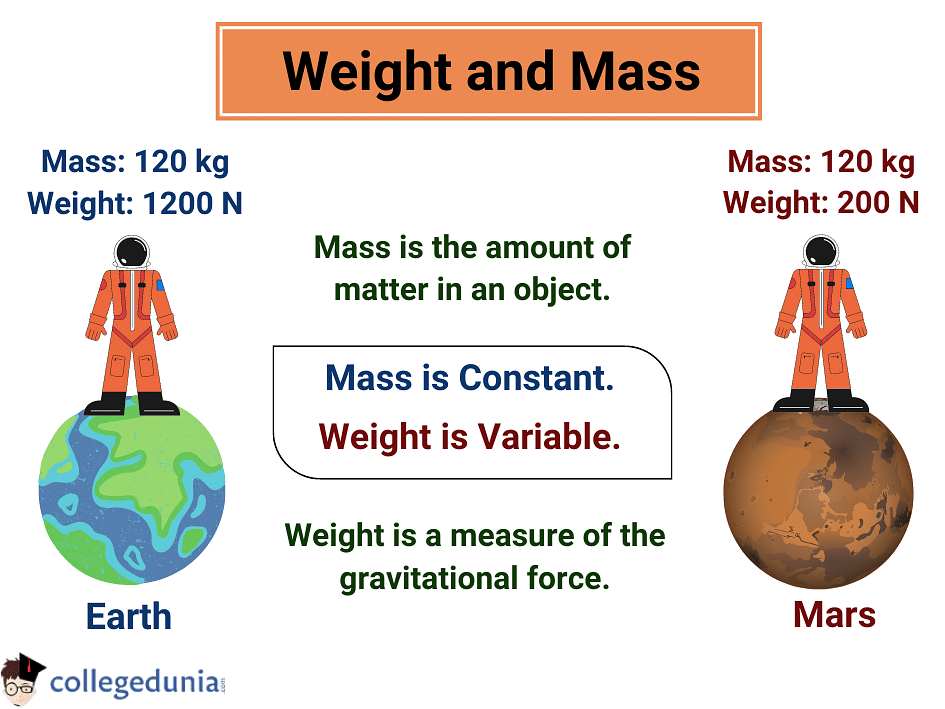
Mass of an object is defined as the number of particles present inside the object. It is the amount of matter in an object.
- The SI unit of Mass is kilograms (kg).
- It can never be zero.
- It is a scalar quantity with only magnitude and no direction.
- The mass of an object rarely changes over time.
- If a large amount of energy is taken out or given to the body, the mass of the body may change.
- For instance, in the case of a nuclear reaction, a large amount of energy is converted from a small amount of energy, resulting in a reduction in the mass of the substance.
Read More: Units and Measurements Class 11 Important Questions
Difference between Weight and Mass
[Click Here for Previous Years' Questions]
Mass and Weight are two terms that are often used interchangeably, however, both of them are two different physical quantities in Physics. The difference between Mass and Weight is listed as follows:
| Parameter | Mass | Weight |
|---|---|---|
| Definition | Mass is defined as the measure of the amount of matter in a body. | Weight is defined as the measure of the amount of force acting on an object due to gravity. |
| Symbol | It is denoted by the symbol “M”. | It is denoted by the symbol “W”. |
| SI Unit | The SI unit of mass is Kilogram (Kg). | The SI unit of weight is Newton (N). |
| Formula | Mass = Volume × Density | Weight = Mass × Acceleration due to Gravity |
| Quantity | Mass is a scalar quantity as it has only magnitude. | Weight is a vector quantity as it has both magnitude and direction. |
| Gravitational Effect | Mass is constant and can never be zero. | Weight varies from place to place and can be zero where there is no gravity. |
Solved Examples on Weight Formula
[Click Here for Sample Questions]
Here are a few solved examples on Weight Formula for better concept clarity:
Example 1: The mass of a body is 50 kg. Using the weight formula, compute the weight of the body. (Hint: g = 9.8 m/s2).
Solution: To determine the body's weight, we are given that
- Mass of the Body (m) = 50 kg
- g = 9.8 m/s2
Using the Weight Formula,
W = mg
W = 50 × 9.8
W = 490 N
Thus, the weight of the body is 490 N.
Example 2: How much mass does a person have if he weighs 200 N on the moon? Consider the moon's gravity to be 1.6 m/s2.
Solution: It is given that
- Weight of the person on the Moon = 200 N
- g = 1.62 m/s2
Using the Weight Formula,
w = mg
m = w/g
m = 200 N / 1.6 m/s2
M = 125 kg
Thus, the mass of the person is 125 kg.
Check More:
Things to Remember
- Weight of a body is the measure of the force of gravity acting on it.
- It is represented by the symbol ‘W’.
- Weight can be defined mathematically as the product of mass and gravitational acceleration.
- Weight Formula is given as W = mg, where m is the mass and g is the acceleration due to gravity.
- The SI unit of weight is the same as that of force, which is Newton (N).
- Mass is a unit of measurement for the amount of matter in a body.
- Kilogram (kg) is the SI unit of mass.
- Mass is a scalar quantity and doesn’t change with its position.
Previous Years’ Questions
- The weight of an object at the earth's surface is… (Rajasthan PMT 2005)
- If G is the universal gravitational constant and… (COMEDK UGET 2000)
- A weight w is suspended from the midpoint of a rope… (Haryana PMT 2006)
- Weight of a body… (COMEDK UGET 2010)
- Two students X and Y report the weight of the same…
- The apparent weight of a person inside a lift is… (Punjab PMET 2008)
- A load of 1kg weight is attached to one end of a steel wire of area… (BITSAT 2008)
- A body of weight 72 N moves from the surface of the earth… (NEET 2000)
- Gravitational mass is proportional to gravitational… (AIIMS 1998)
- The average weight of 25 boys was calculated to be…
- A body has a weight of 90 kg on the earth's surface, the mass… (COMEDK UGET 2004)
- Weight of a body of mass m decreases by 1 when it is raised… (KCET 2003)
Sample Questions
Ques. Determine the weight of a person if the mass is 65 kg, and gravity on earth is 9.8 m/s2. (3 Marks)
Ans. Given that
- Mass = 65 kg
- g = 9.8 m/s2
Using the Weight Formula,
W = mg
W = 65 kg x 9.8 m/s2
W = 637 N
Thus, the weight of the person is 637 N.
Ques. Find the mass of a body on the moon if its weight is 500N. On the moon, the value of g is 1.62 m/s2. (3 Marks)
Ans. Given that
- Weight of body on the Moon = 500 N
- g = 1.62 m/s2
Using the Weight Formula,
W = mg
Mass of the body (m) = W/g
m = 500/1.62
m = 308.64 kg
Thus, the mass of the body on the moon is 308.64 kg.
Ques. The mass of a body is 50 kg, and the weight is 490 N. Prove that g = 9.8 m/s2 using the weight formula. (3 Marks)
Ans. We need to prove that g = 9.8 m/s2
- Weight of the Body = 490 N
- Mass = 50 kg
Using the Weight Formula,
W = mg
g = W/m
g = 490/50
g = 9.8
Hence Proved.
Thus, it is proved that g is 9.8 m/s2.
Ques. A person's mass is 70 kg, and the gravity on Earth is 9.8 m/s2. What is the person's weight? (3 Marks)
Ans. According to the question,
- m = 70 kg
- g = 9.8 m/s2
Using the Weight Formula,
W = mg
W = 70 × 9.8
W = 637 N
Thus, The weight of the person is 637 N.
Ques. On the moon, a person weighs 250 N. Calculate the individual's mass assuming gravity on the mass is 1.6 m/s2. (3 Marks)
Ans. Given that
- Weight of the person on the Moon = 250 N
- g = 1.62 m/s2
Using the Weight Formula
W = mg
m = w/g
m = 250N / 1.6m/s2
m = 156.25 kg
Thus, the mass of the individual is 156.25 kg.
Ques. The mass of an object was measured as 110 grams. What is the weight of the object in Newtons? (3 Marks)
Ans. First, we will convert the mass given in grams to kg.
1 kg = 1000 g
110/1000 = 0.110 kg
Next, we will convert kg to N using the weight formula, w = mg
0.110 x 9.8 = 1.078 N
Thus, the weight of the object is 1.078 N.
Ques. What will be the weight of an object on the moon, if its weight is 90N on earth? (3 Marks)
Ans. The weight of an object on earth is 90 N.
Weight of object on moon =?
We know that the gravitational force on the moon is equal to one-sixth of the earth’s gravitational force.
Therefore, the Weight of a body on the Moon = Weight on Earth / 6
= 90/6
= 15 N
Thus, the weight of the object on the Moon is 15 N.
Ques. Compute the weight of a body on the moon if the mass is 60 Kg and g is given as 1.625 m/s2. (3 Marks)
Ans. It is given that,
- m = 60 kg
- g = 1.625 m/s2
Using the Weight Formula,
W = mg
W = 60 × 1.625
W = 97.5 N
Thus, the weight of the body on the moon is 97.5 N.
Ques. What is 'g' in Weight Formula? (1 Mark)
Ans. Weight Formula is given as W = mg. g in the weight formula refers to the acceleration due to gravity. The value of g on earth is given as 9.8 m/s2. It is also referred to as the gravitational constant.
Ques. What is Weightlessness? (3 Marks)
Ans. Weightlessness is a condition experienced in free fall where the effect of gravity gets canceled by the inertial force arising from orbital flight or other gravity-negating situations. It is experienced when there are no more effects of gravity.
For instance, it is experienced by the astronauts in the international space station where everything in the space station including them is falling indefinitely toward the earth. The weightlessness makes them freely float in the space station.
Check-Out:



Comments