



Content Writer
Aldol condensation reactions are one of the most important reactions of organic chemistry as they provide a good way to form carbon-carbon bonds. In these reactions, an enol or an enolate ion reacts with a carbonyl compound to form a β-hydroxy aldehyde or a β-hydroxy ketone and undergoes dehydration to give a conjugated enone. Let’s discuss more about the Aldol Condensation, its mechanism, and cross aldol condensation.
| Table of Content |
Keyterms: Organic chemistry, Carbon, Ketone, Dehydration, Ion, Aldehyde, Hydrogen, Ketol
Aldol Condensation
[Click Here for Sample Questions]
Aldol Condensation is an organic reaction in which an enolate ion reacts with a carbonyl compound to form a β-hydroxy ketone or β-hydroxy aldehyde. In Organic Chemistry, Aldol Condensation reactions are considered the most important group of reactions.
To explain in brief, the Ketones & Aldehydes, consisting of at least one α-Hydrogen undergoes a reaction in the presence of a catalyst (dilute alkali) to form β- hydroxy ketones (ketol) or β-hydroxy aldehydes (aldol). This reaction is known as Aldol Condensation.
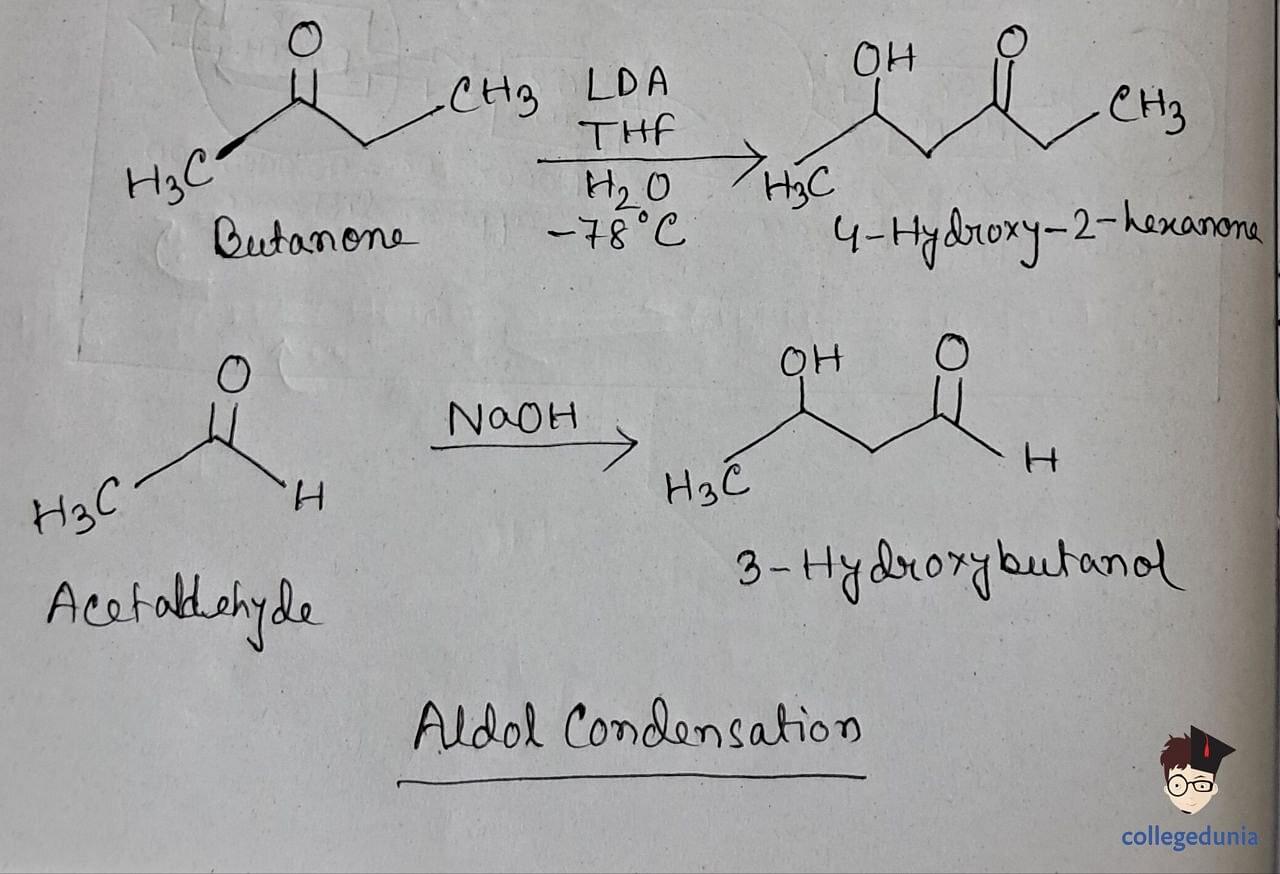
Aldol Condensation
The name Aldol is derived from aldehyde and alcohol, the two functional groups which are present in the products. The ketone reactions are also called aldol reactions due to their similarity with the aldehydes.
The Aldol Condensation reaction was discovered by Alexander Porfir’evich Borodin in 1872. He was the one who first observed the idol formation (3-hydroxybutanal) from acetaldehyde in the presence of few catalysts like zinc chloride or hydrochloric acid.
Also Read:
| Related Articles | ||
|---|---|---|
| Acid Anhydrides | Butyric Acid | Diethyl Ether |
| Dimethyl Sulfoxide | Gattermann Reaction | Malonic Acid |
Aldol Condensation Reaction
[Click Here for Previous Year Questions]
- Aldol reaction ( Aldehyde + Alcohol): The aldehyde (or ketone) enolate react with another molecule of aldehyde or ketone to form β-hydroxy aldehyde (or Ketone) in the presence of Sodium Hydroxide (NaOH) or Potassium hydroxide (KOH).

Aldol reaction
- Elimination or Dehydration Reaction: This reaction results in the formation of an α,β-unsaturated aldehyde or an α,β-unsaturated ketone as it includes a molecule of water from β-hydroxy aldehyde (or Ketone).

Elimination or Dehydration Reaction
Mechanism of Aldol Condensation
[Click Here for Sample Questions]
Aldol condensation works in the following mechanism:
Step.1: The hydroxide ion reversibly deprotonates the aldehyde

Mechanism of Aldol Condensation
Step.2: In this step, the enolate ion 1 adds up to the unreacted aldehyde

Mechanism of Aldol Condensation
Step.3: In the 3rd step, water protonate the alkoxide ion 2

Mechanism of Aldol Condensation
Step.4: Now, the aldol 3 becomes an enolizable aldehyde. Here, a very small amount of aldol 3 is converted to the corresponding enolate ion (4) with the help of a hydroxide ion.

Mechanism of Aldol Condensation
Step.5: In this step, the enolate ion (4) loses a hydroxide ion.

Mechanism of Aldol Condensation
Step 1 and Step 3 briefly explain the Aldol Reaction.
Cross Aldol Condensation
[Click Here for Previous Year Questions]
Cross Aldol Condensation can be elaborated as aldol condensation taking place between two different aldehydes or ketones.
In simple words, when condensation is between two different carbonyl compounds, it is called cross aldol condensation. If both contain the atoms of α-hydrogen, then it will give out a mixture of four products. It is because both can form carbanions and can also act as carbanion acceptors.
If one of the aldehydes does not have alpha hydrogen, it can only act as a carbanion acceptor. In this case, only two products are formed. The common substrate for the cross aldol is aromatic aldehyde without α position. In addition, the dehydration of the initial condensation product is very fast, leading to the formation of α and β unsaturated ketones and preventing the occurrence of the retro aldol reaction.
Let us take up an example of an aldol reaction of ethanol & propanol:

Cross Aldol Condensation
Types of Condensation Reaction
[Click Here for Sample Questions]
Aldol condensation differs from various other reactions of the carbonyl compounds:
- Henry reaction contains an aldehyde and an aliphatic nitro compound
- Two ester compounds are present in Claisen Condensation
- Water gets removed by the nucleophilic displacement in Japp- Maitland Condensation
- Aromatic enolate is formed by the anhydride in Perkin’s reaction.
- Two ester groups are present in the same molecule which is responsible for producing cyclic molecules in Dieckmann Condensation.
Things to Remember
- The process in which the aldehydes and the ketones, with at least one alpha-hydrogen, in the presence of a catalyst (dilute alkali) reacts & forms β-hydroxy aldehydes (aldol) or β-hydroxy ketones (ketol) is called Aldol Condensation.
- Aldol condensation has an important variation called Crossed Aldol Condensation.
- In Cross Aldol Reaction, two dissimilar compounds which contain alpha hydrogen together undergoes the process of condensation reaction due to which up to four different types of products are formed
- In an Aldol Reaction, the aldehyde is attacked by the nucleophilic enolate ion at the electrophilic carbonyl carbon. Hence, it is a nucleophilic addition reaction & it gives alkoxide as an intermediate.
Also Read:
Sample Questions
Ques.1: Formaldehyde does not take part in Aldol condensation. Why ? (1 Mark)
Ans: Formaldehyde takes part in aldol condensation reaction because there is no α-hydrogen atoms.
Ques.2: What type of aldehydes undergo Aldol condensation? ( 1 Mark)
Ans: Aldehyde which contains hydrogen atoms undergo Aldol condensation.
Ques.3 : (a) Describe :
(i) Aldol condensation (ii) Cannizzaro reaction
(b) Describe a chemical test to distinguish between
(i) Ethanal and Propanal (ii) Benzaldehyde and Acetophenone
(iii) Pentan-2-one and Pentan-3-one ( 5 Marks)
Ans: (a) (i) Aldol condensation: Two molecules of aldehydes or ketones condense in the presence of a dil-alkali to form a β-hydroxy aldehyde or β-hydroxyketone respectively.

Aldol condensation
(ii) Cannizzaro’s reaction: Aldehydes not having one-hydrogen atom undergo self oxidation and reduction on treatment with conc. alkali and gives alcohol and carboxylic acid salt.

Cannizzaro’s reaction
(b) (i) Ethanal and Propanal: Ethanal and propanal can be distinguished by the iodoform test. Warm each compound with iodine and sodium hydroxide solution in water. Ethanal gives yellow crystal of iodoform while propanal does not respond to iodoform test.

Ethanal and Propanal
(ii) Tollen’s Test: Benzaldehyde and acetophenone can be distinguished by the Tollen’s test. Benzaldehyde reduces Tollen’s reagent to give a red-brown precipitate of C6H5COO, but acetophenone being a ketone does not undergo Tollen’s Test.

Tollen’s Test
(iii) Pentan-2-one and Pentan-3-one

Pentan-2-one and Pentan-3-one
Add I2 and NaOH in both the solutions. Pentan-2-one gives yellow coloured precipitate, but pentan- 3-one does not give any reaction.
Ques.4: Write structural formulas and names of four possible aldol condensation products from propanal and butanal. In each case, indicate which aldehyde acts as a nucleophile and which as an electrophile. ( 5 Marks)
Ans. (i) Take two molecules of propanal, one will act as a nucleophile and the other will act as an electrophile.

(ii) Take two molecules of butanal, one will act as a nucleophile and the other will act as an electrophile.

(iii) Take one molecule each of propanal and butanal in which propanal will act as a nucleophile and butanal will act as an electrophile.

(iv) Take one molecule each of propanal and butanal in which propanal will act as an electrophile and butanal will act as a nucleophile.

Ques.5: Which of the given product is formed due to Aldol Condensation? (1 Mark)
a) An α-hydroxy aldehyde or ketone
b) An α, β unsaturated ester
c) A β- hydroxy aldehyde or ketone
d) A β- hydroxy acid
Ans: c) A β- hydroxy aldehyde or ketone
Explanation: During the aldol condensation process in between the two molecules of ketone or aldehyde with at least one hydrogen atom in presence of a catalyst to form a β- hydroxy aldehyde or ketone.
Ques.6: Which of the following will not show Aldol Condensation?
a) Chloral
b) Hexanal
c) Ethanol
d) Phenyl acetaldehyde (1 Mark)
Ans: a) Chloral (CCl3CHO).
Explanation: This compound does not contain any hydrogen atom to undergo aldol condensation.
Ques.7: What do we call the reaction between acetophenone and benzaldehyde in presence of a catalyst NaOH (dilute)?
a) Cross Aldol condensation
b) Cross Cannizzaro’s reaction
c) Cannizzaro’s condensation
d) Aldol condensation (1 Mark)
Ans: The reaction will be called (a) cross aldol condensation. The following reaction will be:

The compound which will be formed is Benzyl Acetophenone.
Ques.8: What are the applications of Aldol Condensation? (2 Marks)
Ans: The Aldol Condensation can be used in the following:
- The reaction is used for production of solvents like diacetone and isophorone
- Used as an intermediate in manufacturing perfume
- Used to produce plasticizers
- Used in manufacturing pharmaceuticals, unsaturated ketones and also chalcones.
Ques.9: Define cross aldol condensation? (2 Marks)
Ans: Aldol condensation taking place between two different aldehydes or ketones. If both contain the atoms of α-hydrogen, then it will give out a mixture of four products. This process is known as Cross aldol condensation.
For Latest Updates on Upcoming Board Exams, Click Here: https://t.me/class_10_12_board_updates
Do Check Out:



Comments