




CBSE Class 12 Mathematics Set 1- (65/5/1) Question Paper 2026 is available for download here. CBSE conducted Class 12 Mathematics exam on March 9, 2026 from 10:30 AM to 1:30 PM. The Mathematics theory paper is of 80 marks, and the internal assessment is of 20 marks.
Also Check: CBSE Class 12 Question Paper 2026 (All Subjects)
Mathematics question paper includes the following types of questions:
- MCQs: 1 mark each
- Short-answer type questions: 2 & 3 marks each
- Long-answer type questions: 5 marks each
- Case study-based questions: 4 marks each
- Total: 80 marks
CBSE Class 12 Mathematics Set 1- (65/5/1) Question Paper 2026 with Solution PDF
| CBSE Official PDF | CD PDF | CD PDF with Solutions |
|---|---|---|
| Download official PDF 0.73 MB | Download Collegedunia PDF 0.40 MB | Download solutions PDF 0.47 MB |
CBSE Class 12 Mathematics 2026 Set 1 (65/5/1) Questions with Solutions
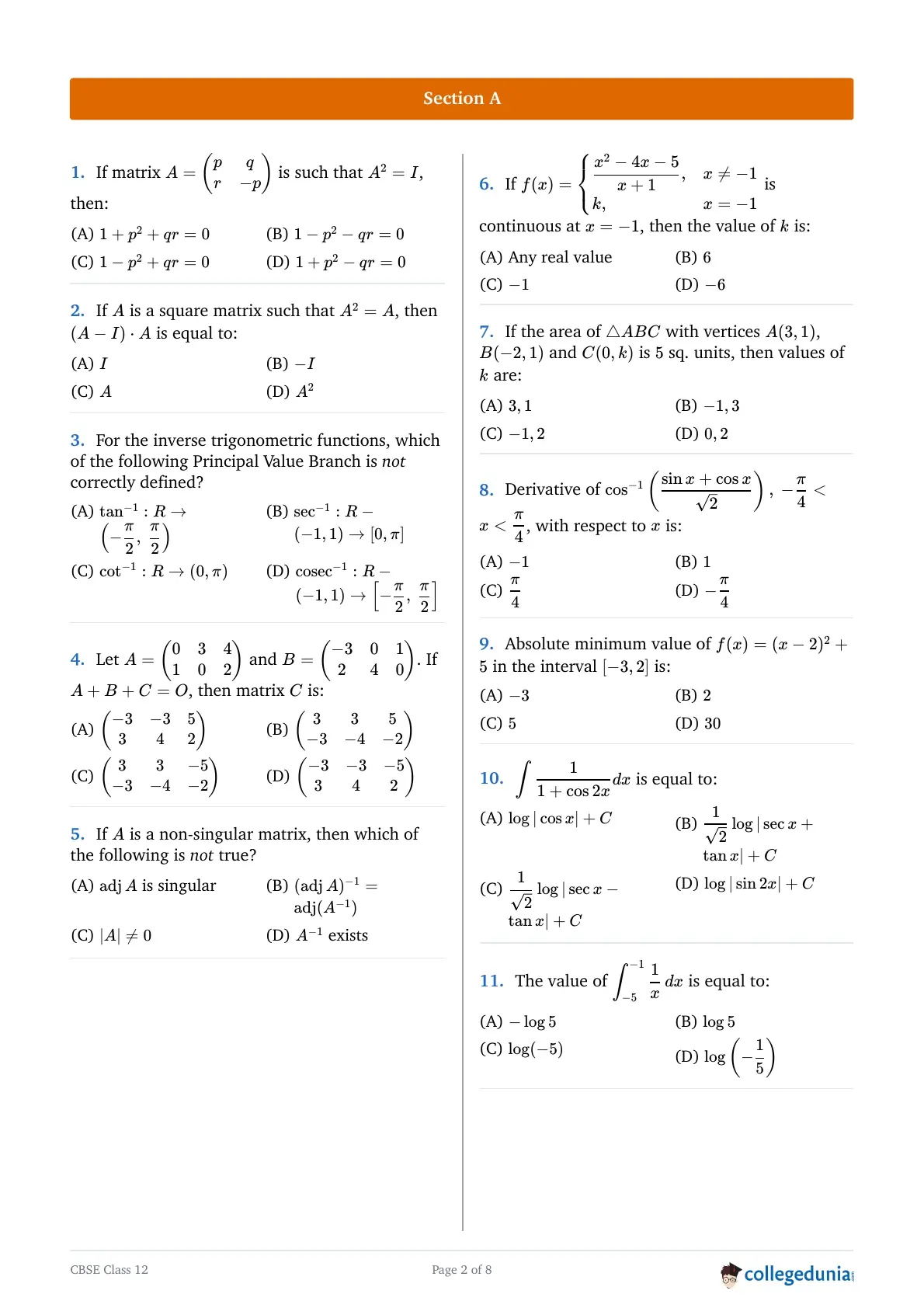
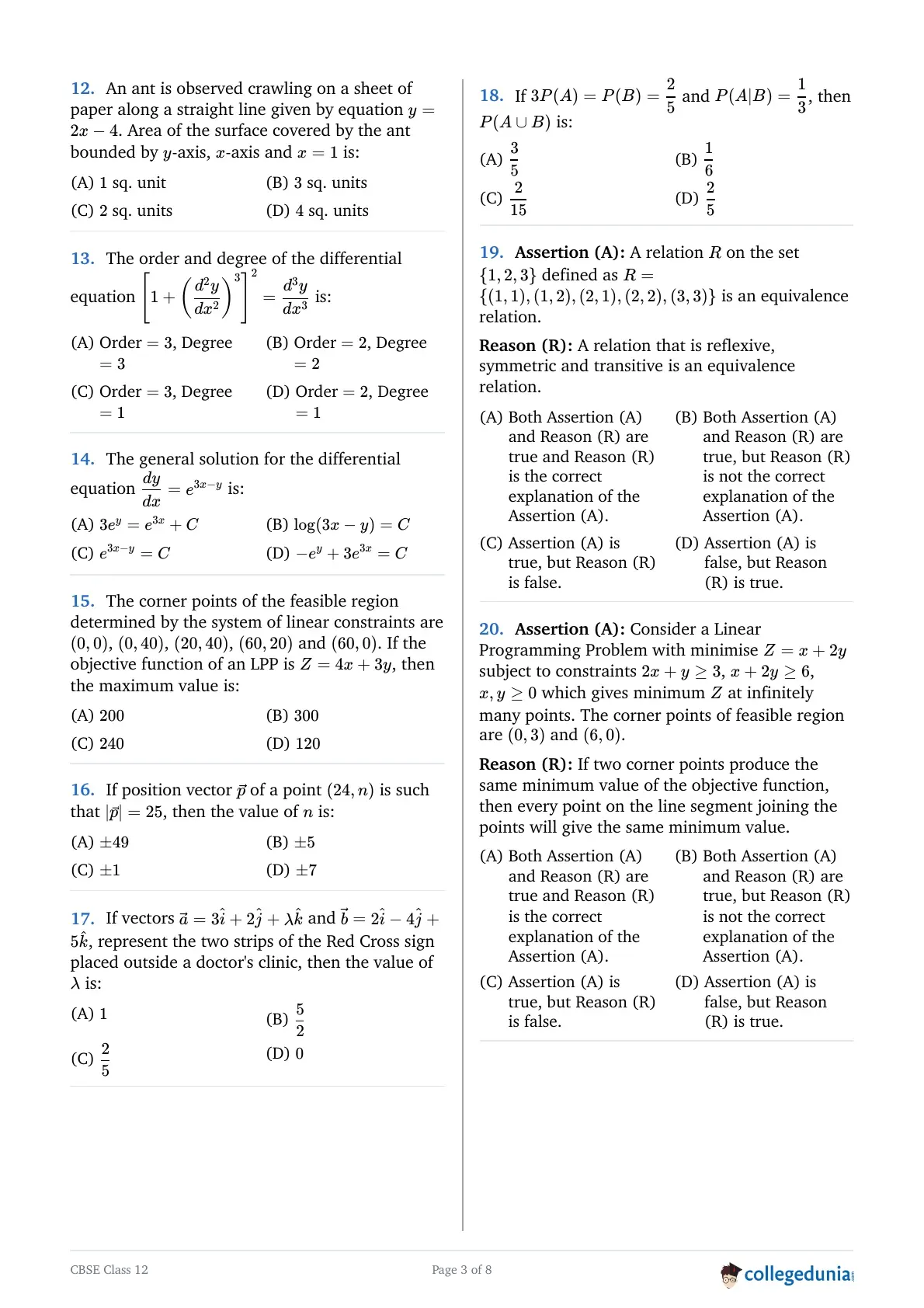
If matrix \( A = \begin{bmatrix} -p & q \\ r & p \end{bmatrix} \) is such that \( A^2 = I \), then :
If \( A \) is a square matrix such that \( A^2 = A \), then \( (A - I)^3 - A \) is equal to :
For the inverse trigonometric functions, which of the following Principal Value Branch is not correctly defined ?
Let \( A = \begin{bmatrix} 0 & -3 & 4 \\ 1 & 0 & 2 \end{bmatrix} \) and \( B = \begin{bmatrix} -3 & 0 & 1 \\ 2 & 4 & 0 \end{bmatrix} \). If \( A + B + C = O \), then matrix \( C \) is :
If \( A \) is a non-singular matrix, then which of the following is not true ?
If \[ f(x)= \begin{cases} \dfrac{x^2-4x-5}{x+1}, & x\neq -1 \\ k, & x=-1 \end{cases} \] is continuous at \(x=-1\), then the value of \(k\) is:
If the area of \( \triangle ABC \) with vertices \( A(3, 1) \), \( B(-2, 1) \) and \( C(0, k) \) is 5 sq. units, then values of \( k \) are :
Derivative of \( \cos^{-1} \left( \frac{\sin x + \cos x}{\sqrt{2}} \right) \), \( -\frac{\pi}{4} < x < \frac{\pi}{4} \) with respect to \( x \) is :
Absolute minimum value of \( f(x) = (x - 2)^2 + 5 \) in the interval \( [-3, 2] \) is :
\( \int \frac{1}{\sqrt{1 + \cos 2x}} \, dx \) is equal to :
An ant is observed crawling on a sheet of paper along a straight line given by equation \( y = 2x - 4 \). Area of the surface covered by the ant bounded by y-axis, x-axis and \( x = 1 \) is :
The order and degree of the differential equation \[ 1+\left(\frac{d^3y}{dx^3}\right)^3 = \lambda \frac{d^2y}{dx^2} \] is:
The general solution for the differential equation \( \frac{dy}{dx} = e^{3x-y} \) is :
The corner points of the feasible region determined by the system of linear constraints are \( (0, 0) \), \( (0, 40) \), \( (20, 40) \), \( (60, 20) \) and \( (60, 0) \). If the objective function of an LPP is \( Z = 4x + 3y \), then the maximum value is :
If position vector \( \vec{p} \) of a point \( (24, n) \) is such that \( |\vec{p}| = 25 \), then the value of \( n \) is :
If vectors \( \vec{a} = 3\hat{i} + 2\hat{j} + \lambda\hat{k} \) and \( \vec{b} = 2\hat{i} - 4\hat{j} + 5\hat{k} \), represent the two strips of the Red Cross sign placed outside a doctor's clinic, then the value of \( \lambda \) is :
If \[ 3P(A)=P(B)=\frac{3}{5} \] and \[ P(A|B)=\frac{2}{3}, \] then \(P(A\cup B)\) is:
Assertion (A): A relation \(R\) on the set \(\{1,2,3\}\) defined as \[ R=\{(1,1),(1,2),(2,1),(2,2),(3,3)\} \] is an equivalence relation.
Reason (R): A relation that is reflexive, symmetric and transitive is an equivalence relation.
Assertion (A) : Consider a Linear Programming Problem with minimise \( Z = x + 2y \) subject to constraints \( 2x + y \geq 3, x + 2y \geq 6, x, y \geq 0 \) which gives minimum \( Z \) at infinitely many points. The corner points of feasible region are \( (0, 3) \) and \( (6, 0) \).
Reason (R) : If two corner points produce the same minimum value of the objective function, then every point on the line segment joining the points will give the same minimum value.
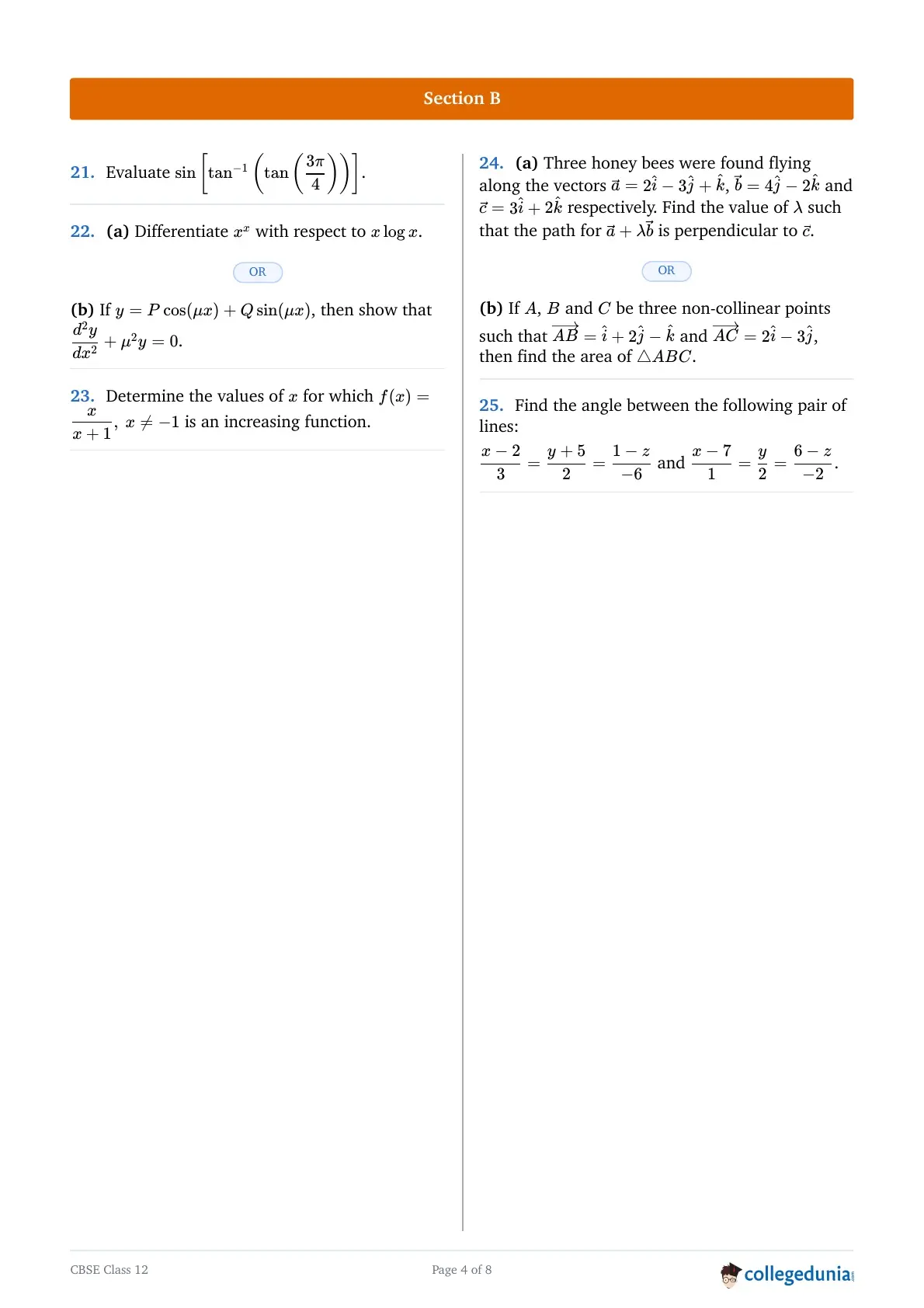
Evaluate \(\sin \left[\tan^{-1} \tan\left(\frac{3\pi}{4}\right)\right]\).
Differentiate \( x^x \) with respect to \( x \log x \).
If \( y = P \cos ux + Q \sin ux \), show that \( \frac{d^2y}{dx^2} + u^2y = 0 \).
Determine the values of \(x\) for which \[ f(x)=\frac{x-3}{x+1}, \quad x\neq -1 \] is an increasing function.
Three honey bees were found flying along the vectors \( \vec{a} = 2\hat{i} - 3\hat{j} + \hat{k} \), \( \vec{b} = 4\hat{j} - 2\hat{k} \) and \( \vec{c} = 3\hat{i} + 2\hat{k} \) respectively. Find the value of \( \lambda \) such that the path for \( \vec{a} + \lambda \vec{b} \) is perpendicular to \( \vec{c} \).
If \( A, B \) and \( C \) be three non-collinear points such that \( \vec{AB} = \hat{i} + 2\hat{j} - \hat{k} \) and \( \vec{AC} = 2\hat{i} - 3\hat{j} \), then find the area of \( \triangle ABC \).
Find the angle between the following pair of lines : \( \frac{x-2}{3} = \frac{y+5}{2} = \frac{1-z}{-6} \) and \( \frac{x-7}{1} = \frac{y}{2} = \frac{6-z}{-2} \).
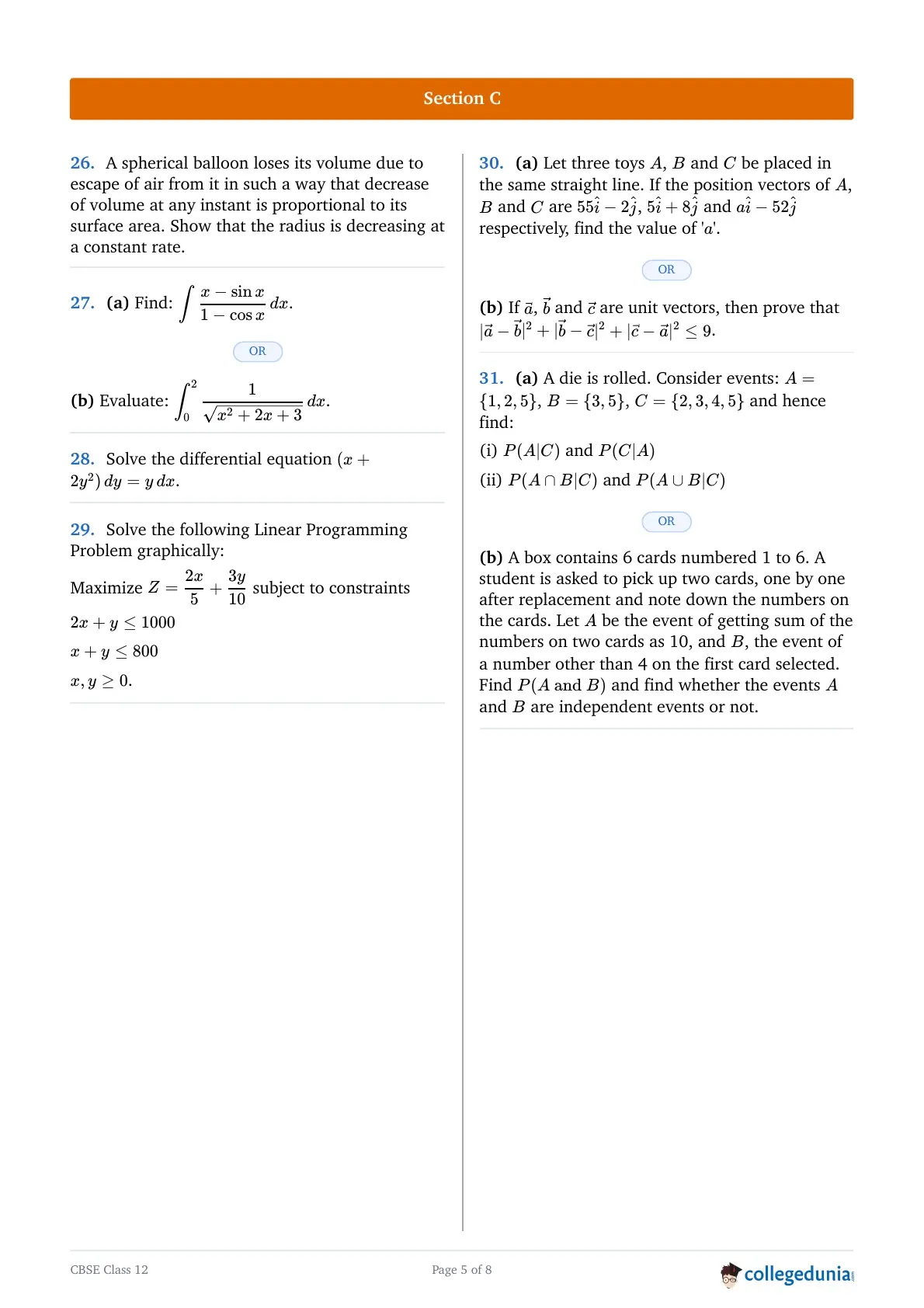
A spherical balloon loses its volume due to escape of air from it in such a way that decrease of volume at any instant is proportional to its surface area. Show that the radius is decreasing at a constant rate.
Find : \( \int \frac{x - \sin x}{1 - \cos x} \, dx \).
Evaluate : \( \int_0^2 \frac{1}{\sqrt{x^2 + 2x + 3}} \, dx \).
Solve the differential equation \[ (x+2y^3)\frac{dy}{dx}=y. \]
Solve the following Linear Programming Problem graphically :
Maximize \( Z = \frac{2x}{5} + \frac{3y}{10} \)
subject to constraints
\( 2x + y \leq 1000 \)
\( x + y \leq 800 \)
\( x, y \geq 0 \).
Let three toys A, B and C be placed in the same straight line. If the position vectors of A, B and C are \( 55\hat{i} - 2\hat{j} \), \( 5\hat{i} + 8\hat{j} \) and \( a\hat{i} - 52\hat{j} \) respectively, find the value of ‘a’.
If \( \vec{a} \), \( \vec{b} \) and \( \vec{c} \) are unit vectors, then prove that \( |\vec{a} - \vec{b}|^2 + |\vec{b} - \vec{c}|^2 + |\vec{c} - \vec{a}|^2 \leq 9 \).
A die is rolled. Consider events : \( A = \{1, 2, 5\}, B = \{3, 5\}, C = \{2, 3, 4, 5\} \) and hence find : (i) \( P(A|C) \) and \( P(C|A) \) (ii) \( P(A \cap B | C) \) and \( P(A \cup B | C) \)
A box contains 6 cards numbered 1 to 6. A student is asked to pick up two cards, one by one after replacement and note down the numbers on the cards. Let A be the event of getting sum of the numbers on two cards as 10, and B, the event of a number other than 4 on the first card selected. Find \( P(A \text{ and } B) \) and find whether the events A and B are independent events or not.
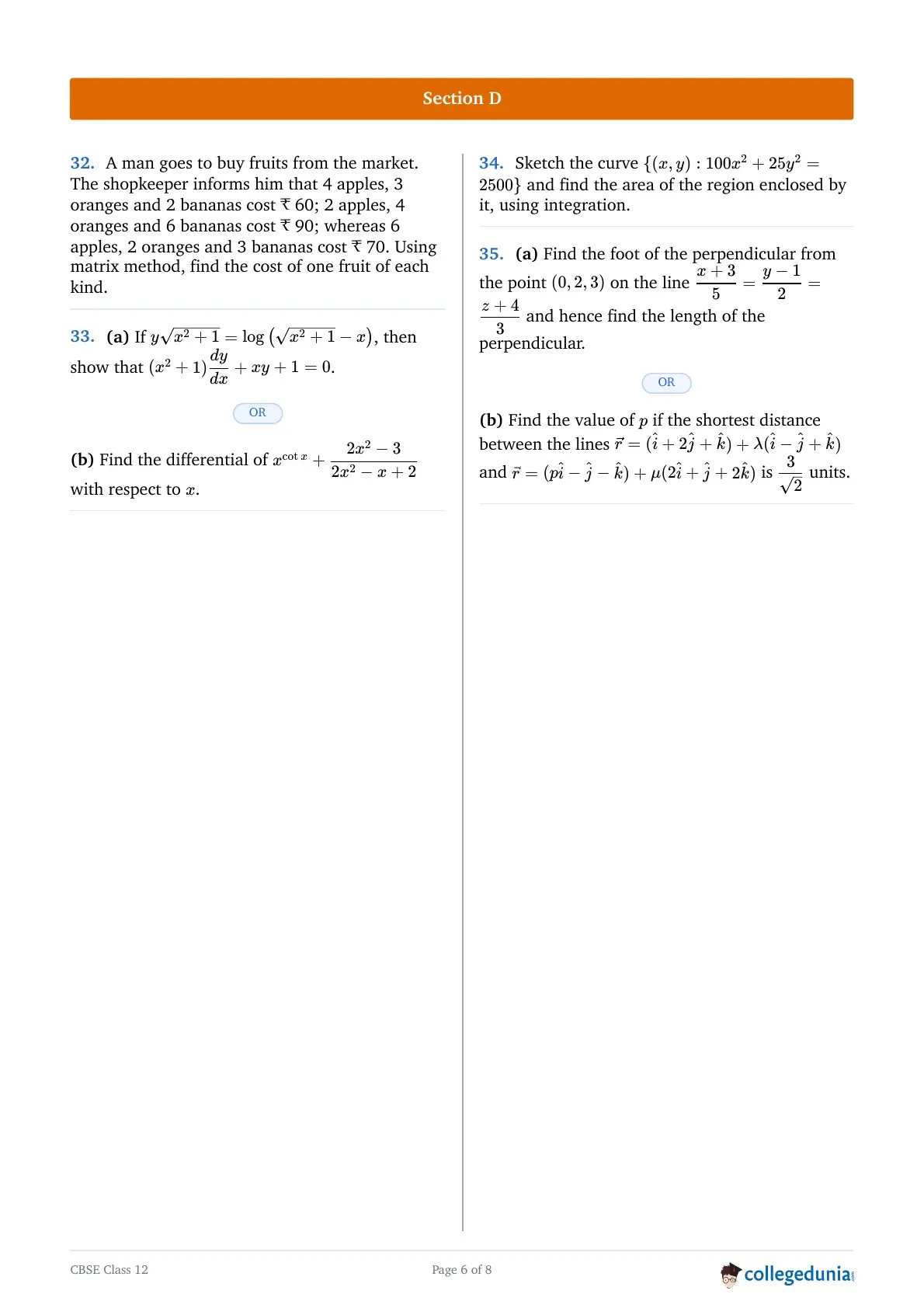
A man goes to buy fruits from the market. The shopkeeper informs him that 4 apples, 3 oranges and 2 bananas cost Rs.60, 2 apples, 4 oranges and 6 bananas cost Rs.90, whereas 6 apples, 2 oranges and 3 bananas cost Rs.70. Using matrix method, find the cost of one fruit of each kind.
If \[ y\sqrt{x^2+1}=\log\left(\sqrt{x^2+1}-x\right), \] show that \[ (x^2+1)\frac{dy}{dx}+xy+1=0. \]
Find the differential of \( x^{\cot x} + \frac{2x^2-3}{2x^2-x+2} \) with respect to \( x \).
Sketch the curve \( \{(x, y) : 100x^2 + 25y^2 = 2500\} \) and find the area of the region enclosed by it, using integration.
Find the foot of the perpendicular from the point \( (0, 2, 3) \) on the line \( \frac{x+3}{5} = \frac{y-1}{2} = \frac{z+4}{3} \) and hence find the length of the perpendicular.
Find the value of \( p \) if the shortest distance between the lines \( \vec{r} = (\hat{i} + 2\hat{j} + \hat{k}) + \lambda(\hat{i} - \hat{j} + \hat{k}) \) and \( \vec{r} = (p\hat{i} - \hat{j} - \hat{k}) + \mu(2\hat{i} + \hat{j} + 2\hat{k}) \) is \( \frac{3}{\sqrt{2}} \) units.
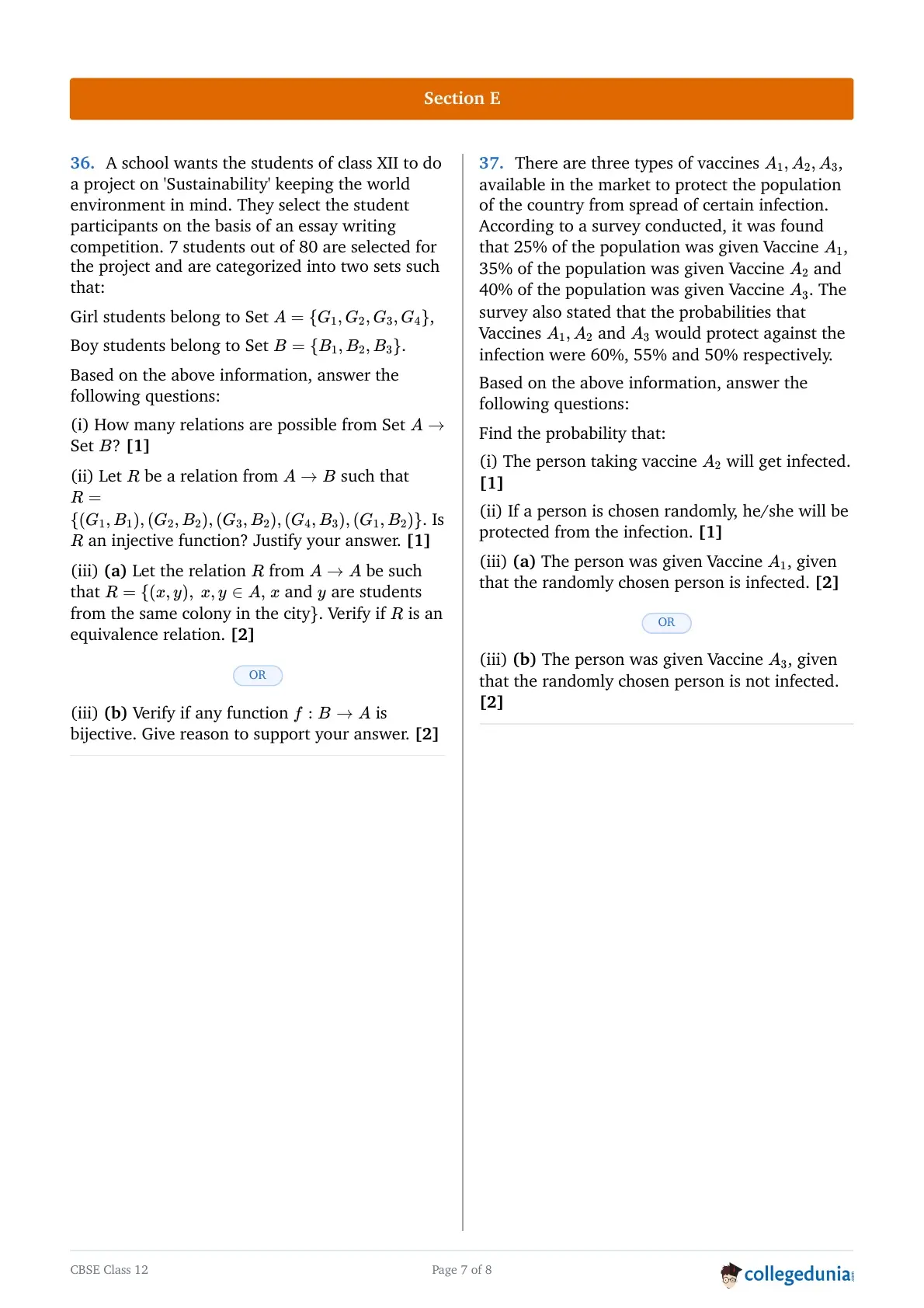
A school wants the students of class XII to do a project on ‘Sustainability’ keeping the world environment in mind. They select the student participants on the basis of an essay writing competition.
7 students out of 80 are selected for the project and are categorized into
two sets such that :
Girl students belong to Set A = \( A = \{G_1, G_2, G_3, G_4\} \) and
Boy students belong to Set B = \( B = \{B_1, B_2, B_3\} \) .
There are three types of vaccines \( A_1, A_2, A_3 \), available in the market to protect the population of the country from spread of certain infection. According to a survey conducted, it was found that 25% of the population was given Vaccine \( A_1 \), 35% of the population was given Vaccine \( A_2 \) and 40% of the population was given Vaccine \( A_3 \). The survey also stated that the probabilities that Vaccines \( A_1, A_2 \) and \( A_3 \) would protect against the infection were 60%, 55% and 50% respectively. Based on the above information, find the probability that:
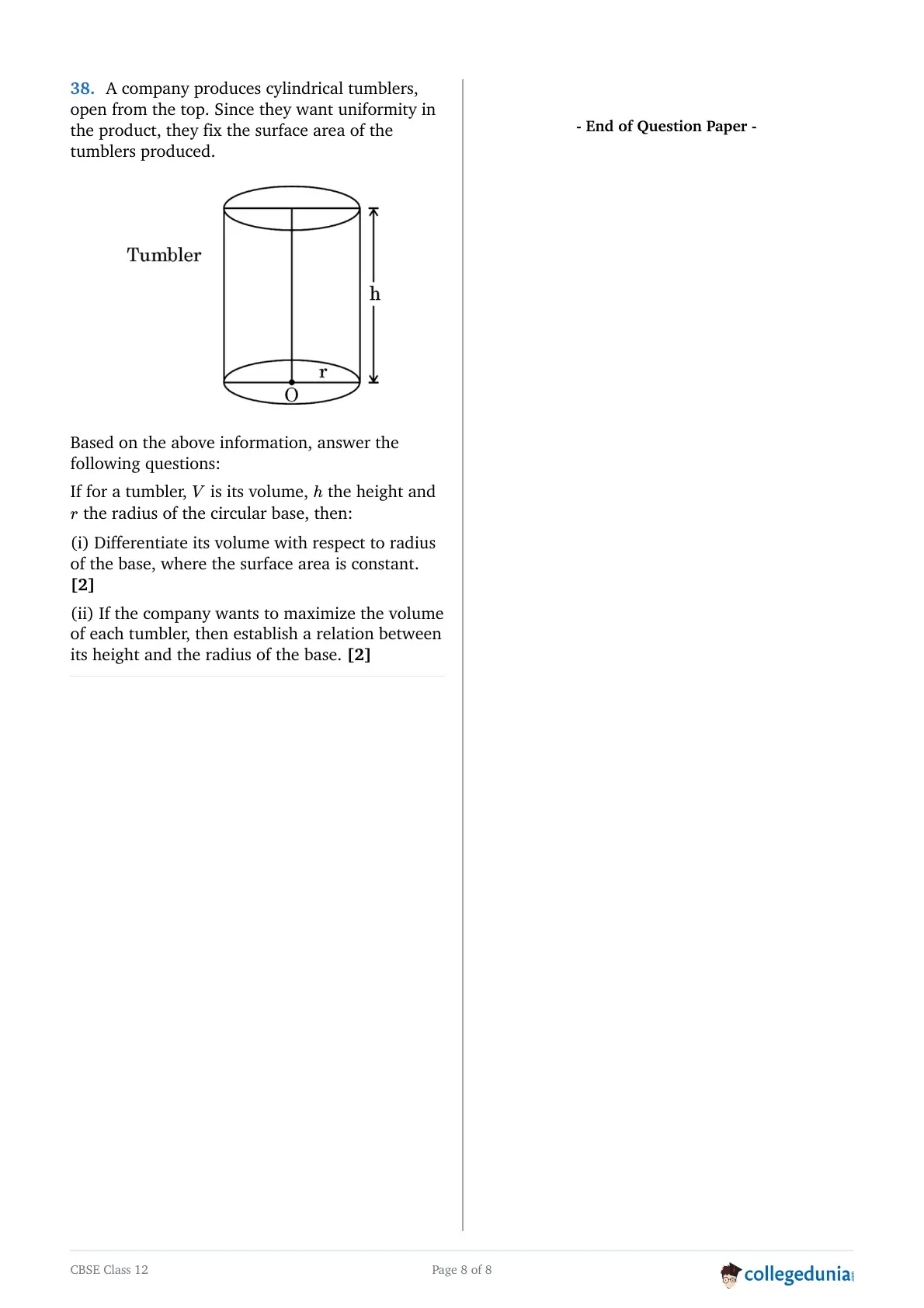
A company produces cylindrical tumblers, open from the top. Since they want uniformity in the product, they fix the surface area of the tumblers produced. If for a tumbler, \( V \) is its volume, \( h \) the height and \( r \) the radius of the circular base, then:

CBSE Class 12 Mathematics Question Paper Pattern and Marking Scheme
The CBSE Class 12 Mathematics 2026 question paper is of 80 marks and has 38 questions in five sections, A to E, all compulsory. The tables below give the section-wise paper pattern and the marking rules from the official CBSE marking scheme.
CBSE Class 12 Mathematics Question Paper Pattern 2026
| Section | Questions | Question Type | Marks per Question | Marks |
|---|---|---|---|---|
| A | Q1 - Q20 | MCQs (Q1 - Q18) and Assertion-Reason questions (Q19 - Q20) | 1 | 20 |
| B | Q21 - Q25 | Very short answer (VSA) questions | 2 | 10 |
| C | Q26 - Q31 | Short answer (SA) questions | 3 | 18 |
| D | Q32 - Q35 | Long answer (LA) questions | 5 | 20 |
| E | Q36 - Q38 | Case study-based questions | 4 | 12 |
| Total | 38 questions | 80 |
CBSE Class 12 Mathematics Marking Scheme 2026
| Marking point | How it is applied |
|---|---|
| Value-point marking | Marks are awarded against the value points (steps) given in the official marking scheme; the marks of an answer are split across its steps. |
| Own expression | The marking scheme carries suggested value points only. A correct answer in the student's own words is awarded due marks. |
| Competency-based questions | If a competency-based answer is not from the marking scheme but shows the correct competency, due marks are awarded. |
| Errors | An error is penalised only once; no marks are deducted for its cumulative effect. |
| Incorrect answer | A totally incorrect answer is awarded zero (0) marks. |
| Scale of marks | The full scale of 0 to 80 marks is used and full marks are awarded whenever the answer deserves them. |
CBSE Class 12 Mathematics Chapter-Wise Weightage
| S.No | Units | Marks |
|---|---|---|
| I | Relations and Functions | 08 |
| II | Algebra | 10 |
| III | Calculus | 35 |
| IV | Vectors and Three-Dimensional Geometry | 14 |
| V | Linear Programming | 05 |
| VI | Probability | 08 |
| Total (Theory) | 80 | |
| Internal Assessment | 20 |



Comments