




CBSE Class 12 Mathematics Set 2- (65/3/2) Question Paper 2026 is available for download here. CBSE conducted Class 12 Mathematics exam on March 9, 2026 from 10:30 AM to 1:30 PM. The Mathematics theory paper is of 80 marks, and the internal assessment is of 20 marks.
Also Check: CBSE Class 12 Question Paper 2026 (All Subjects)
Mathematics question paper includes the following types of questions:
- MCQs: 1 mark each
- Short-answer type questions: 2 & 3 marks each
- Long-answer type questions: 5 marks each
- Case study-based questions: 4 marks each
- Total: 80 marks
CBSE Class 12 Mathematics Set 2- (65/3/2) Question Paper 2026 with Solution PDF
| CBSE Official PDF | CD PDF | CD PDF with Solutions |
|---|---|---|
| Download official PDF 0.94 MB | Download Collegedunia PDF 1.49 MB | Download solutions PDF 0.70 MB |
CBSE Class 12 Mathematics 2026 Set 2 (65/3/2) Questions with Solutions
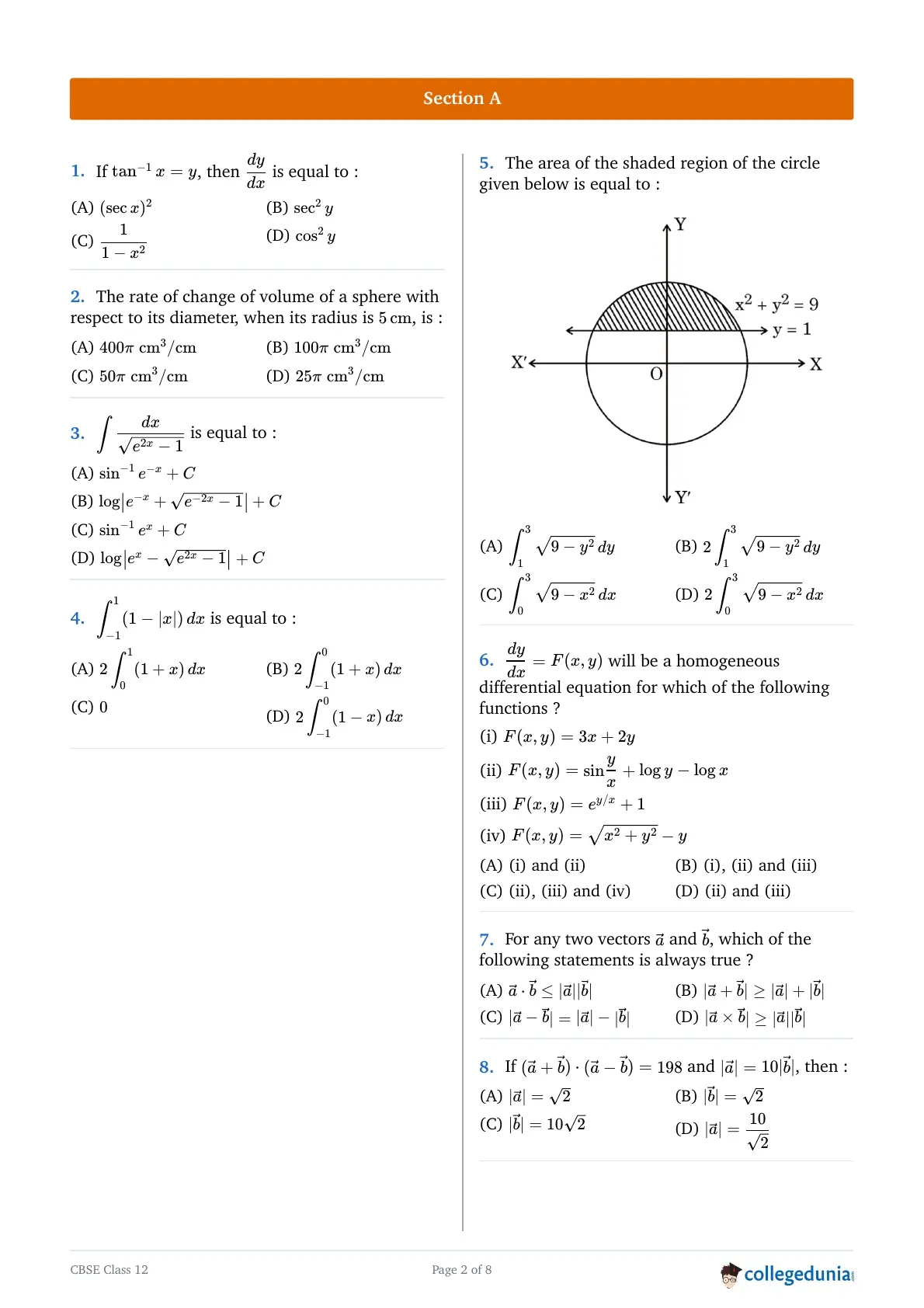
If \( \tan^{-1} x = y \), then \( \frac{dy}{dx} \) is equal to :
The rate of change of volume of a sphere with respect to its diameter, when its radius is 5 cm, is :
\( \int \frac{dx}{\sqrt{e^{-2x} - 1}} \) is equal to :
\( \int_{-1}^{1} (1 - |x|) \, dx \) is equal to :

\( \frac{dy}{dx} = F(x, y) \) will be a homogeneous differential equation for which of the following functions ?
(i) \( F(x, y) = 3x + 2y \)
(ii) \( F(x, y) = \sin \frac{y}{x} + \log y - \log x \)
(iii) \( F(x, y) = e^{y/x} + 1 \)
(iv) \( F(x, y) = \sqrt{x^2 + y^2} - y \)
For any two vectors \( \vec{a} \) and \( \vec{b} \), which of the following statements is always true ?
If \( (\vec{a} + \vec{b}) \cdot (\vec{a} - \vec{b}) = 198 \) and \( |\vec{a}| = 10 |\vec{b}| \), then :
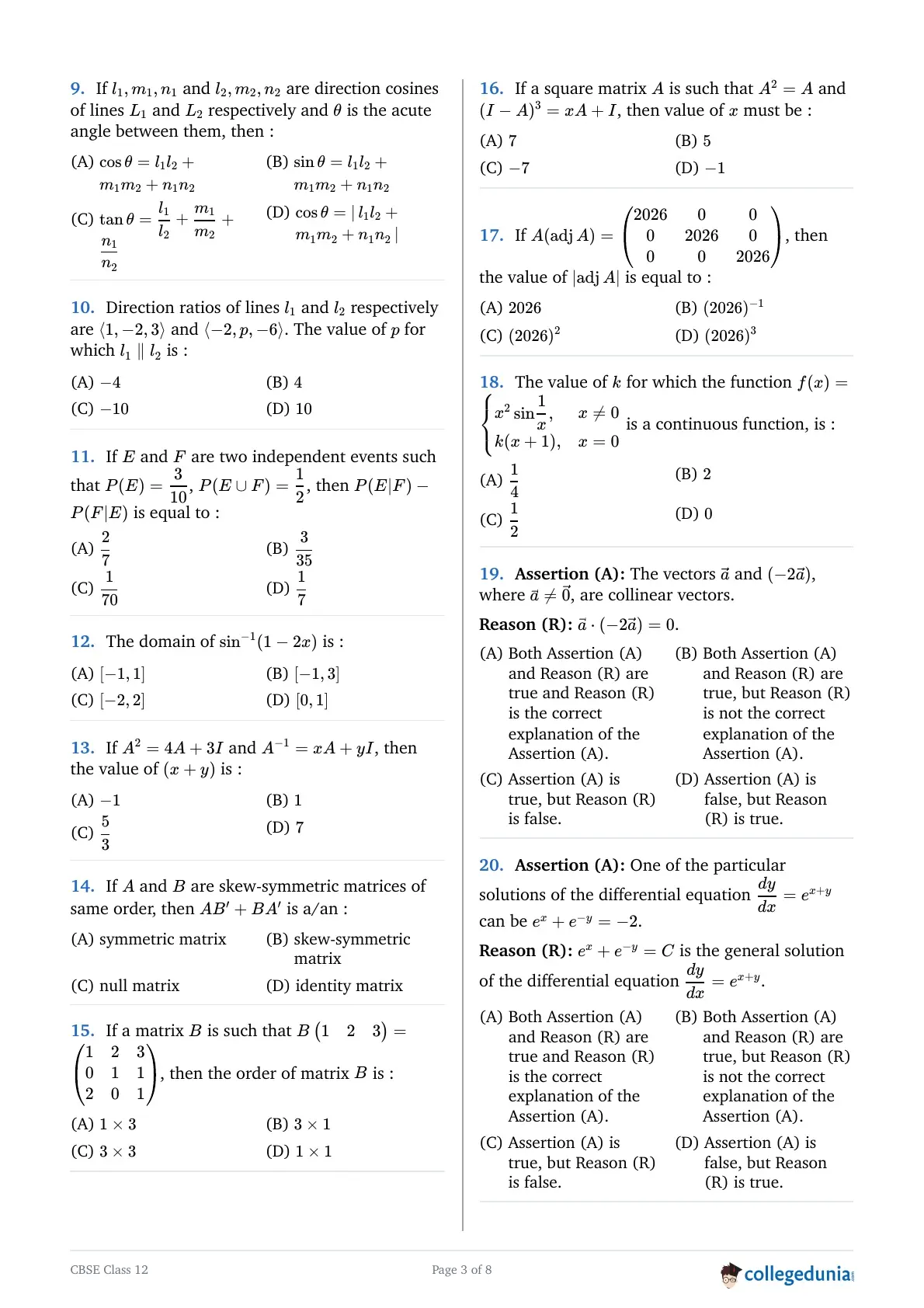
If \( l_1, m_1, n_1 \) and \( l_2, m_2, n_2 \) are direction cosines of lines \( L_1 \) and \( L_2 \) respectively and \( \theta \) is the acute angle between them, then :
Direction ratios of lines \( l_1 \) and \( l_2 \) respectively are \( \langle 1, -2, 3 \rangle \) and \( \langle -2, p, -6 \rangle \). The value of p for which \( l_1 \parallel l_2 \), is :
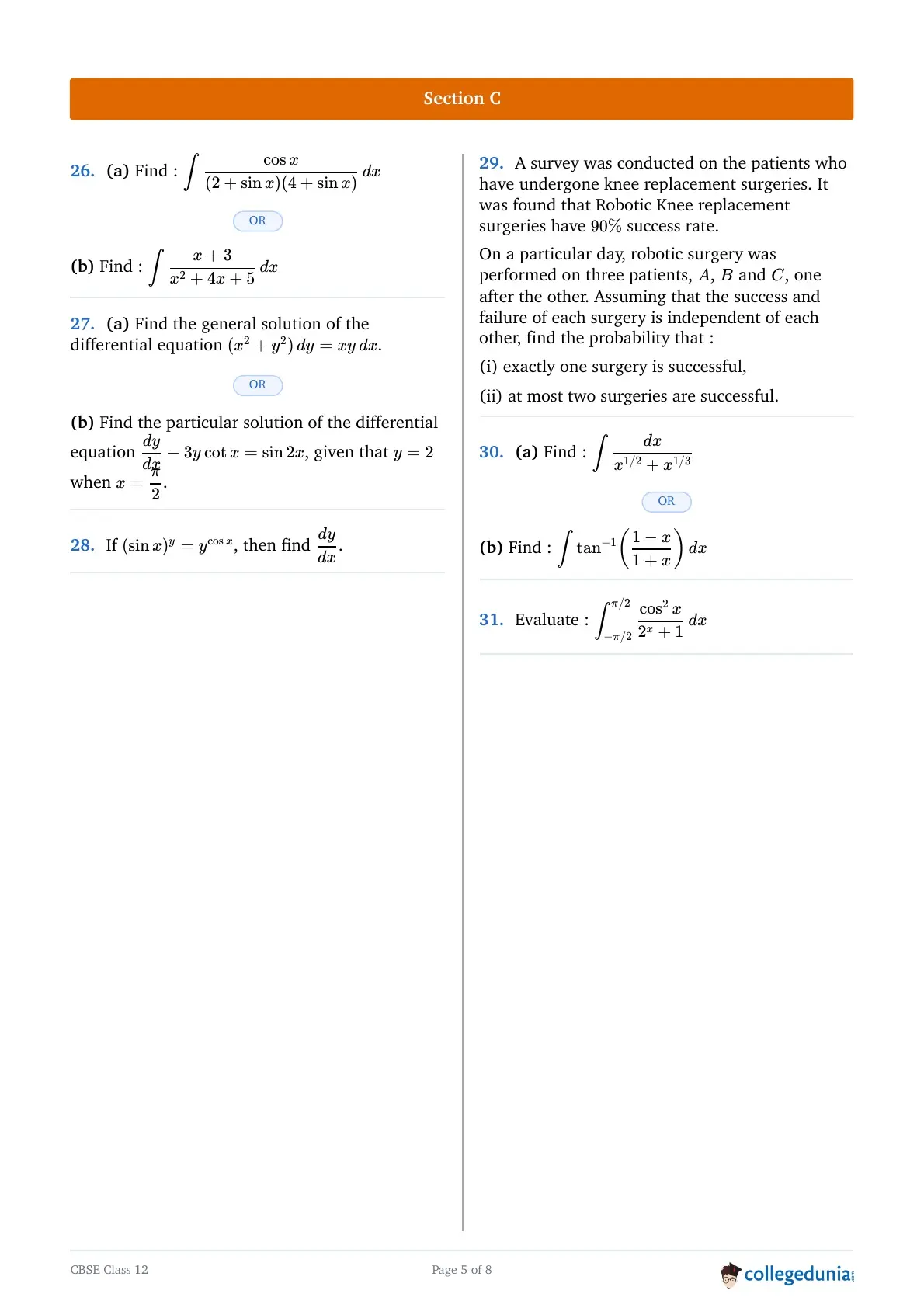
If \(E\) and \(F\) are two independent events such that \[ P(E)=\frac{3}{10}, \qquad P(E\cup F)=\frac{1}{2}, \] then \[ P(E|F)-P(F|E) \] is equal to:
The domain of \( \sin^{-1}(1 - 2x) \) is :
If \(A^2 = 4A + 3I\) and \(A^{-1} = xA + yI\), then the value of \((x + y)\) is :
If \(A\) and \(B\) are skew-symmetric matrices of same order, then \(AB' + BA'\) is a/an :
If a matrix B is such that \( B \begin{bmatrix} 1 & 2 & 3 \end{bmatrix} = \begin{bmatrix} 1 & 2 & 3 \\ 0 & 1 & 1 \\ 2 & 0 & 1 \end{bmatrix} \), then the order of matrix B is :
If a square matrix \(A\) is such that \(A^2 = A\) and \((I - A)^3 = xA + I\), then value of \(x\) must be :
If \[ A(\operatorname{adj}A)= \begin{bmatrix} 2026 & 0 & 0\\ 0 & 2026 & 0\\ 0 & 0 & 2026 \end{bmatrix}, \] then the value of \[ \left|\operatorname{adj}A\right| \] is equal to :
The value of \(k\) for which the function \[ f(x)= \begin{cases} x^2\sin\left(\frac{1}{x}\right), & x\neq 0,\\ k(x+1), & x=0 \end{cases} \] is a continuous function, is:
Assertion (A) : The vectors \(\vec{a}\) and \((-2\vec{a})\), where \(\vec{a} \neq \vec{0}\) are collinear vectors.
Reason (R) : \(\vec{a} \cdot (-2\vec{a}) = 0\).
Assertion (A) : One of the particular solutions of the differential equation \(\frac{dy}{dx} = e^{x+y}\) can be \(e^x + e^{-y} = -2\).
Reason (R) : \(e^x + e^{-y} = C\) is the general solution of the differential equation \(\frac{dy}{dx} = e^{x+y}\).
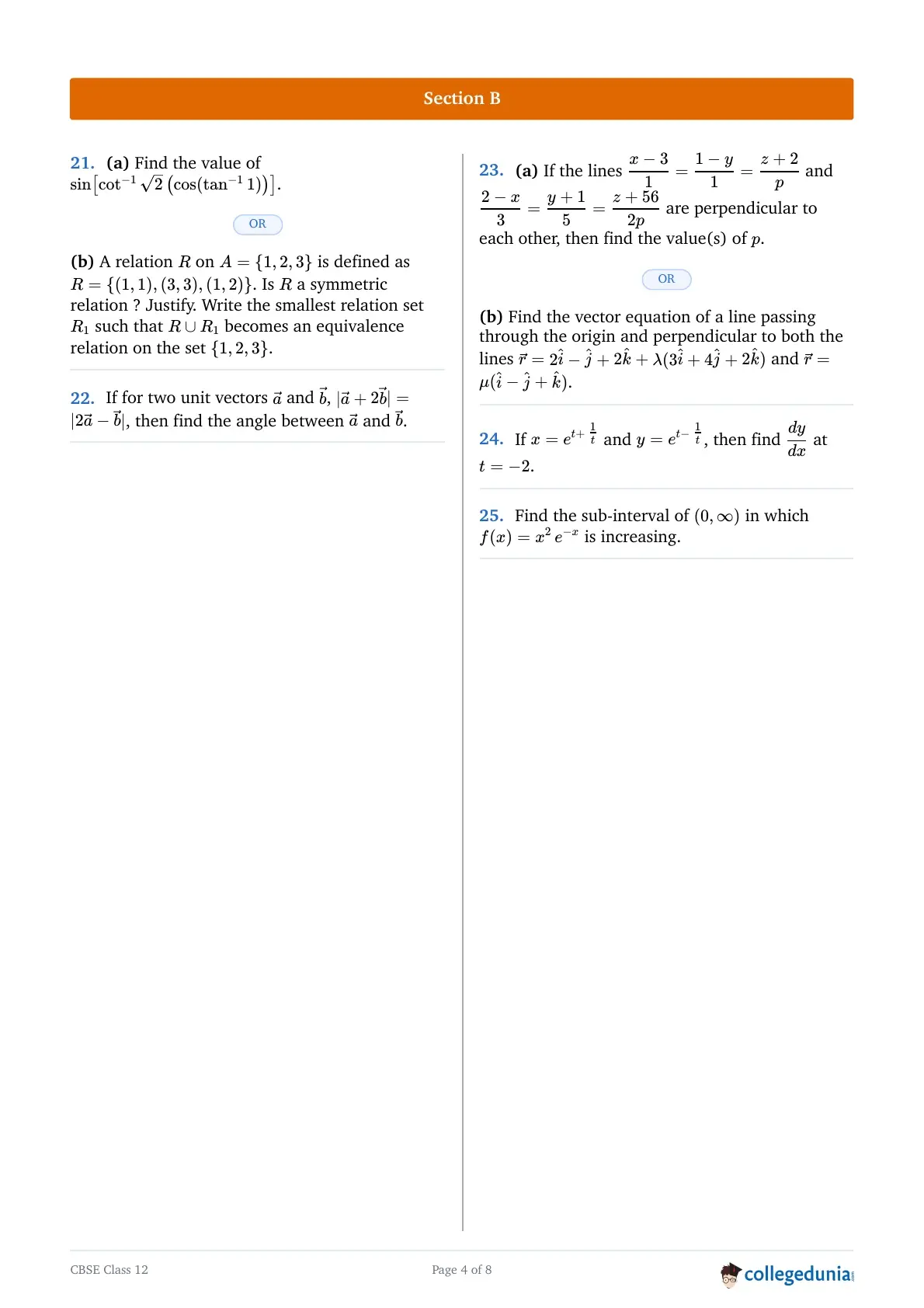
Find the value of \(\sin [\cot^{-1} \sqrt{2} (\cos (\tan^{-1} 1))]\).
A relation \(R\) on
\[
A=\{1,2,3\}
\]
is defined as
\[
R=\{(1,1),(3,3),(1,2)\}.
\]
Is \(R\) a symmetric relation? Justify.
Write the smallest relation set \(R_1\) such that
\[
R\cup R_1
\]
becomes an equivalence relation on the set
\[
\{1,2,3\}.
\]
If for two unit vectors \(\vec{a}\) and \(\vec{b}\), \(|\vec{a} + 2\vec{b}| = |2\vec{a} - \vec{b}|\), then find the angle between \(\vec{a}\) and \(\vec{b}\).
If the lines \(\frac{x - 3}{1} = \frac{1 - y}{1} = \frac{z + 2}{p}\) and \(\frac{2 - x}{3} = \frac{y + 1}{5} = \frac{z + 56}{2p}\) are perpendicular to each other, then find the value(s) of \(p\).
Find the vector equation of a line passing through the origin and perpendicular to both the lines \(\vec{r} = 2\hat{i} - \hat{j} + 2\hat{k} + \lambda(3\hat{i} + 4\hat{j} + 2\hat{k})\) and \(\vec{r} = \mu(\hat{i} - \hat{j} + \hat{k})\).
If \( x = e^{t + \frac{1}{t}} \) and \( y = e^{t - \frac{1}{t}} \), then find \( \frac{dy}{dx} \) at \( t = -2 \).
Find the sub-interval of \[ (0,\infty) \] in which \[ f(x)=x^2e^{-x} \] is increasing.
Find: \[ \int \frac{\cos x}{(2+\sin x)(4+\sin x)}\,dx \]
Find : \( \int \frac{x + 3}{x^2 + 4x + 5} \, dx \)
Find the general solution of the differential equation \( (x^2 + y^2) \, dy = xy \, dx \).
Find the particular solution of the differential equation \( \frac{dy}{dx} - 3y \cot x = \sin 2x \), given that \( y = 2 \) when \( x = \frac{\pi}{2} \).
If \[ (\sin x)^y=y^{\cos x}, \] then find \[ \frac{dy}{dx}. \]
A survey was conducted on the patients who have undergone knee replacement surgeries. It was found that, Robotic Knee replacement surgeries have 90% success rate. On a particular day, robotic surgery was performed on three patients, A, B and C, one after the other. Assuming that the success and failure of each surgery is independent of each other, find the probability that :
(i) exactly one surgery is successful,
(ii) at most two surgeries are successful.

Find : \( \int \frac{dx}{x^{1/2} + x^{1/3}} \)
Find : \( \int \tan^{-1}\left(\frac{1 - x}{1 + x}\right) \, dx \)
Evaluate : \( \int_{-\pi/2}^{\pi/2} \frac{\cos^2 x}{2^x + 1} \, dx \)
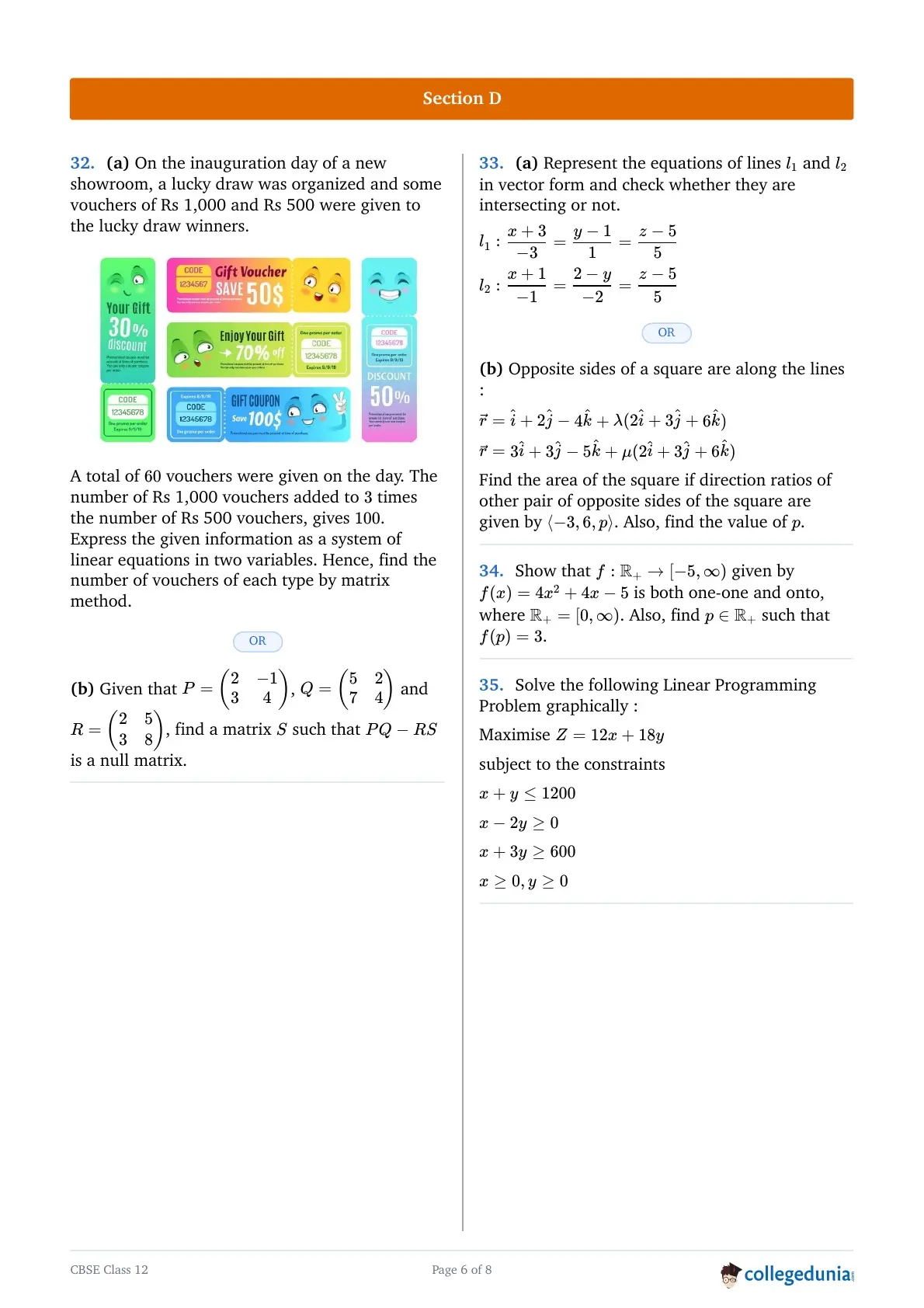
On the inauguration day of a new showroom, a lucky draw was organized and some vouchers of ₹ 1,000 and ₹ 500 were given to the lucky draw winners. A total of 60 vouchers were given on the day. The number of ₹ 1,000 vouchers added to 3 times the number of ₹ 500 vouchers, gives 100. Express the given information as a system of linear equations in two variables. Hence, find the number of vouchers of each type by matrix method.

Given that \(P = \begin{bmatrix} 2 & -1 \\ 3 & 4 \end{bmatrix}\), \(Q = \begin{bmatrix} 5 & 2 \\ 7 & 4 \end{bmatrix}\) and \(R = \begin{bmatrix} 2 & 5 \\ 3 & 8 \end{bmatrix}\), find a matrix \(S\) such that \(PQ - RS\) is a null matrix.
Represent the equations of lines \(l_1\) and \(l_2\) in vector form and check whether they are intersecting or not. \[ l_1 : \frac{x + 3}{-3} = \frac{y - 1}{1} = \frac{z - 5}{5} \quad \text{and} \quad l_2 : \frac{x + 1}{-1} = \frac{2 - y}{-2} = \frac{z - 5}{5} \]
Opposite sides of a square are along the lines : \[ \vec{r} = \hat{i} + 2\hat{j} - 4\hat{k} + \lambda(2\hat{i} + 3\hat{j} + 6\hat{k}) \quad \text{and} \quad \vec{r} = 3\hat{i} + 3\hat{j} - 5\hat{k} + \mu(2\hat{i} + 3\hat{j} + 6\hat{k}) \] Find the area of the square if direction ratios of other pair of opposite sides of the square are given by \(\langle -3, 6, p \rangle\). Also, find the value of \(p\).
Show that \(f : \mathbf{R}_+ \to [-5, \infty)\) given by \(f(x) = 4x^2 + 4x - 5\) is both one-one and onto where \(\mathbf{R}_+ = [0, \infty)\). Also, find \(p \in \mathbf{R}_+\) such that \(f(p) = 3\).
Solve the following Linear Programming Problem graphically :
Maximise \(Z = 12x + 18y\)
subject to the constraints
\[
x + y \le 1200, \quad x - 2y \ge 0, \quad x + 3y \ge 600, \quad x \ge 0, \, y \ge 0
\]
A survey was conducted to find out the success rate of students who qualified the entrance examination by dropping a year after class XII.

Of the dropouts, 5% qualify the examination while 10% of the regular students qualify the examination.
Based on the above information, answer the following questions.
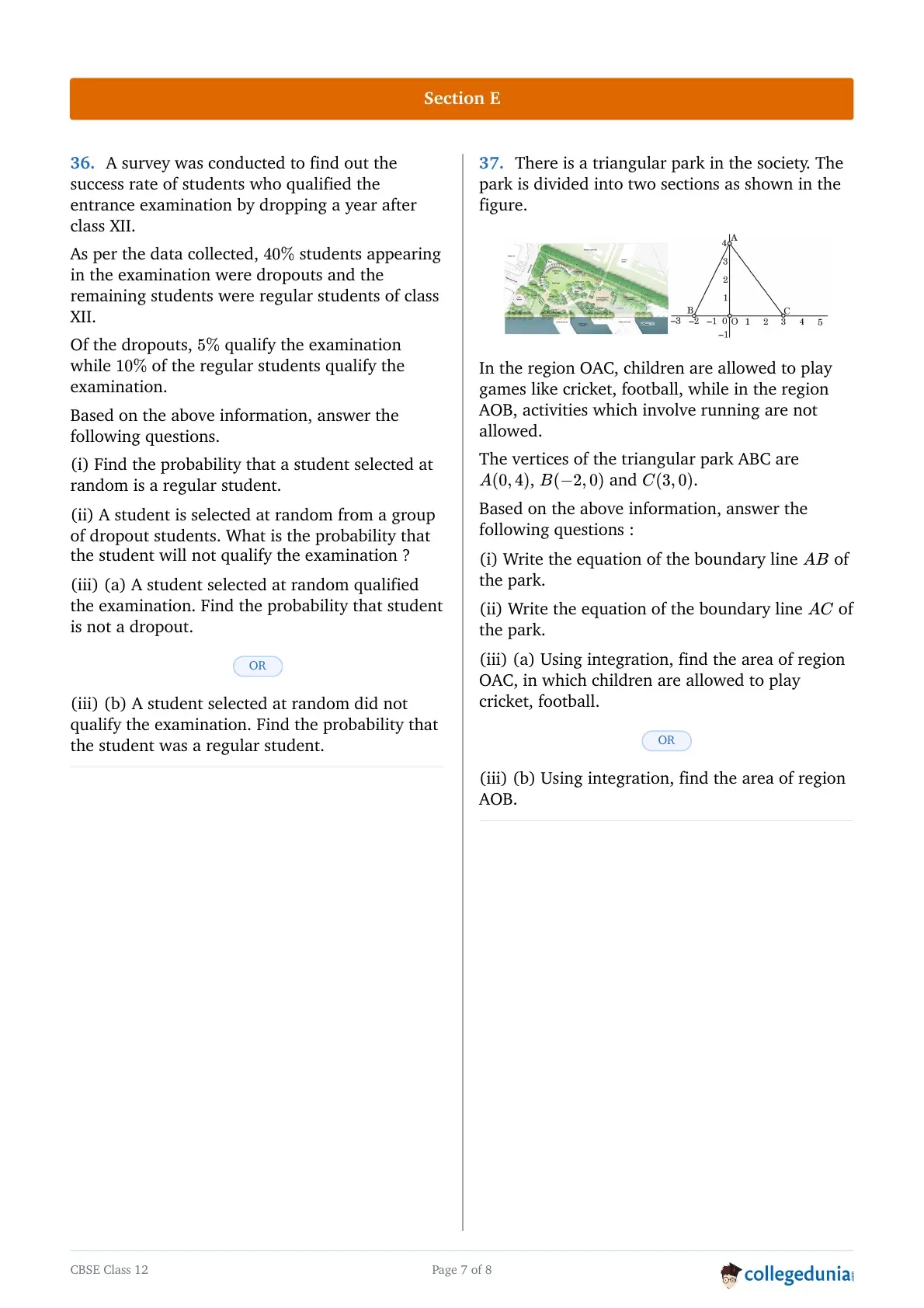
There is a triangular park \(ABC\) in the society. The park is divided into two sections as shown in the figure.

The vertices of the triangular park that is ABC are \(A(0, 4), B(-2, 0)\) and \(C(3, 0)\).
Based on the above information, answer the following questions :
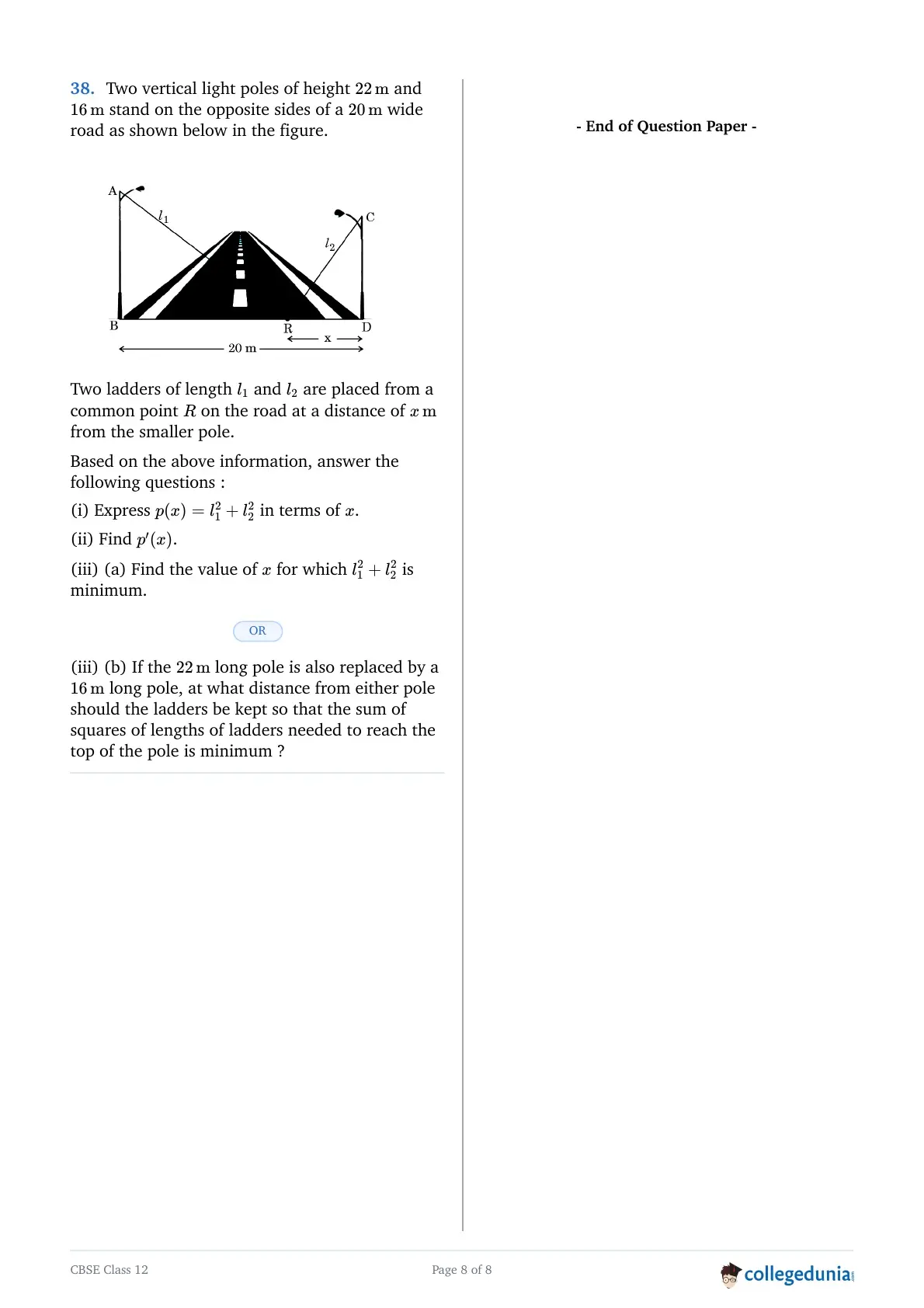
Two vertical light poles of height \(22 \text{ m}\) and \(16 \text{ m}\) stand on the opposite sides of a \(20 \text{ m}\) wide road. Two ladders of length \(l_1\) and \(l_2\) are placed from a common point \(R\) on the road at a distance of \(x \text{ m}\) from the smaller pole.

Two vertical light poles of height 22 m and 16 m stand on the opposite sides of a 20 m wide road as shown below in the figure. Two ladders of length \( l_1 \) and \( l_2 \) are placed from a common point R on the road at a distance of x m from the smaller pole. Based on the above information, answer the following questions :

CBSE Class 12 Mathematics Question Paper Pattern and Marking Scheme
The CBSE Class 12 Mathematics 2026 question paper is of 80 marks and has 38 questions in five sections, A to E, all compulsory. The tables below give the section-wise paper pattern and the marking rules from the official CBSE marking scheme.
CBSE Class 12 Mathematics Question Paper Pattern 2026
| Section | Questions | Question Type | Marks per Question | Marks |
|---|---|---|---|---|
| A | Q1 - Q20 | MCQs (Q1 - Q18) and Assertion-Reason questions (Q19 - Q20) | 1 | 20 |
| B | Q21 - Q25 | Very short answer (VSA) questions | 2 | 10 |
| C | Q26 - Q31 | Short answer (SA) questions | 3 | 18 |
| D | Q32 - Q35 | Long answer (LA) questions | 5 | 20 |
| E | Q36 - Q38 | Case study-based questions | 4 | 12 |
| Total | 38 questions | 80 |
CBSE Class 12 Mathematics Marking Scheme 2026
| Marking point | How it is applied |
|---|---|
| Value-point marking | Marks are awarded against the value points (steps) given in the official marking scheme; the marks of an answer are split across its steps. |
| Own expression | The marking scheme carries suggested value points only. A correct answer in the student's own words is awarded due marks. |
| Competency-based questions | If a competency-based answer is not from the marking scheme but shows the correct competency, due marks are awarded. |
| Errors | An error is penalised only once; no marks are deducted for its cumulative effect. |
| Incorrect answer | A totally incorrect answer is awarded zero (0) marks. |
| Scale of marks | The full scale of 0 to 80 marks is used and full marks are awarded whenever the answer deserves them. |
CBSE Class 12 Mathematics Chapter-Wise Weightage
| S.No | Units | Marks |
|---|---|---|
| I | Relations and Functions | 08 |
| II | Algebra | 10 |
| III | Calculus | 35 |
| IV | Vectors and Three-Dimensional Geometry | 14 |
| V | Linear Programming | 05 |
| VI | Probability | 08 |
| Total (Theory) | 80 | |
| Internal Assessment | 20 |



Comments