




CBSE Class 12 Mathematics Set 3- (65/4/3) Question Paper 2026 is available for download here. CBSE conducted Class 12 Mathematics exam on March 9, 2026 from 10:30 AM to 1:30 PM. The Mathematics theory paper is of 80 marks, and the internal assessment is of 20 marks.
Also Check: CBSE Class 12 Question Paper 2026 (All Subjects)
Mathematics question paper includes the following types of questions:
- MCQs: 1 mark each
- Short-answer type questions: 2 & 3 marks each
- Long-answer type questions: 5 marks each
- Case study-based questions: 4 marks each
- Total: 80 marks
CBSE Class 12 Mathematics Set 3- (65/4/3) Question Paper 2026 with Solution PDF
| CBSE Official PDF | CD PDF | CD PDF with Solutions |
|---|---|---|
| Download official PDF 0.78 MB | Download Collegedunia PDF 0.50 MB | Download solutions PDF 0.73 MB |
CBSE Class 12 Mathematics 2026 Set 3 (65/4/3) Questions with Solutions

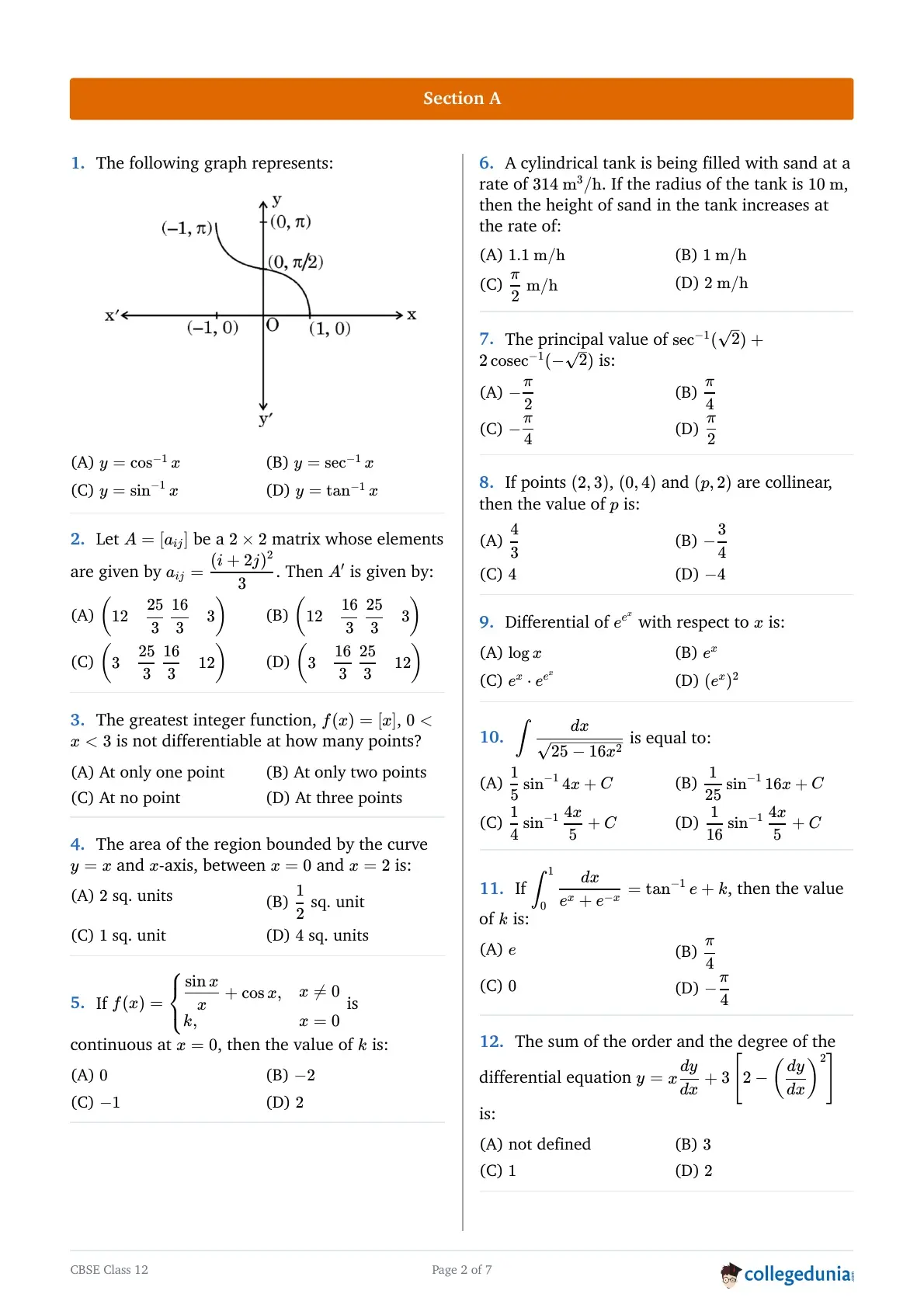
Let \( A = [a_{ij}] \) be a \( 2 \times 2 \) matrix whose elements are given by \( a_{ij} = \frac{(i + 2j)^2}{3} \). Then \( A^{\prime} \) is given by :
The greatest integer function, \(f(x) = [x]\), \(0 < x < 3\) is not differentiable at how many points ?
The area of the region bounded by the curve \(y = x\) and x-axis, between \(x = 0\) and \(x = 2\) is :
If \[ f(x)= \begin{cases} \dfrac{\sin x}{x}+\cos x, & x\neq 0,\\ k, & x=0 \end{cases} \] is continuous at \(x=0\), then the value of \(k\) is:
A cylindrical tank is being filled with sand at a rate of \( 314 \text{ m}^3/\text{h} \). If the radius of the tank is 10 m, then the height of sand in the tank increases at the rate of :
The principal value of \[ \sec^{-1}(\sqrt{2})+2\operatorname{cosec}^{-1}(-\sqrt{2}) \] is:
If points (2, 3), (0, 4) and (p, 2) are collinear, then the value of p is :
Differential of \(e^{e^x}\) with respect to x is :
\(\int \frac{dx}{\sqrt{25 - 16x^2}}\) is equal to :
If \(\int_{0}^{1} \frac{dx}{e^x + e^{-x}} = \tan^{-1} e + k\), then the value of \(k\) is :
The sum of the order and the degree of the differential equation \( y = x\dfrac{dy}{dx} + 3\left[2 - \left(\dfrac{dy}{dx}\right)^{2}\right] \) is :
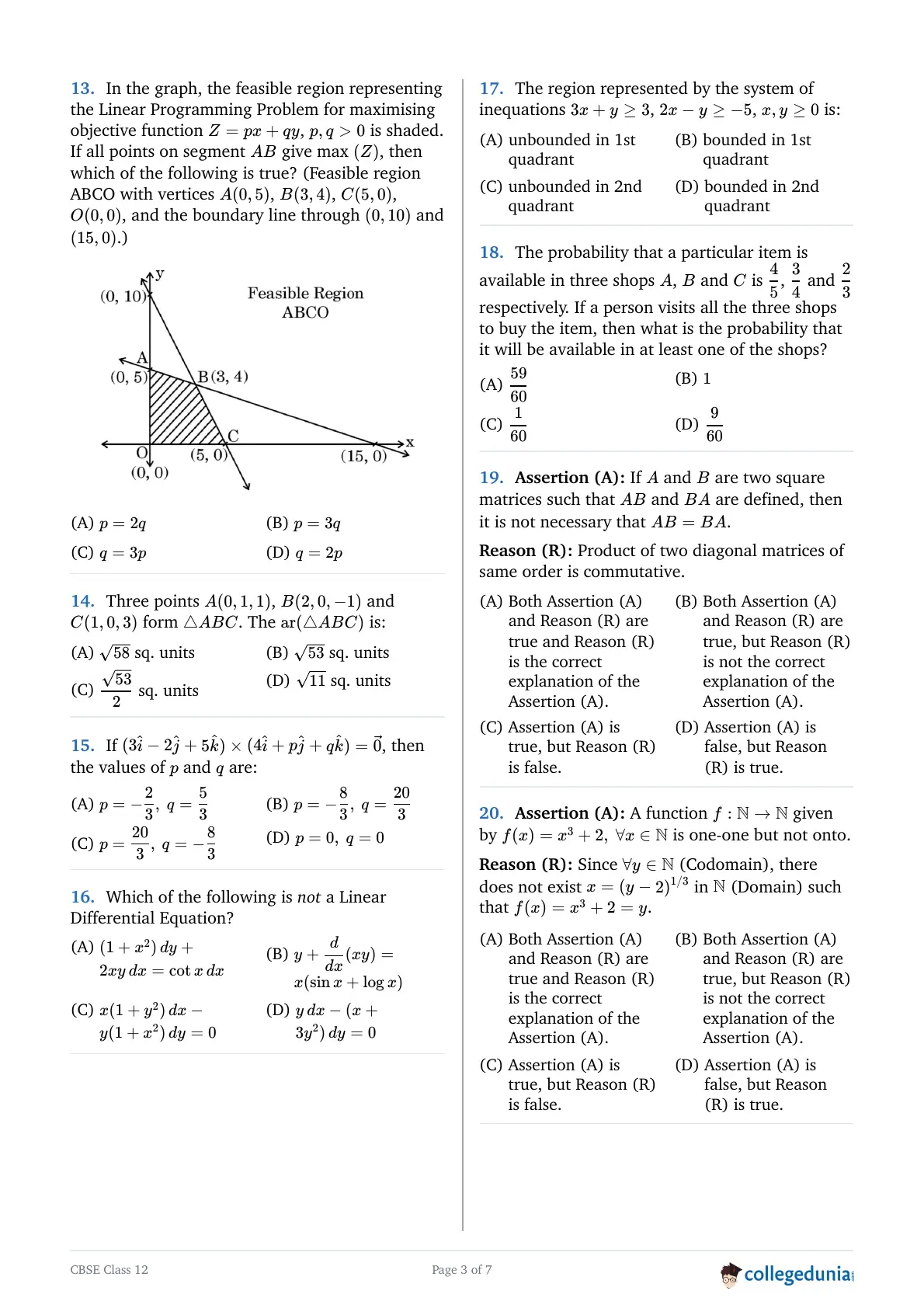
In the graph, the feasible region representing the Linear Programming Problem for maximising objective function \(Z = px + qy, p, q > 0\) is shaded. If all points on segment \(AB\) give max (Z), then which of the following is true ?

Three points \(A(0, 1, 1)\), \(B(2, 0, -1)\) and \(C(1, 0, 3)\) form \(\Delta ABC\). The \(ar (\Delta ABC)\) is :
If \[ (3\hat{i}-2\hat{j}+5\hat{k})\times(4\hat{i}+p\hat{j}+q\hat{k})=\vec{0}, \] then the values of \(p\) and \(q\) are:
Which of the following is not a Linear Differential Equation ?
The region represented by the system of inequations \(3x + y \ge 3, 2x - y \ge - 5, x, y \ge 0\) is :
The probability that a particular item is available in three shops A, B and C is \( \dfrac{4}{5}, \dfrac{3}{4} \) and \( \dfrac{2}{3} \) respectively. If a person visits all the three shops to buy the item, then what is the probability that it will be available in at least one of the shops ?
Assertion (A) : If A and B are two square matrices such that AB and BA are defined, then it is not necessary that AB = BA.
Reason (R) : Product of two diagonal matrices of same order is commutative.
Direction: Questions number 19 and 20 are Assertion and Reason based questions. Two statements are given, one labelled Assertion (A) and the other labelled Reason (R). Select the correct answer from the codes (A), (B), (C) and (D) as given below.
Assertion (A) : A function f : N \(\to\) N given by f(x) = \(x^3\) + 2, \(\forall\) x \(\in\) N is one-one but not onto.
Reason (R) : Since \(\forall\) y \(\in\) N (Codomain), there does not exist x = \((y - 2)^{1/3}\) in N (Domain) such that f(x) = \(x^3\) + 2 = y.
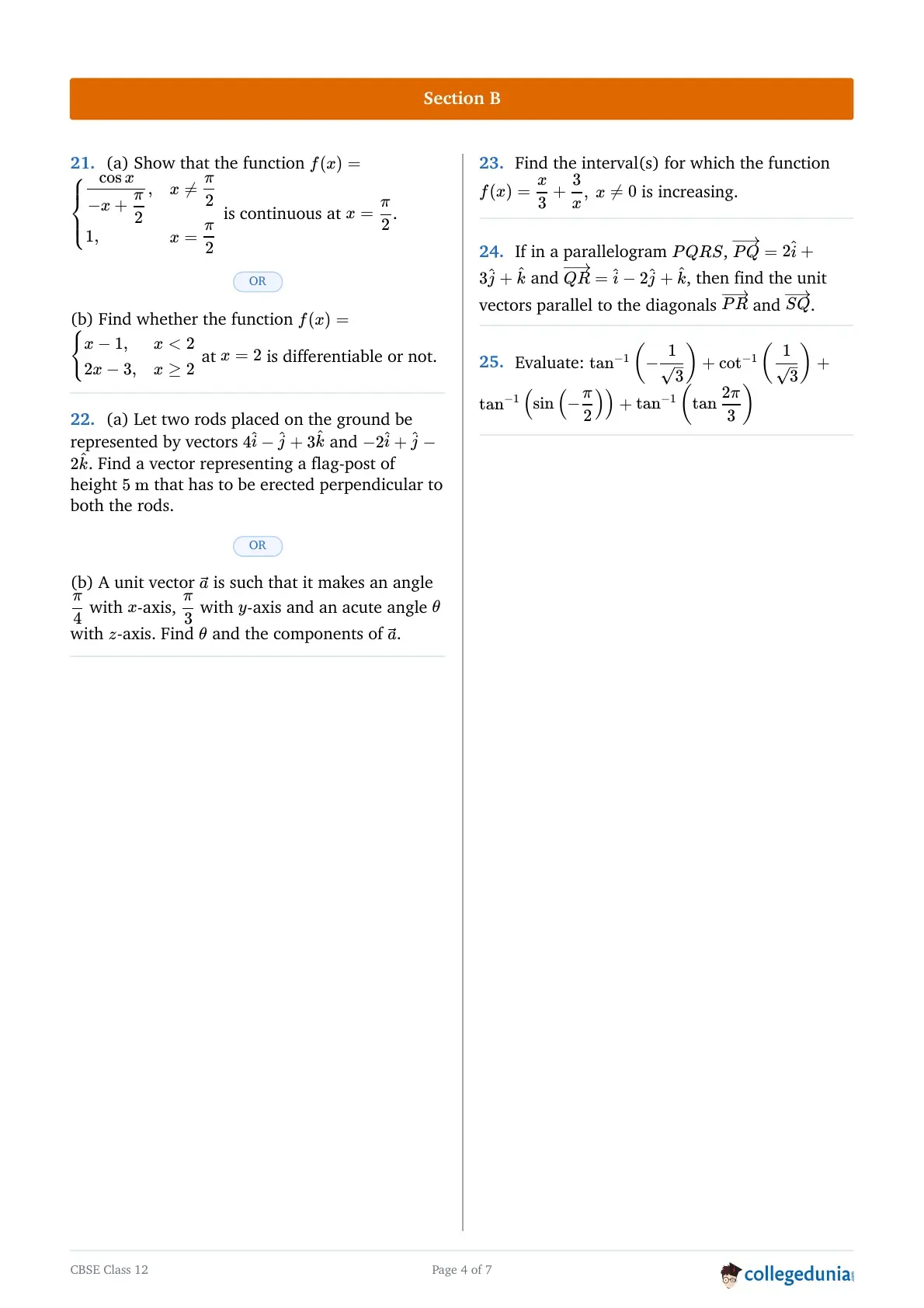
Show that the function \[ f(x)= \begin{cases} \dfrac{\cos x}{\frac{\pi}{2}-x}, & x\neq \frac{\pi}{2},\\ 1, & x=\frac{\pi}{2} \end{cases} \] is continuous at \[ x=\frac{\pi}{2}. \]
Show that the function \(f(x) = \begin{cases} \frac{\cos x}{\frac{\pi}{2} - x}, & x \neq \frac{\pi}{2} \\ 1, & x = \frac{\pi}{2} \end{cases}\) is continuous at \(x = \frac{\pi}{2}\).
Find whether the function \(f(x) = \begin{cases} x - 1, & x < 2 \\ 2x - 3, & x \ge 2 \end{cases}\) at \(x = 2\) is differentiable or not.
Let two rods placed on the ground be represented by vectors \( 4\hat{i} - \hat{j} + 3\hat{k} \) and \( -2\hat{i} + \hat{j} - 2\hat{k} \). Find a vector representing a flag-post of height 5 m that has to be erected perpendicular to both the rods.
A unit vector \( \vec{a} \) is such that it makes an angle \( \frac{\pi}{4} \) with x-axis, \( \frac{\pi}{3} \) with y-axis and an acute angle \( \theta \) with z-axis. Find \( \theta \) and the components of \( \vec{a} \).
Determine the interval(s) in which \[ f(x)=\frac{x}{3}+\frac{3}{x}, \quad x\neq 0 \] is increasing.
If in a parallelogram PQRS, \( \overrightarrow{PQ} = 2\hat{i} + 3\hat{j} + \hat{k} \) and \( \overrightarrow{QR} = \hat{i} - 2\hat{j} + \hat{k} \), then find the unit vectors parallel to the diagonals \( \overrightarrow{PR} \) and \( \overrightarrow{SQ} \).
Evaluate: \[ \tan^{-1}\left(-\frac{1}{\sqrt{3}}\right) +\cot^{-1}\left(\frac{1}{\sqrt{3}}\right) +\tan^{-1}\left(\sin\left(-\frac{\pi}{2}\right)\right) +\tan^{-1}\left(\tan\frac{2\pi}{3}\right). \]
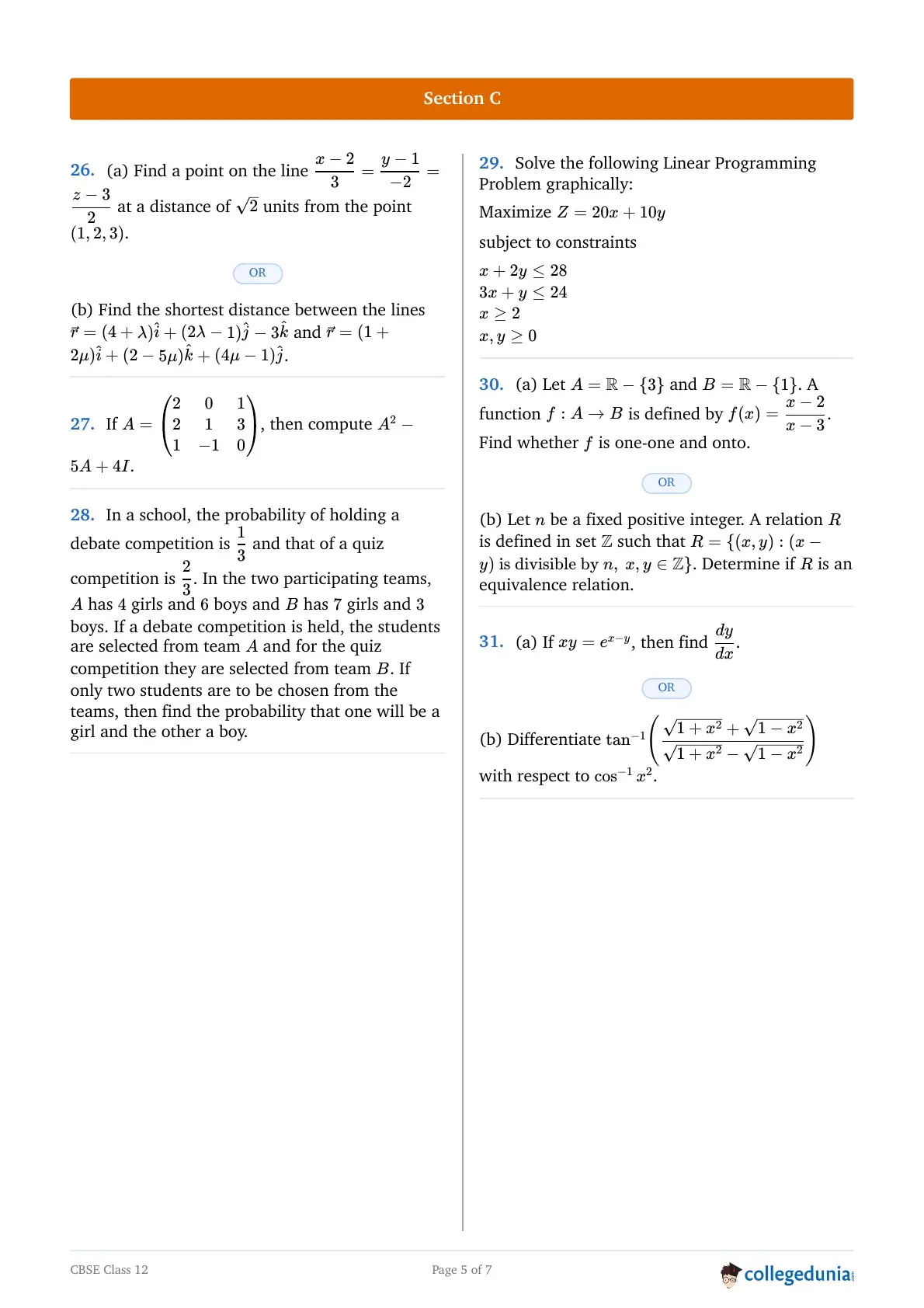
Find a point on the line \(\frac{x - 2}{3} = \frac{1 - y}{2} = \frac{z - 3}{2}\) at a distance of \(\sqrt{2}\) units from the point \((1, 2, 3)\).
Find the shortest distance between the lines \[ \vec{r}=(4+\lambda)\hat{i}+(2\lambda-1)\hat{j}-3\lambda\hat{k} \] and \[ \vec{r}=(1+2\mu)\hat{i}+(4\mu-1)\hat{j}+(2-5\mu)\hat{k}. \]
If \( A = \begin{bmatrix} 2 & 0 & 1 \\ 2 & 1 & 3 \\ 1 & -1 & 0 \end{bmatrix} \), then compute \( A^{2} - 5A + 4I \).
In a school, the probability of holding a debate competition is \( \frac{1}{3} \) and that of a quiz competition is \( \frac{2}{3} \). In the two participating teams, A has 4 girls and 6 boys and B has 7 girls and 3 boys. If a debate competition is held, the students are selected from team A and for the quiz competition they are selected from team B. If only two students are to be chosen from the teams, then find the probability that one will be a girl and the other a boy.
Solve the following Linear Programming Problem graphically :
Maximize \( Z = 20x + 10y \)
subject to constraints
\( x + 2y \leq 28 \)
\( 3x + y \leq 24 \)
\( x \geq 2 \)
\( x, y \geq 0 \)
Let \[ A=\mathbb{R}-\{3\} \] and \[ B=\mathbb{R}-\{1\}. \] A function \(f:A\to B\) is defined by \[ f(x)=\frac{x-2}{x-3}. \] Find whether \(f\) is one-one and onto.
Let \(n\) be a fixed positive integer. A relation \(R\) is defined on the set \(\mathbb{Z}\) by \[ R=\{(x,y):(x-y)\text{ is divisible by }n,\; x,y\in\mathbb{Z}\}. \] Determine whether \(R\) is an equivalence relation.
If \(xy = e^{x-y}\), then find \(\frac{dy}{dx}\).
Differentiate \(\tan^{-1}\left(\frac{\sqrt{1+x^2} - \sqrt{1-x^2}}{\sqrt{1+x^2} + \sqrt{1-x^2}}\right)\) with respect to \(\cos^{-1} x^2\).
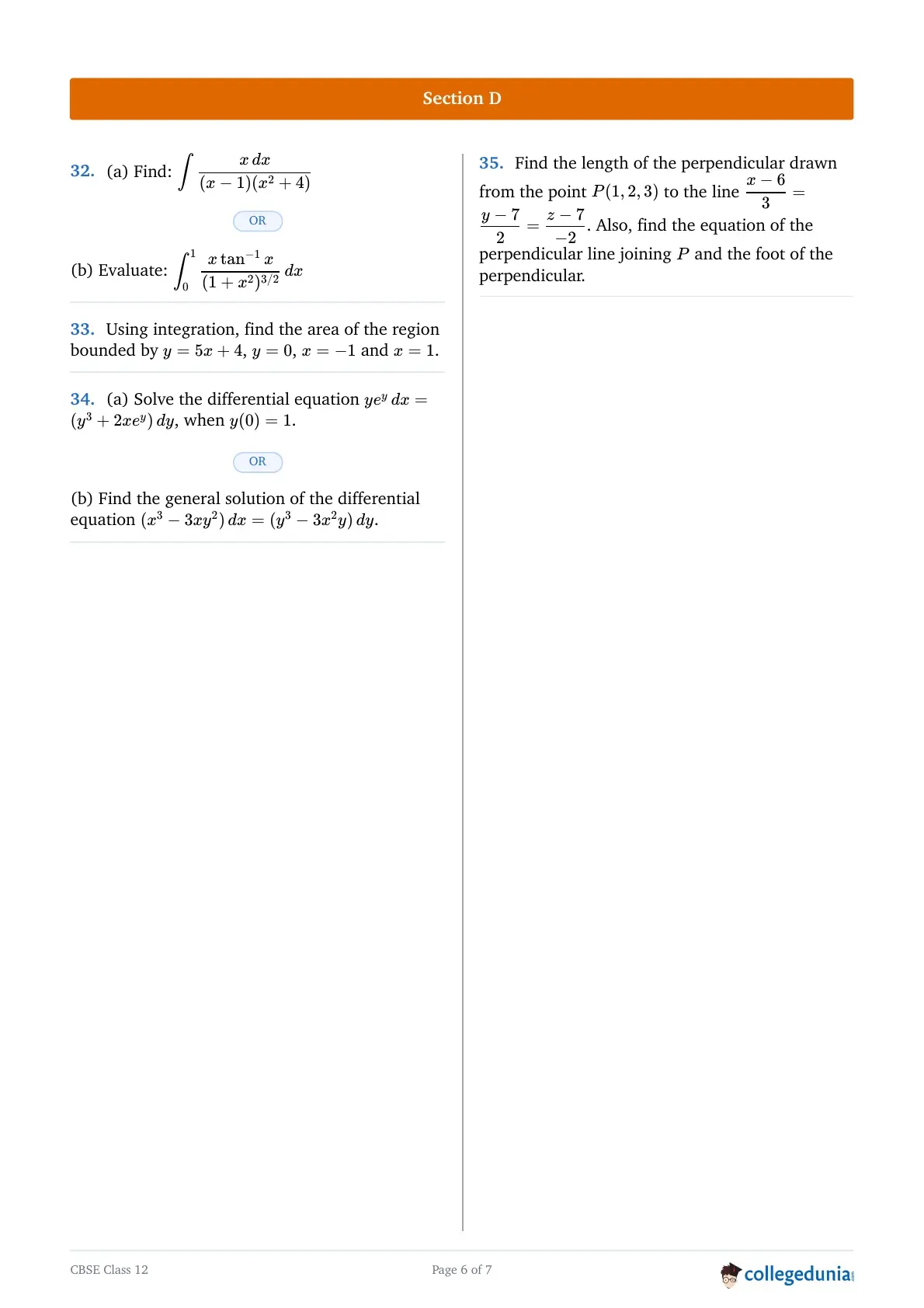
Find : \[ \int \frac{x}{(x - 1)(x^2 + 4)} dx \]
Evaluate : \[ \int_{0}^{1} \frac{x \tan^{-1} x}{(1 + x^2)^{3/2}} dx \]
Using integration, find the area of the region bounded by \( y = 5x + 4 \), \( y = 0 \), \( x = -1 \) and \( x = 1 \).
Solve the differential equation \( y e^y dx = (y^3 + 2x e^y) dy \), when \( y(0) = 1 \).
Find the general solution of the differential equation \( (x^3 - 3xy^2) dx = (y^3 - 3x^2y) dy \).
Find the length of the perpendicular drawn from the point \( P(1, 2, 3) \) to the line \( \frac{x - 6}{3} = \frac{y - 7}{2} = \frac{z - 7}{-2} \). Also, find the equation of the perpendicular line joining \( P \) and the foot of the perpendicular.
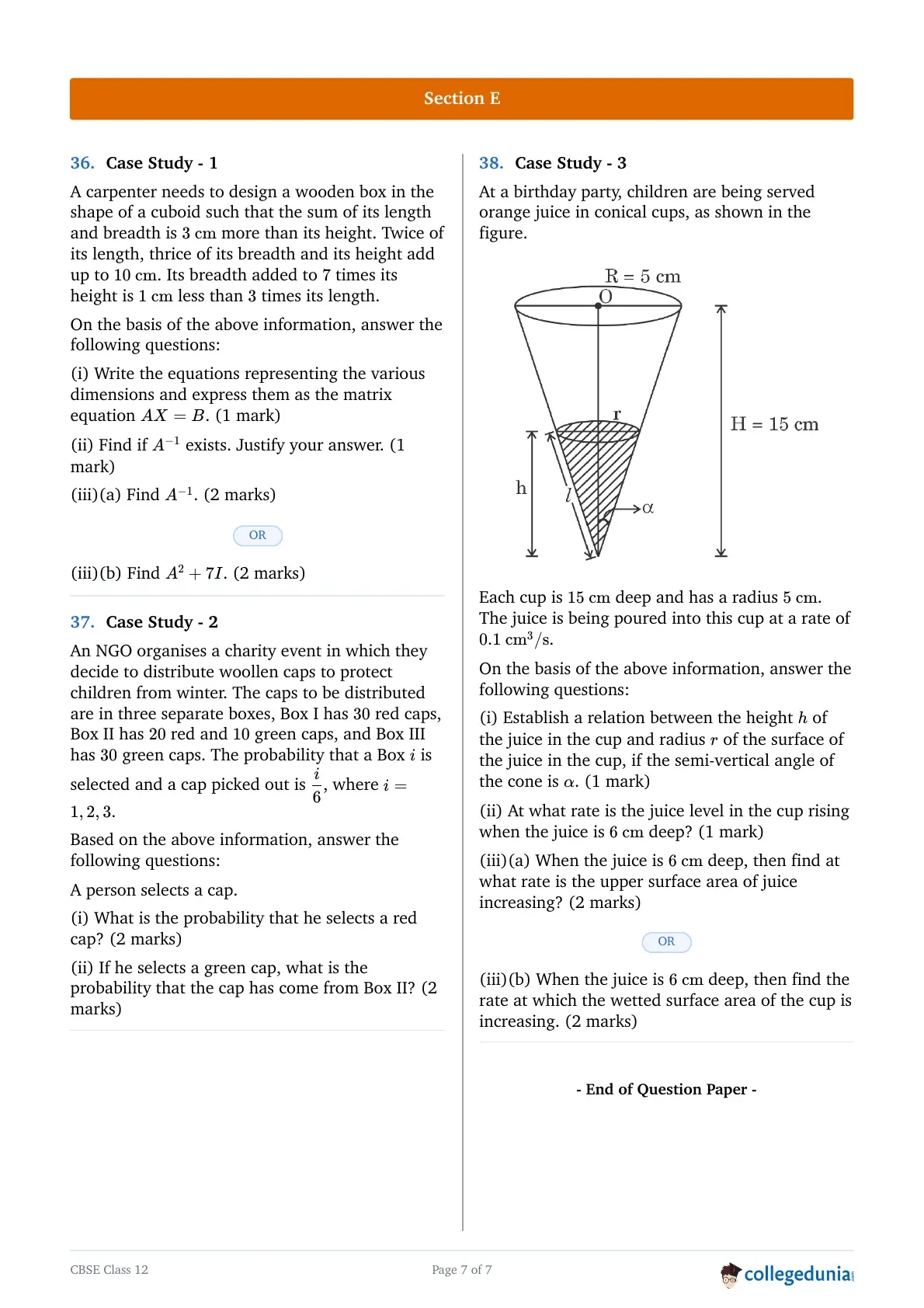
A carpenter needs to design a wooden box in the shape of a cuboid such that the sum of its length and breadth is 3 cm more than its height. Twice of its length, thrice of its breadth and its height add up to 10 cm. Its breadth added to 7 times its height is 1 cm less than 3 times its length.
An NGO organises a charity event in which they decide to distribute woollen caps to protect children from winter. The caps to be distributed are in three separate boxes, Box I has 30 red caps, Box II has 20 red and 10 green caps, and Box III has 30 green caps. The probability that a Box \(i\) is selected and a cap picked out is \(i/6\), where \(i = 1, 2, 3\).
An NGO organises a charity event in which they decide to distribute woollen caps to protect children from winter. The caps to be distributed are in three separate boxes, Box I has 30 red caps, Box II has 20 red and 10 green caps, and Box III has 30 green caps. The probability that a Box i is selected and a cap picked out is i/6, where i = 1, 2, 3.
Based on the above information, answer the following questions :
At a birthday party, children are being served orange juice in conical cups. Each cup is 15 cm deep and has a radius 5 cm. The juice is being poured into this cup at a rate of 0.1 cm\(^3\)/s.

CBSE Class 12 Mathematics Question Paper Pattern and Marking Scheme
The CBSE Class 12 Mathematics 2026 question paper is of 80 marks and has 38 questions in five sections, A to E, all compulsory. The tables below give the section-wise paper pattern and the marking rules from the official CBSE marking scheme.
CBSE Class 12 Mathematics Question Paper Pattern 2026
| Section | Questions | Question Type | Marks per Question | Marks |
|---|---|---|---|---|
| A | Q1 - Q20 | MCQs (Q1 - Q18) and Assertion-Reason questions (Q19 - Q20) | 1 | 20 |
| B | Q21 - Q25 | Very short answer (VSA) questions | 2 | 10 |
| C | Q26 - Q31 | Short answer (SA) questions | 3 | 18 |
| D | Q32 - Q35 | Long answer (LA) questions | 5 | 20 |
| E | Q36 - Q38 | Case study-based questions | 4 | 12 |
| Total | 38 questions | 80 |
CBSE Class 12 Mathematics Marking Scheme 2026
| Marking point | How it is applied |
|---|---|
| Value-point marking | Marks are awarded against the value points (steps) given in the official marking scheme; the marks of an answer are split across its steps. |
| Own expression | The marking scheme carries suggested value points only. A correct answer in the student's own words is awarded due marks. |
| Competency-based questions | If a competency-based answer is not from the marking scheme but shows the correct competency, due marks are awarded. |
| Errors | An error is penalised only once; no marks are deducted for its cumulative effect. |
| Incorrect answer | A totally incorrect answer is awarded zero (0) marks. |
| Scale of marks | The full scale of 0 to 80 marks is used and full marks are awarded whenever the answer deserves them. |
CBSE Class 12 Mathematics Chapter-Wise Weightage
| S.No | Units | Marks |
|---|---|---|
| I | Relations and Functions | 08 |
| II | Algebra | 10 |
| III | Calculus | 35 |
| IV | Vectors and Three-Dimensional Geometry | 14 |
| V | Linear Programming | 05 |
| VI | Probability | 08 |
| Total (Theory) | 80 | |
| Internal Assessment | 20 |



Comments