




CBSE Class 12 Biology Compartment Set 2 - (57/7/2) Question Paper 2026 is available for download here. CBSE conducted the Class 12 Biology Compartment (supplementary) examination on July 28, 2026, from 10:30 AM to 1:30 PM. The Biology paper is of 70 marks and the time allowed is 3 hours. This paper carries the Q.P. code 57/7/2 and is of Set 2. The question paper was handed out at 10:15 AM, and the first 15 minutes were given for reading it.
Also Check: CBSE Class 12 Question Paper 2026 (All Subjects)
The paper has 33 questions in five sections, A to E, and all questions are compulsory:
- Section A has 16 multiple choice questions of 1 mark each
- Section B has 5 very short answer questions of 2 marks each
- Section C has 7 short answer questions of 3 marks each
- Section D has 2 case-based questions of 4 marks each
- Section E has 3 long answer questions of 5 marks each
- There is no overall choice, but an internal choice is given in Sections B, D and E
- Neat and properly labelled diagrams should be drawn wherever necessary
CBSE Class 12 Biology Compartment Set 2 - (57/7/2) Question Paper 2026 PDF
| CBSE Official PDF | CD PDF | CD PDF with Solutions |
|---|---|---|
| Download official PDF 0.53 MB | Download Collegedunia PDF 0.36 MB | Download solutions PDF 0.52 MB |
CBSE Class 12 Biology Compartment 2026 Set 2 (57/7/2) Questions with Solutions
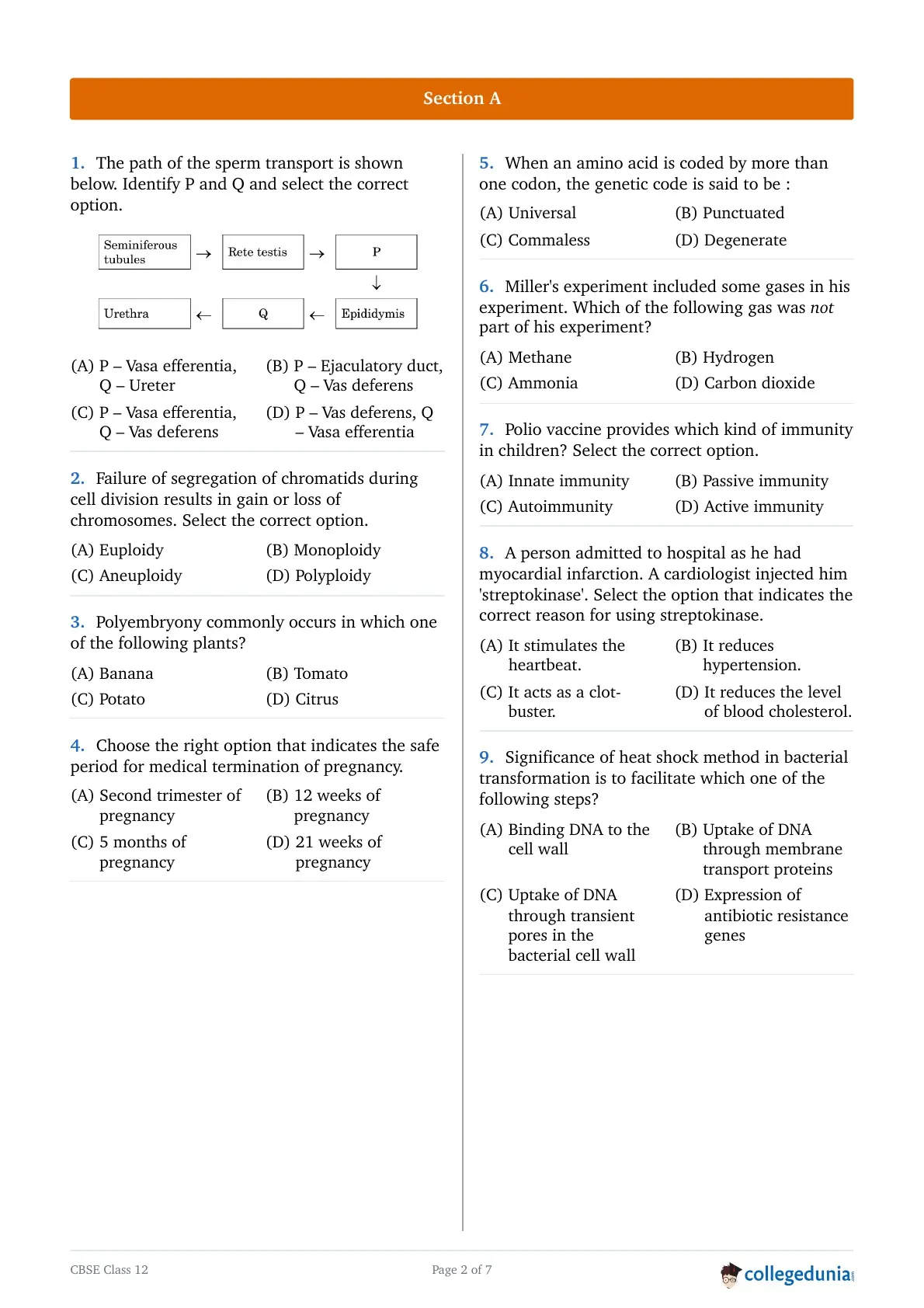
The path of the sperm transport is shown below. Identify P and Q and select the correct option.
| Seminiferous tubules | → | Rete testis | → | P | → | Epididymis | → | Q | → | Urethra |
Failure of segregation of chromatids during cell division results in gain or loss of chromosomes. Select the correct option.
Choose the right option that indicates the safe period for medical termination of pregnancy.
When an amino acid is coded by more than one codon, the genetic code is said to be :
Miller's experiment included some gases in his experiment. Which of the following gas was not part of his experiment ?
Polio vaccine provides which kind of immunity in children ? Select the correct option.
A person admitted to hospital as he had myocardial infarction. A cardiologist injected him 'streptokinase'. Select the option that indicates the correct reason for using streptokinase.
Significance of heat shock method in bacterial transformation is to facilitate which one of the following steps ?
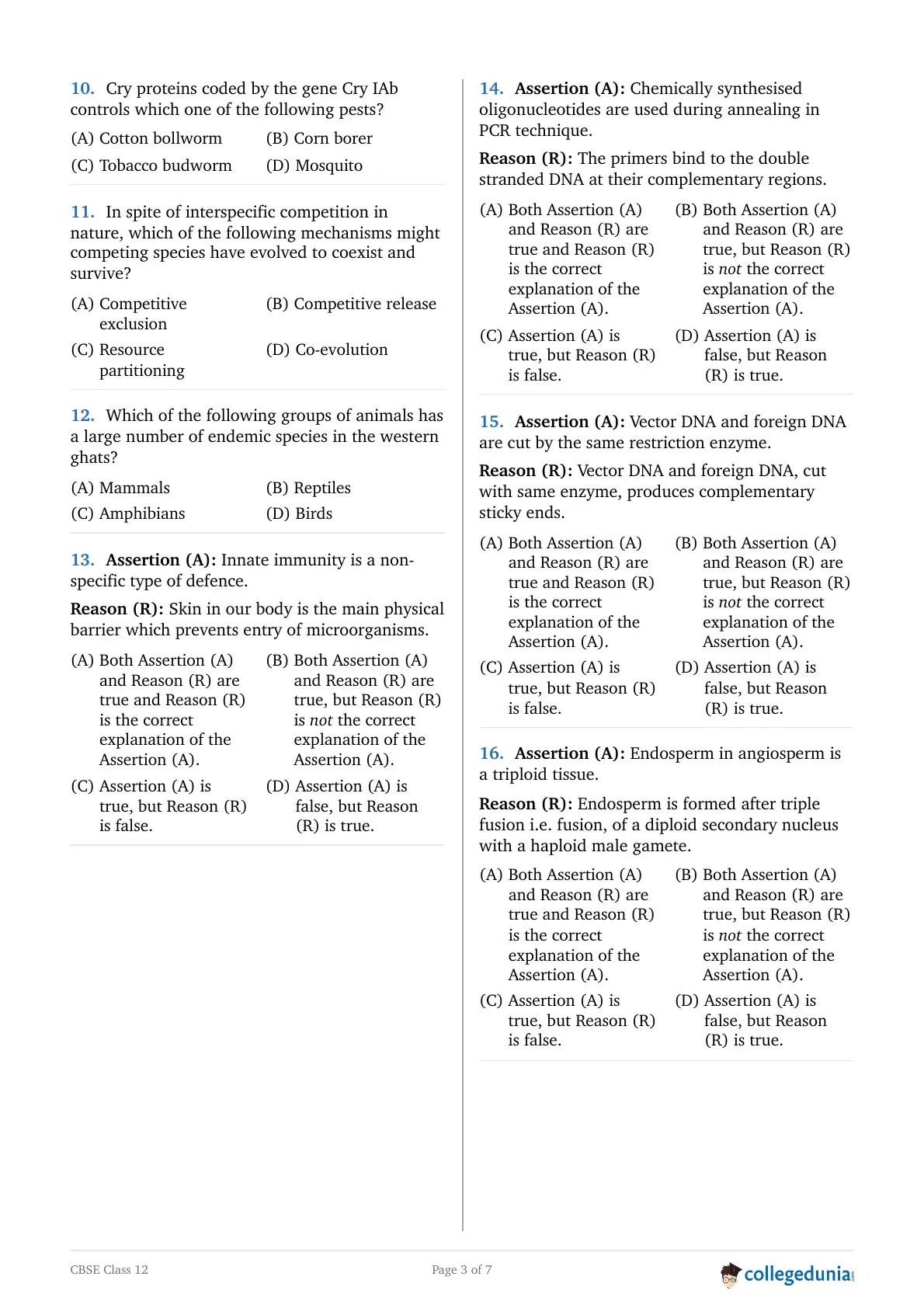
Cry proteins coded by the gene Cry IAb controls which one of the following pests ?
In spite of interspecific competition in nature, which of the following mechanisms might competing species have evolved to coexist and survive ?
Which of the following groups of animals has a large number of endemic species in the western ghats ?
Assertion (A) : Innate immunity is a non-specific type of defence.
Reason (R) : Skin in our body is the main physical barrier which prevents entry of microorganisms.
Assertion (A) : Chemically synthesised oligonucleotides are used during annealing in PCR technique.
Reason (R) : The primers bind to the double stranded DNA at their complementary regions.
Assertion (A) : Vector DNA and foreign DNA are cut by the same restriction enzyme.
Reason (R) : Vector DNA and foreign DNA, cut with same enzyme, produces complimentary sticky ends.
Assertion (A) : Endosperm in angiosperm is a triploid tissue.
Reason (R) : Endosperm is formed after triple fusion i.e. fusion, of a diploid secondary nucleus with a haploid male gamete.
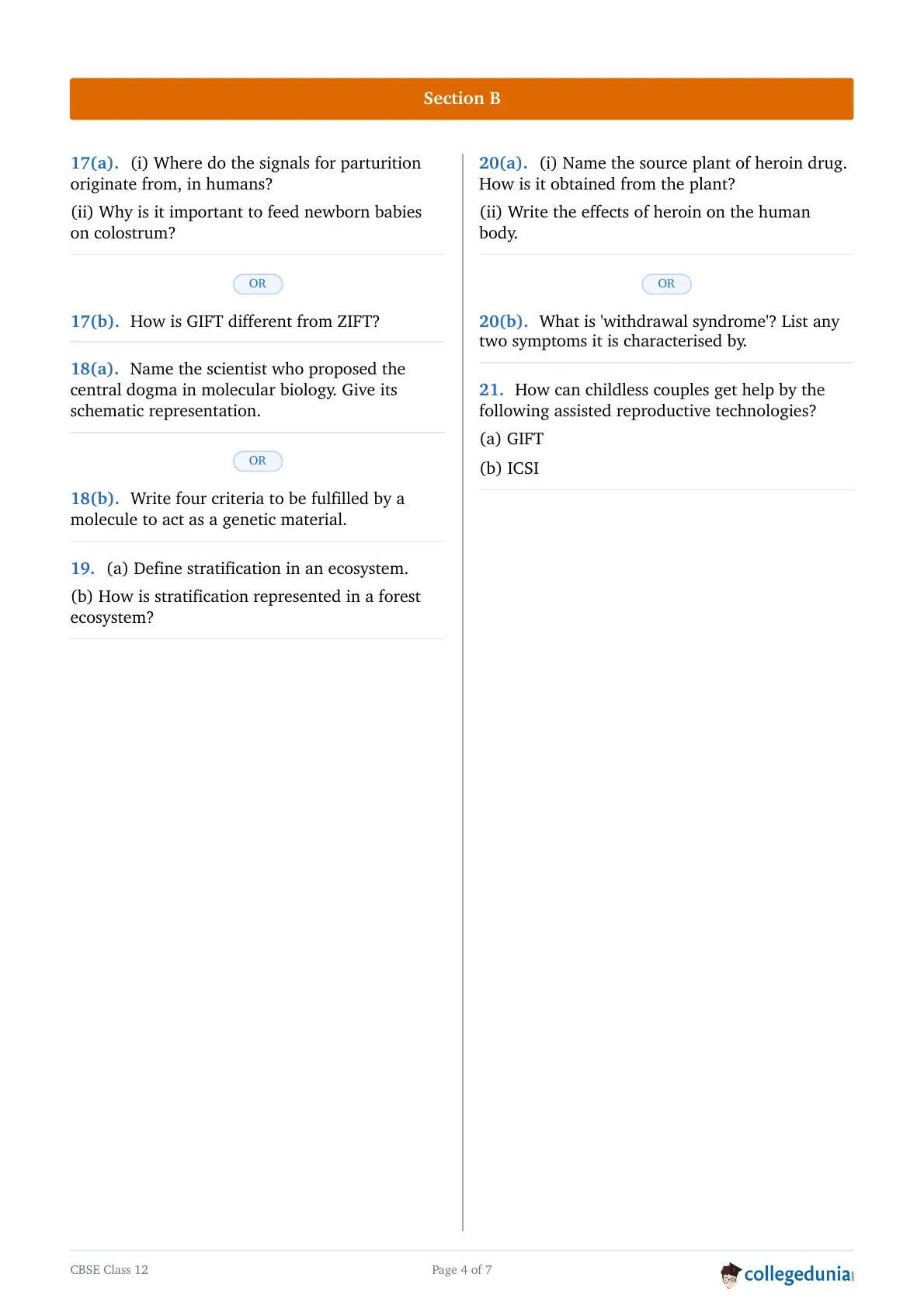
(i) Where do the signals for parturition originate from, in humans ?
(ii) Why is it important to feed newborn babies on colostrum ?
Name the scientist who proposed the central dogma in molecular biology. Give its schematic representation.
Write four criteria to be fulfilled by a molecule to act as a genetic material.
(a) Define stratification in an ecosystem.
(b) How is stratification represented in a forest ecosystem ?
(i) Name the source plant of heroin drug. How is it obtained from the plant ?
(ii) Write the effects of heroin on the human body.
What is "withdrawal syndrome" ? List any two symptoms it is characterised by.
How can childless couples get help by the following assisted reproductive technologies ?
(a) GIFT
(b) ICSI
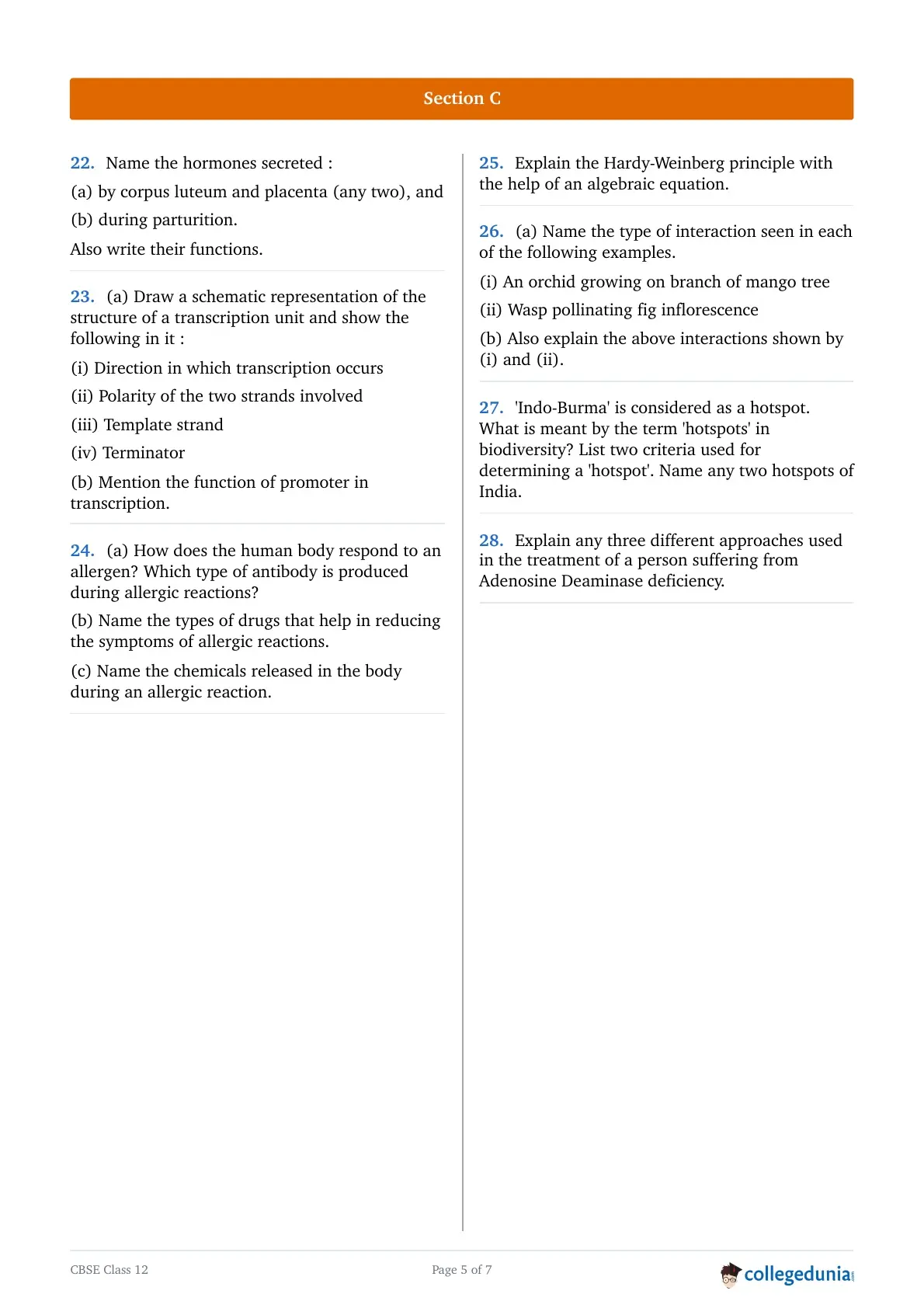
Name the hormones secreted :
(a) by corpus luteum and placenta (any two), and
(b) during parturition.
Also write their functions.
(a) Draw a schematic representation of the structure of a transcription unit and show the following in it :
(i) Direction in which transcription occurs
(ii) Polarity of the two strands involved
(iii) Template strand
(iv) Terminator
(b) Mention the function of promoter in transcription.
(a) How does the human body respond to an allergen ? Which type of antibody is produced during allergic reactions ?
(b) Name the types of drugs that help in reducing the symptoms of allergic reactions.
(c) Name the chemicals released in the body during an allergic reaction.
Explain the Hardy-Weinberg principle with the help of an algebric equation.
(a) Name the type of interaction seen in each of the following examples.
(i) An orchid growing on branch of mango tree
(ii) Wasp pollinating fig inflorescence
(b) Also explain the above interactions shown by (i) and (ii).
"Indo-Burma" is considered as a hotspot. What is meant by the term "hotspots" in biodiversity ? List two criteria used for determining a "hotspot". Name any two hotspots of India.
Explain any three different approaches used in the treatment of a person suffering from Adenosine Deaminase deficiency.
Sewage is generated in large quantities in the urban areas. It is treated in sewage treatment-plants (STPs) to make it less polluted before discharging into any natural water body. Observe the flow chart given below and answer the questions that follow :
Primary effluent is passed into large aeration tank
↓
Effluent is passed into settling tank to form the sediment (activated sludge)
(a) Name the two products obtained after primary treatment of sewage.
Sewage is generated in large quantities in the urban areas. It is treated in sewage treatment-plants (STPs) to make it less polluted before discharging into any natural water body. Observe the flow chart given below and answer the questions that follow :
Primary effluent is passed into large aeration tank
↓
Effluent is passed into settling tank to form the sediment (activated sludge)
(b) What happens to the activated sludge when it is passed into an anaerobic sludge digester ? Explain.
Sewage is generated in large quantities in the urban areas. It is treated in sewage treatment-plants (STPs) to make it less polluted before discharging into any natural water body. Observe the flow chart given below and answer the questions that follow :
Primary effluent is passed into large aeration tank
↓
Effluent is passed into settling tank to form the sediment (activated sludge)
(c) (i) Name the two groups of microbes present in the primary effluent after it is passed into large aeration tanks.
Sewage is generated in large quantities in the urban areas. It is treated in sewage treatment-plants (STPs) to make it less polluted before discharging into any natural water body. Observe the flow chart given below and answer the questions that follow :
Primary effluent is passed into large aeration tank
↓
Effluent is passed into settling tank to form the sediment (activated sludge)
(c) (ii) Define BOD. What happens to the BOD when organic matter present in the wastewater increases ?
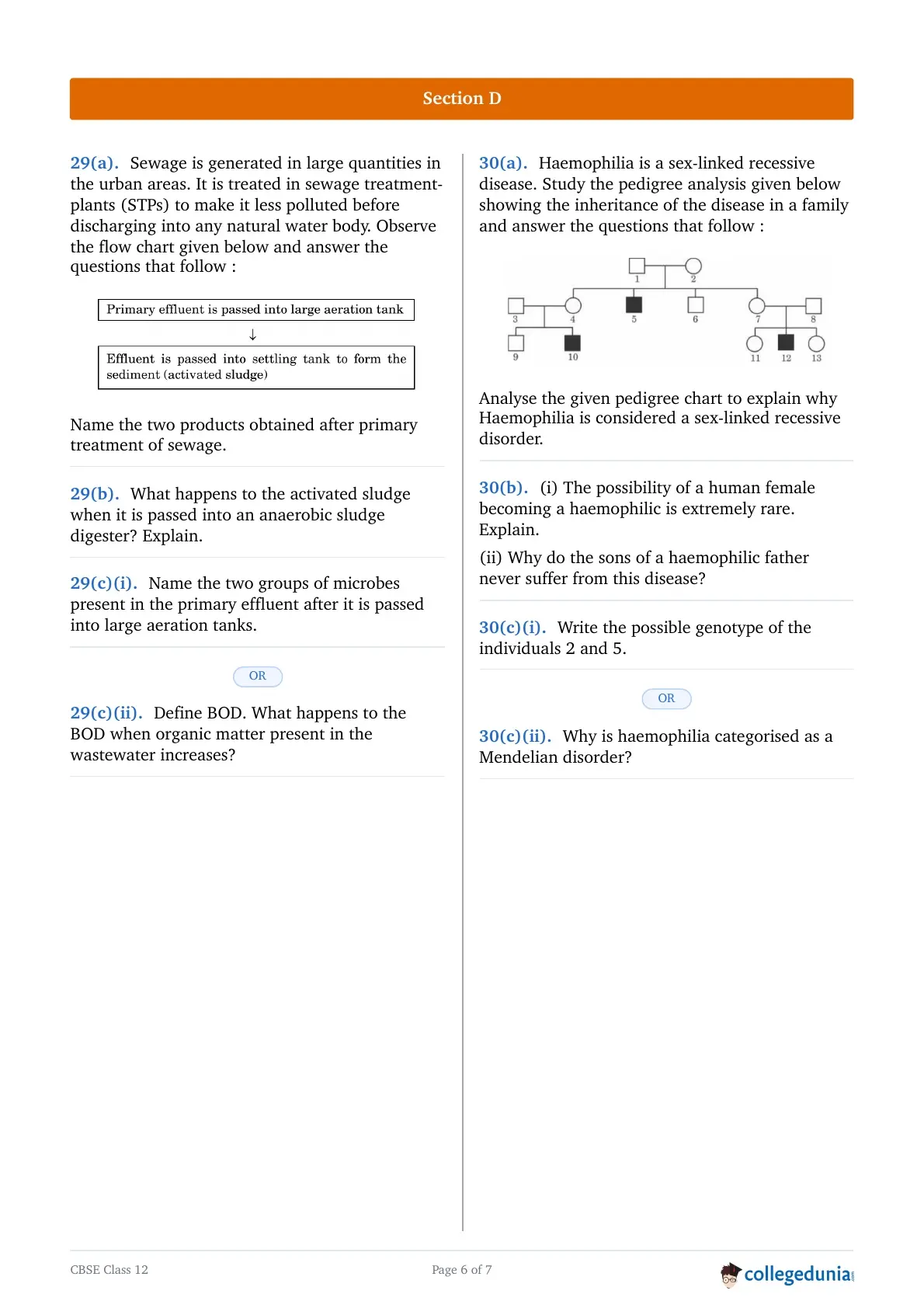
Haemophilia is a sex-linked recessive disease. Study the pedigree analysis given below showing the inheritance of the disease in a family and answer the questions that follow :
(a) Analyse the given pedigree chart to explain why Haemophilia is considered a sex-linked recessive disorder.

Haemophilia is a sex-linked recessive disease. Study the pedigree analysis given below showing the inheritance of the disease in a family and answer the questions that follow :
(b) (i) The possibility of a human female becoming a haemophilic is extremely rare. Explain.
(ii) Why do the sons of a haemophilic father never suffer from this disease ?
Haemophilia is a sex-linked recessive disease. Study the pedigree analysis given below showing the inheritance of the disease in a family and answer the questions that follow :
(c) (i) Write the possible genotype of the individuals 2 and 5.
Haemophilia is a sex-linked recessive disease. Study the pedigree analysis given below showing the inheritance of the disease in a family and answer the questions that follow :
(c) (ii) Why is haemophilia categorised as a Mendelian disorder ?
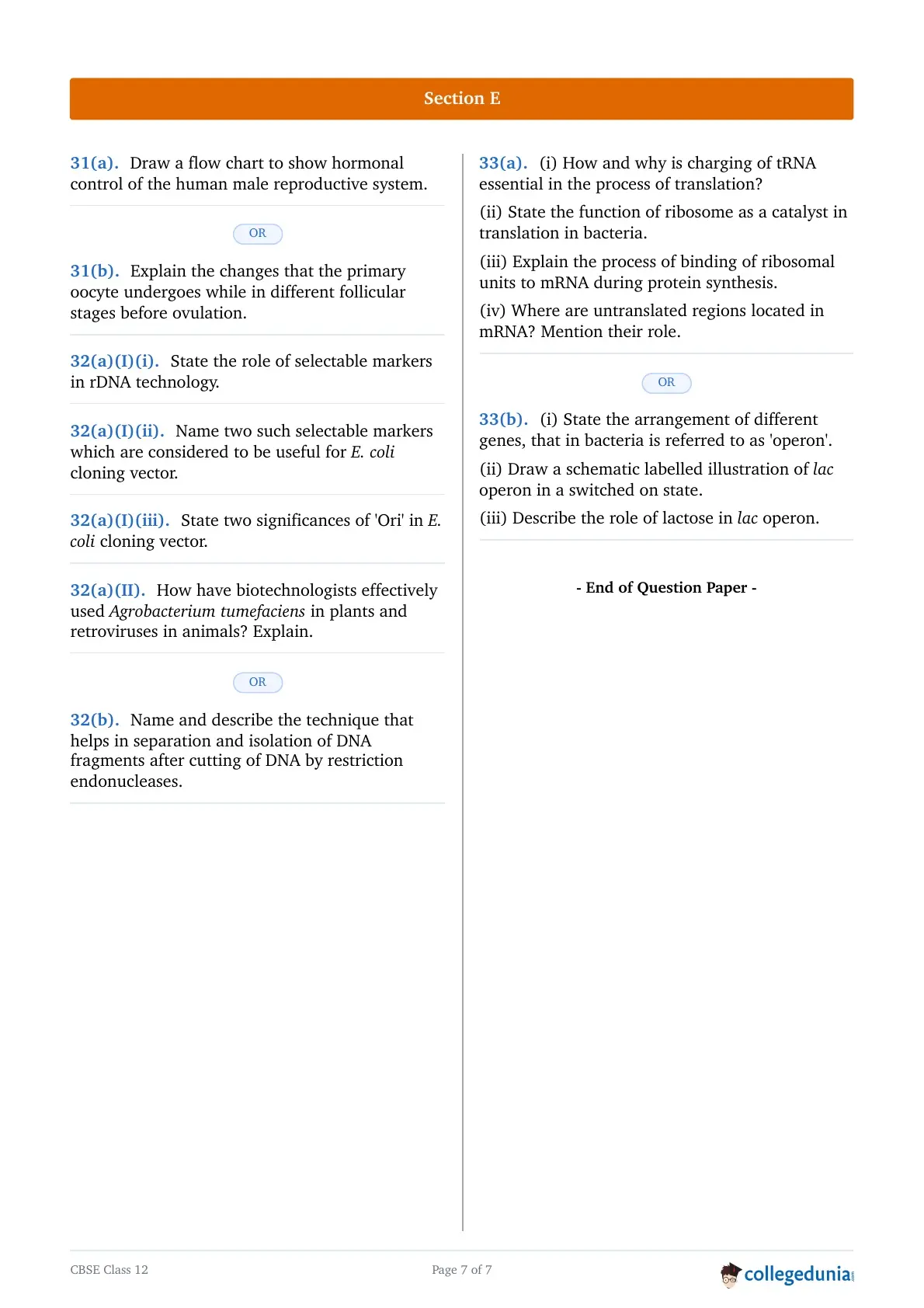
(a) Draw a flow chart to show hormonal control of the human male reproductive system.
(b) Explain the changes that the primary oocyte undergoes while in different follicular stages before ovulation.
(I) (i) State the role of selectable markers in rDNA technology.
(ii) Name two such selectable markers which are considered to be useful for E. coli cloning vector.
(iii) State two significances of "Ori" in E. coli cloning vector.
(II) How have biotechnologists effectively used Agrobacterium tumefaciens in plants and retroviruses in animals ? Explain.
Name and describe the technique that helps in separation and isolation of DNA fragments after cutting of DNA by restriction endonucleases.
(i) How and why is charging of tRNA essential in the process of translation ?
(ii) State the function of ribosome as a catalyst in translation in bacteria.
(iii) Explain the process of binding of ribosomal units to mRNA during protein synthesis.
(iv) Where are untranslated regions located in mRNA ? Mention their role.
(i) State the arrangement of different genes, that in bacteria is referred to as "operon".
(ii) Draw a schematic labelled illustration of lac operon in a switched on state.
(iii) Describe the role of lactose in lac operon.
CBSE Class 12 Biology Compartment 2026 Set 2 - (57/7/2) Exam Pattern and Marking Scheme
| Section | Questions | Question Type | Marks per Question | Marks |
|---|---|---|---|---|
| A | Q1 - Q16 | Multiple choice questions | 1 | 16 |
| B | Q17 - Q21 | Very short answer type | 2 | 10 |
| C | Q22 - Q28 | Short answer type | 3 | 21 |
| D | Q29 - Q30 | Case-based questions | 4 | 8 |
| E | Q31 - Q33 | Long answer type | 5 | 15 |
| Total | 33 questions | 70 |
CBSE Class 12 Biology Compartment 2026 Set 2 - (57/7/2) Question Paper FAQs
Ques. How many questions are there in the CBSE Class 12 Biology Compartment 2026 paper (Set 2 - 57/7/2)?
Ans. The paper has 33 questions in five sections (A to E) and all of them are compulsory.
Ques. How are the marks divided in the Biology Compartment 2026 paper?
Ans. Section A carries 16 marks, Section B 10 marks, Section C 21 marks, Section D 8 marks and Section E 15 marks, for a total of 70 marks.
Ques. Is there any internal choice in the paper?
Ans. There is no overall choice. An internal choice is given in Sections B, D and E, and a candidate writes only one of the alternatives.
Ques. Where can I download the solutions of this paper?
Ans. The table above has the Collegedunia PDF of this paper with detailed solutions.
Ques. How much time is given for the CBSE Class 12 Biology Compartment 2026 paper?
Ans. The paper is of 3 hours (10:30 AM to 1:30 PM). The question paper is distributed at 10:15 AM and candidates get 15 minutes to read it before they start writing.
Ques. When was the CBSE Class 12 Biology Compartment 2026 exam held?
Ans. The Class 12 compartment (supplementary) paper of Biology was held on July 28, 2026.
Ques. Where can I get the official CBSE Class 12 Biology Compartment question paper?
Ans. The official question papers are published on the CBSE website, cbse.gov.in.



Comments