




CBSE Class 12 Business Studies Compartment Set 1 - (66/7/1) Question Paper 2026 is available for download here. CBSE conducted the Class 12 Business Studies Compartment (supplementary) examination on July 28, 2026, from 10:30 AM to 1:30 PM. The Business Studies paper is of 80 marks and the time allowed is 3 hours. This paper carries the Q.P. code 66/7/1 and is of Set 1. The question paper was handed out at 10:15 AM, and the first 15 minutes were given for reading it.
Also Check: CBSE Class 12 Question Paper 2026 (All Subjects)
The paper has 34 questions, all compulsory, for 80 marks:
- Questions 1 to 20: multiple choice questions of 1 mark each
- Questions 21 to 24: 3 marks each (50 - 75 words)
- Questions 25 to 30: 4 marks each (about 150 words)
- Questions 31 to 34: 6 marks each (about 200 words)
- Internal choice is given in several questions
CBSE Class 12 Business Studies Compartment Set 1 - (66/7/1) Question Paper 2026 PDF
| CBSE Official PDF | CD PDF | CD PDF with Solutions |
|---|---|---|
| Download official PDF 0.47 MB | Download Collegedunia PDF 0.66 MB | Download solutions PDF 0.79 MB |
CBSE Class 12 Business Studies Compartment 2026 Set 1 (66/7/1) Questions with Solutions
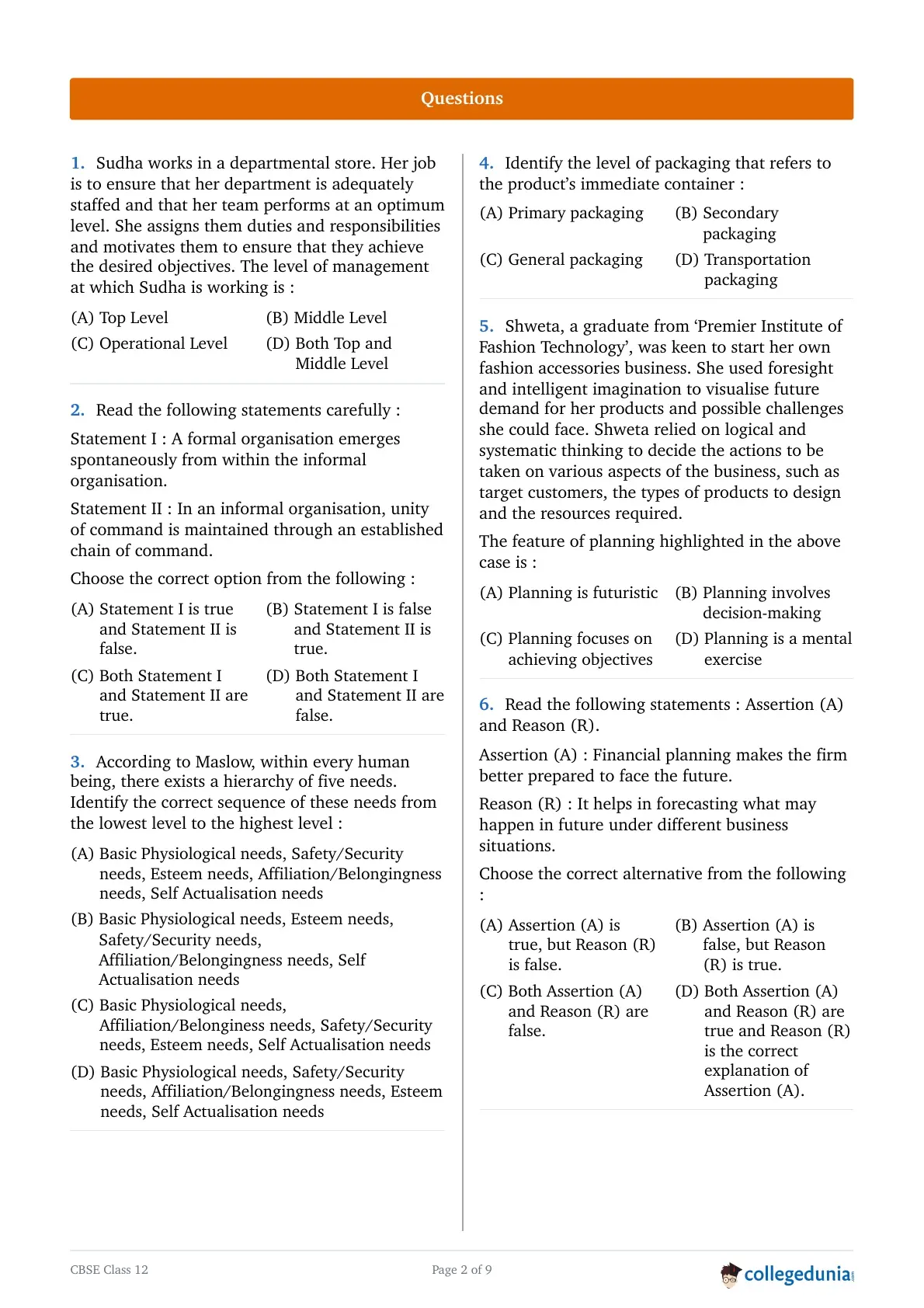
Sudha works in a departmental store. Her job is to ensure that her department is adequately staffed and that her team performs at an optimum level. She assigns them duties and responsibilities and motivates them to ensure that they achieve the desired objectives. The level of management at which Sudha is working is :
Read the following statements carefully :
Statement I : A formal organisation emerges spontaneously from within the informal organisation.
Statement II : In an informal organisation, unity of command is maintained through an established chain of command.
Choose the correct option from the following :
According to Maslow, within every human being, there exists a hierarchy of five needs. Identify the correct sequence of these needs from the lowest level to the highest level :
Identify the level of packaging that refers to the product’s immediate container :
Shweta, a graduate from ‘Premier Institute of Fashion Technology’, was keen to start her own fashion accessories business. She used foresight and intelligent imagination to visualise future demand for her products and possible challenges she could face. Shweta relied on logical and systematic thinking to decide the actions to be taken on various aspects of the business, such as target customers, the types of products to design and the resources required.
The feature of planning highlighted in the above case is :
Read the following statements : Assertion (A) and Reason (R).
Assertion (A) : Financial planning makes the firm better prepared to face the future.
Reason (R) : It helps in forecasting what may happen in future under different business situations.
Choose the correct alternative from the following :
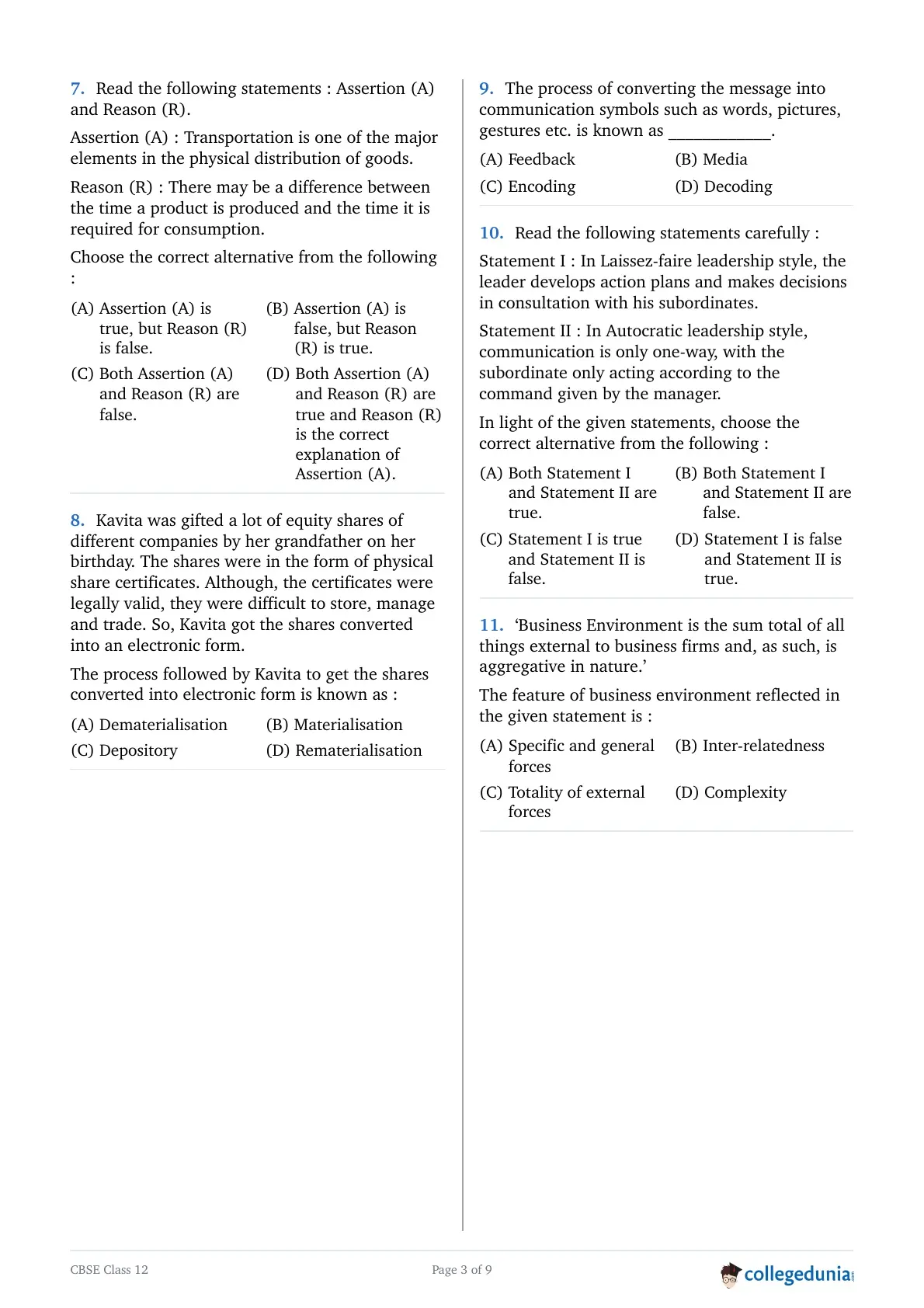
Read the following statements : Assertion (A) and Reason (R).
Assertion (A) : Transportation is one of the major elements in the physical distribution of goods.
Reason (R) : There may be a difference between the time a product is produced and the time it is required for consumption.
Choose the correct alternative from the following :
Kavita was gifted a lot of equity shares of different companies by her grandfather on her birthday. The shares were in the form of physical share certificates. Although, the certificates were legally valid, they were difficult to store, manage and trade. So, Kavita got the shares converted into an electronic form.
The process followed by Kavita to get the shares converted into electronic form is known as :
The process of converting the message into communication symbols such as words, pictures, gestures etc. is known as ____________.
Read the following statements carefully :
Statement I : In Laissez-faire leadership style, the leader develops action plans and makes decisions in consultation with his subordinates.
Statement II : In Autocratic leadership style, communication is only one-way, with the subordinate only acting according to the command given by the manager.
In light of the given statements, choose the correct alternative from the following :
‘Business Environment is the sum total of all things external to business firms and, as such, is aggregative in nature.’
The feature of business environment reflected in the given statement is :
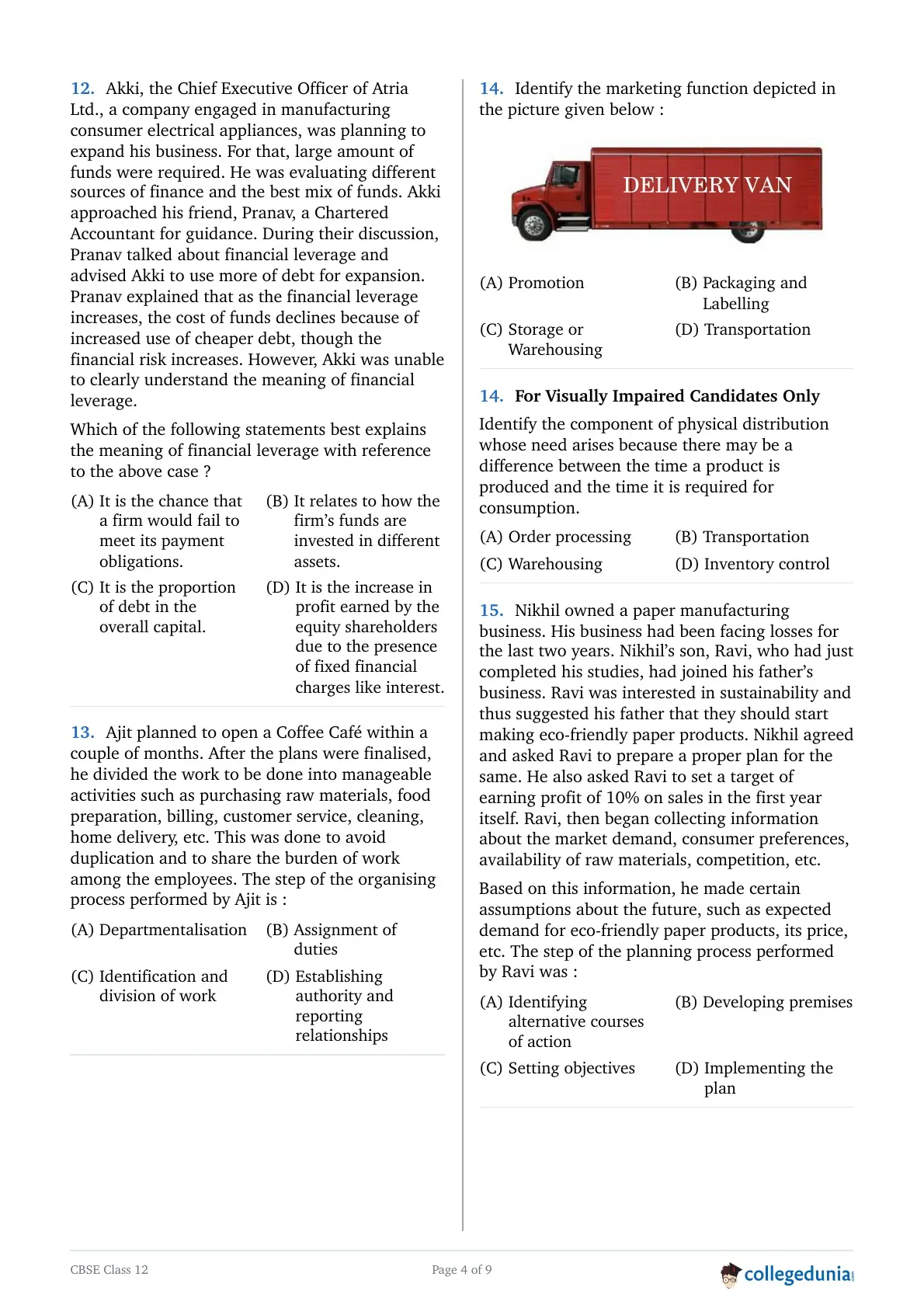
Akki, the Chief Executive Officer of Atria Ltd., a company engaged in manufacturing consumer electrical appliances, was planning to expand his business. For that, large amount of funds were required. He was evaluating different sources of finance and the best mix of funds. Akki approached his friend, Pranav, a Chartered Accountant for guidance. During their discussion, Pranav talked about financial leverage and advised Akki to use more of debt for expansion. Pranav explained that as the financial leverage increases, the cost of funds declines because of increased use of cheaper debt, though the financial risk increases. However, Akki was unable to clearly understand the meaning of financial leverage.
Which of the following statements best explains the meaning of financial leverage with reference to the above case ?
Ajit planned to open a Coffee Café within a couple of months. After the plans were finalised, he divided the work to be done into manageable activities such as purchasing raw materials, food preparation, billing, customer service, cleaning, home delivery, etc. This was done to avoid duplication and to share the burden of work among the employees. The step of the organising process performed by Ajit is :
Identify the marketing function depicted in the picture given below :

Nikhil owned a paper manufacturing business. His business had been facing losses for the last two years. Nikhil’s son, Ravi, who had just completed his studies, had joined his father’s business. Ravi was interested in sustainability and thus suggested his father that they should start making eco-friendly paper products. Nikhil agreed and asked Ravi to prepare a proper plan for the same. He also asked Ravi to set a target of earning profit of 10% on sales in the first year itself. Ravi, then began collecting information about the market demand, consumer preferences, availability of raw materials, competition, etc.
Based on this information, he made certain assumptions about the future, such as expected demand for eco-friendly paper products, its price, etc. The step of the planning process performed by Ravi was :
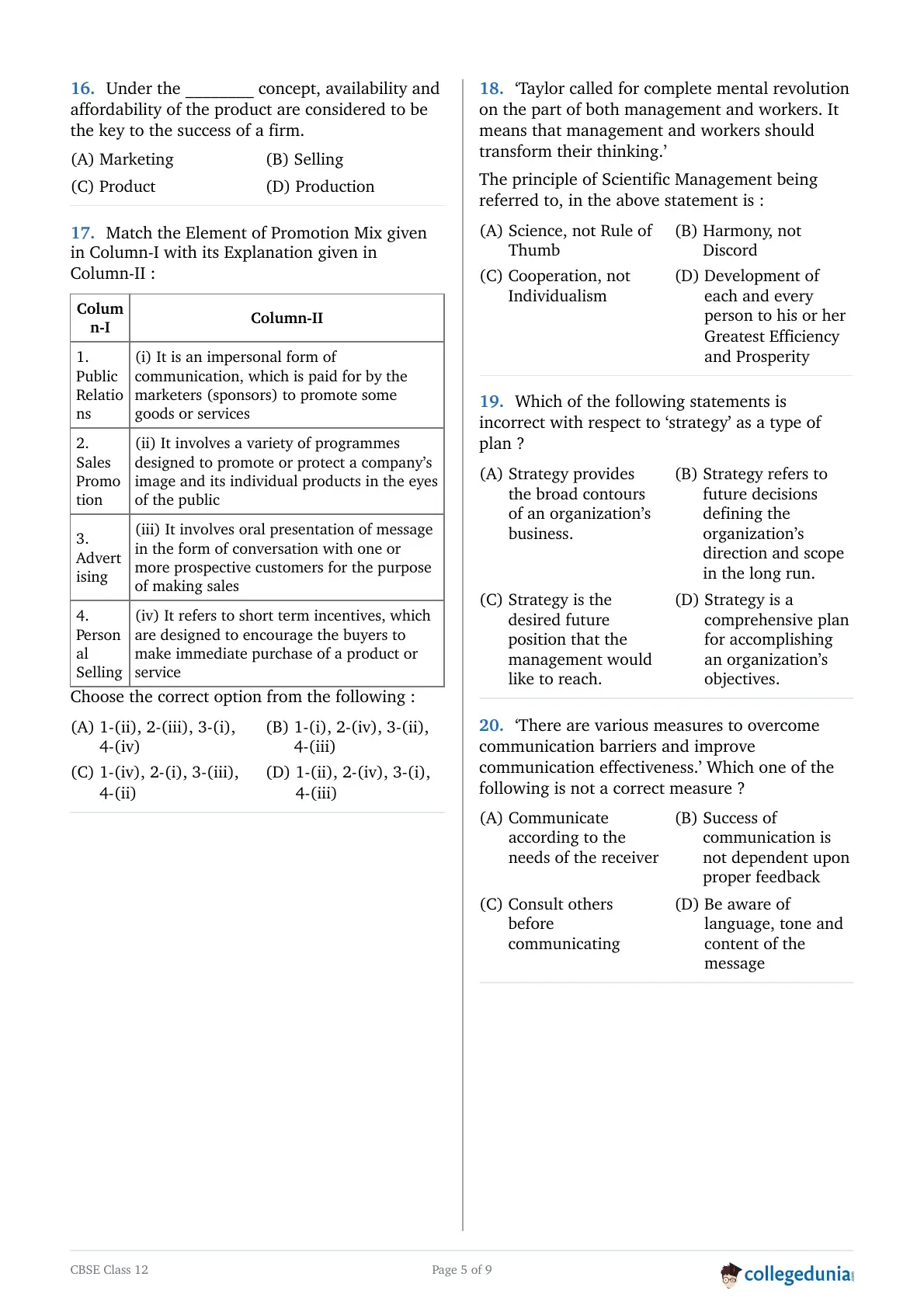
Under the ________ concept, availability and affordability of the product are considered to be the key to the success of a firm.
Match the Element of Promotion Mix given in Column-I with its Explanation given in Column-II :
| Column-I | Column-II |
|---|---|
| 1. Public Relations | (i) It is an impersonal form of communication, which is paid for by the marketers (sponsors) to promote some goods or services |
| 2. Sales Promotion | (ii) It involves a variety of programmes designed to promote or protect a company’s image and its individual products in the eyes of the public |
| 3. Advertising | (iii) It involves oral presentation of message in the form of conversation with one or more prospective customers for the purpose of making sales |
| 4. Personal Selling | (iv) It refers to short term incentives, which are designed to encourage the buyers to make immediate purchase of a product or service |
Choose the correct option from the following :
‘Taylor called for complete mental revolution on the part of both management and workers. It means that management and workers should transform their thinking.’
The principle of Scientific Management being referred to, in the above statement is :
Which of the following statements is incorrect with respect to ‘strategy’ as a type of plan ?
‘There are various measures to overcome communication barriers and improve communication effectiveness.’ Which one of the following is not a correct measure ?
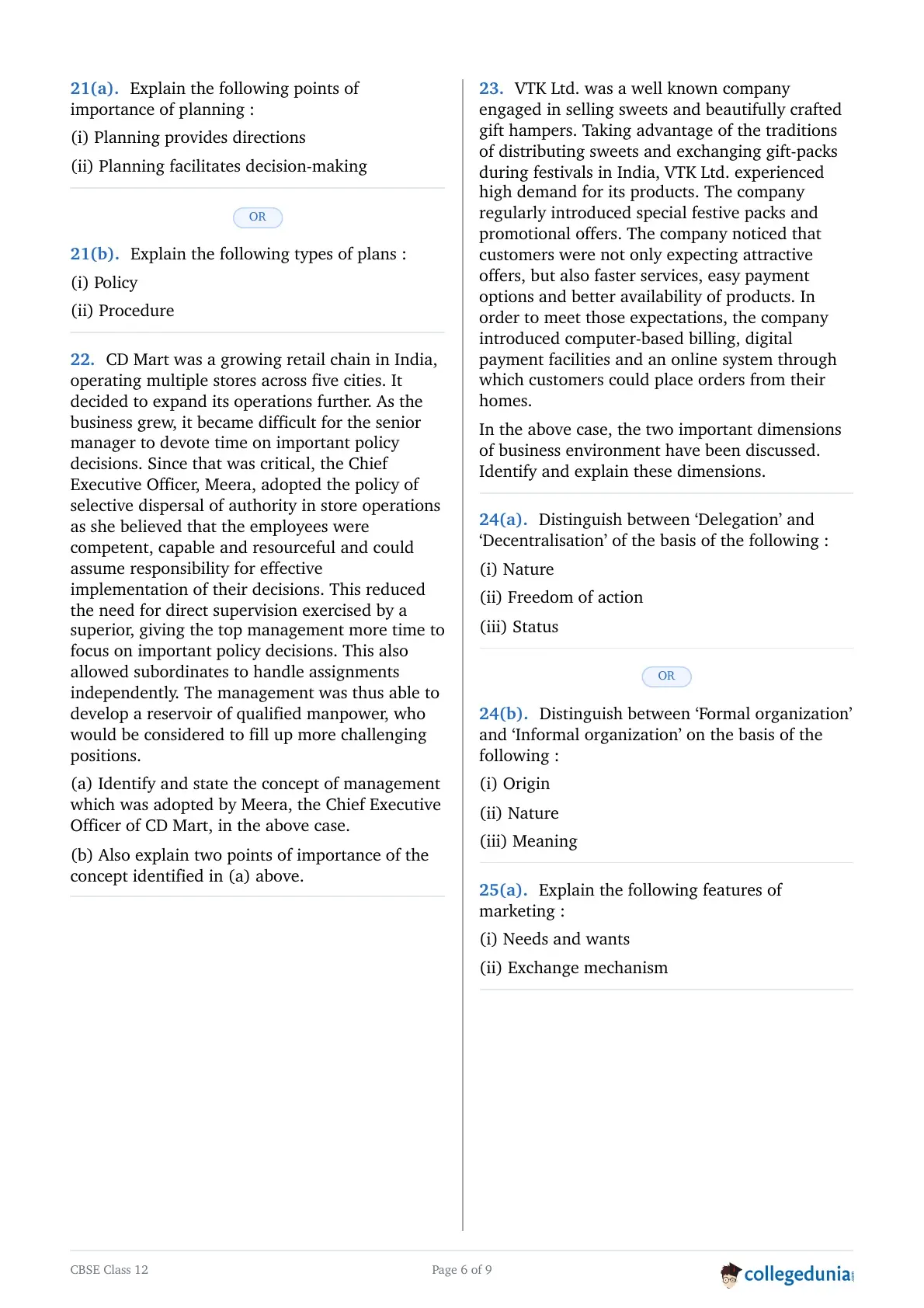
Explain the following points of importance of planning :
(i) Planning provides directions
(ii) Planning facilitates decision-making
Explain the following types of plans :
(i) Policy
(ii) Procedure
CD Mart was a growing retail chain in India, operating multiple stores across five cities. It decided to expand its operations further. As the business grew, it became difficult for the senior manager to devote time on important policy decisions. Since that was critical, the Chief Executive Officer, Meera, adopted the policy of selective dispersal of authority in store operations as she believed that the employees were competent, capable and resourceful and could assume responsibility for effective implementation of their decisions. This reduced the need for direct supervision exercised by a superior, giving the top management more time to focus on important policy decisions. This also allowed subordinates to handle assignments independently. The management was thus able to develop a reservoir of qualified manpower, who would be considered to fill up more challenging positions.
(a) Identify and state the concept of management which was adopted by Meera, the Chief Executive Officer of CD Mart, in the above case.
(b) Also explain two points of importance of the concept identified in (a) above.
VTK Ltd. was a well known company engaged in selling sweets and beautifully crafted gift hampers. Taking advantage of the traditions of distributing sweets and exchanging gift-packs during festivals in India, VTK Ltd. experienced high demand for its products. The company regularly introduced special festive packs and promotional offers. The company noticed that customers were not only expecting attractive offers, but also faster services, easy payment options and better availability of products. In order to meet those expectations, the company introduced computer-based billing, digital payment facilities and an online system through which customers could place orders from their homes.
In the above case, the two important dimensions of business environment have been discussed. Identify and explain these dimensions.
Distinguish between ‘Delegation’ and ‘Decentralisation’ of the basis of the following :
(i) Nature
(ii) Freedom of action
(iii) Status
Distinguish between ‘Formal organization’ and ‘Informal organization’ on the basis of the following :
(i) Origin
(ii) Nature
(iii) Meaning
Explain the following features of marketing :
(i) Needs and wants
(ii) Exchange mechanism
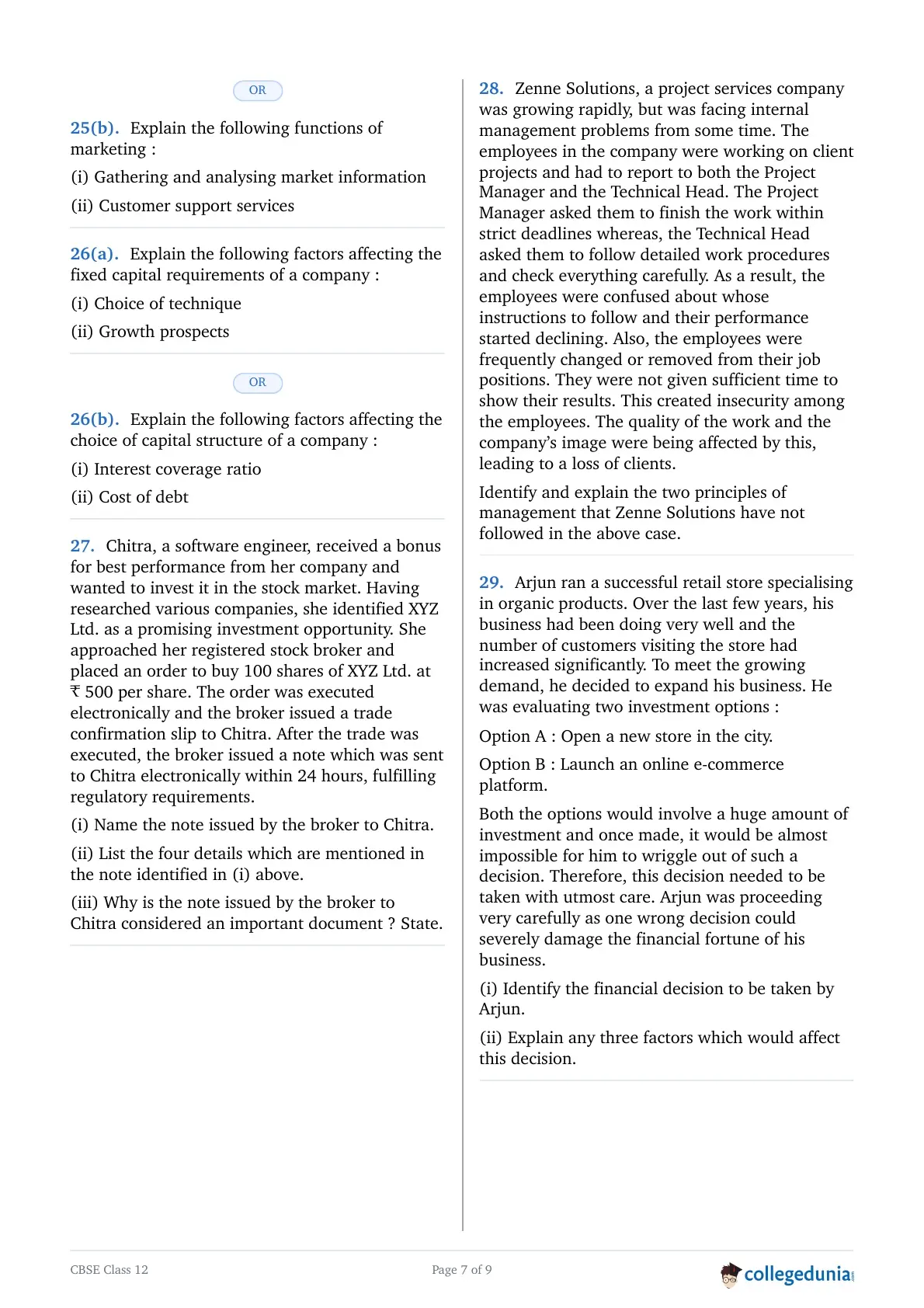
Explain the following functions of marketing :
(i) Gathering and analysing market information
(ii) Customer support services
Explain the following factors affecting the fixed capital requirements of a company :
(i) Choice of technique
(ii) Growth prospects
Explain the following factors affecting the choice of capital structure of a company :
(i) Interest coverage ratio
(ii) Cost of debt
Chitra, a software engineer, received a bonus for best performance from her company and wanted to invest it in the stock market. Having researched various companies, she identified XYZ Ltd. as a promising investment opportunity. She approached her registered stock broker and placed an order to buy 100 shares of XYZ Ltd. at ₹ 500 per share. The order was executed electronically and the broker issued a trade confirmation slip to Chitra. After the trade was executed, the broker issued a note which was sent to Chitra electronically within 24 hours, fulfilling regulatory requirements.
(i) Name the note issued by the broker to Chitra.
(ii) List the four details which are mentioned in the note identified in (i) above.
(iii) Why is the note issued by the broker to Chitra considered an important document ? State.
Zenne Solutions, a project services company was growing rapidly, but was facing internal management problems from some time. The employees in the company were working on client projects and had to report to both the Project Manager and the Technical Head. The Project Manager asked them to finish the work within strict deadlines whereas, the Technical Head asked them to follow detailed work procedures and check everything carefully. As a result, the employees were confused about whose instructions to follow and their performance started declining. Also, the employees were frequently changed or removed from their job positions. They were not given sufficient time to show their results. This created insecurity among the employees. The quality of the work and the company’s image were being affected by this, leading to a loss of clients.
Identify and explain the two principles of management that Zenne Solutions have not followed in the above case.
Arjun ran a successful retail store specialising in organic products. Over the last few years, his business had been doing very well and the number of customers visiting the store had increased significantly. To meet the growing demand, he decided to expand his business. He was evaluating two investment options :
Option A : Open a new store in the city.
Option B : Launch an online e-commerce platform.
Both the options would involve a huge amount of investment and once made, it would be almost impossible for him to wriggle out of such a decision. Therefore, this decision needed to be taken with utmost care. Arjun was proceeding very carefully as one wrong decision could severely damage the financial fortune of his business.
(i) Identify the financial decision to be taken by Arjun.
(ii) Explain any three factors which would affect this decision.
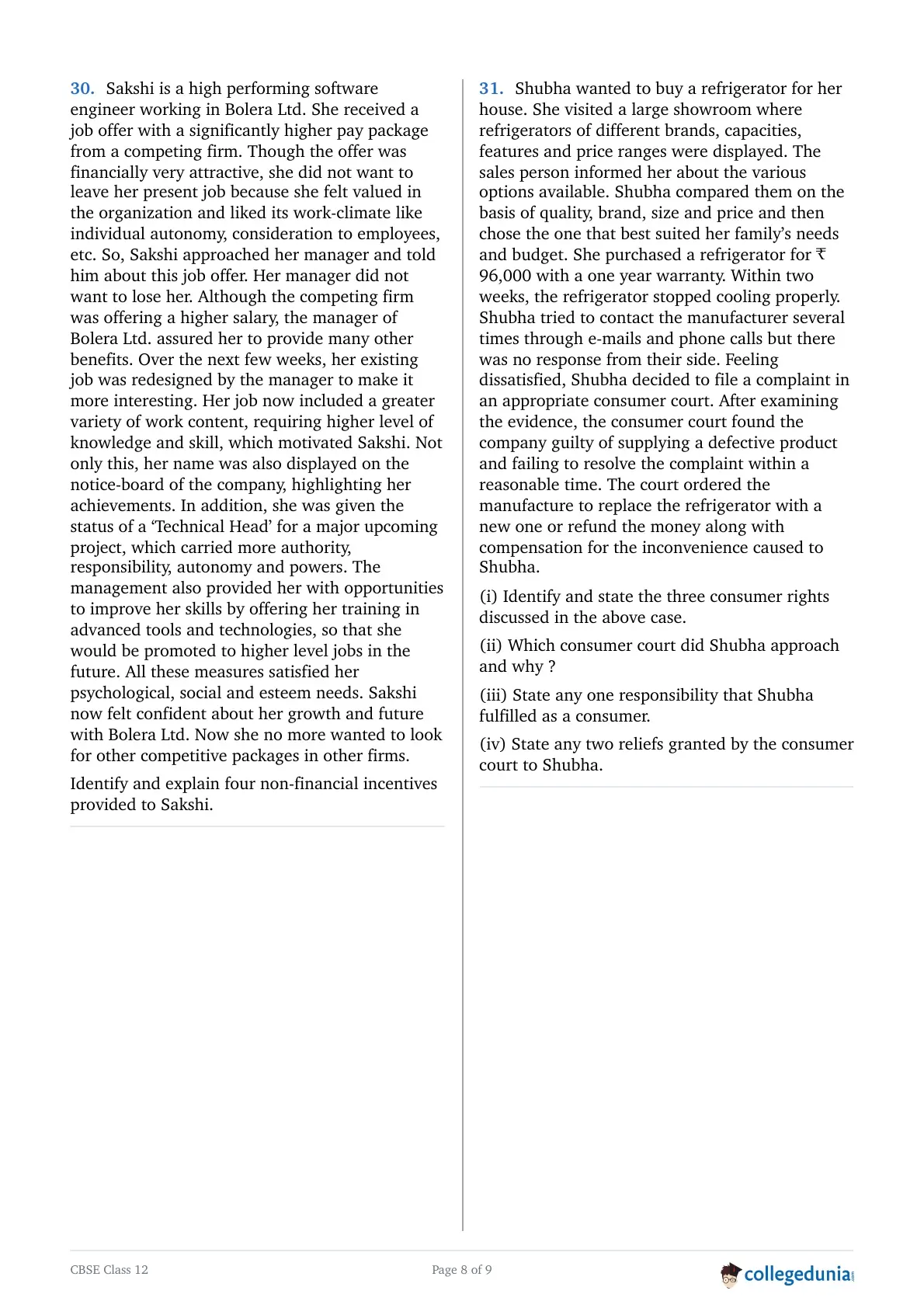
Sakshi is a high performing software engineer working in Bolera Ltd. She received a job offer with a significantly higher pay package from a competing firm. Though the offer was financially very attractive, she did not want to leave her present job because she felt valued in the organization and liked its work-climate like individual autonomy, consideration to employees, etc. So, Sakshi approached her manager and told him about this job offer. Her manager did not want to lose her. Although the competing firm was offering a higher salary, the manager of Bolera Ltd. assured her to provide many other benefits. Over the next few weeks, her existing job was redesigned by the manager to make it more interesting. Her job now included a greater variety of work content, requiring higher level of knowledge and skill, which motivated Sakshi. Not only this, her name was also displayed on the notice-board of the company, highlighting her achievements. In addition, she was given the status of a ‘Technical Head’ for a major upcoming project, which carried more authority, responsibility, autonomy and powers. The management also provided her with opportunities to improve her skills by offering her training in advanced tools and technologies, so that she would be promoted to higher level jobs in the future. All these measures satisfied her psychological, social and esteem needs. Sakshi now felt confident about her growth and future with Bolera Ltd. Now she no more wanted to look for other competitive packages in other firms.
Identify and explain four non-financial incentives provided to Sakshi.
Shubha wanted to buy a refrigerator for her house. She visited a large showroom where refrigerators of different brands, capacities, features and price ranges were displayed. The sales person informed her about the various options available. Shubha compared them on the basis of quality, brand, size and price and then chose the one that best suited her family’s needs and budget. She purchased a refrigerator for ₹ 96,000 with a one year warranty. Within two weeks, the refrigerator stopped cooling properly. Shubha tried to contact the manufacturer several times through e-mails and phone calls but there was no response from their side. Feeling dissatisfied, Shubha decided to file a complaint in an appropriate consumer court. After examining the evidence, the consumer court found the company guilty of supplying a defective product and failing to resolve the complaint within a reasonable time. The court ordered the manufacture to replace the refrigerator with a new one or refund the money along with compensation for the inconvenience caused to Shubha.
(i) Identify and state the three consumer rights discussed in the above case.
(ii) Which consumer court did Shubha approach and why ?
(iii) State any one responsibility that Shubha fulfilled as a consumer.
(iv) State any two reliefs granted by the consumer court to Shubha.
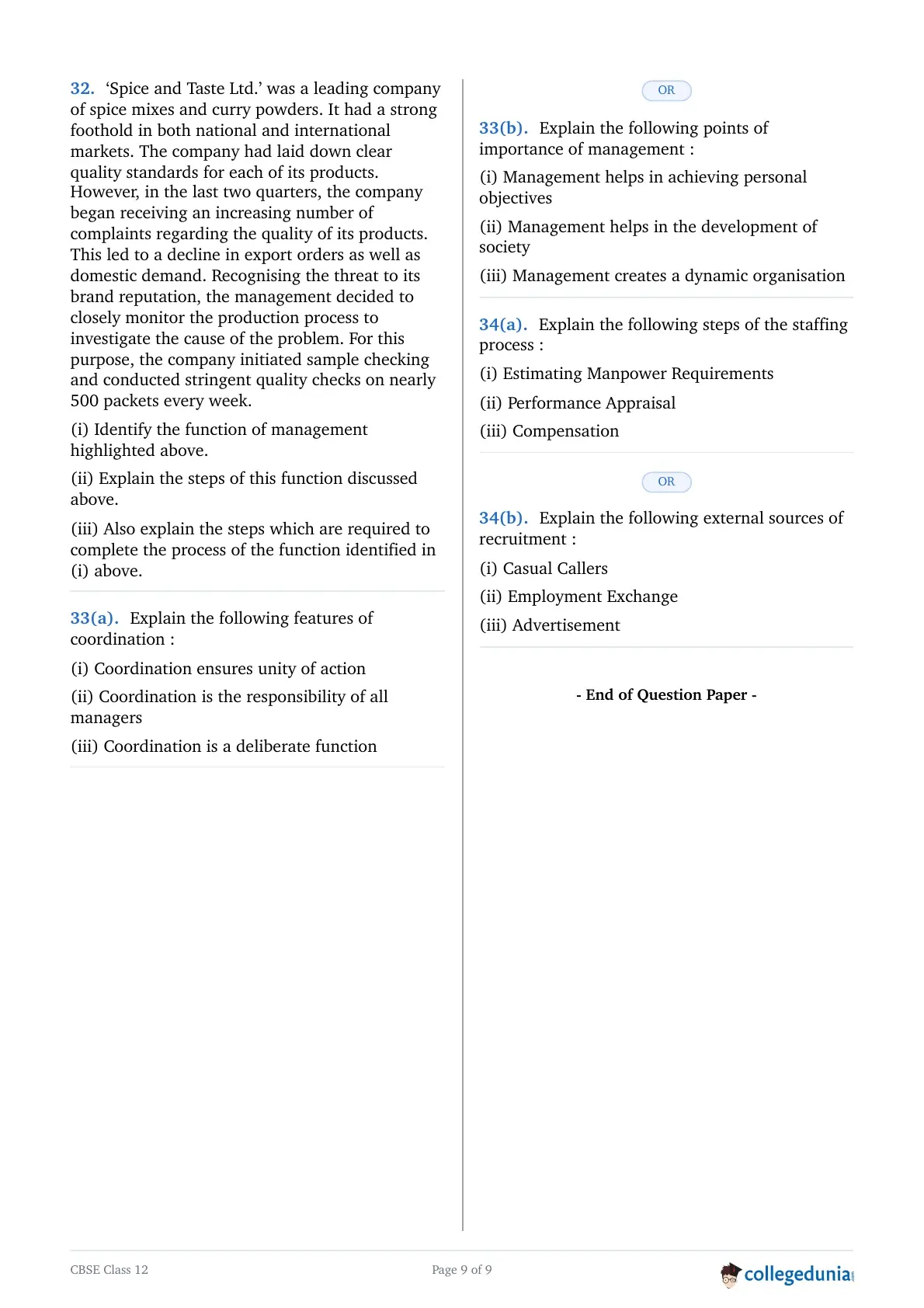
‘Spice and Taste Ltd.’ was a leading company of spice mixes and curry powders. It had a strong foothold in both national and international markets. The company had laid down clear quality standards for each of its products. However, in the last two quarters, the company began receiving an increasing number of complaints regarding the quality of its products. This led to a decline in export orders as well as domestic demand. Recognising the threat to its brand reputation, the management decided to closely monitor the production process to investigate the cause of the problem. For this purpose, the company initiated sample checking and conducted stringent quality checks on nearly 500 packets every week.
(i) Identify the function of management highlighted above.
(ii) Explain the steps of this function discussed above.
(iii) Also explain the steps which are required to complete the process of the function identified in (i) above.
Explain the following features of coordination :
(i) Coordination ensures unity of action
(ii) Coordination is the responsibility of all managers
(iii) Coordination is a deliberate function
Explain the following points of importance of management :
(i) Management helps in achieving personal objectives
(ii) Management helps in the development of society
(iii) Management creates a dynamic organisation
Explain the following steps of the staffing process :
(i) Estimating Manpower Requirements
(ii) Performance Appraisal
(iii) Compensation
Explain the following external sources of recruitment :
(i) Casual Callers
(ii) Employment Exchange
(iii) Advertisement
CBSE Class 12 Business Studies Compartment 2026 Set 1 - (66/7/1) Exam Pattern and Marking Scheme
| Questions | Question Type | Marks per Question | Word Limit | Marks |
|---|---|---|---|---|
| Q1 - Q20 | Multiple choice questions | 1 | - | 20 |
| Q21 - Q24 | Short answer / case-based questions | 3 | 50 - 75 words | 12 |
| Q25 - Q30 | Short answer / case-based questions | 4 | About 150 words | 24 |
| Q31 - Q34 | Long answer questions | 6 | About 200 words | 24 |
| Total | 34 questions | 80 |
CBSE Class 12 Business Studies Compartment 2026 Set 1 - (66/7/1) Question Paper FAQs
Ques. How many questions are there in the CBSE Class 12 Business Studies Compartment 2026 paper (Set 1 - 66/7/1)?
Ans. The paper has 34 questions and all of them are compulsory.
Ques. How are the marks divided in the Business Studies Compartment 2026 paper?
Ans. Q1 - Q20 (MCQs) carry 20 marks, Q21 - Q24 (3 marks each) carry 12 marks, Q25 - Q30 (4 marks each) carry 24 marks and Q31 - Q34 (6 marks each) carry 24 marks, for a total of 80 marks.
Ques. What is the word limit for the answers?
Ans. Answers to 3-mark questions may be 50 to 75 words, answers to 4-mark questions about 150 words and answers to 6-mark questions about 200 words.
Ques. How much time is given for the CBSE Class 12 Business Studies Compartment 2026 paper?
Ans. The paper is of 3 hours (10:30 AM to 1:30 PM). The question paper is distributed at 10:15 AM and candidates get 15 minutes to read it before they start writing.
Ques. When was the CBSE Class 12 Business Studies Compartment 2026 exam held?
Ans. The Class 12 compartment (supplementary) paper of Business Studies was held on July 28, 2026.
Ques. Where can I get the official CBSE Class 12 Business Studies Compartment question paper?
Ans. The official question papers are published on the CBSE website, cbse.gov.in. You can also download the official PDF from the table above.



Comments