




CBSE Class 12 Chemistry Question Paper 2025 (Set 2 - 56/5/2) with Solutions is now available here for download. CBSE conducted the Class 12 Chemistry examination on February 27, 2025, from 10:30 AM to 1:30 PM.
CBSE Class 12 Chemistry paper is of total 100 marks out of which 70 marks are allocated to the theory paper and 30 marks are for practical examination.
Also Check: CBSE Class 12 Question Paper 2025 (All Subjects)
The theory paper consists of 33 questions divided into five sections:
- Section A contains Multiple Choice Questions (MCQs),
- Section B contains Very Short Answer Type (VSA) Questions,
- Section C contains Short Answer Type (SA) Questions,
- Section D contains Case-Study based Questions,
- Section E contains Long Answer (LA) Type Questions.
All sections are compulsory.
CBSE Class 12 Chemistry Question Paper 2025 (Set 2 - 56/5/2) with Solution PDF
| CBSE Official PDF | CD PDF | CD PDF with Solutions |
|---|---|---|
| Download official PDF 0.61 MB | Download Collegedunia PDF 0.44 MB | Download solutions PDF 0.50 MB |
CBSE Class 12 Chemistry 2025 Set 2 (56/5/2) Questions with Solutions
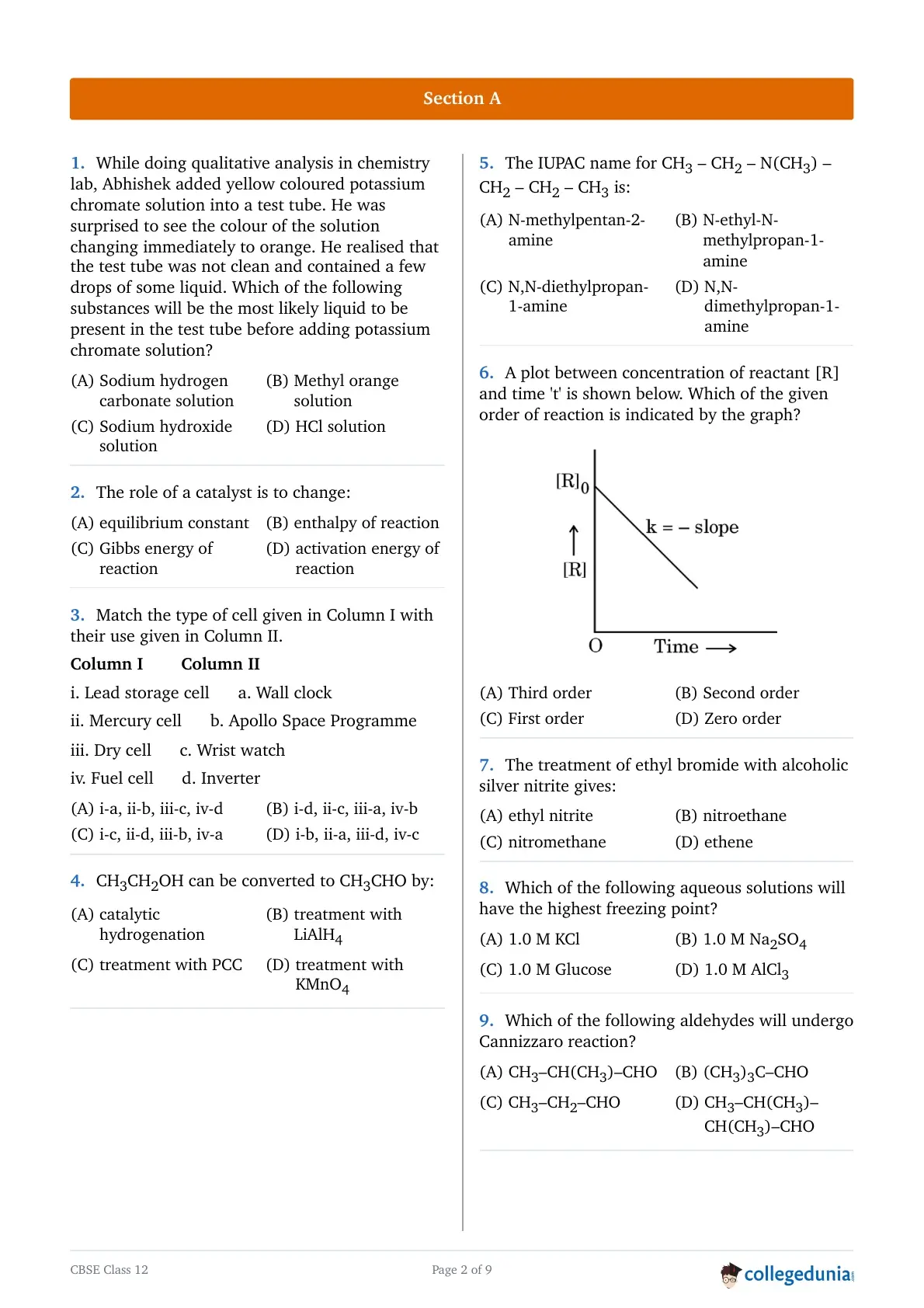
While doing qualitative analysis in chemistry lab, Abhishek added yellow coloured potassium chromate solution into a test tube. He was surprised to see the colour of the solution changing immediately to orange. He realised that the test tube was not clean and contained a few drops of some liquid. Which of the following substances will be the most likely liquid to be present in the test tube before adding potassium chromate solution?
The role of a catalyst is to change _____________ .
Match the type of cell given in Column I with their use given in Column II.
| Column I | Column II |
|---|---|
| i. Lead storage cell | a. Wall clock |
| ii. Mercury cell | b. Apollo Space Programme |
| iii. Dry cell | c. Wrist watch |
| iv. Fuel cell | d. Inverter |
A plot between concentration of reactant [R] and time 't' is shown below. Which of the given order of reaction is indicated by the graph?
Which of the following aqueous solutions will have the highest freezing point?
Which of the following aldehydes will undergo Cannizzaro reaction?
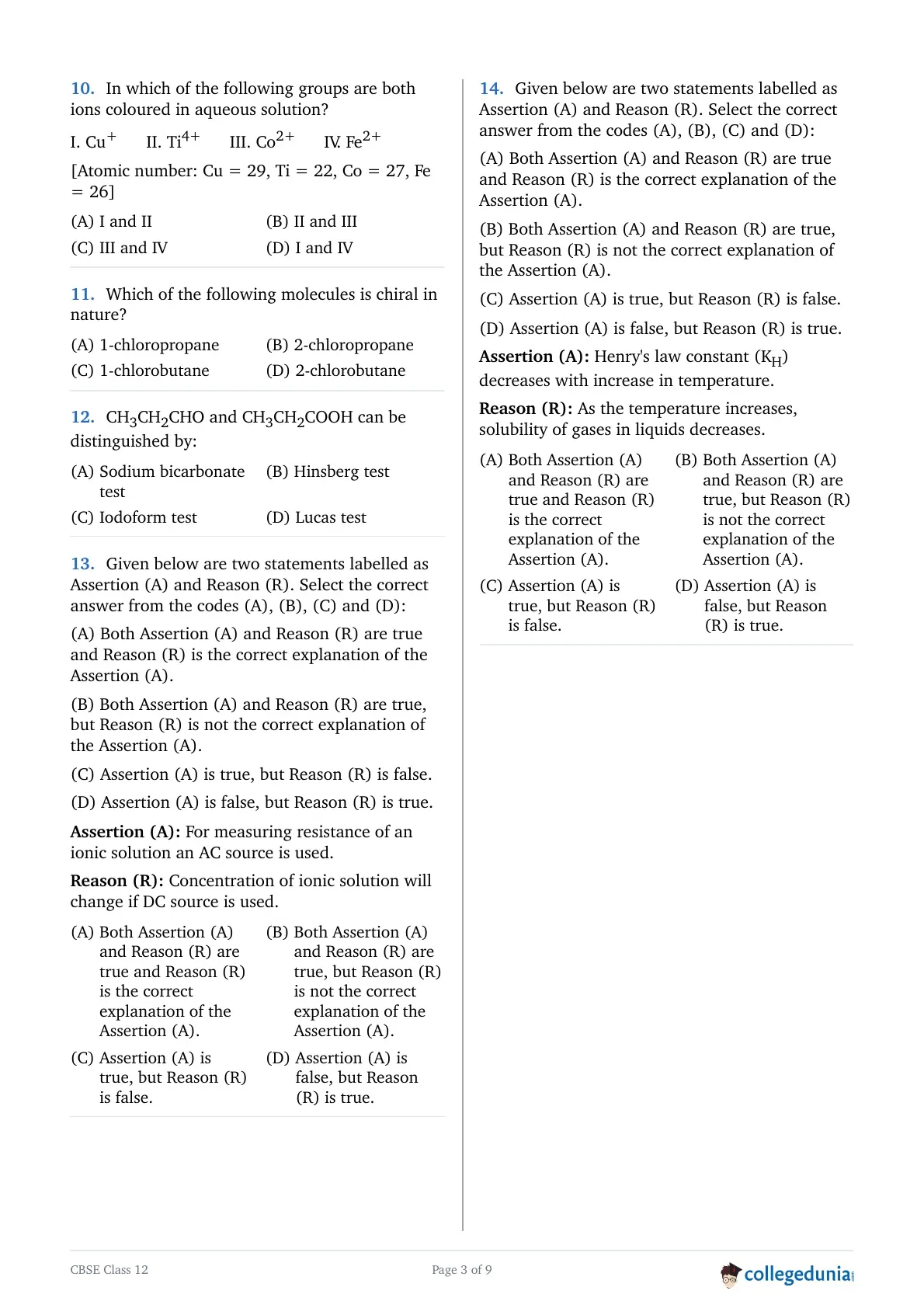
In which of the following groups are both ions coloured in aqueous solution?
I. \( Cu^{+} \) II. \( Ti^{4+} \) III. \( Co^{2+} \) IV. \( Fe^{2+} \)
[Atomic number : Cu = 29, Ti = 22, Co = 27, Fe = 26]
Given below are two statements labelled as Assertion (A) and Reason (R). Select the correct answer from the codes (A), (B), (C) and (D):
(A) Both Assertion (A) and Reason (R) are true and Reason (R) is the correct explanation of the Assertion (A).
(B) Both Assertion (A) and Reason (R) are true, but Reason (R) is not the correct explanation of the Assertion (A).
(C) Assertion (A) is true, but Reason (R) is false.
(D) Assertion (A) is false, but Reason (R) is true.
Assertion (A): For measuring resistance of an ionic solution an AC source is used.
Reason (R): Concentration of ionic solution will change if DC source is used.
Given below are two statements labelled as Assertion (A) and Reason (R). Select the correct answer from the codes (A), (B), (C) and (D):
(A) Both Assertion (A) and Reason (R) are true and Reason (R) is the correct explanation of the Assertion (A).
(B) Both Assertion (A) and Reason (R) are true, but Reason (R) is not the correct explanation of the Assertion (A).
(C) Assertion (A) is true, but Reason (R) is false.
(D) Assertion (A) is false, but Reason (R) is true.
Assertion (A): Henry's law constant (KH) decreases with increase in temperature.
Reason (R): As the temperature increases, solubility of gases in liquids decreases.
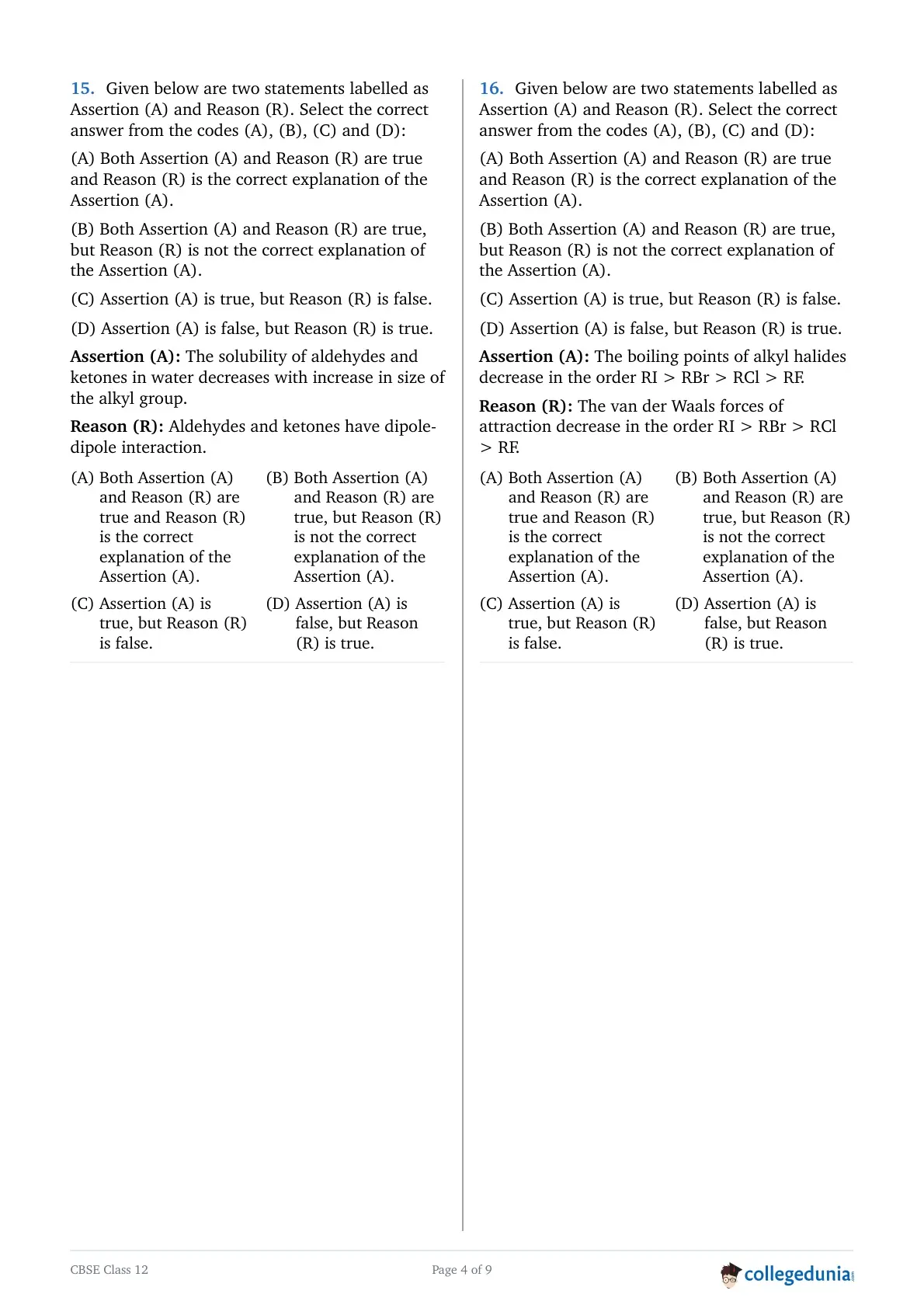
Assertion (A): The solubility of aldehydes and ketones in water decreases with increase in size of the alkyl group.
Reason (R): Aldehydes and ketones have dipole-dipole interaction.
Given below are two statements labelled as Assertion (A) and Reason (R).
Assertion (A): The boiling points of alkyl halides decrease in the order RI > RBr > RCl > RF.
Reason (R): The van der Waals forces of attraction decrease in the order RI > RBr > RCl > RF.
Select the correct answer from the codes (A), (B), (C) and (D) given below.
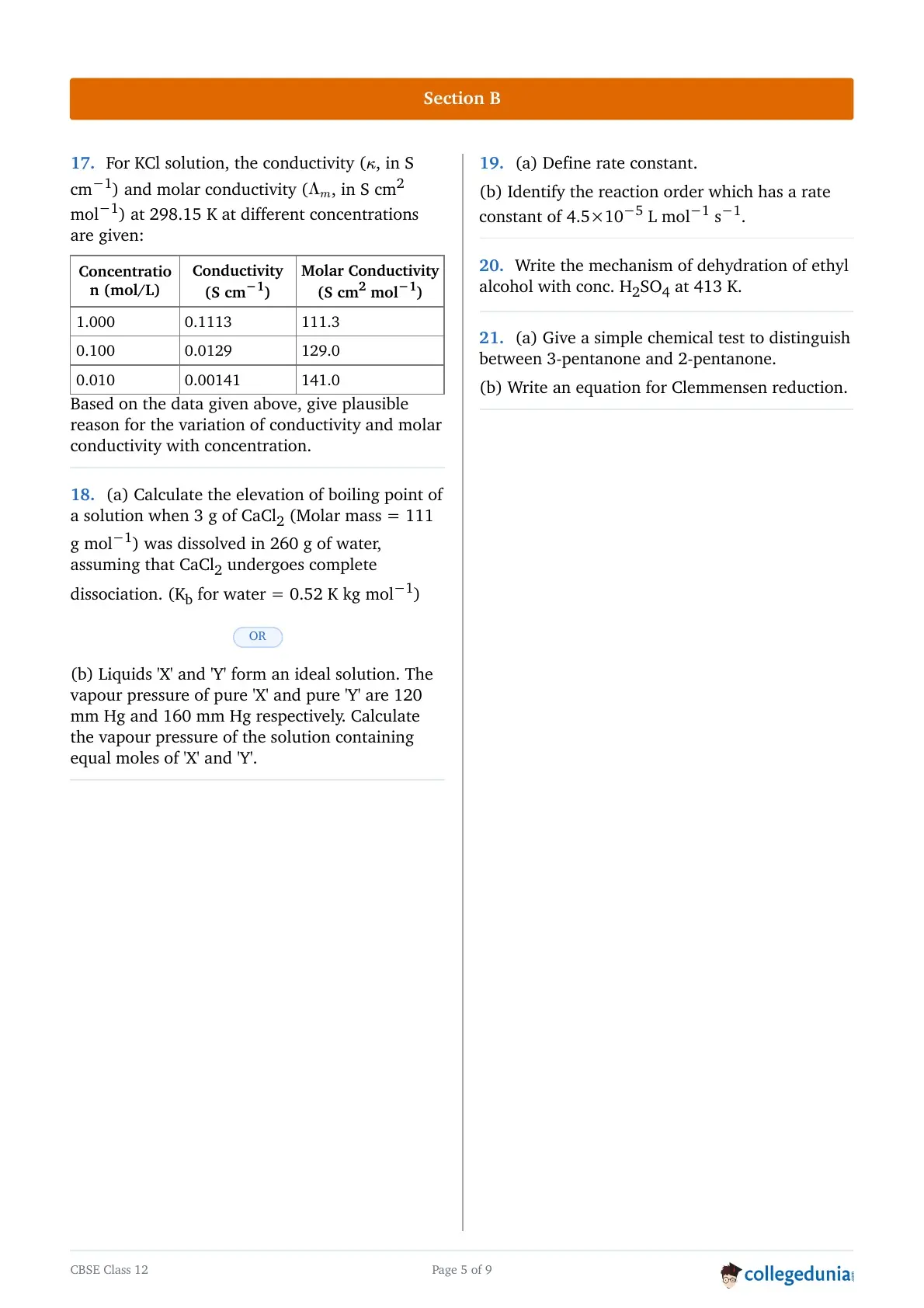
Based on the data given above, give plausible reason for the variation of conductivity and molar conductivity with concentration.
| Concentration of KCl solution (mol/L) | Conductivity at 298.15 K (S cm-1) | Molar Conductivity at 298.15 K (S cm2 mol-1) |
|---|---|---|
| 1.000 | 0.1113 | 111.3 |
| 0.100 | 0.0129 | 129.0 |
| 0.010 | 0.00141 | 141.0 |
Calculate the elevation of boiling point of a solution when 3 g of CaCl2 (Molar mass = 111 g mol\textsuperscript{-1}) was dissolved in 260 g of water, assuming that CaCl2 undergoes complete dissociation. (Kb for water = 0.52 K kg mol\textsuperscript{-1})
Liquids 'X' and 'Y' form an ideal solution. The vapour pressure of pure 'X' and pure 'Y' are 120 mm Hg and 160 mm Hg respectively. Calculate the vapour pressure of the solution containing equal moles of 'X' and 'Y'.
Identify the reaction order which has a rate constant of 4.5×10⁻⁵ L mol−1 s−1.
Write the mechanism of dehydration of ethyl alcohol with conc. H2SO4 at 413 K.
Give a simple chemical test to distinguish between 3-pentanol and 2-pentanol.
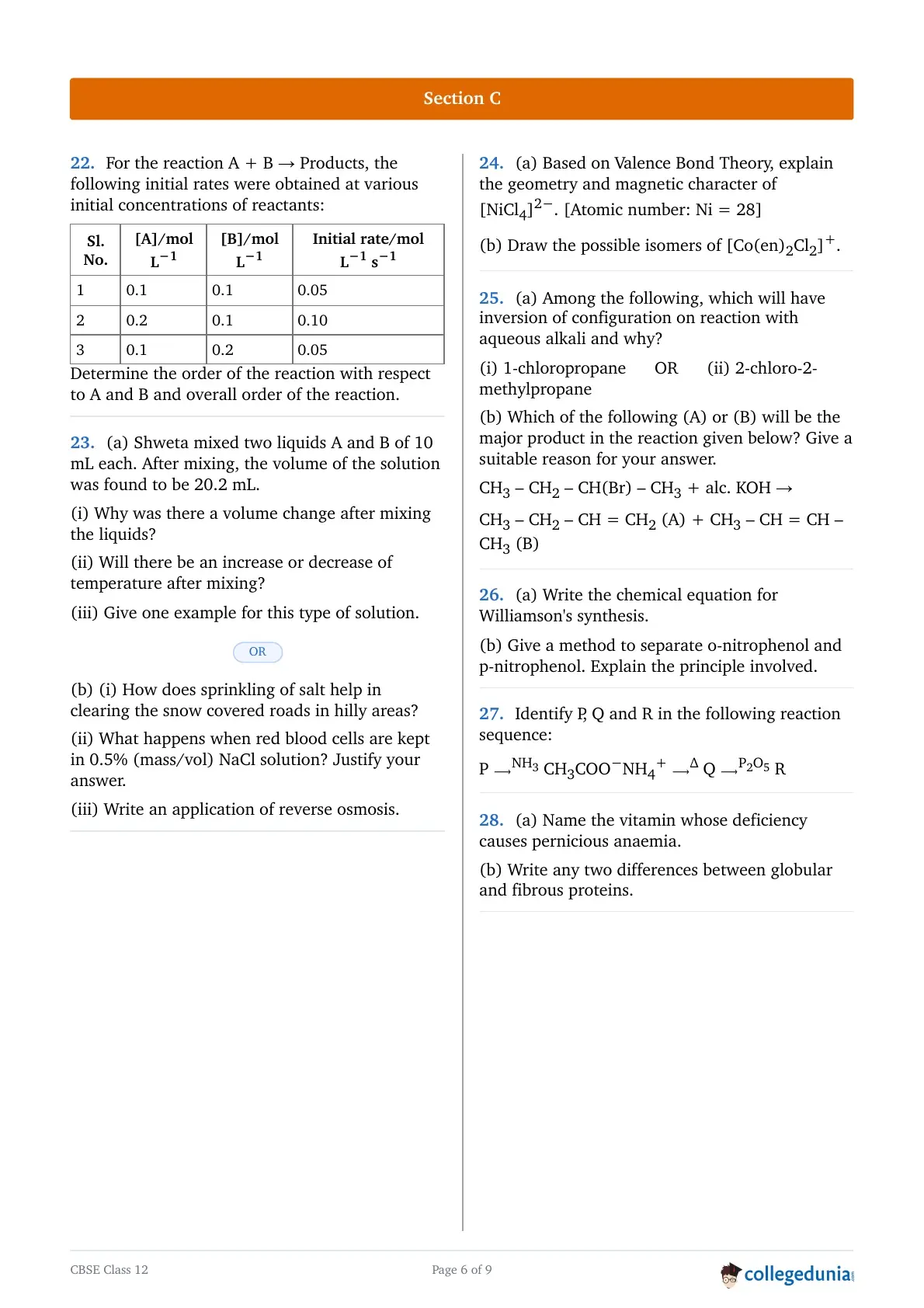
For the reaction A + B \(\to\) Products, the following initial rates were obtained at various initial concentrations of reactants:
| Sl. No. | [A] (mol L-1) | [B] (mol L-1) | Initial rate (mol L-1 s-1) |
|---|---|---|---|
| 1 | 0.1 | 0.1 | 0.05 |
| 2 | 0.2 | 0.1 | 0.10 |
| 3 | 0.1 | 0.2 | 0.05 |
Shweta mixed two liquids A and B of 10 mL each. After mixing, the volume of the solution was found to be 20.2 mL.
(i) Why was there a volume change after mixing the liquids?
(ii) Will there be an increase or decrease of temperature after mixing?
(iii) Give one example for this type of solution.
Shweta mixed two liquids A and B of 10 mL each. After mixing, the volume of the solution was found to be 20.2 mL.
(i) Why was there a volume change after mixing the liquids?
(ii) Will there be an increase or decrease of temperature after mixing?
(iii) Give one example for this type of solution.
Shweta mixed two liquids A and B of 10 mL each. After mixing, the volume of the solution was found to be 20.2 mL.
(i) Why was there a volume change after mixing the liquids?
(ii) Will there be an increase or decrease of temperature after mixing?
(iii) Give one example for this type of solution.
How does sprinkling of salt help in clearing the snow covered roads in hilly areas?
What happens when red blood cells are kept in 0.5% (mass/vol) NaCl solution? Justify your answer.
Based on Valence Bond Theory, explain the geometry and magnetic character of [NiCl4]2−. [Atomic number: Ni = 28]
Among the following, which will have inversion of configuration on reaction with aqueous alkali and why?
(i) 1-chloropropane OR (ii) 2-chloro-2-methylpropane
Which of the following (A) or (B) will be the major product in the reaction given below? Give a suitable reason for your answer.
\[ \text{CH}_3\text{CH}_2\text{CH}_2\text{Br} + \text{KOH} \rightarrow \]
Give a method to separate o-nitrophenol and p-nitrophenol. Explain the principle involved.
Identify P, Q and R in the following reaction sequence:
\[ P \xrightarrow{\mathrm{NH_3}} \mathrm{CH_3COO^-NH_4^+} \xrightarrow{\Delta} Q \]
\[ P \xrightarrow{\mathrm{PCl_5}} R \]
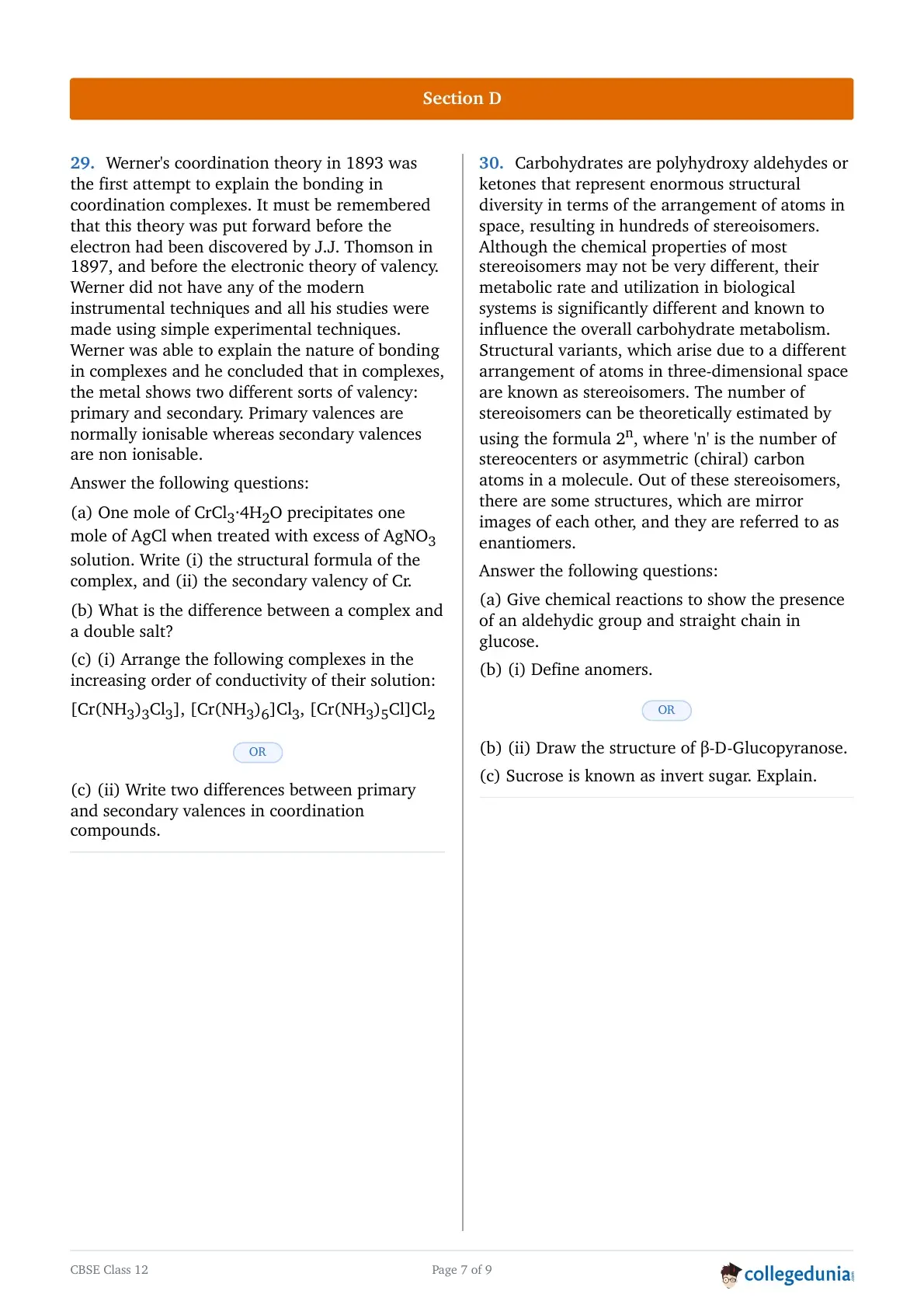
Werner's coordination theory in 1893 was the first attempt to explain the bonding in coordination complexes. It must be remembered that this theory was put forward before the electron had been discovered by J.J. Thomson in 1897, and before the electronic theory of valency. Werner did not have any of the modern instrumental techniques and all his studies were made using simple experimental techniques. Werner was able to explain the nature of bonding in complexes and he concluded that in complexes, the metal shows two different sorts of valency: primary and secondary. Primary valences are normally ionisable whereas secondary valences are non ionisable.
Answer the following questions:
One mole of CrCl3·4H2O precipitates one mole of AgCl when treated with excess of AgNO3 solution. Write (i) the structural formula of the complex, and (ii) the secondary valency of Cr.
Arrange the following complexes in the increasing order of conductivity of their solution:
[Cr(NH3)3Cl3], [Cr(NH3)6]Cl3, [Cr(NH3)5Cl]Cl2
Write two differences between primary and secondary valences in coordination compounds.
Carbohydrates are polyhydroxy aldehydes or ketones that represent enormous structural diversity in terms of the arrangement of atoms in space, resulting in hundreds of stereoisomers. Although the chemical properties of most stereoisomers may not be very different, their metabolic rate and utilization in biological systems is significantly different and known to influence the overall carbohydrate metabolism. Structural variants, which arise due to a different arrangement of atoms in three-dimensional space are known as stereoisomers. The number of stereoisomers can be theoretically estimated by using the formula 2n, where 'n' is the number of stereocenters or asymmetric (chiral) carbon atoms in a molecule. Out of these stereoisomers, there are some structures, which are mirror images of each other, and they are referred to as enantiomers.
Answer the following questions:
Give chemical reactions to show the presence of an aldehydic group and straight chain in glucose.
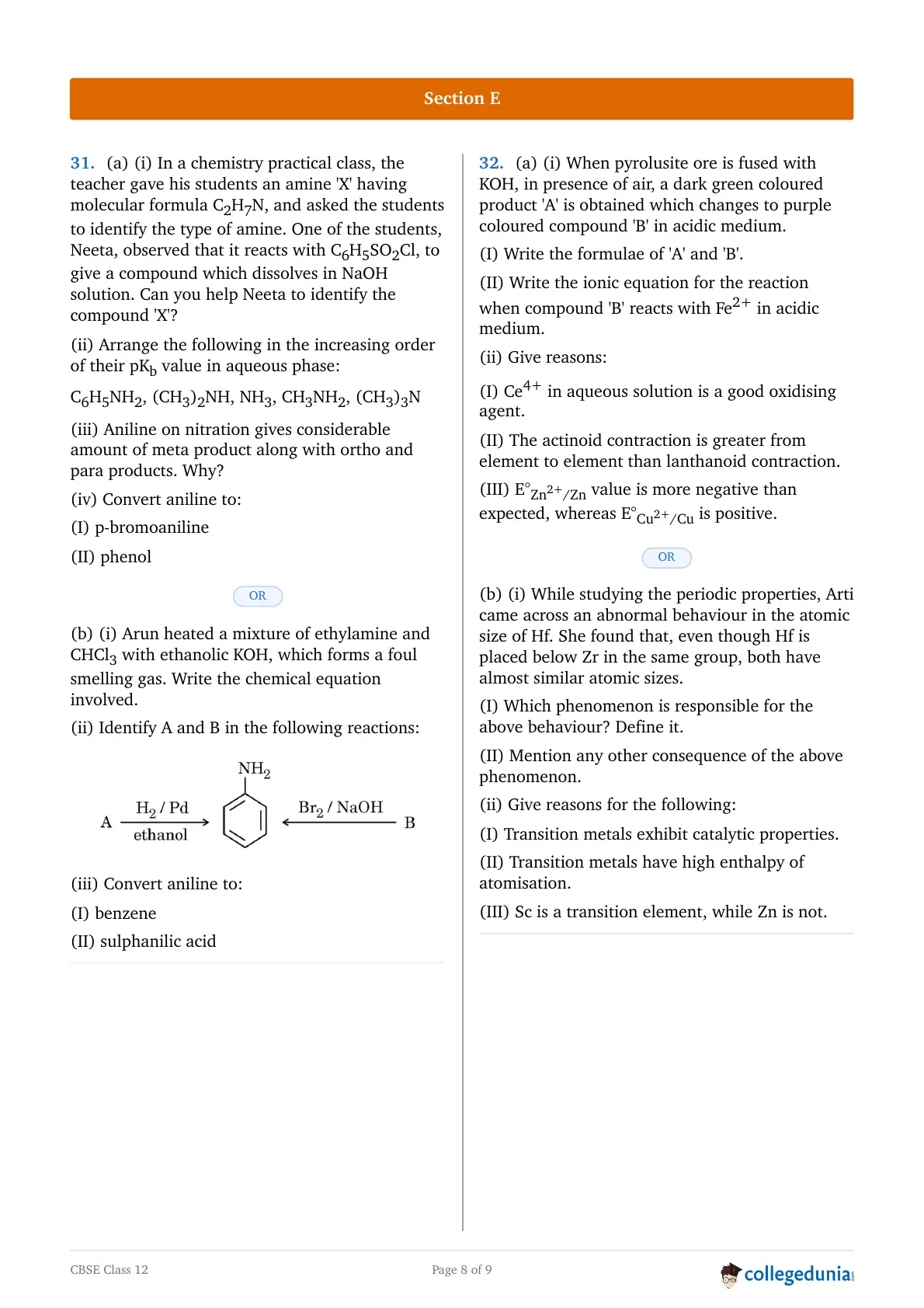
(i) In a chemistry practical class, the teacher gave his students an amine 'X' having molecular formula C2H7N, and asked the students to identify the type of amine. One of the students, Neeta, observed that it reacts with C6H5SO2Cl, to give a compound which dissolves in NaOH solution. Can you help Neeta to identify the compound 'X'?
(ii) Arrange the following in the increasing order of their pKb value in aqueous phase:
C6H5NH2, (CH3)2NH, NH3, CH3NH2, (CH3)3N
(iii) Aniline on nitration gives considerable amount of meta product along with ortho and para products. Why?
(iv) Convert aniline to:
(I) p-bromoaniline
(II) phenol
Arun heated a mixture of ethylamine and CHCl3 with ethanolic KOH, which forms a foul smelling gas. Write the chemical equation involved.
When pyrolusite ore is fused with KOH, in presence of air, a dark green coloured product 'A' is obtained which changes to purple coloured compound 'B' in acidic medium.
(I) Write the formulae of 'A' and 'B'.
(II) Write the ionic equation for the reaction when compound 'B' reacts with Fe2+ in acidic medium.
Give Reasons:
(I) \( \text{Ce}^{4+} \) in aqueous solution is a good oxidising agent.
(II) The actinoid contraction is greater from element to element than lanthanoid contraction.
(III) \( E^\circ_{\text{M}^{2+}/\text{M}} \) value is more negative than expected, whereas \( E^\circ_{\text{Cu}^{2+}/\text{Cu}} \) is positive.
While studying the periodic properties, Arti came across an abnormal be
haviour in the atomic size of HF. She found that, even though HF is placed below
Zr in the same group, both have almost similar atomic sizes.
(I) Which phenomenon is responsible for the above behaviour? Define it
Give reasons for the following:
(I) Transition metals exhibit catalytic properties.
(II) Transition metals have high melting points.
(III) Zn is a transition element, while Zn is not
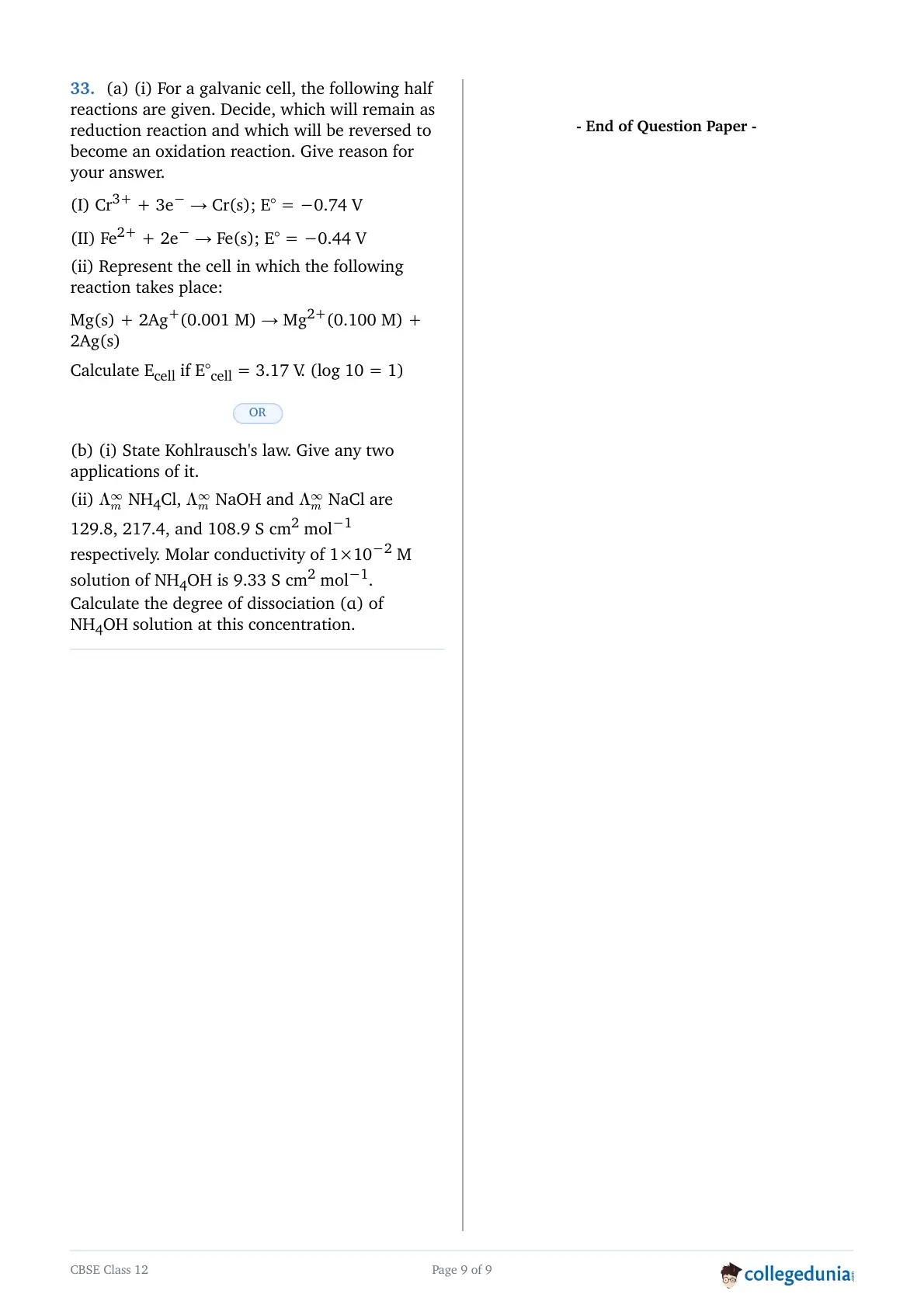
For a galvanic cell, the following half reactions are given. Decide, which will remain as reduction reaction and which will be reversed to become an oxidation reaction. Give reason for your answer.
(I) Cr3+ + 3e− → Cr(s); E° = −0.74 V
(II) Fe2+ + 2e− → Fe(s); E° = −0.44 V
Represent the cell in which the following reaction takes place:
\text{Mg(s)} + 2Ag^{+} (0.001 M) \rightarrow \text{Mg}^{2+} (0.100 M) + 2Ag(s)
Calculate E_{cell} if E^\circ_{cell} = 3.17 V. (log 10 = 1)
Given that \( \Lambda^\circ_{\text{m}} \) for NH₄Cl, NaOH, and NaCl are 129.8, 217.4, and 108.9 S cm² mol⁻¹ respectively. The molar conductivity of a 1 × 10⁻² M solution of NH₄OH is 9.33 S cm² mol⁻¹. Calculate the degree of dissociation (\( \alpha \)) of the NH₄OH solution at this concentration.
CBSE Class 12 Chemistry Question Paper Pattern 2025
The CBSE Class 12 Chemistry 2025 question paper is of 70 marks and has 33 questions in five sections, A to E, all compulsory, with internal choice in some questions of Sections B to E. The time allowed is 3 hours, with 15 minutes of extra reading time. The table below gives the section-wise paper pattern from the official CBSE question paper.
| Section | Questions | Question Type | Marks per Question | Marks |
|---|---|---|---|---|
| A | Q1 - Q16 | Multiple choice questions | 1 | 16 |
| B | Q17 - Q21 | Very short answer questions | 2 | 10 |
| C | Q22 - Q28 | Short answer questions | 3 | 21 |
| D | Q29 - Q30 | Case study-based questions | 4 | 8 |
| E | Q31 - Q33 | Long answer questions | 5 | 15 |
| Total | 33 questions | 70 |
CBSE Class 12 Chemistry Unit-Wise Weightage
| Unit No. | Unit Name | Marks |
|---|---|---|
| 1 | Solutions | 7 |
| 2 | Electrochemistry | 9 |
| 3 | Chemical Kinetics | 7 |
| 4 | d- and f-Block Elements | 7 |
| 5 | Coordination Compounds | 7 |
| 6 | Haloalkanes and Haloarenes | 6 |
| 7 | Alcohols, Phenols and Ethers | 6 |
| 8 | Aldehydes, Ketones and Carboxylic Acids | 8 |
| 9 | Amines | 6 |
| 10 | Biomolecules | 7 |
| Total | — | 70 |



Comments