




CBSE Class 12 English Core Set 2 - (1/3/2) Question Paper 2026 is available for download here. CBSE conducted the Class 12 English Core exam on March 12, 2026, from 10:30 AM to 1:30 PM. The English Core theory paper is of 80 marks, and the internal assessment is of 20 marks.
The English Core question paper includes MCQs (1 mark each), very-short-answer type questions (2 marks each), short-answer type questions (3 marks each), and long-answer type questions (4 & 6 marks each), making up the total of 80 marks.
Download CBSE Class 12 English Core Set 2 - (1/3/2) Question Paper 2026 with detailed solutions from the links provided below.
CBSE Class 12 English Core Set 2 - (1/3/2) Question Paper 2026 with Solution PDF
| CBSE 2026 Class 12 English Core Set 2 - (1/3/2) Question Paper 2026 | Download PDF | Check Solutions |






Read the following passage carefully :
(1) Science fiction, often abbreviated as sci-fi, is a genre of literature and
film that explores imaginative and futuristic concepts such as advanced
technology, space exploration, time travel, and extra-terrestrial life.
While sci-fi has long captivated audiences in western countries, its
growth in India has been comparatively slower. However, the genre is
gradually gaining popularity among Indian readers and writers.
(2) One of the major advantages of science fiction is its ability to stimulate
imagination and curiosity. It encourages readers to think beyond the
present and explore possibilities that lie in the future. For students and
young readers, sci-fi can act as a bridge between literature and science,
making learning more engaging. Books like Isaac Asimov’s Foundation
or Indian writer Samit Basu’s Turbulence have introduced scientific
ideas in exciting narratives.
(3) Science fiction also reflects social and ethical concerns. In a rapidly
changing world, sci-fi allows authors to speculate on how technology
might shape society, for better or worse. In India, where issues like
climate change, overpopulation, and digital surveillance are becoming
more relevant, science fiction provides a creative lens through which
these problems can be examined.
(4) Despite its potential, science fiction remains a niche genre in India.
One of the key disadvantages is the lack of access to quality sci-fi
literature in Indian languages. Most of the well-known works are
written in English, which limits their reach. Moreover, there is a lack
of mainstream platforms that promote Indian sci-fi writers. Many
readers are unaware of homegrown authors contributing meaningfully
to the genre.
(5) To enhance the science fiction reading experience in India, several
steps can be taken. Schools and colleges can include sci-fi stories in
their curriculum to expose students to the genre early on. Indian
authors should be encouraged to write in regional languages to broaden
the audience base. Libraries and online platforms can host reading
clubs and discussions to make science fiction more interactive and
engaging.
(6) In conclusion, science fiction has immense potential to grow in India.
With the right support and exposure, it can become a powerful tool to
inspire imagination, promote scientific thinking, and spark
conversations about the future.
Answer the following questions, based on the above passage :
According to paragraph 1, how did the western countries react to science fiction ?
Detailed Solution
Concept:
This is a factual comprehension question based on Paragraph 1 of the passage.
Such questions require the reader to identify the exact information stated by the author.
The answer should be brief, accurate, and directly supported by the passage.
Avoid adding personal opinions or information not mentioned in the text.
Step 1: Read the first paragraph carefully.
The opening paragraph states that science fiction explores imaginative and futuristic concepts such as advanced technology, space exploration, time travel, and extra-terrestrial life.
Step 2: Identify the author's statement about western countries.
The passage clearly mentions:
“While sci-fi has long captivated audiences in Western countries, its growth in India has been comparatively slower.”
Step 3: Interpret the meaning of the statement.
The expression ``has long captivated audiences'' means that people in western countries have shown great interest in science fiction for many years.
This indicates that science fiction has been widely accepted, appreciated, and enjoyed by readers and viewers in western nations.
Step 4: Write the final answer.
Answer:
Western countries enthusiastically embraced science fiction, and the genre has long captivated audiences there. Quick Tip: • Look for direct factual statements in the passage.
• Use the author's own words whenever possible.
• Avoid adding outside knowledge.
• Keep one-mark answers concise and precise.
Complete the following suitably.
In paragraph 1, the author uses the word ‘comparatively’ to highlight __________.
Detailed Solution
Concept:
Vocabulary-in-context questions test the meaning and purpose of a particular word.
The meaning of a word should always be understood according to the surrounding sentences.
The word ``comparatively'' is used to compare two situations rather than describe one independently.
Readers should identify what two things are being compared.
Step 1: Locate the word in the passage.
The sentence reads:
“While sci-fi has long captivated audiences in Western countries, its growth in India has been comparatively slower.”
Step 2: Understand the comparison.
The author compares:
the popularity and growth of science fiction in western countries, and
the popularity and growth of science fiction in India.
Step 3: Interpret the purpose of the word.
The word ``comparatively'' means ``when compared with something else.''
Here, it emphasizes that although science fiction has become extremely popular in western countries, its development in India has been slower.
Step 4: Complete the sentence appropriately.
Answer:
In paragraph 1, the author uses the word ``comparatively'' to highlight that the growth of science fiction in India has been slower than its growth in western countries. Quick Tip: • Read the complete sentence before interpreting a word.
• Comparative words always compare two ideas.
• Use the surrounding context to determine the intended meaning.
• Never interpret vocabulary in isolation.
Identify one advantage of science fiction with reference to paragraph 2.
Detailed Solution
Concept:
This is a direct reading comprehension question based on Paragraph 2 of the passage.
The reader must identify one benefit of science fiction mentioned by the author.
The answer should be taken directly from the passage without introducing personal opinions.
For one-mark questions, the response should be brief but complete.
Step 1: Locate Paragraph 2 of the passage.
Paragraph 2 discusses the positive role played by science fiction in education and learning.
It explains how science fiction goes beyond entertainment and contributes to intellectual growth.
Step 2: Identify the advantages mentioned by the author.
The author states several advantages of science fiction:
It stimulates imagination.
It develops curiosity.
It encourages readers to think beyond the present.
It helps readers explore future possibilities.
It makes learning science more interesting.
It acts as a bridge between literature and science.
Any one of these advantages is acceptable as the answer.
Step 3: Choose one suitable advantage.
Among the advantages listed, the most direct statement given by the author is that science fiction stimulates imagination and curiosity.
This is also the opening idea of Paragraph 2, making it the most appropriate answer.
Step 4: Write the final answer.
Answer:
One advantage of science fiction is that it stimulates imagination and curiosity, encouraging readers to think beyond the present and explore future possibilities. Quick Tip: • Read the paragraph carefully before answering.
• Pick only one advantage when the question asks for one.
• Use the author's words as far as possible.
• Avoid unnecessary explanation in one-mark answers.
Why does the writer refer to science fiction as a ‘bridge’ ? (Paragraph 2)
Because :
Detailed Solution
Concept:
This is a Multiple Choice Question (MCQ) based on interpretation.
The reader must understand why the author has used the metaphor ``bridge''.
A bridge connects two different things.
Here, the bridge represents the connection between literature and science, making learning easier and more engaging.
Step 1: Read the relevant sentence carefully.
The passage states:
“For students and young readers, sci-fi can act as a bridge between literature and science, making learning more engaging.”
Step 2: Understand the meaning of the metaphor "bridge".
The word ``bridge'' is used metaphorically.
It does not refer to a physical structure.
Instead, it means something that connects two different areas.
Here, science fiction connects:
scientific ideas,
literary storytelling,
imagination, and
classroom learning.
Step 3: Evaluate each option.
Option (A):
It connects youth to adults.
This idea is not mentioned anywhere in the passage.
Hence, it is incorrect.
Option (B):
It makes learning more interactive.
The passage clearly states that science fiction makes learning more engaging by connecting science with literature.
Therefore, this option correctly expresses the author's idea.
Option (C):
It supports introduction to reading among early readers.
Although students are mentioned, the passage does not say science fiction is meant only to develop reading habits.
Hence, this option is incorrect.
Option (D):
It helps build better engineers and doctors.
The passage never makes this claim.
Therefore, this option is also incorrect.
Step 4: Select the correct answer.
Since science fiction connects literature with science and makes learning engaging, the correct option is:
\[ \boxed{\textbf{(B) it makes learning more interactive.}} \] Quick Tip: • Metaphors usually express an idea rather than a literal meaning.
• Eliminate options not supported by the passage.
• Look for keywords like "bridge" and "making learning more engaging".
• Choose the option that best matches the author's intention.
‘...science fiction provides a creative lens through which these problems can be examined.’ (Paragraph 3)
In the given line, what does the phrase ‘creative lens’ refer to ?
Detailed Solution
Concept:
This is an inference-based reading comprehension question.
The reader must understand the figurative expression ``creative lens'' from the context rather than its literal meaning.
A lens is something through which we observe or understand things.
Here, the author uses the expression metaphorically to explain how science fiction helps people think differently about real-life issues.
The answer should explain the intended meaning instead of defining the individual words.
Step 1: Read the complete sentence carefully.
The passage states:
“In India, where issues like climate change, overpopulation, and digital surveillance are becoming more relevant, science fiction provides a creative lens through which these problems can be examined.”
Step 2: Understand the meaning of the expression "creative lens".
The word lens does not refer to a physical object in this context.
Instead, it represents a particular way of looking at, understanding, or analysing a situation.
The adjective creative suggests imagination, innovation, and originality.
Therefore, the phrase creative lens means an imaginative and thought-provoking perspective through which important issues can be explored.
Step 3: Relate the phrase to the context of the passage.
The author explains that science fiction allows writers and readers to imagine possible future situations.
Using fictional stories, they can examine real-world concerns such as:
climate change,
overpopulation,
technological advancement,
digital surveillance,
ethical dilemmas, and
the future of society.
Instead of discussing these problems directly, science fiction presents them through imaginative stories, making readers think more deeply about their possible consequences.
Step 4: Form the complete answer.
Answer:
The phrase ``creative lens'' refers to an imaginative and innovative way of understanding and examining real-life social and technological problems through science fiction.
It enables readers to explore important issues from fresh perspectives and think critically about the future. Quick Tip: • Figurative expressions should always be interpreted according to the context.
• "Lens" usually means a viewpoint or perspective.
• Science fiction combines imagination with real-world issues.
• In inference questions, explain the idea instead of translating the words literally.
Complete the analogy with one word from paragraph 4.
possibility : potential :: unique : ________
Detailed Solution
Concept:
This is a vocabulary-based analogy question.
Analogies test the relationship between two words.
The second pair should have the same relationship as the first pair.
Here, potential is a synonym of possibility.
Therefore, we need a word from paragraph 4 that has a meaning similar to unique.
Step 1: Understand the first relationship.
The first pair is:
\[ possibility : potential \]
Both words express the idea of something that may happen or be developed in the future.
Thus, they are nearly synonymous.
Step 2: Identify the meaning of the word "unique".
The word unique means:
different from others,
uncommon,
distinctive,
special, or
belonging to a small or limited category.
Hence, we need an option that conveys a similar meaning.
Step 3: Evaluate each option carefully.
Option (A): Mainstream
Mainstream means something that is popular or widely accepted.
This is the opposite of unique.
Hence, it is incorrect.
Option (B): Access
Access means the opportunity or right to use something.
Its meaning is unrelated to "unique."
Therefore, it is incorrect.
Option (C): Homegrown
Homegrown means produced locally or developed within one's own country.
Although it describes origin, it is not a synonym of "unique."
Hence, it is incorrect.
Option (D): Niche
A niche refers to something that appeals to only a small, specialised group.
It is uncommon and distinct from the mainstream.
Therefore, it is the closest in meaning to "unique."
Step 4: Select the correct answer.
Since niche means specialised, uncommon, and distinct, it best matches the meaning of unique.
Hence,
\[ \boxed{\textbf{(D) niche}} \]
is the correct answer. Quick Tip: • In analogy questions, first identify the relationship between the first pair of words.
• Look for a similar relationship in the second pair.
• Eliminate options whose meanings are unrelated.
• Contextual vocabulary questions often test synonyms or closely related meanings.
Why is science fiction still not very popular in India ? (Paragraph 4)
Detailed Solution
Concept:
This is a factual reading comprehension question.
The answer must be taken directly from Paragraph 4.
The reader should identify the reasons mentioned by the author without adding personal opinions.
Since the question asks "Why", mention the major causes given in the passage.
Step 1: Read Paragraph 4 carefully.
Paragraph 4 explains that despite its potential, science fiction continues to remain a niche genre in India.
The author then discusses the reasons responsible for its limited popularity.
Step 2: Identify the reasons mentioned by the author.
According to the passage, science fiction is not very popular in India because:
There is limited access to quality science fiction literature in Indian languages.
Most famous science fiction books are available only in English.
This limits their reach among regional language readers.
There are very few mainstream platforms promoting Indian science fiction writers.
Many readers are unaware of talented Indian authors working in this genre.
Step 3: Summarise the information.
All these factors together reduce the visibility and accessibility of science fiction in India.
As a result, the genre has not yet become popular among a wider audience.
Step 4: Write the final answer.
Answer:
Science fiction is still not very popular in India because there is limited access to quality science fiction literature in Indian languages, most famous works are available only in English, and there are very few mainstream platforms promoting Indian science fiction writers. Quick Tip: • "Why" questions usually require reasons given in the passage.
• Mention all major causes briefly.
• Avoid introducing personal opinions.
• Use the author's own ideas for maximum accuracy.
Provide one textual evidence with reference to paragraph 4 to prove that there is a lack of mainstream platforms.
Detailed Solution
Concept:
This is a textual evidence-based comprehension question.
Such questions require the reader to locate the exact statement from the passage that supports the given idea.
The answer should quote or closely paraphrase the relevant line from the passage.
Personal opinions should not be included.
Step 1: Identify what needs to be proved.
The question asks for evidence that supports the statement that there is a lack of mainstream platforms promoting science fiction in India.
Therefore, we must locate the sentence in Paragraph 4 that directly mentions this idea.
Step 2: Locate the supporting statement.
Paragraph 4 clearly states:
“Moreover, there is a lack of mainstream platforms that promote Indian sci-fi writers.”
This sentence directly proves the given statement.
Step 3: Write the textual evidence.
Since the question specifically asks for textual evidence, the answer should reproduce the author's own words.
Step 4: Final Answer.
Answer:
The textual evidence is:
``Moreover, there is a lack of mainstream platforms that promote Indian sci-fi writers.'' Quick Tip: • Textual evidence questions require proof directly from the passage.
• Quote the author's words whenever possible.
• Avoid explaining unless the question specifically asks for it.
• Read the paragraph carefully before selecting evidence.
In what context does the author use the phrase ‘broaden the audience base’ in paragraph 5 ?
Detailed Solution
Concept:
This is an inference-based comprehension question.
The meaning of a phrase should always be understood from its context.
The phrase ``broaden the audience base'' refers to increasing the number of people who read or enjoy something.
The answer should explain why the author has used this phrase in Paragraph 5.
Step 1: Read the relevant sentence carefully.
The passage states:
“Indian authors should be encouraged to write in regional languages to broaden the audience base.”
Step 2: Interpret the phrase.
The phrase ``broaden the audience base'' means increasing the number of readers who can access and enjoy science fiction.
Writing in regional languages would allow people who do not read English to understand and appreciate science fiction.
Step 3: Connect the phrase with the author's purpose.
The author believes that language is one of the major barriers preventing science fiction from becoming popular in India.
If books are available in regional languages, they will reach a much larger audience.
This will encourage more people across different parts of the country to read science fiction.
Step 4: Final Answer.
Answer:
The author uses the phrase ``broaden the audience base'' to suggest that Indian authors should write science fiction in regional languages so that it reaches more readers across the country and becomes popular among a wider audience. Quick Tip: • Understand phrases according to the surrounding sentences.
• "Audience base" means the group of readers or viewers.
• "Broaden" means increase or expand.
• Always relate the phrase to the main idea of the paragraph.
Assess the feasibility of steps suggested to promote science fiction in India. (Paragraph 5)
Detailed Solution
Concept:
This is a value-based assessment question.
The reader is expected to evaluate whether the suggestions given by the author are practical and achievable.
The answer should be based on the passage while adding logical reasoning.
A balanced response should explain why the suggested measures can be implemented successfully.
Step 1: Identify the suggested measures.
Paragraph 5 recommends several steps to promote science fiction in India:
introducing science fiction stories in school and college curricula,
encouraging Indian authors to write in regional languages,
organising reading clubs and discussions in libraries,
using online platforms to make science fiction more interactive and engaging.
Step 2: Evaluate whether these suggestions are practical.
These suggestions are realistic because schools, colleges, libraries, publishers, and digital platforms already exist.
Only greater encouragement, planning, and promotion are required to implement these ideas effectively.
Writing in regional languages can also help reach readers from different linguistic backgrounds.
Step 3: Assess the overall feasibility.
The proposed measures are practical, economical, and capable of increasing awareness and interest in science fiction.
If educational institutions, authors, publishers, and online communities work together, these initiatives can significantly expand the popularity of science fiction in India.
Step 4: Final Answer.
Answer:
The suggested steps are highly feasible because they can be implemented through schools, colleges, libraries, publishers, and digital platforms. Including science fiction in the curriculum, promoting regional language writing, and organising reading activities can effectively increase awareness, encourage scientific thinking, and attract a wider audience across India. Quick Tip: • Assessment questions require evaluation, not just repetition.
• Mention whether the suggestions are practical and explain why.
• Base your answer on the passage while adding logical reasoning.
• Keep the conclusion balanced and well supported.
Read the following passage carefully :
(1) Introduction : Nutrition plays a critical role in human development,
especially during periods of growth, aging, and recovery. This case
study explores the changing nutritional requirements across age
groups — from children to the elderly ⎯ highlighting how dietary
habits must adapt to support health and wellbeing.
(2) Methodology : A team of dietitians conducted a three-month
observational study across five schools, two universities, three
workplaces, and two retirement communities. Nutritional intake was
recorded using food diaries, and health parameters were monitored
through BMI, energy levels, and blood reports.
(3) Survey Examination : Participants were grouped into four age
categories : children (6 – 12 years), adolescents (13 – 19 years), adults
(20 – 59 years), and elderly (60+ years). Surveys assessed daily intake
of macronutrients (carbohydrates, proteins, fats) and micronutrients
(vitamins and minerals), alongside hydration habits and meal
frequency.
(4) Results : Children had higher energy and protein needs per kilogram
of body weight, essential for growth and cognitive development.
Adolescents showed increased calorie and calcium requirements due
to rapid bone growth and hormonal changes. Adults required
balanced intake to maintain weight and prevent chronic diseases,
while the elderly needed more fibre, calcium and vitamin D to
support bone health and digestion. Interestingly, adolescents
consumed the most processed foods, while elderly participants had
the most balanced diets due to regular meal routines. Adults often
skipped meals due to work stress. Dehydration was common in both
children and the elderly.
(5) Implications and Interventions : The findings highlight the need
for age-specific dietary education. In schools, awareness programmes
on healthy snacks and hydration were introduced. For working
adults, meal planning workshops and healthy vending machines were
recommended. Retirement homes integrated vitamin D supplements
and fibre-rich meals into weekly menus. Across all groups, hydration
reminders were implemented using digital tools and scheduled water
breaks.
(6) Conclusion : Nutritional needs vary significantly with age,
influenced by physical, cognitive, and lifestyle factors. Regular
assessments and tailored interventions are essential for promoting
long-term health across populations.
Answer the following questions, based on the given passage.
Complete the following suitably.
In the introduction, the researcher links changing dietary requirements to highlight __________.
Detailed Solution
Concept:
This is a sentence completion question based on the introductory paragraph of the passage.
Such questions test the reader's ability to identify the central idea presented by the author.
The answer should be derived directly from the introduction without adding personal opinions.
The completed sentence should preserve the meaning intended by the researcher.
Step 1: Read the introduction carefully.
The introduction states that nutrition plays a vital role in human development, particularly during growth, ageing, and recovery.
It further explains that nutritional requirements change with age and dietary habits should also change accordingly.
Step 2: Identify the main purpose of the introduction.
The researcher introduces the study by emphasizing that different stages of life require different nutritional needs.
This highlights the importance of adapting diet according to age for maintaining good health and overall well-being.
Step 3: Complete the sentence logically.
The incomplete sentence asks what the researcher intends to highlight.
The passage clearly indicates that dietary requirements change with age and these changes are necessary for healthy development.
Step 4: Write the final answer.
Answer:
In the introduction, the researcher links changing dietary requirements to highlight the importance of adapting nutrition according to different stages of life for maintaining health and well-being. Quick Tip: • Read the introductory paragraph carefully before answering.
• Focus on the central idea rather than supporting details.
• Complete the sentence using the author's intended meaning.
• Avoid introducing information that is not mentioned in the passage.
What would the following be classified as ?
Nutritional intake was recorded using food diaries.
Select the appropriate response :
Detailed Solution
Concept:
This question tests the understanding of research methodology.
In any research study, the methodology explains how data is collected, recorded, or analysed.
Statements describing the techniques or tools used by researchers belong to the research method or method of analysis.
The answer should be chosen by understanding the function of the given statement.
Step 1: Read the given statement carefully.
The statement says:
“Nutritional intake was recorded using food diaries.”
This explains how researchers collected information from participants.
Step 2: Understand the purpose of the statement.
Food diaries are a research tool used to record participants' daily food consumption.
They help researchers collect reliable data for further study and interpretation.
Therefore, this statement explains the research procedure rather than the objective or result.
Step 3: Evaluate each option.
Option (A): Primary purpose
The primary purpose explains why the research was conducted.
The statement does not describe the objective of the study.
Hence, this option is incorrect.
Option (B): Secondary objective
A secondary objective refers to an additional research goal.
The statement does not mention any objective.
Therefore, this option is incorrect.
Option (C): Method of analysis
The statement describes the procedure used to collect nutritional information.
Food diaries are part of the research methodology.
Hence, this is the correct answer.
Option (D): Research outcome
A research outcome refers to the final findings or conclusions.
The statement does not present any result.
Therefore, this option is incorrect.
Step 4: Select the correct answer.
Since the statement explains the procedure adopted by researchers for collecting dietary information, the correct option is
\[ \boxed{\textbf{(C) Method of analysis}} \] Quick Tip: • Methodology explains how research is conducted.
• Tools such as surveys, questionnaires and food diaries are research methods.
• Do not confuse methodology with objectives or results.
• Read every option carefully before selecting the answer.
Give two points to support how the case study explored various age groups. (Paragraphs 2, 3)
Detailed Solution
Concept:
This is a factual reading comprehension question based on Paragraphs 2 and 3.
The question requires identifying two pieces of evidence showing how the researchers conducted the study across different age groups.
The answer should be based on the methodology and survey examination described in the passage.
Since the question asks for two points, both should be mentioned clearly.
Step 1: Read Paragraphs 2 and 3 carefully.
Paragraph 2 explains the methodology adopted by the researchers.
It describes where the study was conducted and how the information was collected.
Paragraph 3 explains how the participants were divided and what nutritional aspects were examined.
Step 2: Identify the first supporting point.
The researchers selected participants from a wide range of institutions, including:
five schools,
two universities,
three workplaces, and
two retirement communities.
This ensured that people belonging to different stages of life were included in the study.
Step 3: Identify the second supporting point.
The participants were further classified into four different age categories:
Children (6--12 years),
Adolescents (13--19 years),
Adults (20--59 years), and
Elderly (60+ years).
The researchers then assessed their intake of macronutrients, micronutrients, hydration habits, and meal frequency.
This helped compare the nutritional requirements of each age group.
Step 4: Write the final answer.
Answer:
The case study explored various age groups by:
conducting the study across schools, universities, workplaces, and retirement communities, and
dividing participants into children, adolescents, adults, and the elderly while analysing their nutritional intake, hydration habits, and meal frequency. Quick Tip: • When a question asks for two points, write them separately.
• Use information directly from the relevant paragraphs.
• Mention both the methodology and participant classification whenever applicable.
• Keep the answer concise but complete.
Paragraph 4 includes the words ‘development’ and ‘prevent’. Classify the following sentences as ‘development’ and ‘prevent’.
Sentence A : Children had higher energy and protein needs per kilogram of body weight, essential for growth.
Sentence B : Adolescents need increased calcium so that their bone growth is not impacted.
Detailed Solution
Concept:
This question tests the understanding of contextual vocabulary.
The reader must classify the given sentences according to the ideas of development and prevention.
Development refers to promoting growth or improvement.
Prevention refers to avoiding a problem or protecting against a harmful condition.
Step 1: Read Sentence A carefully.
Sentence A:
``Children had higher energy and protein needs per kilogram of body weight, essential for growth.''
The emphasis is on providing nutrients that support physical growth and healthy body development.
Therefore, this sentence represents the idea of development.
Step 2: Read Sentence B carefully.
Sentence B:
``Adolescents need increased calcium so that their bone growth is not impacted.''
The sentence focuses on ensuring that bone growth is protected from being affected negatively.
Thus, it highlights the idea of preventing a health problem.
Hence, it represents prevention.
Step 3: Classify both statements.
The first statement promotes healthy growth.
The second statement focuses on avoiding harm to bone development.
Hence, they belong to different categories.
Step 4: Write the final answer.
Answer:
Sentence A -- Development
Sentence B -- Prevent Quick Tip: • Development means promoting growth or improvement.
• Prevention means avoiding damage or illness.
• Identify the main purpose of each sentence before classifying it.
• Focus on the keywords such as "growth" and "not impacted".
Although all age groups require balanced intake, why do the elderly need more fibre ? (Paragraph 4)
Detailed Solution
Concept:
This is a direct reading comprehension question based on Paragraph 4.
The answer should be taken directly from the information provided in the passage.
Fibre is an important nutrient that supports proper digestive functioning.
Elderly people require additional fibre because their digestive system becomes less efficient with age.
Step 1: Locate the relevant information in Paragraph 4.
Paragraph 4 explains the nutritional requirements of different age groups.
Regarding elderly people, the passage states that they require more fibre, calcium and Vitamin D.
Step 2: Identify the reason given by the author.
The author specifically mentions that additional fibre is required to support healthy digestion.
As people grow older, digestion generally slows down, making fibre-rich foods more important.
Step 3: Form the complete answer.
The answer should clearly mention the reason stated in the passage without adding unnecessary details.
Step 4: Write the final answer.
Answer:
Although all age groups require a balanced diet, the elderly need more fibre because it helps support healthy digestion and maintains proper digestive function. Quick Tip: • "Why" questions require the reason stated in the passage.
• Use the author's wording whenever possible.
• Fibre is commonly associated with digestive health.
• Keep one-mark answers short and precise.
Complete the sentence suitably.
Digital tools were used to give hydration reminders to _________.
Detailed Solution
Concept:
This is a Multiple Choice Question based on Paragraph 5.
The answer depends upon understanding the purpose of hydration reminders.
Hydration reminders are designed to encourage regular water intake and prevent dehydration.
The correct option should match the author's intended purpose.
Step 1: Read the relevant statement carefully.
Paragraph 5 states:
“Across all groups, hydration reminders were implemented using digital tools and scheduled water breaks.”
Step 2: Understand the purpose of hydration reminders.
Hydration reminders encourage people to drink water at regular intervals.
Their objective is to maintain proper hydration and prevent dehydration.
Step 3: Evaluate each option.
Option (A):
Hydration reminders help ensure that people drink enough water and do not become dehydrated.
This exactly matches the purpose mentioned in the passage.
Hence, this is the correct answer.
Option (B):
Hydration has no direct connection with preventing starvation.
Therefore, this option is incorrect.
Option (C):
The passage never mentions weight loss as the purpose of hydration reminders.
Hence, this option is incorrect.
Option (D):
Hydration reminders are unrelated to balancing processed food consumption.
Therefore, this option is also incorrect.
Step 4: Select the correct option.
Since hydration reminders are intended to encourage regular water intake and prevent dehydration, the correct answer is
\[ \boxed{\textbf{(A) ensure people did not get dehydrated}} \] Quick Tip: • Read the entire sentence before choosing an option.
• Eliminate choices that are unrelated to the passage.
• Hydration always refers to maintaining proper water balance.
• Match the option with the author's exact purpose.
Why is age-specific nutrition important ? Give textual evidence to support your answer.
Detailed Solution
Concept:
This is an evidence-based comprehension question.
The answer requires both an explanation and supporting textual evidence.
The explanation should state why age-specific nutrition is necessary.
The textual evidence should be taken directly from the passage.
Step 1: Identify the main idea.
The passage explains that nutritional needs are not the same for everyone.
They vary according to age because each stage of life has different physical, cognitive, and lifestyle requirements.
Step 2: Locate the supporting evidence.
The concluding paragraph clearly states:
“Nutritional needs vary significantly with age, influenced by physical, cognitive, and lifestyle factors. Regular assessments and tailored interventions are essential for promoting long-term health across populations.”
This statement directly supports the importance of age-specific nutrition.
Step 3: Combine explanation and evidence.
Different age groups require different nutrients for growth, maintenance, disease prevention, and healthy ageing.
Therefore, diets should be planned according to age.
Step 4: Write the final answer.
Answer:
Age-specific nutrition is important because nutritional requirements change with different stages of life and help support healthy growth, development, and overall well-being.
Textual Evidence:
``Nutritional needs vary significantly with age, influenced by physical, cognitive, and lifestyle factors. Regular assessments and tailored interventions are essential for promoting long-term health across populations.'' Quick Tip: • Evidence-based questions require both explanation and proof.
• Quote the passage whenever textual evidence is asked.
• Explain first, then provide supporting evidence.
• Keep the evidence exactly as given in the passage.
What is the key takeaway of the study ?
Detailed Solution
Concept:
This is a conclusion-based reading comprehension question.
The answer should be taken from the concluding paragraph of the passage.
The reader has to identify the central message or overall learning from the study.
The response should summarize the author's final conclusion in simple and precise language.
Step 1: Locate the conclusion of the passage.
The final paragraph summarises the entire case study by explaining the importance of nutrition throughout different stages of life.
It highlights that nutritional requirements are not the same for everyone.
Step 2: Identify the main conclusion.
The author concludes that nutritional needs vary according to age because they are influenced by physical growth, cognitive development, and lifestyle factors.
Therefore, people require age-specific diets and regular nutritional assessment.
Step 3: Summarise the conclusion.
The overall message is that maintaining good health requires nutritional plans that are suited to different age groups.
Tailored dietary interventions help promote long-term health and well-being.
Step 4: Write the final answer.
Answer:
The key takeaway of the study is that nutritional needs change with age, and age-specific diets along with regular nutritional assessments are essential for promoting long-term health and well-being. Quick Tip: • Conclusion questions ask for the central message of the passage.
• Focus on the final paragraph.
• Summarise the author's main finding instead of repeating details.
• Keep the answer concise and relevant.
Your school is planning to put up a photography exhibition on ‘My City’. As Reena/Rohit, the Head of the Photography Club of MX School, write a notice to inform all students about the exhibition and to submit their photographs for selection. Include other necessary details. Put your notice in a box.
Detailed Solution
Concept:
A notice is a formal means of communication used to inform a specific group of people about an event, activity, or announcement.
It should be brief, factual, and written in an organized format.
A good notice must answer the questions What, When, Where, Who, and Whom to Contact.
CBSE notices generally contain the following components:
Name of the Institution
The word NOTICE
Date
Title
Body (40--50 words)
Name and Designation
The language should be formal, clear, and concise.
Step 1: Identify the purpose of the notice.
The purpose is to inform students that the Photography Club is organizing a photography exhibition titled ``My City''.
Students are invited to submit their original photographs for selection.
Step 2: Include all necessary details.
The notice should mention:
Theme of the exhibition
Last date for submission
Venue for submission
Eligibility
Contact details
These details make the notice complete and informative.
Step 3: Use the correct notice format.
Write the notice in a box with proper headings.
Maintain formal language throughout.
Step 4: Draft the notice.
MX SCHOOL
NOTICE
15 July 2026
Photography Exhibition -- ``My City''
Students are informed that the Photography Club is organizing a photography exhibition on the theme ``My City''. Interested students are requested to submit their original photographs to the Photography Club Room by 20 July 2026. The best entries will be displayed in the exhibition. For further details, contact the undersigned.
Reena
Head, Photography Club
Quick Tip: • Always write the institution name at the top.
• Mention the date and a suitable title.
• Include all important details (What, When, Where, Contact).
• Keep the notice within the prescribed word limit and use formal language.
You are Amita/Akshay. The Horticulture Club of your colony, Kailash Colony, Oldtown, is hosting the annual flower show. As President of the club, draft a notice to be put up on the Resident Welfare Association notice board, inviting residents to contribute personal flower pots for the exhibition. Include necessary details. Put your notice in a box.
Detailed Solution
Concept:
A notice is a short formal announcement intended to inform a particular group of people.
It should be written in a clear, precise, and attractive manner so that readers can quickly understand the purpose.
The format of a notice includes:
Name of the Organisation
NOTICE
Date
Suitable Heading
Body containing all relevant information
Name and Designation of the Issuing Authority
While drafting a notice, ensure that all essential details such as purpose, date, venue, last date for participation and contact details are included.
The language should remain formal and within the prescribed word limit.
Step 1: Understand the purpose of the notice.
The Horticulture Club is organizing its Annual Flower Show.
Residents are invited to contribute their own flower pots for display in the exhibition.
Step 2: Identify the important details.
The notice should mention:
Name of the organising club.
Purpose of the notice.
Date of the flower show.
Last date for submitting flower pots.
Venue.
Contact details.
Step 3: Follow the correct CBSE notice format.
The notice should be enclosed in a box.
Use an appropriate heading and formal language.
Step 4: Draft the notice.
HORTICULTURE CLUB
Kailash Colony, Oldtown
NOTICE
15 July 2026
Annual Flower Show
Residents are informed that the Annual Flower Show will be organised on 25 July 2026 in the Community Hall of Kailash Colony. Residents are requested to contribute their healthy and well-maintained flower pots for the exhibition. Kindly submit your entries by 22 July 2026. Attractive prizes will be awarded to the best displays. For further information, contact the undersigned.
Amita
President
Horticulture Club
Quick Tip: • Mention the organisation's name before writing NOTICE.
• Give a short and meaningful title.
• Include all essential information such as date, venue and last date for participation.
• Use formal language and keep the notice brief and informative.
You are Veena/Vivek. You are planning to celebrate your parents' 25th wedding anniversary in a grand manner. Draft a formal invitation card to be sent to relatives and friends. Include necessary details.
Detailed Solution
Concept:
A formal invitation card is a printed invitation used to invite guests to official or family functions such as anniversaries, weddings, inaugurations, and award ceremonies.
It follows a fixed format and is written in a polite, formal, and attractive manner.
Unlike letters, invitation cards do not contain the sender's address or salutation.
The language should be brief, courteous, and pleasant.
A formal invitation card generally includes:
Name(s) of the host(s)
Occasion
Name(s) of the guest(s)
Date
Day
Time
Venue
RSVP details
Decorative presentation and proper alignment make the invitation more attractive.
Step 1: Understand the purpose of the invitation.
The invitation is being drafted to celebrate the 25th Wedding Anniversary of the writer's parents.
The invite is meant for relatives and friends.
Step 2: Include all essential details.
The invitation card should clearly mention:
the occasion,
names of the hosts,
date and time,
venue,
a cordial invitation message, and
RSVP information.
Step 3: Follow the proper format.
A formal invitation card should be centrally aligned and enclosed within a box to make it attractive.
Step 4: Draft the invitation card.
Cordially Invite You
to celebrate the
Silver Jubilee Celebration
of the
25th Wedding Anniversary
of our beloved parents
Mr. and Mrs. Sharma
on
Sunday, 26 July 2026
at
7:00 p.m. onwards
Venue
The Grand Celebration Banquet
Civil Lines, New Delhi
Your gracious presence will make this joyous occasion even more memorable.
RSVP
Veena
Mobile: 98XXXXXXXX
Quick Tip: • Formal invitation cards are written in a fixed format.
• Mention the occasion, date, time, venue and RSVP clearly.
• Use polite and formal language throughout.
• Avoid unnecessary details and keep the presentation neat and attractive.
You are Yogita/Yogesh. You have recently received an invite from your colleague, Mita, to celebrate her milestone promotion. Draft a reply consenting to attend.
Detailed Solution
Concept:
A formal reply to an invitation is written to either accept or decline an invitation politely.
Since this is an acceptance (consenting) reply, the tone should be warm, courteous, and appreciative.
A formal reply is generally written in the third person or first person depending on the format prescribed by CBSE.
It should be brief, precise, and contain only the essential details.
While accepting an invitation, one should:
Thank the host for the invitation.
Express happiness for the occasion.
Clearly mention acceptance.
Assure one's presence.
The language should remain formal yet pleasant.
Step 1: Understand the situation.
Yogita/Yogesh has received an invitation from a colleague, Mita, to celebrate her milestone promotion.
The reply should express gratitude and confirm attendance.
Step 2: Include the necessary details.
The reply should include:
acknowledgement of the invitation,
congratulations,
acceptance of the invitation,
assurance of attending the celebration.
Step 3: Maintain a formal and courteous tone.
The language should be respectful and positive while conveying enthusiasm for the occasion.
Step 4: Draft the formal reply.
Reply to Invitation (Acceptance)
Dear Mita,
Thank you very much for inviting me to celebrate your milestone promotion. Heartiest congratulations on this well-deserved achievement. I am delighted to accept your invitation and shall be pleased to join you on this special occasion. Looking forward to celebrating your success and wishing you many more achievements in the future.
Yours sincerely,
Yogita
Quick Tip: • Begin by thanking the host for the invitation.
• Congratulate the host on the occasion.
• Clearly mention your acceptance of the invitation.
• End the reply politely with a positive closing.
You are Rimple/Ratul Grover, a renowned psychologist. Your study on teenagers reveals the fact that transition to adolescence can bring conflict between parents and teens, especially when teens seek independence. Write a letter to the editor of a national daily suggesting how parents can deal with this conflict and help adolescents grow into positive individuals. You may use the following cues along with your own ideas to draft the letter. You are a resident of 34, J.P. Singh Marg, Mayanagar.
- Reason for conflict
- Need for open dialogue
- Role of school in educating teenagers
- Active listening by parents
Detailed Solution
Concept:
A Letter to the Editor is a formal letter written to express views, create awareness, or suggest solutions regarding a public issue.
The language should be formal, polite, and persuasive.
The letter follows a fixed format consisting of:
Sender's Address
Date
Receiver's Address
Subject
Salutation
Body of the Letter
Complimentary Close
Name and Designation (if any)
The body should generally be divided into three paragraphs:
Introduction of the issue
Discussion with reasons and suggestions
Conclusion with an appeal
Since the writer is a psychologist, the suggestions should be practical, balanced, and supported with logical reasoning.
Step 1: Identify the issue.
The issue is the growing conflict between parents and teenagers during adolescence.
As teenagers seek greater independence, misunderstandings often arise, affecting family relationships and emotional well-being.
Step 2: Use the given cues effectively.
The letter should include the following ideas:
Adolescence is a period of emotional and psychological changes.
Parents should encourage open communication instead of imposing strict control.
Schools should organise counselling sessions and awareness programmes for both students and parents.
Parents should actively listen to their children, respect their opinions, and guide them patiently.
Step 3: Maintain the formal letter format.
Use a suitable subject, formal salutation, and conclude the letter with a constructive appeal.
Step 4: Draft the letter.
34, J.P. Singh Marg
Mayanagar
15 July 2026
The Editor
The National Herald
New Delhi
Subject: Need for Better Parent--Teen Communication During Adolescence
Sir/Madam,
Through the columns of your esteemed newspaper, I wish to draw attention to the increasing conflicts between parents and teenagers during adolescence. My recent study as a psychologist reveals that this phase is marked by emotional, physical, and psychological changes, making teenagers seek greater independence. Unfortunately, this often leads to misunderstandings within families.
Parents should understand that trust and open dialogue are more effective than strict control. They must patiently listen to their children's concerns, respect their opinions, and guide them with empathy. At the same time, schools should organise counselling sessions and awareness programmes to educate both parents and students about healthy communication and emotional development.
If parents and educational institutions work together, adolescents will feel understood, become more confident, and develop into responsible and emotionally balanced individuals. I hope this important issue receives the attention it deserves.
Yours faithfully,
Ratul Grover
(Psychologist) Quick Tip: • Follow the complete format of a formal letter.
• Write a clear and meaningful subject line.
• Divide the body into introduction, discussion, and conclusion.
• Use the given cues naturally along with your own ideas.
• Maintain a formal, persuasive, and solution-oriented tone throughout.
You are Ayesha/Anil of 26, Pinewood Avenue, Mompur. You have recently come across the following advertisement. Write an application with your bio-data.

Detailed Solution
Concept:
A Job Application is a formal letter written to apply for a specific post advertised by an organisation.
It should be written in a professional, polite, and formal tone.
A job application generally consists of two parts:
Formal Application Letter
Bio-data/Resume
The application letter should explain why the applicant is suitable for the post by referring to the qualifications, experience, and skills mentioned in the advertisement.
The bio-data should present personal, educational, and professional information in a systematic manner.
Always include only relevant qualifications and experience matching the advertised post.
Step 1: Analyse the advertisement.
The school requires a P.G.T. History teacher.
The essential requirements are:
Post Graduation in History.
B.Ed. degree.
Minimum three years of teaching experience for Class XII.
Good subject knowledge.
Fluency in language.
Effective classroom management skills.
Step 2: Match the applicant's profile.
The application should demonstrate that the applicant fulfils all the required qualifications and possesses the desired teaching skills.
Step 3: Follow the proper format.
Write the application letter first, followed by a neatly organised bio-data.
Use formal language throughout.
Step 4: Draft the application and bio-data.
26, Pinewood Avenue
Mompur
15 July 2026
The Principal
Green Wood Public School
Mompur
Subject: Application for the Post of P.G.T. History
Sir/Madam,
With reference to your advertisement inviting applications for the post of P.G.T. History, I wish to apply for the same. I hold a Master's degree in History along with a B.Ed. qualification and possess more than three years of teaching experience at the senior secondary level. I have excellent subject knowledge, effective classroom management skills, and good communication abilities. I am confident that I will be able to contribute positively to the academic excellence of your institution.
Kindly consider my application. My bio-data is enclosed for your kind consideration. I shall be grateful if I am given an opportunity to appear for an interview.
Yours faithfully,
Anil
BIO-DATA
Name : Anil
Father's Name : Mr. Rajesh Kumar
Date of Birth : 12 March 1998
Address : 26, Pinewood Avenue, Mompur
Mobile : 98XXXXXXXX
Email : anil@email.com
Educational Qualifications :
M.A. (History)
B.Ed.
Teaching Experience :
Three years as P.G.T. History (Class XII).
Skills :
Excellent subject knowledge
Fluency in English and Hindi
Effective classroom management
Good communication and interpersonal skills
Languages Known :
English and Hindi
Hobbies :
Reading historical literature and public speaking.
References :
Available on request. Quick Tip: • Carefully read the advertisement before drafting the application.
• Mention only qualifications relevant to the advertised post.
• Write a brief, formal application letter followed by a neat bio-data.
• Ensure that the bio-data is well-organised and easy to read.
• Maintain a professional and courteous tone throughout.
You are Rajni/Raghav and are very upset about the increase in cyber bullying among school students today. Write an article exploring the reasons and suggest solutions to help students live in a safe space in the world of digital technology. You may use some of the cues given along with your own ideas.
Reasons:
peer pressure, lack of self-esteem
lack of empathy
access to digital freedom
Solutions:
educate students on safe online behaviour
collaborate with parents
establish clear policies and reporting channels
Detailed Solution
Concept:
An article is a piece of formal writing that aims to inform, educate, persuade, or create awareness among readers.
It should have an interesting title, the writer's name, and well-organised paragraphs.
The content should include:
Introduction
Discussion of the issue
Causes and effects
Practical solutions
Conclusion with a positive message
The language should be formal, engaging, and easy to understand.
Facts, logical arguments, and relevant suggestions make an article more effective.
Step 1: Understand the topic.
The article focuses on the growing problem of cyber bullying among school students.
It should explain why cyber bullying has become common and suggest practical measures to make the online environment safer.
Step 2: Use the given cues.
The article should include the following ideas:
Peer pressure and low self-esteem often encourage students to bully others online.
Lack of empathy makes many children ignore the emotional impact of their actions.
Easy access to digital devices and social media increases opportunities for cyber bullying.
Students should receive digital safety education.
Parents and teachers should work together to guide children.
Schools must establish clear reporting mechanisms and strict anti-cyber bullying policies.
Step 3: Maintain the correct article format.
Begin with an attractive title, followed by the writer's name.
Organise the article into logical paragraphs with a smooth flow of ideas.
Step 4: Draft the article.
Cyber Bullying -- A Growing Threat to Students
By Rajni
The rapid growth of digital technology has made communication easier than ever before. Unfortunately, it has also led to a sharp rise in cyber bullying among school students. Many children become victims of online harassment, abusive messages, rumours, and social exclusion, which seriously affect their confidence and mental well-being.
Peer pressure, low self-esteem, lack of empathy, and unrestricted access to social media are some of the major reasons behind cyber bullying. Many students fail to realise that their online behaviour can deeply hurt others and leave lasting emotional scars.
To tackle this problem, schools should educate students about responsible online behaviour and digital ethics. Parents should maintain open communication with their children and monitor their online activities without invading their privacy. Schools must also establish clear anti-bullying policies, confidential reporting systems, and counselling support for victims.
Cyber bullying can only be eliminated through awareness, empathy, cooperation, and responsible use of technology. Together, parents, teachers, and students can create a safe, respectful, and positive digital environment for everyone. Quick Tip: • Begin with an attractive title and the writer's name.
• Divide the article into introduction, discussion, solutions, and conclusion.
• Use the given cues naturally along with your own ideas.
• Maintain a formal, informative, and solution-oriented tone.
• End with a positive message or appeal to readers.
Write a comprehensive report of the Inter-House Cuisine Competition on the theme ‘Healthy Eating’ held in your school. Include details of the event, participation details, students' feedback and its overall impact on the student community. You are Sunidhi/Sudhakar, Student Editor.
You may use the following cues along with your own ideas to draft the report.
Detailed Solution
Concept:
A report is a formal piece of writing that presents factual information about an event or activity.
Its purpose is to inform readers in a clear, objective, and systematic manner.
A report should answer the questions Who, What, When, Where, Why, and How.
The standard format of a report includes:
Title
Byline (Name of the Reporter)
Introduction
Description of the event
Conclusion highlighting the outcome or impact
The language should be formal, factual, and written in the past tense.
Personal opinions should be avoided unless students' reactions or feedback are specifically required.
Step 1: Understand the event.
The event is an Inter-House Cuisine Competition organised in the school on the theme ``Healthy Eating''.
The report should describe how the event was conducted and its significance.
Step 2: Include all the important details.
The report should mention:
Organising institution.
Date and venue.
Participating houses.
Theme of the competition.
Activities performed by the students.
Judges' evaluation.
Students' feedback.
Overall impact of the programme.
Step 3: Maintain the report format.
Begin with an appropriate heading followed by the byline.
Write the report in well-connected paragraphs using formal language.
Step 4: Draft the report.
Inter-House Cuisine Competition Promotes Healthy Eating
By Sunidhi
Student Editor
An Inter-House Cuisine Competition on the theme ``Healthy Eating'' was organised in our school on 12 July 2026 in the school auditorium. The event aimed to spread awareness about healthy food habits and encourage students to adopt a balanced lifestyle through creative cooking.
Students from all four houses enthusiastically participated by preparing a variety of nutritious dishes without using processed ingredients. The participants explained the nutritional value of their recipes before a panel of judges, who evaluated them on taste, presentation, creativity, hygiene, and health benefits. Teachers and students appreciated the colourful displays and innovative ideas presented during the competition.
The event received an overwhelming response from the students. Many expressed that they had learnt how healthy food could also be delicious and attractive. The competition inspired students to make healthier food choices and highlighted the importance of proper nutrition in daily life. Overall, the programme was a grand success and created greater awareness about healthy eating habits among the entire school community. Quick Tip: • Begin with a clear and meaningful title.
• Mention the reporter's name below the title.
• Cover the questions: Who, What, When, Where, Why, and How.
• Write the report in the past tense using formal language.
• Conclude by mentioning the outcome or overall impact of the event.
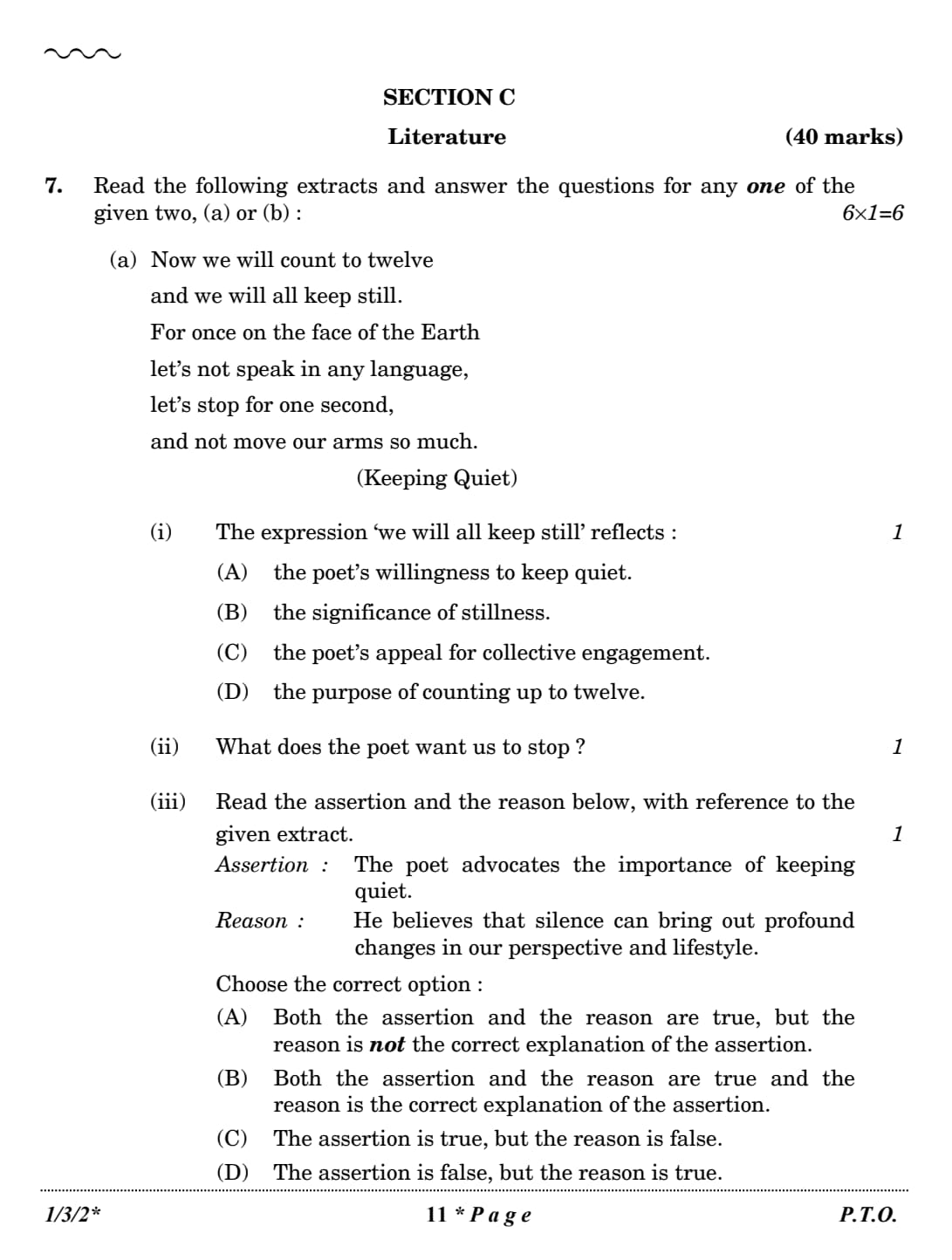
Read the following extract and answer the questions that follow:
Now we will count to twelve
and we will all keep still.
For once on the face of the Earth
let’s not speak in any language,
let’s stop for one second,
and not move our arms so much.
(Keeping Quiet)
The expression ‘we will all keep still’ reflects:
Detailed Solution
N/A Quick Tip: In poetry-based MCQs, identify whether the poet’s idea is personal or universal. Words like “we”, “all”, and “everyone” usually indicate a collective message.
What does the poet want us to stop?
Detailed Solution
N/A Quick Tip: In comprehension questions based on poems, focus on the poet’s central idea. In “Keeping Quiet”, silence represents peace, self-analysis, and unity rather than complete inactivity.
Read the assertion and the reason below, with reference to the given extract.
Assertion : The poet advocates the importance of keeping quiet.
Reason : He believes that silence can bring out profound changes in our perspective and lifestyle.
Choose the correct option :
Detailed Solution
Concept:
Assertion-Reason questions test the logical link between a statement and its underlying justification.
In ‘Keeping Quiet,’ the physical act of silence is the "means" to an "end"—which is spiritual and mental transformation.
Step 1: Evaluate the Assertion
The entire poem is a plea for humans to pause and be silent.
Thus, the assertion that the poet advocates keeping quiet is True.
Step 2: Evaluate the Reason
Neruda suggests that in the moment of silence, we can introspect and realize the damage we do to ourselves and nature.
This leads to a "profound change" in how we live. Thus, the reason is True.
Step 3: Determine the logical connection
The *reason* we should keep quiet (Assertion) is *because* it facilitates this change in perspective (Reason).
Since the Reason justifies why the poet advocates the action, it is the correct explanation. Quick Tip: Use the word "because" between the Assertion and the Reason to see if the sentence makes logical sense. Silence in this poem is never an end in itself; it is always a tool for self-realization.
Complete the following statement correctly :
The poet urges the people to count to twelve so that __________.
Detailed Solution
Concept:
Counting to twelve provides a brief, defined interval of time for preparation.
It acts as a countdown to a shared experience of absolute silence.
The number twelve may represent the hours on a clock or the months in a year, symbolizing a complete cycle of time.
Step 1: Identify the immediate purpose of counting in the poem
The poet uses the countdown as a structural device to transition the readers from their busy, noisy lives into a state of stillness.
Step 2: Determine the outcome of this action
Once the count is finished, the poet expects everyone to "all keep still."
This suggests that the counting is a collective ritual to ensure everyone enters the silence at the exact same moment.
Step 3: Synthesize the completed statement
The poet urges the people to count to twelve so that they can transition collectively and simultaneously into a state of absolute silence and mutual introspection. Quick Tip: Focus on the result of the count; counting is the means, while "keeping still" is the end goal. Ensure the completion maintains the logical flow of the sentence provided in the question.
‘Counting to twelve’ is suggested as a _____________ (synchronized/disorganized) effort for everybody to keep quiet.
Detailed Solution
Concept:
Synchronized action refers to multiple individuals performing the same task at the exact same time.
The poet's use of "we will all" indicates that the silence is not a solitary endeavor but a global, unified act.
Step 1: Analyze the phrasing "we will all" in the text
The poet addresses the entire human race, inviting everyone to count together and stop together.
Step 2: Determine the nature of the effort
If every person on Earth counts and then stops at the same time, the effort is inherently coordinated and timed.
This type of coordinated effort is described as "synchronized."
Step 3: Verify the logic
A disorganized effort would mean everyone stopping at different times, which would fail to create the "exotic moment" of total global silence that the poet desires. Quick Tip: "Synchronized" denotes unity and harmony, which are central themes of Pablo Neruda's poem. Look for inclusive pronouns like "we" and "all" to identify a coordinated action.
How can the message in the excerpt, about silence and stillness be applied to promote peace in today’s world ?
Detailed Solution
Concept:
Silence allows for the suspension of political and cultural rhetoric that often fuels conflict.
Stillness provides the mental space required to recognize shared human vulnerabilities and common goals.
The poem suggests that most human suffering is caused by a lack of self-understanding and a frantic pace of life.
Step 1: Apply the 'cessation of language' to modern diplomacy
By "not speaking in any language," the world could momentarily step away from the aggressive debates and propaganda that divide nations.
This creates a neutral ground where shared humanity is the only common denominator.
Step 2: Apply 'stillness' to global aggression and industry
Not "moving our arms so much" can be interpreted as a cease-fire for physical violence (weapons) and a pause in environmental destruction.
This stillness allows leaders and citizens to evaluate the true cost of their "progress" and wars.
Step 3: Analyze the psychological impact of collective silence
In today’s world of digital noise and constant competition, a shared moment of silence would promote peace by fostering empathy.
It encourages individuals to look inward and realize that their "enemy" is essentially just like them, seeking the same peace and survival.
Step 4: Finalize the practical application
Applying this message would lead to a reduction in reactive aggression and an increase in thoughtful communication.
Peace is promoted when we stop rushing into conflict and instead choose the stillness necessary to understand our own actions and their consequences on others. Quick Tip: Relate the "movement of arms" directly to modern conflict and the arms race for a strong contemporary application. Emphasize that silence is not "doing nothing," but is an active psychological tool for building understanding.
The little old house was out with a little new shed
In front at the edge of the road where the traffic sped,
A roadside stand that too pathetically pled,
It would not be fair to say for a dole of bread,
But for some money, the cash, whose flow supports
The flower of cities from sinking and withering faint.
The first two lines of the extract refer to the :
Detailed Solution
Concept:
The poem ‘A Roadside Stand’ by Robert Frost contrasts the lives of poor rural people with the wealthy city dwellers.
The opening lines establish the setting and the physical appearance of the subject of the poem.
Step 1: Examine the text of the first two lines
"The little old house was out with a little new shed / In front at the edge of the road where the traffic sped,"
Step 2: Identify the primary subject being described
The text describes a "little old house" that has added a "new shed."
This combination of the old structure and the new addition at the edge of the road constitutes the "roadside stand."
Step 3: Eliminate incorrect options
While traffic is mentioned (B), it is not the *focus* of the description; it provides the location.
The lines are clearly a physical description of the stall/stand itself. Quick Tip: Look for nouns that describe structures (house, shed) to identify a descriptive passage. The "roadside stand" is the central object that the poet wants the reader to visualize first.
Complete the following sentence with a suitable reason :
The cash flow is important for urban life because ________.
Detailed Solution
Concept:
In ‘A Roadside Stand,’ Robert Frost highlights the economic interdependence between rural and urban areas.
Cash flow is portrayed as the lifeblood of the city's sophisticated and luxurious lifestyle.
The poem suggests that without this continuous circulation of money, the very essence of urban civilization would deteriorate.
Step 1: Identify the function of cash mentioned in the text
The poet explicitly states that the flow of cash "supports / The flower of cities from sinking and withering faint."
Step 2: Interpret the metaphor 'flower of cities'
The "flower of cities" represents the pinnacle of urban achievement—its beauty, prosperity, high culture, and advanced standards of living.
Step 3: Finalize the reason for importance
The cash flow is important for urban life because it provides the necessary financial support to maintain the city's prosperity and prevents its sophisticated social and economic structures from collapsing or losing their vitality. Quick Tip: Relate the "flow" of money to the prevention of "withering" to show understanding of the poet's imagery. Recognize that the poet is critiquing how city wealth depends on the very money the rural poor are trying to access.
Complete the following sentence suitably :
Rural people put up their roadside stands in the hope of ________.
Detailed Solution
Concept:
The rural poor described in the poem are not looking for handouts or basic charity like "a dole of bread."
They seek economic empowerment and a fair share of the wealth that they see circulating in the cities.
Their "hope" is rooted in a desire for a life of dignity and comfort, similar to what is portrayed in popular media.
Step 1: Analyze the objective stated in the poem
The poet clarifies that the stand is not begging for food, but is pleading "for some money, the cash."
Step 2: Contextualize the desire for 'city money'
The rural folk want to feel the "glow" of city life. They hope that by selling their produce, they can gain the purchasing power required to improve their standard of living.
Step 3: Complete the sentence
Rural people put up their roadside stands in the hope of earning some 'city money' to uplift their financial status and experience the same prosperity and comforts that are enjoyed by urban dwellers. Quick Tip: Differentiate between "necessity" (bread) and "ambition" (cash) to accurately capture the rural folk's motives. Use terms like "standard of living" or "prosperity" to explain the broader meaning of "cash" in this context.
Choose the correct option :
The expression ‘flower of cities’ reflects the ________ (prosperity/poverty) of city life.
Detailed Solution
Concept:
Metaphors using botanical imagery like "flowers" or "blooms" typically signify peak health, beauty, and successful growth.
In the poem, this phrase is used to contrast the vibrant urban environment with the struggling rural one.
Step 1: Analyze the word choice 'flower'
A flower is the most delicate, beautiful, and sought-after part of a plant. In an urban context, this refers to the luxuries and the successful facets of city life.
Step 2: Connect to the appropriate adjective
"Prosperity" refers to the state of being successful and wealthy, which aligns perfectly with the image of a city that is flourishing like a flower.
Step 3: Contrast with the alternative
Poverty is characterized by lack and decay, which would be represented by "withering" or "sinking"—the very things the poet says the cash flow prevents. Quick Tip: Positive, vibrant imagery almost always denotes prosperity in 20th-century poetry. Look for the surrounding verbs; "supporting" a flower implies keeping it prosperous.
Why is the roadside stand described as pathetic ?
Detailed Solution
Concept:
Pathos is a literary device used to evoke a feeling of pity or sorrow for the subject's condition.
The description highlights the emotional and social gap between the rural poor and the urban rich.
Step 1: Evaluate the physical and social situation of the stand
The stand is a humble, "little" structure built desperately at the edge of a road. It represents the meager resources and high hopes of the rural folk.
Step 2: Explain the personification used by the poet
The poet says the stand "too pathetically pled." It is described as "pathetic" because it seems to be begging for attention and business from a "polished traffic" that completely ignores its existence.
Step 3: Synthesize the reasons for this description
It is described as pathetic because it represents a desperate and unrequited plea for economic inclusion. The owners are waiting in vain for city people to stop and spend money, but the wealthy drivers are indifferent to their struggle, making the stand's attempt at commerce appear heart-wrenchingly futile and sad. Quick Tip: The "pathos" lies in the contrast between the rural folk's "pleading" hope and the city folk's "speeding" indifference. Focus on the word "pleading" to explain why the stand is more than just a shop—it is a cry for help.
Read the assertion and the reason below, with reference to the given extract :
Assertion : Rural people put up their stand at the edge of the road.
Reason : The flow of traffic will help them promote their business.
Choose the correct option :
Detailed Solution
Concept:
Robert Frost's 'A Roadside Stand' highlights the economic desperation of rural folk who set up stalls to sell local produce to city dwellers.
Strategic positioning is a fundamental requirement for small businesses that rely on the visibility and accessibility of potential customers.
The poem contrasts the 'static' poverty of the rural life with the 'moving' wealth of the urban traffic.
Step 1: Evaluate the validity of the Assertion
The extract explicitly mentions the physical setting: "In front at the edge of the road where the traffic sped".
The rural people have deliberately extended their "little old house" into the public space of the highway to establish a point of contact with outsiders.
Thus, the Assertion is True.
Step 2: Evaluate the validity of the Reason
A business requires a customer base. For rural dwellers living far from city markets, the "flow of traffic" (the cars of wealthy city people) represents their only market opportunity.
They hope that by placing themselves in the path of this "cash flow," they can promote their trade and earn money to improve their lives.
Thus, the Reason is True.
Step 3: Analyze the logical connection between the two statements
The decision to place the stand "at the edge of the road" (the action in the Assertion) is a direct consequence of wanting to tap into the passing traffic (the logic in the Reason).
If there were no traffic flow, there would be no reason to build a stand at that specific, busy location.
Therefore, the Reason provides the underlying justification for the Assertion.
Step 4: Conclusion
Since both statements are factually correct within the context of the poem and the second statement explains the motivation behind the first, Option (B) is the correct choice. Quick Tip: To solve Assertion-Reason questions effectively, read the two statements as a single sentence connected by the word "because". If the resulting sentence "Rural people put up their stand at the edge of the road because the flow of traffic will help them promote their business" is true and logical, then the Reason is the correct explanation.
Read the following extracts and answer the questions:
‘‘You are to come to the palace,’’ the man said. ‘‘The old General is in
pain again.’’
‘‘Oh,’’ Hana breathed, ‘‘is that all ?’’
‘‘All ?’’ the messenger exclaimed.
‘‘Is it not enough ?’’
“Indeed it is,” she replied. ‘‘I am very sorry.’’
When Sadao came to say goodbye, she was in the kitchen, but doing
nothing. The children were asleep and she sat merely resting for a
moment, more exhausted from her fright than from work.
‘‘I thought they had come to arrest you,’’ she said.
(The Enemy)
‘‘Oh,’’ Hana breathed. ‘‘Is that all ?’’
What is the reason for Hana’s tone of relief in the above expression ?
Detailed Solution
Concept:
In the story ‘The Enemy,’ Dr. Sadao and Hana are harboring an American Prisoner of War (POW), which is a treasonous act during wartime.
They live under extreme psychological pressure and the constant threat of being discovered by the authorities.
The arrival of an official or uniformed messenger is a high-stress event that triggers their deepest anxieties.
Step 1: Identify Hana's initial psychological state
When Hana saw the uniformed messenger from the palace, she was struck with terror.
She immediately assumed the worst—that their secret had been exposed and the authorities had come to arrest Dr. Sadao for his crime.
Step 2: Analyze the messenger's actual announcement
The messenger quickly clarified his purpose by stating, ‘‘The old General is in pain again,’’ implying a need for Dr. Sadao's medical expertise.
This revealed that the visit was a routine medical summons rather than a military raid or arrest.
Step 3: Explain the reason for the relief
Hana’s tone of relief stems from the sudden dissipation of her intense fear of being caught.
The phrase ‘‘Is that all?’’ highlights that to her, the General's life-threatening pain was a minor matter compared to the terrifying prospect of her husband's arrest. Quick Tip: Contrast Hana's internal "imagined danger" (arrest) with the "external reality" (medical visit). Mention the context of harboring a POW to explain the disproportionate reaction to a messenger.
Complete the following analogy by choosing one word from the extract :
pain : pleasure :: courage : __________
Detailed Solution
Concept:
An analogy is a comparison between two pairs of words that share a similar logical relationship.
To solve it, one must first identify the relationship between the primary pair (pain and pleasure) and then apply that exact same logic to the secondary pair.
The word chosen for the second pair must be present within the provided literary extract to ensure textual accuracy.
Step 1: Analyze the relationship of the first word pair
The words "pain" and "pleasure" represent opposite physical or emotional states.
Therefore, the underlying logical relationship is that of antonyms.
Step 2: Identify the target word for the second pair
The word "courage" refers to the ability to face danger or difficulty without fear.
To complete the analogy, we must find a word in the text that represents the opposite of courage—namely, intense fear or terror.
Step 3: Search the extract for the appropriate antonym
In the final paragraph of the extract, the narrator describes Hana's state: "more exhausted from her fright than from work."
The word "fright" denotes a sudden and intense feeling of fear, which serves as a perfect antonym for courage.
Step 4: Finalize the analogy
By pairing courage with fright, we maintain the antonymous relationship established by the first pair. Quick Tip: Always establish the logic (Synonym, Antonym, Part-to-Whole) of the first pair before looking at the second. When a question specifies "from the extract," synonyms from your own vocabulary will be marked incorrect even if they logically fit.
According to the above extract, Hana was drained and weakened due to __________.
Detailed Solution
Concept:
Character analysis involves understanding the internal motivations and emotional drivers behind a character's physical symptoms.
In a high-stakes setting like wartime espionage or treason, psychological stress often manifests as physical exhaustion.
Step 1: Locate the textual description of the character's physical state
The text states that when Sadao came to say goodbye, Hana "was in the kitchen, but doing nothing... she sat merely resting for a moment."
This indicates she was physically and mentally drained.
Step 2: Identify the explicit cause mentioned by the narrator
The narrator clarifies the reason for this exhaustion: she was "more exhausted from her fright than from work."
This proves that her weakness was not due to labor, but due to a powerful emotion.
Step 3: Map the text word to the provided options
The word "fright" is a direct synonym for "fear."
Hana was afraid that the messenger had come to arrest her husband for harboring an American soldier.
Step 4: Eliminate incorrect emotions
There is no mention of her being sad (A), frustrated with her chores (B), or angry at the authorities (C).
Her primary motivation throughout the scene is pure terror. Quick Tip: Look for contrast words like "than" to see what the author is emphasizing (e.g., fright is emphasized over work). In "The Enemy," almost every action taken by Hana and Sadao is driven by the underlying fear of discovery.
Complete the following sentence suitably.
Dr. Sadao was asked to come to the palace to __________.
Detailed Solution
Concept:
Understanding the "Inciting Incident" or the immediate plot trigger is essential for comprehension.
Dr. Sadao’s professional identity as a surgeon is the primary reason why he is indispensable to the Japanese military elite despite their suspicions of him.
Step 1: Analyze the dialogue of the messenger
The man from the palace delivers a specific message: "‘‘You are to come to the palace... The old General is in pain again.’’"
Step 2: Connect the character's profession to the situation
Dr. Sadao is a highly skilled surgeon.
The General suffers from a chronic condition that requires specialized medical attention that only Sadao can provide reliably.
Step 3: Synthesize the purpose of the summons
The purpose of the visit is purely medical and professional.
He is being summoned to provide relief or treatment for the General's recurring physical ailment.
Step 4: Finalize the completion with textual accuracy
The sentence is completed by stating that he was needed to treat the General’s pain. Quick Tip: When completing a sentence about a character's actions, always link their profession (Doctor) to the specific problem (Pain). Avoid over-explaining; stick to the immediate reason provided in the dialogue.
And he added, ‘‘Because we are born into this community, we are
never given any honour or dignity or respect; we are stripped of all
that. But if we study and make progress, we can throw away these
indignities. So study with care, learn all you can. ...’’
The expression ‘these indignities’ in the above extract refers to ________ .
Detailed Solution
Concept:
The term ‘indignity’ in literature often denotes treatment that is perceived as being beneath one's dignity, involving humiliation or a lack of basic human respect.
In the context of marginalized narratives like ‘Memories of Childhood,’ it specifically highlights the deep-seated psychological and social impact of caste-based discrimination.
Deciphering such references requires analyzing the negative descriptors provided by the author in the preceding sentences.
Step 1: Analyze the immediate context within the speaker’s dialogue
The speaker begins by describing the current state of their community, stating that they are "never given any honour or dignity or respect."
He further emphasizes that they have been "stripped of all that."
Step 2: Identify the thematic link to the word ‘indignities’
The "indignities" serve as a summary for the collective lack of honor and the systemic humiliation mentioned in the previous sentence.
It encapsulates the feeling of being treated as inferior.
Step 3: Formulate a comprehensive definition for the blank
The phrase refers to the social humiliation, discrimination, and the total denial of basic human honor and respect that the community suffers due to their marginalized status. Quick Tip: When explaining a summary phrase like "these [noun]," always refer back to the specific list of problems mentioned right before it. "Indignity" is the opposite of "Honor"; using this contrast helps in clarifying the definition.
List one personality trait that is exhibited by the speaker in the above extract.
Detailed Solution
Concept:
Character traits are the underlying qualities of a person revealed through their speech, actions, and beliefs.
A character who encourages another to take a difficult path for future benefit usually possesses traits of foresight or wisdom.
Step 1: Evaluate the nature of the speaker’s advice
The speaker (Annan) does not encourage despair or violent rebellion.
Instead, he offers a constructive and pragmatic solution: "if we study and make progress, we can throw away these indignities."
Step 2: Deduce a trait from the dialogue
The speaker is clearly progressive and visionary.
He understands that intellectual development is the most potent weapon against social stagnation.
Step 3: Finalize the selection with justification
One primary trait is that he is motivational or encouraging.
He uses the harsh reality of their situation to spur the listener (Bama) toward academic excellence and self-improvement. Quick Tip: Look for the "call to action" in the text; the character's reaction to adversity defines their personality trait. Standard positive traits like "resilient," "wise," or "progressive" are usually applicable to characters offering mentorship.
What, according to the speaker, is the way out of the situation ?
Detailed Solution
Concept:
The "way out" refers to the specific strategy or tool proposed by a character to overcome an obstacle.
This strategy is often signaled by conditional words like "if" or imperative words like "so," "study," or "learn."
Step 1: Locate the explicit solution provided in the text
The speaker suggests: "But if we study and make progress, we can throw away these indignities."
He follows this with the imperative: "So study with care, learn all you can."
Step 2: Identify the core activity being suggested
The verbs "study" and "learn" are central to the speaker's philosophy.
These actions are the fundamental components of a formalized academic pursuit.
Step 3: Match the textual evidence with the given options
The suggestion to "study" and "learn" corresponds directly to Option (A) education.
There is no mention of physical fighting (aggression), accepting the status quo (compliance), or waiting for legal reform (legislation).
Step 4: Finalize the conclusion
Since education is the only method proposed to "throw away indignities" and "make progress," it is the definitive way out according to the speaker. Quick Tip: When keywords like "study" and "learn" appear, the theme is almost certainly related to the transformative power of education. Eliminate options that suggest passive behavior (compliance) or external reliance (legislation) if the character is calling for personal effort.
The message conveyed in the given extract is ________.
Detailed Solution
Concept:
A literary "message" represents the underlying moral or universal truth that the author intends to communicate to the reader.
In narratives concerning social justice, the message often focuses on the shift from passive victimhood to active empowerment.
The core of this extract is the transformative potential of knowledge in a prejudiced society.
Step 1: Identify the conflict described by the speaker
The speaker outlines a scenario where a community is systematically denied basic human rights like "honour," "dignity," and "respect" simply due to the circumstances of their birth.
Step 2: Analyze the relationship between the problem and the solution
The "indignities" are the problem, and "study and progress" are presented as the specific remedy.
This establishes a direct causal link between academic excellence and social liberation.
Step 3: Synthesize the core takeaway
The message is that education is not just about gaining information; it is the most powerful tool for the marginalized to reclaim their self-respect and overcome systemic oppression.
Step 4: Finalize the completion
The message conveyed is that education and intellectual advancement are the primary means of overcoming social discrimination and regaining one's lost dignity and honor in society. Quick Tip: When summarizing a message, use words like "empowerment," "transformation," or "catalyst." Ensure the message is stated as a universal principle that applies beyond the specific characters in the story.
Read the following extracts and answer the questions:
(a) And in dark hutments, next to lines of flames of flickering oil lamps,
sit boys and girls with their fathers and mothers, welding pieces of
coloured glass into circles of bangles. Their eyes are more adjusted to
the dark than to the light outside. That is why they often end up
losing their eyesight before they become adults.
What do ‘flickering oil lamps’ suggest ?
Detailed Solution
Concept:
Imagery in literature is used to evoke specific settings and socio-economic conditions without explicitly stating them.
Primitive lighting sources often serve as a symbol of technological backwardness and economic deprivation.
Step 1: Identify the environmental setting described in the extract
The narrator describes "dark hutments" where the only source of light is "lines of flames of flickering oil lamps."
Step 2: Analyze the social implications of this imagery
The use of oil lamps instead of electricity in a workplace indicates a complete lack of modern infrastructure and basic amenities.
The word "flickering" suggests instability and poor visibility, which adds to the physical strain on the workers.
Step 3: Synthesize the final suggestion
The ‘flickering oil lamps’ suggest the extreme poverty, the primitive working conditions, and the absence of basic facilities like electricity in the lives of the bangle makers of Firozabad. Quick Tip: Contrast modern amenities with the primitive ones mentioned in the text to identify the author's social commentary. Descriptive adjectives like "flickering" or "dim" are almost always used to highlight the pathetic state of the setting.
Select the correct option from those given in brackets to fill in the blank.
The description of the hutments highlights the ___________ situation of the workers. (pathetic/comfortable)
Detailed Solution
Concept:
Tone and mood analysis requires matching the vocabulary to the descriptions provided in the text.
Situations involving child labor, darkness, and health hazards are inherently negative.
Step 1: Review the descriptors used for the hutments
The text uses words like "dark," "flickering oil lamps," and mentions that workers lose their "eyesight" before becoming adults.
Step 2: Evaluate the given bracketed options
"Comfortable" implies ease, health, and well-being, which contradicts every detail in the extract.
"Pathetic" refers to a condition that is miserably inadequate and heart-breaking.
Step 3: Finalize the selection
Given the tragic health consequences and the gloomy environment, "pathetic" is the only appropriate descriptor. Quick Tip: Always choose the word that aligns with the negative or positive "vibe" created by the author's imagery. "Pathetic" often relates to a situation that evokes pity; look for health hazards or extreme poverty to confirm its use.
Bring out the irony in the statement, ‘‘Their eyes are more adjusted to the dark than to the light outside.’’
Detailed Solution
Concept:
Irony is a literary device where the reality is the opposite of what is expected or what is natural for human well-being.
Light is naturally beneficial and healthy for human eyes, while prolonged darkness is detrimental.
Step 1: Identify the "unnatural" state of the workers
The human eye is biologically designed to thrive in natural light.
However, these children have spent so much time in the "dark hutments" that their eyes have adapted to gloom.
Step 2: Contrast the work with the outcome
There is a deeper irony: these workers spend their lives creating bright, colorful, and shining bangles that bring beauty and joy to others' lives,
yet they are forced to work in such darkness that they lose their own "light" (eyesight).
Step 3: Synthesize the ironical observation
The irony lies in the fact that natural light has become foreign and uncomfortable for them because they are trapped in a cycle of labor that thrives in darkness,
eventually leading to the permanent loss of their vision. Quick Tip: Look for the "Bangle-Maker's Paradox": creating beauty for others while destroying their own physical health. Irony is often found when a character is "adapted" to a harmful or unnatural environment.
Complete the following suitably.
The boys and girls sitting with their fathers and mothers in the dark hutments indicates ___________.
Detailed Solution
Concept:
The presence of multiple generations in a single hazardous workspace indicates a social and economic pattern.
It suggests that the profession is not a choice but a hereditary necessity handed down through the family.
Step 1: Analyze the group dynamic mentioned in the text
The text says boys and girls sit "next to lines of flames... with their fathers and mothers."
This shows that the entire family unit is involved in the same labor.
Step 2: Determine what this signifies for the children's future
Because the children are with their parents, it indicates the complete absence of schooling and the lack of any alternative career path.
It shows the normalization of child labor within the community.
Step 3: Formulate the completion
...indicates the inter-generational cycle of poverty and the hereditary nature of the bangle-making industry,
where children are inducted into the hazardous trade from a very young age. Quick Tip: Use terms like "hereditary" or "vicious cycle" to describe situations where families are trapped in the same poor conditions for generations. Mention the lack of education as a direct consequence of children working alongside parents.
What does the following line from the extract showcase ?
That is why, they often end up losing their eyesight before they become adults.
Detailed Solution
Concept:
Transitional phrases like "That is why" are used to link a cause to its inevitable effect or result.
A "conclusion" in this context is the logical and tragic outcome of a set of circumstances.
Step 1: Identify the cause-effect relationship
The "cause" is working in dark hutments with flickering lamps.
The "effect" is the loss of eyesight.
Step 2: Categorize the statement based on the prefix phrase
The phrase "That is why" signals that the author is drawing a final result or a deduction from the facts presented.
This is the definition of a conclusion.
Step 3: Eliminate incorrect options
It is not an "expectation" (which is future-oriented and hopeful) or "confusion."
It is a hard, factual result of their current reality. Quick Tip: Phrases like "Therefore," "Consequently," or "That is why" always point toward a "conclusion" or "result." Look at the certainty of the statement; "often end up" indicates a predictable and documented outcome.
Select the textual option that is closest to acceptance of their plight.
Detailed Solution
Concept:
"Acceptance of plight" refers to the psychological state where individuals stop resisting a bad situation and treat it as their normal way of life or destiny.
This is often shown through collective participation in the struggle without any attempt to change the status quo.
Step 1: Evaluate each option for the theme of "acceptance"
Option (A) is a physical description. Option (B) is a physical consequence. Option (C) is a specific task.
Step 2: Analyze Option (D) in a social context
When children ("boys and girls") sit alongside their "fathers and mothers" to do the same hazardous work, it shows that the whole community has accepted this labor as their inevitable fate.
The parents are not trying to send the children to school; they are teaching them the trade they themselves have accepted.
Step 3: Confirm the logic
This quiet, group participation represents the "God-given lineage" concept mentioned elsewhere in the story—the belief that they were born into this and must accept it. Quick Tip: Acceptance is often indicated by the "normalization" of a tragedy—when families do it together, it's no longer seen as a choice. Look for descriptors that show the inter-generational nature of a problem to find "acceptance."
But Champaran did not begin as an act of defiance. It grew out of an
attempt to alleviate the distress of large numbers of poor peasants.
This was the typical Gandhi pattern — his politics were intertwined
with the practical, day-to-day problems of the millions. His was not a
loyalty to abstractions; it was a loyalty to living, human beings.
In everything Gandhi did, moreover, he tried to mould a new free
Indian who could stand on his own feet and thus make India free.
Choose the option that stands as an example of ‘act of defiance’ :
Detailed Solution
Concept:
"Defiance" is defined as open resistance or bold disobedience toward an established authority or a direct command.
To identify an act of defiance, look for a situation where a rule or warning is consciously ignored.
Step 1: Analyze the components of a defiant act
Defiance requires two things: an authority figure giving a command/warning, and a subject actively choosing to do the opposite.
Step 2: Evaluate the options
Option (A) shows compliance (yielding). Option (B) shows a natural emotional reaction (fear). Option (D) shows an abuse of power, not resistance.
Step 3: Apply the logic to Option (C)
In Option (C), the father is the authority figure providing a "strict warning."
Arun's action of "venturing out" is a direct, conscious violation of that warning.
This is a perfect example of defiance. Quick Tip: Defiance = Warning/Rule + Action that breaks that Rule. Look for words like "Despite," "However," or "Refused" to find acts of defiance in text.
What was the primary purpose of the Champaran episode as suggested in the extract ?
Detailed Solution
Concept:
The Champaran episode is historically significant as Gandhi's first civil disobedience movement in India.
The extract focuses on the humanitarian motivation behind the political movement.
Step 1: Locate the origin of the movement in the text
The extract states: "It grew out of an attempt to alleviate the distress of large numbers of poor peasants."
Step 2: Define the primary goal
While it eventually became a political victory, its starting point and primary purpose was the "alleviation of distress."
The goal was to provide immediate relief to the suffering sharecroppers.
Step 3: Synthesize the final answer
The primary purpose of the Champaran episode was to alleviate the economic and psychological distress of the large population of poor peasants who were being exploited. Quick Tip: Focus on the "distress" of the peasants as the catalyst for the movement. Differentiate between the *outcome* (victory/defiance) and the *purpose* (helping the poor).
The expression ‘to mould’ in the above extract suggests :
Detailed Solution
Concept:
"To mould" is a metaphor borrowed from pottery or sculpting.
It implies taking a raw, unrefined material (in this case, the Indian psyche) and carefully giving it a new form or character.
Step 1: Analyze the metaphor in context
Gandhi wanted "to mould a new free Indian."
He wasn't just giving them advice; he was trying to fundamentally change their mindset from fear to self-reliance.
Step 2: Identify the synonym for 'mould'
To "shape" something is to give it a specific form or characteristic.
This perfectly matches the artistic and transformative meaning of "moulding" a person's character.
Step 3: Eliminate incorrect choices
"Release" (A) is the goal, but "mould" is the process.
"Advise" (C) is too weak a word for the profound change Gandhi was seeking. Quick Tip: "Mould" = Active Transformation. Think of a sculptor shaping clay. In character development contexts, "mould" always refers to building or shaping personality.
The above extract suggests that Gandhi was more concerned about ____________ (politics/people).
Detailed Solution
Concept:
Leadership can be ideological (focused on abstract politics) or humanistic (focused on people's needs).
The author contrasts these two approaches to explain Gandhi's unique success.
Step 1: Examine the description of Gandhi's loyalty
The text says his politics were "intertwined with the practical, day-to-day problems of the millions."
It explicitly states: "it was a loyalty to living, human beings."
Step 2: Determine the priority
While he engaged in "politics," his primary motivation and loyalty were to "living, human beings."
Politics was merely the tool he used to serve people.
Step 3: Finalize the selection
Therefore, Gandhi was more concerned about people than about abstract political theories. Quick Tip: Look for words like "millions," "peasants," or "human beings" to identify a people-centric approach. The text rejects "abstractions," which is a key hint that abstract politics was not his main concern.
What does the writer mean by the expression ‘typical Gandhi pattern’ ?
Detailed Solution
Concept:
A "pattern" in this sense refers to a consistent method or approach used by an individual.
The "Gandhi pattern" was his unique way of blending high-level political resistance with local, grass-roots human issues.
Step 1: Analyze the author's explanation of the pattern
The text defines it as: "his politics were intertwined with the practical, day-to-day problems of the millions."
It also mentions his rejection of "abstractions."
Step 2: Explain the components of the pattern
The pattern involves addressing large political structures (like British rule) by first solving the concrete, personal problems of the common man.
It is an approach based on practical humanity rather than theoretical ideology.
Step 3: Synthesize the final meaning
The ‘typical Gandhi pattern’ refers to an approach where political activism is inseparable from the practical, everyday struggles of ordinary people,
aimed at making individuals self-reliant and free in their minds first. Quick Tip: "Pattern" = Practicality + Politics. Gandhi didn't just fight for a "free India" (an abstraction); he fought for "free Indians" (living beings).
Complete the following analogy by choosing one word from the above extract :
disagree : oppose :: mitigate : _________
Detailed Solution
Concept:
Analogies require finding a synonym or a closely related word.
To "mitigate" means to make something (like pain or suffering) less severe or intense.
Step 1: Identify the relationship of the first pair
"Disagree" and "oppose" are near-synonyms, both representing a lack of agreement or resistance.
Step 2: Search the extract for a synonym of 'mitigate'
The extract describes Gandhi's goal: "...to alleviate the distress of large numbers of poor peasants."
Step 3: Compare 'mitigate' and 'alleviate'
Both words mean to reduce or lessen the intensity of a negative state (suffering, distress, pain).
Therefore, "alleviate" is the correct textual match. Quick Tip: "Alleviate" and "Mitigate" are standard synonyms in academic writing. Ensure the word is spelled exactly as it appears in the text (alleviate).
The people in the story ‘The Last Lesson’ suddenly realise how precious their language is to them. Why does this happen ?
Detailed Solution
Concept:
Language is more than just a means of communication; it is a fundamental pillar of cultural and national identity.
People often take their heritage for granted until they are faced with the immediate threat of losing it.
In Alphonse Daudet's story, the "linguistic chauvinism" of the victors forces the vanquished to appreciate their mother tongue.
Step 1: Identify the external political cause
An order had arrived from Berlin stating that henceforth, only German would be taught in the schools of Alsace and Lorraine.
This meant that the French language was being systematically removed from the education system and public life.
Step 2: Explain the psychological impact of the news
The sudden realization that they would no longer be able to speak or learn their mother tongue acted as a "thunderclap" for the villagers.
It shifted their perspective from seeing language as a chore to seeing it as a precious possession.
Step 3: Analyze M. Hamel's role in this realization
M. Hamel, the schoolmaster, emphasized that French was the most beautiful, clearest, and most logical language in the world.
He told them that when a people are enslaved, as long as they hold fast to their language, it is as if they had the key to their prison.
Step 4: Finalize the reason for the realization
The villagers realized its value because its loss symbolized the loss of their freedom and identity.
The presence of the village elders in the back of the classroom was a tribute to the language they would now be forced to abandon. Quick Tip: Use the phrase "key to their prison" as it is a central metaphor in the story. Mention the "Order from Berlin" to provide the specific historical context for the realization.
Explain the contrast between ‘the late winter’s moon’ and the ‘trees sprinting’ in the poem ‘My Mother at Sixty-six’.
Detailed Solution
Concept:
Kamala Das uses contrasting imagery to highlight the inevitable gap between the vitality of youth and the frailty of old age.
Imagery in poetry often serves as a symbolic shorthand for complex human emotions like fear of loss.
Step 1: Analyze the symbolism of ‘the late winter’s moon’
The moon in late winter appears pale, hazy, and lacks its usual brightness due to fog or mist.
It symbolizes the mother’s aging face, which has lost its luster and vitality, appearing "ashen" and nearing the "winter" (end) of her life.
Step 2: Analyze the symbolism of the ‘trees sprinting’
In contrast, the "trees sprinting" seen outside the moving car represent life, energy, and the rapid passage of time.
The trees are young, green, and full of vigor, moving fast—just as youth passes quickly.
Step 3: Synthesize the contrast
The contrast is between stagnation and motion, or between impending death and exuberant life.
While the mother is still and fading like the winter moon, the outside world (the trees) is dynamic and full of the "sprinting" energy of youth.
Step 4: Final conclusion
This juxtaposition heightens the poet's sense of pain and anxiety, as the vivid life outside makes the mother's approaching end seem even more stark and inevitable. Quick Tip: "Late winter" is a metaphor for the final stage of life (old age). "Sprinting" is used to show the speed and energy of life, which contrasts with the mother's "corpse-like" stillness.
Beautiful things ‘never pass into nothingness’. Explain in the context of the poem, ‘A Thing of Beauty’.
Detailed Solution
Concept:
John Keats, a Romantic poet, believes that beauty is an eternal source of joy that transcends time and space.
Unlike material pleasures that fade, the spiritual and mental impact of beauty is permanent.
Step 1: Interpret the literal meaning of the phrase
When Keats says beauty "never passes into nothingness," he means that it is immortal.
Its "loveliness increases" as we remember it, rather than diminishing with time.
Step 2: Explain the therapeutic effect of beauty
In a world filled with "despondence" and "gloomy days," beauty acts as a healing balm.
It provides us with a "quiet bower"—a peaceful place of rest—that offers sweet dreams, health, and quiet breathing.
Step 3: Discuss the permanence of the memory
Even if the physical object of beauty is no longer before us, the impression it leaves on our soul is indelible.
It remains an "endless fountain of immortal drink" that continues to nourish the human spirit forever.
Step 4: Final Conclusion
Thus, beauty is a constant companion that removes the "pall" of sadness from our spirits, ensuring that the joy it provides is never truly lost. Quick Tip: Use Keats' own vocabulary like "quiet bower" and "immortal drink" to strengthen your answer. Emphasize that the *joy* increases even if the *object* of beauty might perish.
Saul Bellow views interviews as ‘thumbprints on the windpipe’. Comment. (The Interview)
Detailed Solution
Concept:
For many celebrities, the act of being interviewed is seen as a violation of their privacy and personal space.
This metaphor highlights the physical and psychological discomfort felt by the person being questioned.
Step 1: Analyze the metaphor ‘thumbprints on the windpipe’
The "windpipe" is essential for breathing and life. "Thumbprints" imply a forceful, physical pressure.
Bellow suggests that an interview is like being throttled or suffocated.
Step 2: Explain the feeling of intrusion
The metaphor suggests that the interviewer's persistent and often personal questions leave a mark on the interviewee.
It feels like an assault where the person's private self is being compressed or distorted for public consumption.
Step 3: Connect the metaphor to Bellow's perspective
Despite being a frequent subject of interviews, Bellow felt that the process was an unwanted intrusion.
It made him feel as though his very identity was being stifled or that he was being forced into a role that didn't fit.
Step 4: Conclusion
This strong imagery conveys the profound sense of vulnerability and "victimization" that many artists feel when faced with the modern media's intrusive nature. Quick Tip: Link the "thumbprints" to the idea of a permanent, unwanted mark left on one's personality. Mention "suffocation" or "loss of breath" to explain the "windpipe" aspect of the metaphor.
They were all averse to the term ‘communism’. What was the notion that prevailed in Gemini Studios about communists ? (Poets and Pancakes)
Detailed Solution
Concept:
In the 1950s, during the Cold War era, there were strong global prejudices and stereotypes regarding political ideologies like Communism.
The middle class in South India, including those at Gemini Studios, held a very specific, negative view of these "godless" men.
Step 1: Describe the perceived character of a communist
The prevailing notion at the studio was that a communist was a "godless man" who possessed no filial or matrimonial love.
They were seen as cold and emotionless individuals.
Step 2: Explain the perceived social goals of communism
Communists were believed to have "no compunction" about killing their own parents or children.
They were viewed as agents of unrest and violence who only wanted to spread chaos and revolution.
Step 3: Detail the studio's reaction
This prejudice was so deep that even the simple, khadi-clad workers of the studio felt a natural aversion to the term.
They associated it with a complete lack of traditional values and humanity.
Step 4: Final Conclusion
Thus, the "Gemini family" viewed communism not as a political choice, but as a dangerous, anti-social, and anti-religious force. Quick Tip: Use the phrase "no filial or matrimonial love" to capture the specific cultural fear mentioned in the text. Mention the term "godless man" as it is the primary label used by the narrator.
What was the main agreement between the indigo planters and the peasants ? (Indigo)
Detailed Solution
Concept:
The Champaran struggle was rooted in an exploitative feudal system backed by colonial laws.
The agreement forced the poor sharecroppers into a state of permanent debt and labor.
Step 1: Define the 15 percent arrangement
The "ancient arrangement" required the Champaran peasants to plant three-twentieths (or 15 percent) of their entire landholding with indigo.
Step 2: Identify the rental conditions
The agreement stipulated that the peasants had to surrender the entire indigo harvest to the British landlords as rent for the land.
Step 3: Explain the impact of synthetic indigo
When Germany developed synthetic indigo, the natural crop lost its value.
The landlords then tried to extort compensation from the peasants to release them from this 15 percent arrangement.
Step 4: Final Conclusion
This long-term contract was the primary cause of the sharecroppers' misery, as it left them with no control over their own produce or livelihood. Quick Tip: Be specific with numbers: "15 percent" or "three-twentieths" are key technical details. Clarify that the harvest was given as "rent," not sold for profit.
Why was Charley in ‘The Third Level’ keen to buy old currency ?
Detailed Solution
Concept:
The theme of the story is escapism from the harsh realities, insecurities, and stresses of the modern post-war world.
Time travel in literature often requires the character to adapt to the material conditions of the destination era, including its monetary system.
Step 1: Identify Charley's intended destination
Charley wanted to escape to Galesburg, Illinois, specifically to the year 1894. He viewed this era as a peaceful, idyllic time far removed from the anxieties of the 20th century.
Step 2: Explain the practical necessity for old currency
When he first visited the "Third Level" at Grand Central Station, the clerk at the ticket counter refused his modern bills, calling them "not money."
To buy two tickets to Galesburg for himself and his wife Louisa, he needed "old-style" bills that were in circulation during the 1890s.
Step 3: Synthesize the final answer
Charley was keen to buy old currency because he intended to travel back to the year 1894. Since modern currency was useless in the past, he exchanged his life savings to obtain old-style bills to pay for train tickets to Galesburg. Quick Tip: Mention the specific year (1894) and the location (Galesburg) to provide a complete context. Highlight that the ticket clerk’s rejection of modern money is what prompted Charley to seek old currency.
The Maharaja, on the third birthday of the crown prince, gave him a special gift. What was special about the gift ? (The Tiger King)
Detailed Solution
Concept:
This story centers on the irony of fate and the futility of trying to escape a prophecy.
A seemingly harmless, "special" object can become the instrument of destiny.
Step 1: Identify the gift
For his son's third birthday, the Maharaja bought a wooden toy tiger from a shop in the town's shopping center.
Step 2: Describe the physical "specialty" and flaws of the gift
The wooden tiger was special because it was meant to be a royal gift, but it was actually very poorly crafted by an unskilled carpenter. Its surface was rough, with tiny slivers of wood standing up like quills all over it.
Step 3: Explain the ironic significance of the gift
One of those tiny wooden slivers pierced the Maharaja's right hand while he was playing with his son. This caused an infection that spread throughout his arm, ultimately leading to his death. Thus, the wooden toy became the "hundredth tiger" that fulfilled the prophecy. Quick Tip: The "specialty" of the gift lies in its irony; the King killed 99 real tigers only to be killed by a cheap wooden one. Ensure you mention the "unskilled carpenter" to explain why the toy was dangerous.
What efforts did Zitkala-Sa make to save her hair from being cut ? (Memories of Childhood)
Detailed Solution
Concept:
In many Native American cultures, long hair is a symbol of bravery and identity, whereas short hair is associated with mourning or cowardice.
Resistance against forced assimilation is a central theme in Zitkala-Sa's narrative.
Step 1: Describe the initial attempt to hide
When Zitkala-Sa learned her hair was to be "shingled," she disappeared unnoticed. She crept up the stairs and hid in a large, dark room filled with beds, crawling under the one furthest from the door in a corner.
Step 2: Detail the physical resistance during capture
Despite her efforts to remain silent, she was discovered and dragged out. She resisted by kicking and scratching wildly as she was carried downstairs and tied fast to a chair.
Step 3: Conclude with the result of her struggle
Even when she was caught, she continued to cry and shake her head in protest until her "heavy braids" were finally cut off, symbolizing her loss of spirit and cultural connection. Quick Tip: Focus on the verbs "crept," "crawled," "kicked," and "scratched" to show the intensity of her resistance. Explain *why* she resisted (cultural beliefs) to provide a complete thematic answer.
The peddler’s temptation for money and Sophie’s unrealistic dreams were the root cause for the sufferings of both the characters. Analyse the lessons ‘The Rattrap’ and ‘Going Places’ in the light of the above statement.
Detailed Solution
Concept:
Human suffering often originates from an inability to reconcile one's desires with reality.
In ‘The Rattrap,’ the peddler represents the moral vulnerability of the poor when faced with material temptation.
In ‘Going Places,’ Sophie represents the psychological vulnerability of the youth who use fantasy as an escape from a mediocre life.
Step 1: Analyze the peddler's temptation and its consequences
The peddler viewed the world as a giant rattrap where riches and joys are baits.
Despite this philosophy, he succumbed to the temptation of stealing thirty kronors from the hospitable old crofter.
This act of greed forced him to avoid the public highway and hide in the woods, where he eventually became lost and felt the "rattrap" closing in on him.
His suffering was primarily internal—a mix of fear of capture and the guilt of betraying someone's trust.
Step 2: Analyze Sophie's unrealistic dreams and their impact
Sophie, a teenager from a lower-middle-class family, lives in a world of pure imagination to escape her drab surroundings.
She dreams of owning a boutique, becoming an actress, or a fashion designer, despite her family's limited means.
Her ultimate unrealistic dream involves a romantic meeting with the football star Danny Casey.
When the reality of his absence hits her at the canal, she experiences a deep sense of disappointment and the "burden" of a self-created sadness.
Step 3: Synthesize the comparison and conclusion
Both characters suffer because they reach for something that is either unethical or unattainable.
The peddler's suffering is a result of a moral lapse triggered by poverty, while Sophie's suffering is a result of an emotional lapse triggered by escapism.
The lessons suggest that true peace is found in accepting reality and maintaining moral integrity, rather than chasing "baits" or "mirages." Quick Tip: Contrast the "material bait" in The Rattrap with the "psychological bait" in Going Places. Use the word "escapism" to define Sophie's character and "cynicism" for the peddler. Highlight how both characters find themselves isolated by their choices.
Analyse the portrayal of fear and freedom in ‘Deep Water’ and ‘Aunt Jennifer’s Tigers’.
Detailed Solution
Concept:
Fear is portrayed as a restrictive, paralyzing force that prevents individuals from living a full life.
Freedom is defined as the successful transcendence of these fears, either through physical determination or creative projection.
‘Deep Water’ explores fear through an individual's physical struggle, while ‘Aunt Jennifer's Tigers’ explores it through a social and gendered lens.
Step 1: Analyze fear and freedom in ‘Deep Water’
William Douglas suffers from a deep-seated, paralyzing fear of water caused by childhood accidents.
This fear robs him of the freedom to enjoy fishing, canoeing, and swimming.
To gain freedom, Douglas employs a professional instructor and practices with grim determination for months.
His ultimate freedom is achieved when he swims across Lake Wentworth, realizing that "in death there is peace" and the only thing to fear is "fear itself."
Step 2: Analyze fear and freedom in ‘Aunt Jennifer’s Tigers’
Aunt Jennifer lives in a state of constant, suppressed fear of her husband, represented by the "massive weight of Uncle’s wedding band."
Her life is restricted by the "ordeals" of a patriarchal marriage where she lacks agency and voice.
Freedom for her is only possible through her art—the embroidered tigers which are "bright," "proud," and "unafeared."
Unlike Jennifer, the tigers do not fear the men beneath the tree, representing the bold freedom her spirit craves but cannot achieve in reality.
Step 3: Compare the outcomes of both portrayals
In ‘Deep Water,’ freedom is attainable and life-affirming through individual willpower.
In ‘Aunt Jennifer’s Tigers,’ freedom remains elusive and symbolic; even after death, Jennifer’s hands remain "terrified," while her art continues to "prance" in freedom.
The contrast highlights that some fears can be conquered by the self, while others are deeply rooted in oppressive social structures. Quick Tip: Link Douglas's fear to a specific physical trauma and Aunt Jennifer's fear to a systemic social structure (patriarchy). Mention the "internal freedom" of art versus the "external freedom" of action. Use the quote "All we have to fear is fear itself" to ground the analysis of Deep Water.
People with physical impairments deserve acceptance, not sympathy. How does the play ‘On The Face Of It’ advocate the above philosophy through the characters of Mr. Lamb and Derry.
Detailed Solution
Concept:
Susan Hill’s play explores the psychological impact of physical deformities and the social isolation that often accompanies them.
It highlights the distinction between "sympathy" (which can be condescending and alienating) and "acceptance" (which is inclusive and empowering).
The encounter between a bitter young boy and an optimistic old man serves as a transformative lesson in self-worth.
Step 1: Analyze Derry’s initial psychological state and his reaction to social pity
Derry is a fourteen-year-old boy with a face badly scarred by acid.
He lives in a state of perpetual bitterness, believing that people are either afraid of his face or merely pretend to feel sorry for him.
To Derry, sympathy is a reminder of his abnormality; he hates the "kind" remarks people make because they feel like lies.
He withdraws into isolation to avoid the "looks" of others, showing how the lack of genuine acceptance can damage a person's spirit.
Step 2: Examine Mr. Lamb’s non-judgmental and accepting approach
Mr. Lamb, who has a tin leg due to a war injury, presents a complete contrast to Derry.
He does not greet Derry with shock or pity. Instead, he treats Derry’s intrusion into his garden as a normal, welcome event.
By focusing on things like "weeds" being just as much "living things" as flowers, he teaches Derry that physical appearance does not define one’s essence.
Lamb’s acceptance is rooted in the philosophy that "everything is the same... but everything is different," encouraging Derry to look at the world, not just his reflection.
Step 3: Evaluate the shift from self-pity to empowerment through their interaction
Mr. Lamb challenges Derry’s self-imposed prison by pointing out that he has "two arms, two legs, and eyes and ears... and a tongue and a brain."
He urges Derry to stop waiting for people to change and instead change his own perspective.
The "acceptance" Lamb offers is a tough, realistic one—he tells Derry that he can get on "better than all the rest" if he chooses to.
This shifts the narrative from Derry being a victim of his face to being the master of his own life.
Step 4: Conclude how the play emphasizes shared humanity over pity
The play concludes that what people with impairments need is not a "special" status or pitying glances, but to be treated as ordinary members of society.
By the end, Derry is no longer bothered by his face; he runs back to Mr. Lamb because he has finally found a place where he is accepted for who he is, not judged for how he looks.
The philosophy is clear: sympathy keeps the "wall" up between people, but acceptance breaks it down. Quick Tip: Contrast Derry’s focus on his "burnt face" with Mr. Lamb’s focus on the "mind" and the "world." Use the "weeds and flowers" metaphor to explain the concept of universal equality. Highlight that sympathy emphasizes "disability," while acceptance emphasizes "ability."
‘Journey to the end of the Earth’ gives an awakening call to man to act with responsibility to save the environment. Substantiate the above statement with textual evidence.
Detailed Solution
Concept:
Antarctica serves as a pristine laboratory that holds the secrets of the Earth’s past, present, and future.
Tishani Doshi’s narrative emphasizes the extreme fragility of the polar ecosystem and its role as a climate regulator.
The "awakening call" is the realization that human actions in populated areas are directly causing irreversible damage to the most remote parts of the planet.
Step 1: Identify the significance of Antarctica as a laboratory of nature
The text describes Antarctica as a place where "90 percent of the Earth’s total ice volumes" are stored.
Because it has never sustained a human population, it remains relatively pristine, making it the perfect place to study the impact of global warming.
It holds in its ice cores "half-million-year-old carbon records," which are essential for understanding climate history.
Step 2: Analyze the impact of human activity as described in the text
The author points out the "human impact" on the planet—how in a mere "12,000 years" (a blink in geological time), humans have created a "dominance over nature."
This dominance has led to the "rapid increase in human populations" and the "unmitigated burning of fossil fuels," creating a "blanket of carbon dioxide" around the world.
The text explicitly mentions the rising global temperatures as the primary threat.
Step 3: Provide textual evidence of the environmental 'awakening call'
The awakening call is substantiated through visible, alarming evidence: the "retreating glaciers" and "ice shelves collapsing."
The author mentions the threat to "microscopic phytoplankton," which are the foundation of the entire Southern Ocean's food chain.
Any further depletion of the ozone layer will affect the activities of these organisms, which in turn will affect the lives of all marine animals and the global carbon cycle.
This "chain reaction" is a stark warning that small changes in the environment have massive, global consequences.
Step 4: Conclude with the urgency of global responsibility
The "Students on Ice" programme aims to provide students with an "inspiring educational opportunity" to foster a new understanding and respect for our planet.
The narrative concludes that we cannot afford to be "indifferent" anymore.
The experience of walking on a "moving piece of history" serves as a reminder that we must act now if we want to ensure a future for the next generation. Quick Tip: Focus on the "phytoplankton" example to show how a small change leads to a large-scale catastrophe. Mention the "Students on Ice" programme as the practical solution proposed for the awakening call. Use the phrase "carbon records" to explain why studying Antarctica is scientifically crucial.
CBSE Class 12 English Core Section-Wise Weightage
| Section | Marks | Expected Weightage |
|---|---|---|
| Section A: Reading Skills | 22 | 22% |
| Section B: Creative Writing Skills | 18 | 18% |
| Section C: Literature | 40 | 40% |
| TOTAL | 80 | 100% |



Comments