




CBSE Class 12 Hindi Elective Question Paper 2007 Code Delhi is available for download here. CBSE conducted the Class 12 Hindi Elective exam on March 17, 2007. The paper carries 100 marks and the time allowed is 3 hours.
Also Check: CBSE Class 12 Question Paper 2007 (All Subjects)
The Hindi Elective question paper includes the following types of questions:
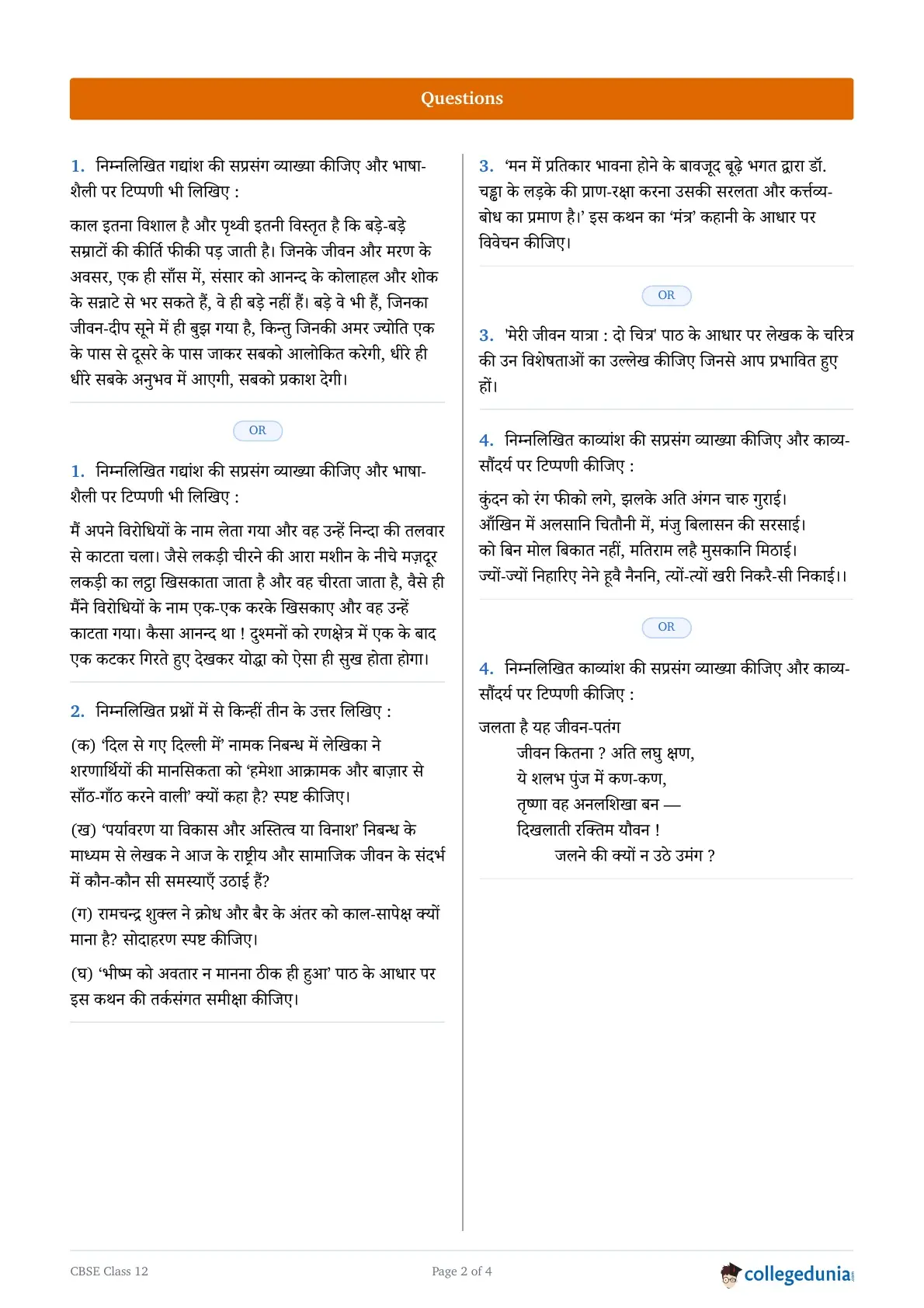
- The question paper has 15 questions, all compulsory, for 100 marks in 3 hours
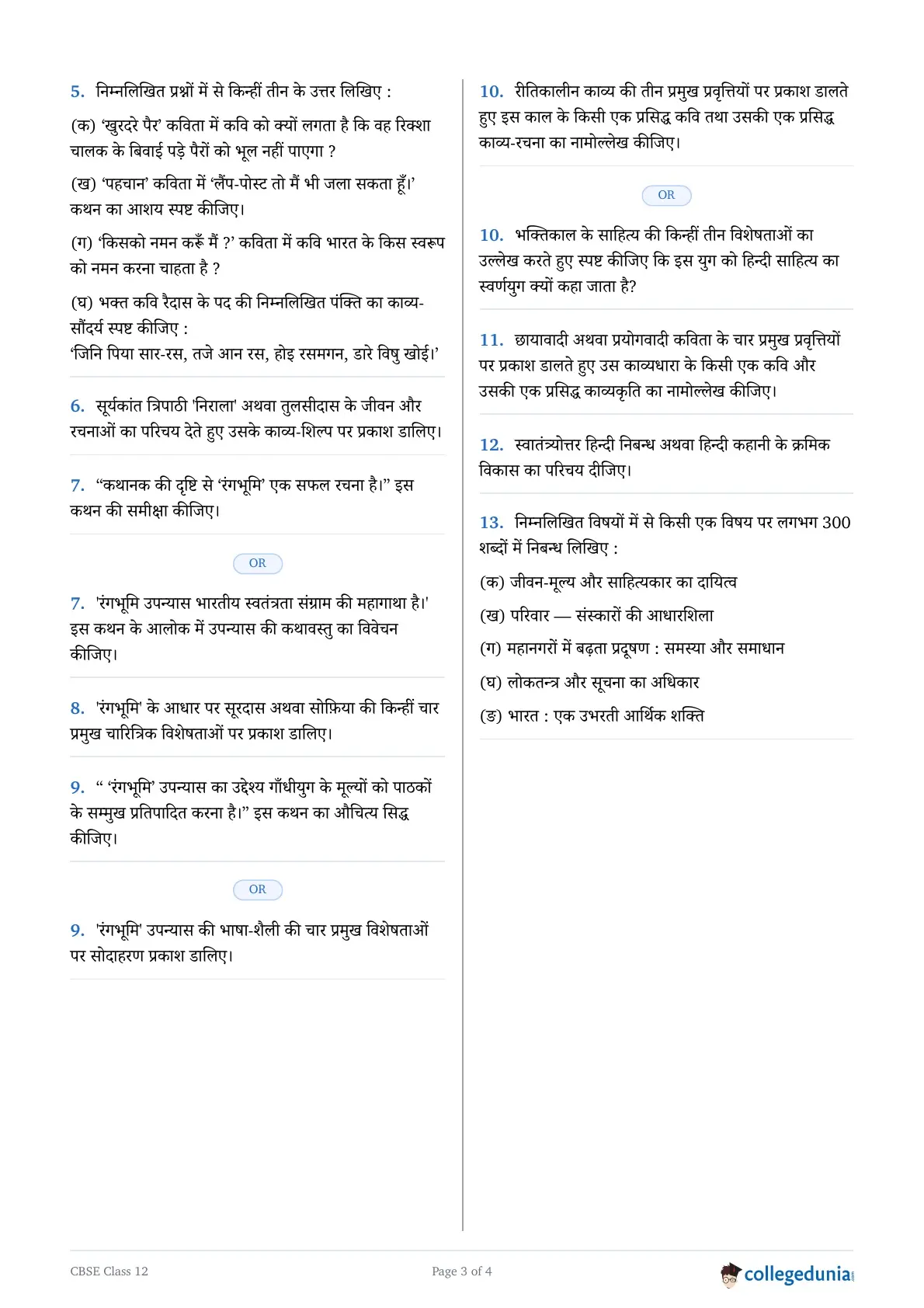
- The paper is not divided into printed sections; for easy reading the questions are grouped here as Part 1 (Q1-Q3, prose, 25 marks), Part 2 (Q4-Q6, poetry and poets, 25 marks), Part 3 (Q7-Q9, the novel 'Rangbhoomi', 15 marks), Part 4 (Q10-Q12, literary history, 13 marks) and Part 5 (Q13-Q15, essay and unseen passages, 22 marks)
- Question 2 and Question 5 ask for any three of four answers (4 marks each and 3 marks each respectively)
- Question 13 is an essay of about 300 words on one of five topics for 12 marks
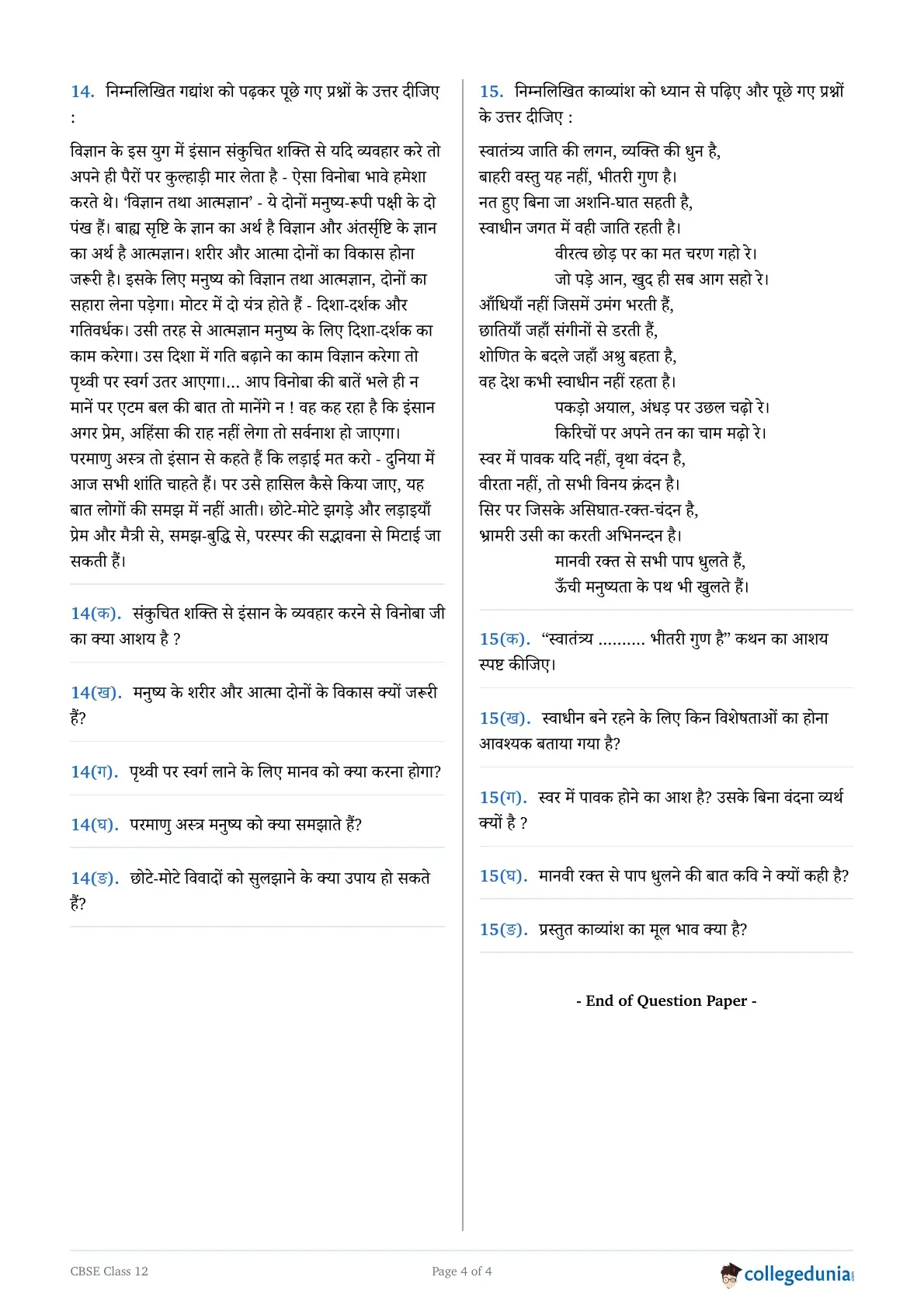
- Questions 14 and 15 are an unseen prose passage and an unseen poem with five questions of 1 mark each; the paper prints both of them under the number 14, although the cover says there are 15 questions
CBSE Class 12 Hindi Elective Question Paper 2007 Code Delhi PDF
| CBSE Official PDF | CD PDF | CD PDF with Solutions |
|---|---|---|
| Download official PDF 0.05 MB | Download Collegedunia PDF 0.20 MB | – |
CBSE Class 12 Hindi Elective 2007 Question Paper Details
| Exam | CBSE Class 12 Board Examination 2007 |
| Subject | Hindi Elective |
| Paper code | Delhi |
| Exam date | March 17, 2007 |
| Time allowed | 3 hours |
| Maximum marks | 100 |
| Total questions | 15 (attempt 15) |
CBSE Class 12 Hindi Elective Question Paper Pattern and Marking Scheme
The CBSE Class 12 Hindi Elective 2007 question paper is of 100 marks and has 15 questions, of which 15 are to be attempted. The tables below give the section-wise paper pattern and the split of marks, as printed in the official question paper.
CBSE Class 12 Hindi Elective Question Paper Pattern 2007
| Section | Questions | Question Type | Choice | Marks per Question | Marks |
|---|---|---|---|---|---|
| Part 1 (Q1-Q3): prose | Q1 | Prose passage: explanation with reference to context and comment on language and style, with internal choice of passage | All 1 | 10 | 10 |
| Q2 | Prose short-answer questions: any three of four, 4 marks each | All 1 | 12 | 12 | |
| Q3 | Prose long-answer question on a story or autobiographical piece, with internal choice | All 1 | 3 | 3 | |
| Part 2 (Q4-Q6): poetry and poets | Q4 | Poetry extract: explanation with reference to context and comment on poetic beauty, with internal choice | All 1 | 10 | 10 |
| Q5 | Poetry short-answer questions: any three of four, 3 marks each | All 1 | 9 | 9 | |
| Q6 | Life and works of a poet (Nirala or Tulsidas), with internal choice | All 1 | 6 | 6 | |
| Part 3 (Q7-Q9): the novel 'Rangbhoomi' | Q7 | Question on the plot of the novel 'Rangbhoomi', with internal choice | All 1 | 5 | 5 |
| Q8 | Character sketch question on the novel 'Rangbhoomi' (Surdas or Sophia) | All 1 | 5 | 5 | |
| Q9 | Question on the purpose or the language and style of the novel 'Rangbhoomi', with internal choice | All 1 | 5 | 5 | |
| Part 4 (Q10-Q12): history of Hindi literature | Q10 | Literary history question on Reetikal or Bhaktikal poetry, with internal choice | All 1 | 4 | 4 |
| Q11 | Literary history question on Chhayavad, Prayogvad, Pragativad or Nayi Kavita, with choice | All 1 | 5 | 5 | |
| Q12 | Literary history question on the post-independence essay or the story, with choice | All 1 | 4 | 4 | |
| Part 5 (Q13-Q15): essay and unseen passages | Q13 | Essay of about 300 words on one of five topics | All 1 | 12 | 12 |
| Q14 | Unseen prose passage: five questions of 1 mark each | All 1 | 5 | 5 | |
| Q15 | Unseen poetry passage: five questions of 1 mark each (printed in the paper under the number 14) | All 1 | 5 | 5 | |
| Total | 15 questions | Attempt 15 | 100 |
CBSE Class 12 Hindi Elective Marks Distribution 2007
| Question Type | Questions to Attempt | Marks per Question | Total Marks |
|---|---|---|---|
| Prose passage: explanation with reference to context and comment on language and style, with internal choice of passage (Prose) | 1 | 10 | 10 |
| Prose short-answer questions: any three of four, 4 marks each (Prose) | 1 | 12 | 12 |
| Prose long-answer question on a story or autobiographical piece, with internal choice (Prose) | 1 | 3 | 3 |
| Poetry extract: explanation with reference to context and comment on poetic beauty, with internal choice (Poetry) | 1 | 10 | 10 |
| Poetry short-answer questions: any three of four, 3 marks each (Poetry) | 1 | 9 | 9 |
| Life and works of a poet (Nirala or Tulsidas), with internal choice (Poetry) | 1 | 6 | 6 |
| Question on the plot of the novel 'Rangbhoomi', with internal choice (Novel) | 1 | 5 | 5 |
| Character sketch question on the novel 'Rangbhoomi' (Surdas or Sophia) (Novel) | 1 | 5 | 5 |
| Question on the purpose or the language and style of the novel 'Rangbhoomi', with internal choice (Novel) | 1 | 5 | 5 |
| Literary history question on Reetikal or Bhaktikal poetry, with internal choice (Literary history) | 1 | 4 | 4 |
| Literary history question on Chhayavad, Prayogvad, Pragativad or Nayi Kavita, with choice (Literary history) | 1 | 5 | 5 |
| Literary history question on the post-independence essay or the story, with choice (Literary history) | 1 | 4 | 4 |
| Essay of about 300 words on one of five topics (Essay and unseen passages) | 1 | 12 | 12 |
| Unseen prose passage: five questions of 1 mark each (Essay and unseen passages) | 1 | 5 | 5 |
| Unseen poetry passage: five questions of 1 mark each (printed in the paper under the number 14) (Essay and unseen passages) | 1 | 5 | 5 |
| Total | 15 | 100 |



Comments