




CBSE Class 12 Mathematics Set 1- (65/3/1) Question Paper 2026 is available for download here. CBSE conducted Class 12 Mathematics exam on March 9, 2026 from 10:30 AM to 1:30 PM. The Mathematics theory paper is of 80 marks, and the internal assessment is of 20 marks.
Mathematics question paper includes MCQs (1 mark each), short-answer type questions (2 & 3 marks each), and long-answer type questions (4 & 6 marks each) which makes up the total of 80 marks.
Download CBSE Class 12 Mathematics Set 1- (65/3/1) Question Paper 2026 with detailed solutions from the links provided below.
CBSE Class 12 Mathematics Set 1- (65/3/1) Question Paper 2026 with Solution PDF
| CBSE Official PDF | CD PDF | CD PDF with Solutions |
|---|---|---|
| Download official PDF 0.95 MB | Download Collegedunia PDF 1.49 MB | Download solutions PDF 0.65 MB |







The domain of \(f(x) = \cos^{-1} (2x - 5)\) is :
Detailed Solution
Concept:
The inverse cosine function, \(y = \cos^{-1}(u)\), has a defined domain of \([-1, 1]\).
This implies that the argument \(u\) must satisfy the inequality \(-1 \leq u \leq 1\).
To find the domain of the given function, we solve this inequality for \(x\).
Step 1: {\color{redIdentify the argument and set up the inequality
In the function \(f(x) = \cos^{-1}(2x - 5)\), the argument is \(2x - 5\).
For the function to be well-defined, the argument must lie within the interval \([-1, 1]\): \[ -1 \leq 2x - 5 \leq 1 \]
Step 2: {\color{redSolve the linear inequality for \(x\)
To isolate the term with \(x\), we first add \(5\) to all parts of the inequality: \[ -1 + 5 \leq 2x - 5 + 5 \leq 1 + 5 \] \[ 4 \leq 2x \leq 6 \]
Now, divide the entire inequality by \(2\) to solve for \(x\): \[ \frac{4}{2} \leq \frac{2x}{2} \leq \frac{6}{2} \] \[ 2 \leq x \leq 3 \]
Step 3: {\color{redExpress the domain in interval notation
The possible values for \(x\) range from \(2\) to \(3\), including both endpoints.
Therefore, the domain is \([2, 3]\). Quick Tip: Always remember the standard domains of inverse trigonometric functions: \(\sin^{-1}(x)\) and \(\cos^{-1}(x)\) are both defined for \([-1, 1]\). When solving double inequalities, perform the same operation on the left, middle, and right sides simultaneously.
If \(A^2 = 4A + 3I\) and \(A^{-1} = xA + yI\), then the value of \((x + y)\) is :
Detailed Solution
Concept:
Matrix equations involving powers of \(A\) and the identity matrix \(I\) can often be used to derive the expression for the inverse matrix \(A^{-1}\).
By pre-multiplying or post-multiplying the entire equation by \(A^{-1}\), we can reduce the degree of the terms and isolate \(A^{-1}\).
Matrix multiplication is distributive: \(A^{-1}(B + C) = A^{-1}B + A^{-1}C\).
Step 1: {\color{redManipulate the given matrix equation
We are given: \[ A^2 = 4A + 3I \]
Rearrange the equation to bring the terms containing \(A\) to one side and the identity matrix to the other: \[ A^2 - 4A = 3I \]
Step 2: {\color{redMultiply the equation by \(A^{-1}\)
Pre-multiply both sides of the equation by \(A^{-1}\): \[ A^{-1}(A^2 - 4A) = A^{-1}(3I) \] \[ A^{-1} \cdot A \cdot A - 4(A^{-1} \cdot A) = 3(A^{-1} \cdot I) \]
Step 3: {\color{redSimplify using matrix identities
Recall that \(A^{-1} \cdot A = I\) and \(A^{-1} \cdot I = A^{-1}\). Substituting these into the equation: \[ I \cdot A - 4I = 3A^{-1} \] \[ A - 4I = 3A^{-1} \]
Step 4: {\color{redIsolate \(A^{-1}\) and compare coefficients
Divide the equation by \(3\): \[ A^{-1} = \frac{1}{3}A - \frac{4}{3}I \]
The given form is \(A^{-1} = xA + yI\). By comparing the two expressions, we get: \[ x = \frac{1}{3} \] \[ y = -\frac{4}{3} \]
Step 5: {\color{redCalculate the final value
Find the sum of \(x\) and \(y\): \[ x + y = \frac{1}{3} + \left(-\frac{4}{3}\right) = \frac{1 - 4}{3} = \frac{-3}{3} = -1 \] Quick Tip: If a matrix equation is of the form \(aA^2 + bA + cI = 0\), the inverse \(A^{-1}\) can always be found as \(-\frac{1}{c}(aA + bI)\). This is a direct application of the Cayley-Hamilton theorem.
If \(A\) and \(B\) are skew-symmetric matrices of same order, then \(AB' + BA'\) is a/an :
Detailed Solution
Concept:
A matrix \(M\) is symmetric if \(M' = M\).
A matrix \(M\) is skew-symmetric if \(M' = -M\).
Transpose properties to use: \((A+B)' = A' + B'\), \((AB)' = B'A'\), and \((A')' = A\).
Step 1: {\color{redApply the skew-symmetric definitions
Since \(A\) and \(B\) are skew-symmetric matrices: \[ A' = -A \] \[ B' = -B \]
Step 2: {\color{redAnalyze the target matrix by taking its transpose
Let \(X = AB' + BA'\). To find the nature of \(X\), we compute \(X'\): \[ X' = (AB' + BA')' \]
Using the addition rule for transposes: \[ X' = (AB')' + (BA')' \]
Step 3: {\color{redApply the product rule for transposes
Using the rule \((MN)' = N'M'\): \[ X' = (B')'A' + (A')'B' \]
Since the double transpose of a matrix is the matrix itself (\((M')' = M\)): \[ X' = BA' + AB' \]
Step 4: {\color{redCompare with the original expression
Matrix addition is commutative (\(P + Q = Q + P\)): \[ X' = AB' + BA' \]
We observe that \(X' = X\). By definition, this means the matrix is symmetric. Quick Tip: The transpose of a product always reverses the order of the matrices. Even though \(A\) and \(B\) are individually skew-symmetric, specific combinations like \(AB' + BA'\) result in a symmetric structure because the signs cancel out during the transpose operation.
If \(\begin{bmatrix} 4 \\
1 \\
3 \end{bmatrix} A = \begin{bmatrix} -4 & 8 & 4 \\
-1 & 2 & 1 \\
-3 & 6 & 3 \end{bmatrix}\), then order of \(A\) must be :
Detailed Solution
Concept:
Multiplication of two matrices is only possible if the number of columns in the first matrix equals the number of rows in the second matrix.
If matrix \(P\) is of order \(m \times n\) and matrix \(Q\) is of order \(n \times p\), their product \(PQ\) will be of order \(m \times p\).
Step 1: {\color{redDetermine the order of the known matrices
Let the column matrix on the left be \(M\). It has \(3\) rows and \(1\) column, so its order is \(3 \times 1\).
The result matrix on the right is a square matrix with \(3\) rows and \(3\) columns, so its order is \(3 \times 3\).
Step 2: {\color{redDefine the order of matrix \(A\)
Let the order of matrix \(A\) be \(r \times c\), where \(r\) is the number of rows and \(c\) is the number of columns.
Step 3: {\color{redUse the compatibility rule for multiplication
For the product \(M \cdot A\) to be defined:
The columns of \(M\) must equal the rows of \(A\). \[ 1 = r \]
So, \(A\) must have \(1\) row.
Step 4: {\color{redUse the rule for the order of the product
The order of the resulting product is (rows of first matrix) \(\times\) (columns of second matrix).
The order of the product is \(3 \times c\).
Comparing this with the given product order (\(3 \times 3\)): \[ c = 3 \]
So, \(A\) must have \(3\) columns.
Step 5: {\color{redConclusion
The order of matrix \(A\) is \(r \times c = 1 \times 3\). Quick Tip: Always visualize the order as \((3 \times 1) \cdot (1 \times 3) = (3 \times 3)\). The "inner" numbers (1 and 1) must match for the operation to be valid, and the "outer" numbers (3 and 3) determine the size of the final matrix.
If a square matrix \(A\) is such that \(A^2 = A\) and \((I - A)^3 = xA + I\), then value of \(x\) must be :
Detailed Solution
Concept:
A matrix \(A\) for which \(A^2 = A\) is called an idempotent matrix.
For such matrices, any power \(A^n = A\) for \(n \geq 1\). For example, \(A^3 = A^2 \cdot A = A \cdot A = A^2 = A\).
Since the identity matrix \(I\) commutes with any matrix \(A\) (\(IA = AI = A\)), we can expand \((I - A)^n\) using the standard binomial expansion formula.
Step 1: {\color{redExpand the binomial expression
Use the identity \((a - b)^3 = a^3 - 3a^2b + 3ab^2 - b^3\): \[ (I - A)^3 = I^3 - 3I^2A + 3IA^2 - A^3 \]
Since \(I^k = I\) for any power \(k\), and \(I \cdot A = A\): \[ (I - A)^3 = I - 3A + 3A^2 - A^3 \]
Step 2: {\color{redSubstitute the idempotent property values
We are given \(A^2 = A\).
As derived in the concept section, this implies \(A^3 = A\).
Substitute these values into the expansion: \[ (I - A)^3 = I - 3A + 3(A) - (A) \]
Step 3: {\color{redSimplify the expression
The terms \(-3A\) and \(+3A\) are additive inverses and cancel each other out: \[ (I - A)^3 = I - A \]
Step 4: {\color{redCompare with the given equation to find \(x\)
The problem states: \[ (I - A)^3 = xA + I \]
From our calculation: \[ I - A = xA + I \]
Subtract \(I\) from both sides: \[ -A = xA \]
By comparing the coefficients of the matrix \(A\), we conclude: \[ x = -1 \] Quick Tip: Whenever you see the condition \(A^2 = A\), immediately simplify all higher powers of \(A\) down to \(A\). In many competitive exams, similar problems involve \((I + A)^n\) or \((I - A)^n\), and the binomial expansion combined with the idempotent property is the standard approach.
If \(B(adj B) = \begin{bmatrix} \frac{1}{3} & 0 & 0 \\
0 & \frac{1}{3} & 0 \\
0 & 0 & \frac{1}{3} \end{bmatrix}\), then the value of \(\det (B^{-1}) =\)
Detailed Solution
Concept:
For any non-singular square matrix \(B\) of order \(n\), the fundamental relation between the matrix and its adjoint is given by \(B(adj B) = |B| I_n\), where \(I_n\) is the identity matrix of order \(n\).
The determinant of the inverse of a matrix is the reciprocal of the determinant of the matrix: \(\det(B^{-1}) = |B^{-1}| = \frac{1}{|B|}\).
Step 1: {\color{redRewrite the given matrix in terms of the identity matrix
The given equation is: \[ B(adj B) = \begin{bmatrix} \frac{1}{3} & 0 & 0
0 & \frac{1}{3} & 0
0 & 0 & \frac{1}{3} \end{bmatrix} \]
Factoring out the scalar \(\frac{1}{3}\) from the matrix: \[ B(adj B) = \frac{1}{3} \begin{bmatrix} 1 & 0 & 0
0 & 1 & 0
0 & 0 & 1 \end{bmatrix} = \frac{1}{3} I_3 \]
Step 2: {\color{redFind the determinant of \(B\)
Comparing this with the property \(B(adj B) = |B| I_3\): \[ |B| I_3 = \frac{1}{3} I_3 \]
Therefore: \[ |B| = \frac{1}{3} \]
Step 3: {\color{redCalculate \(\det(B^{-1})\)
Using the property of determinants for inverse matrices: \[ \det(B^{-1}) = \frac{1}{|B|} = \frac{1}{\frac{1}{3}} = 3 \] Quick Tip: Whenever a diagonal matrix with identical diagonal elements \(k\) is given as \(B(adj B)\), simply identify \(|B| = k\). The determinant of the inverse is then instantly found as \(\frac{1}{k}\).
The value of \(k\) for which the function \(f(x) = \begin{cases} x^2 \sin \frac{1}{x}, & x \neq 0
k(x + 1), & x = 0 \end{cases}\) is a continuous function, is :
Detailed Solution
Concept:
A function \(f(x)\) is continuous at a point \(x = a\) if and only if \(\lim_{x \to a} f(x) = f(a)\).
The sine function is a bounded function such that \(-1 \leq \sin\left(\frac{1}{x}\right) \leq 1\) for all \(x \neq 0\).
The limit of the product of a function approaching zero and a bounded function is zero: \(\lim_{x \to 0} [x^2 \cdot (bounded function)] = 0\).
Step 1: {\color{redEvaluate the limit of \(f(x)\) as \(x \to 0\)
For \(x \neq 0\), the function is defined as \(f(x) = x^2 \sin \left(\frac{1}{x}\right)\).
Taking the limit as \(x\) approaches \(0\): \[ \lim_{x \to 0} f(x) = \lim_{x \to 0} x^2 \sin \left(\frac{1}{x}\right) \]
Step 2: {\color{redUse the Sandwich (Squeeze) Theorem
Since \(-1 \leq \sin \left(\frac{1}{x}\right) \leq 1\) for all \(x \neq 0\), multiplying throughout by \(x^2\) (which is strictly positive for \(x \neq 0\)) gives: \[ -x^2 \leq x^2 \sin \left(\frac{1}{x}\right) \leq x^2 \]
Taking the limit as \(x \to 0\) on both sides: \[ \lim_{x \to 0} (-x^2) = 0 \quad and \quad \lim_{x \to 0} (x^2) = 0 \]
By the Sandwich Theorem: \[ \lim_{x \to 0} x^2 \sin \left(\frac{1}{x}\right) = 0 \]
Step 3: {\color{redEvaluate \(f(0)\) and equate it to the limit
From the definition of the piecewise function: \[ f(0) = k(0 + 1) = k \]
For \(f(x)\) to be continuous at \(x = 0\): \[ \lim_{x \to 0} f(x) = f(0) \] \[ 0 = k \] \[ k = 0 \] Quick Tip: Remember that \(\lim_{x \to 0} x^n \sin\left(\frac{1}{x}\right) = 0\) for any power \(n > 0\). Equating the limiting value \(0\) directly to the definition at the given point \(f(0)\) immediately yields the required constant.
If \(\sin^{-1} x = y\), then \(\frac{dy}{dx}\) is :
Detailed Solution
Concept:
If \(y = \sin^{-1} x\), then by the definition of inverse trigonometric functions, \(x = \sin y\), where \(y \in \left[-\frac{\pi}{2}, \frac{\pi}{2}\right]\).
The derivative can be determined by implicitly differentiating with respect to \(x\) or by differentiating \(x\) with respect to \(y\) using \(\frac{dy}{dx} = \frac{1}{\frac{dx}{dy}}\).
Recall the basic reciprocal trigonometric relation: \(\frac{1}{\cos y} = \sec y\).
Step 1: {\color{redRewrite the inverse equation in direct trigonometric form
Given: \[ y = \sin^{-1} x \]
Taking the sine on both sides: \[ x = \sin y \]
Step 2: {\color{redDifferentiate both sides with respect to \(y\)
Differentiating \(x\) with respect to \(y\): \[ \frac{dx}{dy} = \frac{d}{dy}(\sin y) = \cos y \]
Step 3: {\color{redDetermine \(\frac{dy}{dx}\)
Using the derivative rule for inverse functions: \[ \frac{dy}{dx} = \frac{1}{\frac{dx}{dy}} = \frac{1}{\cos y} \]
Using the reciprocal trigonometric identity: \[ \frac{dy}{dx} = \sec y \] Quick Tip: Standard differentiation gives \(\frac{dy}{dx} = \frac{1}{\sqrt{1-x^2}}\). Since \(\sqrt{1-x^2} = \sqrt{1-\sin^2 y} = \cos y\), the derivative can also be simply expressed in terms of \(y\) as \(\sec y\).
The rate of change of volume of a sphere with respect to its diameter, when its radius is 5 cm, is :
Detailed Solution
Concept:
The volume of a sphere in terms of its radius \(r\) is \(V = \frac{4}{3}\pi r^3\).
The diameter \(D\) is related to the radius by \(D = 2r\), which implies \(r = \frac{D}{2}\).
The rate of change of volume with respect to diameter can be found by evaluating \(\frac{dV}{dD} = \frac{\frac{dV}{dr}}{\frac{dD}{dr}}\) or by expressing \(V\) directly in terms of \(D\).
Step 1: {\color{redExpress the volume in terms of diameter \(D\)
Substitute \(r = \frac{D}{2}\) into the volume formula: \[ V = \frac{4}{3}\pi \left(\frac{D}{2}\right)^3 \] \[ V = \frac{4}{3}\pi \left(\frac{D^3}{8}\right) = \frac{1}{6}\pi D^3 \]
Step 2: {\color{redDifferentiate the volume with respect to \(D\)
Differentiating with respect to the diameter \(D\): \[ \frac{dV}{dD} = \frac{d}{dD}\left(\frac{1}{6}\pi D^3\right) \] \[ \frac{dV}{dD} = \frac{1}{6}\pi (3D^2) = \frac{1}{2}\pi D^2 \]
Step 3: {\color{redEvaluate the rate of change at the given radius
We are given that the radius is \(r = 5 cm\).
The corresponding diameter is: \[ D = 2r = 2(5) = 10 cm \]
Substitute \(D = 10 cm\) into the derivative formula: \[ \frac{dV}{dD} = \frac{1}{2}\pi (10)^2 = \frac{1}{2}\pi (100) = 50\pi cm^3/cm \] Quick Tip: Alternatively, use the chain rule: \(\frac{dV}{dD} = \frac{dV/dr}{dD/dr} = \frac{4\pi r^2}{2} = 2\pi r^2\). Substituting \(r = 5\) directly gives \(2\pi(5)^2 = 50\pi cm^3/cm\) in just one step!
\(\int \frac{dx}{2^x + 2^{-x}}\) is equal to :
Detailed Solution
Concept:
Rewrite negative exponents using fractions: \(2^{-x} = \frac{1}{2^x}\).
Use substitution method for integration where \(u = a^x\) and \(du = a^x \ln a \, dx\).
The standard integral formula: \(\int \frac{1}{u^2 + 1} \, du = \tan^{-1}(u) + C\).
Step 1: {\color{redSimplify the integrand algebraically
Let the integral be \(I = \int \frac{dx}{2^x + 2^{-x}}\).
Write \(2^{-x}\) as \(\frac{1}{2^x}\): \[ I = \int \frac{dx}{2^x + \frac{1}{2^x}} \]
Multiply numerator and denominator by \(2^x\): \[ I = \int \frac{2^x}{(2^x)^2 + 1} \, dx \]
Step 2: {\color{redApply the method of substitution
Let \(u = 2^x\).
Differentiating both sides with respect to \(x\): \[ \frac{du}{dx} = 2^x \log 2 \implies du = 2^x \log 2 \, dx \]
Rearranging for \(2^x dx\): \[ 2^x dx = \frac{du}{\log 2} \]
Step 3: {\color{redIntegrate with respect to \(u\)
Substitute \(u\) and \(du\) into the integral: \[ I = \int \frac{\frac{du}{\log 2}}{u^2 + 1} = \frac{1}{\log 2} \int \frac{du}{u^2 + 1} \]
Using the standard inverse tangent integration formula: \[ I = \frac{1}{\log 2} \tan^{-1}(u) + C \]
Step 4: {\color{redSubstitute back the original variable
Replace \(u\) with \(2^x\): \[ I = \frac{\tan^{-1}(2^x)}{\log 2} + C \] Quick Tip: Whenever an integrand contains \(a^x + a^{-x}\) in the denominator, multiply top and bottom by \(a^x\) to create the derivative of \(a^x\) in the numerator. Remember the scaling factor of \(\frac{1}{\log a}\) which arises from the differentiation of exponential terms with base other than \(e\).
\( \int_{-1}^{1} (1 - |x|) \, dx \) is equal to :
Detailed Solution
Concept:
Parity of Functions: A function \( f(x) \) is even if \( f(-x) = f(x) \).
Integration Property: For an even function, \( \int_{-a}^{a} f(x) \, dx = 2 \int_{0}^{a} f(x) \, dx = 2 \int_{-a}^{0} f(x) \, dx \).
Definition of Absolute Value: \( |x| = x \) if \( x \geq 0 \) and \( |x| = -x \) if \( x < 0 \).
Step 1: {\color{redDetermine the parity of the integrand
Let \( f(x) = 1 - |x| \).
Substitute \( -x \) for \( x \): \[ f(-x) = 1 - |-x| = 1 - |x| = f(x) \]
Since \( f(x) = f(-x) \), the function is an even function.
Step 2: {\color{redApply the property of even functions
Using the definite integral property for even functions: \[ \int_{-1}^{1} (1 - |x|) \, dx = 2 \int_{-1}^{0} (1 - |x|) \, dx \]
Step 3: {\color{redSimplify the expression within the chosen sub-interval
In the interval \( [-1, 0] \), \( x \) is negative, so \( |x| = -x \).
The integrand becomes: \[ 1 - |x| = 1 - (-x) = 1 + x \]
Therefore: \[ 2 \int_{-1}^{0} (1 - |x|) \, dx = 2 \int_{-1}^{0} (1 + x) \, dx \] Quick Tip: Before integrating symmetric limits, always check if the function is even or odd. For even functions, doubling the integral over half the interval often simplifies the math, especially when absolute values are involved.
The area of the shaded region of the circle given below is equal to :

Detailed Solution
Concept:
The area of a region bounded by a curve can be calculated using integration with respect to either axis.
For a shaded region with vertical symmetry, it is often convenient to integrate along the y-axis using horizontal strips of width \( (x_{right} - x_{left}) \).
The circle equation \( x^2 + y^2 = 9 \) implies \( x = \pm \sqrt{9 - y^2} \).
Step 1: {\color{redIdentify the boundary equations and limits
The circle is \( x^2 + y^2 = 9 \), so its radius is \( 3 \).
The shaded region is bounded below by the line \( y = 1 \) and above by the top of the circle at \( y = 3 \).
The limits for integration along the y-axis are \( y = 1 \) to \( y = 3 \).
Step 2: {\color{redDetermine the width of a horizontal strip
For any given \( y \) between \( 1 \) and \( 3 \), the left boundary is \( x = -\sqrt{9 - y^2} \) and the right boundary is \( x = \sqrt{9 - y^2} \).
The width of the horizontal strip is: \[ Width = x_{right} - x_{left} = \sqrt{9 - y^2} - (-\sqrt{9 - y^2}) = 2\sqrt{9 - y^2} \]
Step 3: {\color{redSet up the area integral
The area \( A \) is the integral of the width over the y-limits: \[ A = \int_{1}^{3} 2\sqrt{9 - y^2} \, dy \] Quick Tip: When a region is easier to describe horizontally (from left to right) than vertically, use \( \int (x_2 - x_1) \, dy \). Always ensure your limits of integration match the variable you are integrating with respect to.
\( \frac{dy}{dx} = F(x, y) \) will be a homogeneous differential equation for which of the following functions ?
(i) \( F(x, y) = 3x + 2y \)
(ii) \( F(x, y) = \sin \frac{y}{x} + \log y - \log x \)
(iii) \( F(x, y) = e^{y/x} + 1 \)
(iv) \( F(x, y) = \sqrt{x^2 + y^2} - y \)
Detailed Solution
Concept:
A differential equation \( \frac{dy}{dx} = F(x, y) \) is homogeneous if \( F(x, y) \) is a homogeneous function of degree zero.
A function is homogeneous of degree zero if \( F(\lambda x, \lambda y) = F(x, y) \) for any non-zero scalar \( \lambda \).
This effectively means \( F(x, y) \) can be expressed solely as a function of the ratio \( \frac{y}{x} \).
Step 1: {\color{redTest function (i)
\( F(x, y) = 3x + 2y \) \[ F(\lambda x, \lambda y) = 3(\lambda x) + 2(\lambda y) = \lambda(3x + 2y) \neq F(x, y) \]
This is degree 1, not homogeneous of degree 0.
Step 2: {\color{redTest function (ii)
\( F(x, y) = \sin \frac{y}{x} + \log y - \log x = \sin \frac{y}{x} + \log \left(\frac{y}{x}\right) \) \[ F(\lambda x, \lambda y) = \sin \left(\frac{\lambda y}{\lambda x}\right) + \log \left(\frac{\lambda y}{\lambda x}\right) = \sin \frac{y}{x} + \log \frac{y}{x} = F(x, y) \]
This is degree 0, so it is a homogeneous differential equation.
Step 3: {\color{redTest function (iii)
\( F(x, y) = e^{y/x} + 1 \) \[ F(\lambda x, \lambda y) = e^{\lambda y / \lambda x} + 1 = e^{y/x} + 1 = F(x, y) \]
This is degree 0, so it is a homogeneous differential equation.
Step 4: {\color{redTest function (iv)
\( F(x, y) = \sqrt{x^2 + y^2} - y \) \[ F(\lambda x, \lambda y) = \sqrt{(\lambda x)^2 + (\lambda y)^2} - \lambda y = \lambda(\sqrt{x^2 + y^2} - y) \neq F(x, y) \]
This is degree 1, not homogeneous of degree 0. Quick Tip: A quick shortcut: if every term in the expression has the same combined power of \( x \) and \( y \), and those powers cancel out to zero, the function is homogeneous. Look for functions that only contain terms like \( y/x \), \( \sin(y/x) \), \( e^{y/x} \), or \( \log(y/x) \).
For any two vectors \( \vec{a} \) and \( \vec{b} \), which of the following statements is always true ?
Detailed Solution
\
Concept:
Scalar Product: \( \vec{a} \cdot \vec{b} = |\vec{a}| |\vec{b}| \cos \theta \), where \( \theta \) is the angle between the vectors.
Properties of Cosine: The value of \( \cos \theta \) always lies in the range \( [-1, 1] \).
Triangle Inequality: For any two vectors, \( |\vec{a} + \vec{b}| \leq |\vec{a}| + |\vec{b}| \).
Step 1: {\color{redEvaluate statement (A)
We know that \( \vec{a} \cdot \vec{b} = |\vec{a}| |\vec{b}| \cos \theta \).
Since \( \cos \theta \leq 1 \) for all \( \theta \):
\[ \vec{a} \cdot \vec{b} \leq |\vec{a}| |\vec{b}| \cdot (1) \] \[ \vec{a} \cdot \vec{b} \leq |\vec{a}| |\vec{b}| \]
This is the Cauchy-Schwarz inequality and it is always true.
Step 2: {\color{redEvaluate statement (B)
According to the Triangle Inequality, \( |\vec{a} + \vec{b}| \leq |\vec{a}| + |\vec{b}| \).
The statement \( |\vec{a} + \vec{b}| \geq |\vec{a}| + |\vec{b}| \) is false except in the limiting case where vectors are parallel.
Step 3: {\color{redEvaluate statement (D)
The magnitude of the cross product is \( |\vec{a} \times \vec{b}| = |\vec{a}| |\vec{b}| \sin \theta \).
Since \( \sin \theta \leq 1 \), it follows that \( |\vec{a} \times \vec{b}| \leq |\vec{a}| |\vec{b}| \).
Thus, statement (D) is false. Quick Tip: Cauchy-Schwarz (\( \vec{a} \cdot \vec{b} \leq |\vec{a}| |\vec{b}| \)) and Triangle Inequality (\( |\vec{a} + \vec{b}| \leq |\vec{a}| + |\vec{b}| \)) are the most important vector inequalities to memorize. They are fundamental to understanding vector projections and geometry.
If \( (\vec{a} + \vec{b}) \cdot (\vec{a} - \vec{b}) = 198 \) and \( |\vec{a}| = 10|\vec{b}| \), then :
Detailed Solution
Concept:
Distributive Property: The dot product distributes over addition and subtraction: \( (\vec{u} + \vec{v}) \cdot \vec{w} = \vec{u} \cdot \vec{w} + \vec{v} \cdot \vec{w} \).
Self-Dot Product: The dot product of a vector with itself is the square of its magnitude: \( \vec{a} \cdot \vec{a} = |\vec{a}|^2 \).
Commutativity: Dot product is commutative: \( \vec{a} \cdot \vec{b} = \vec{b} \cdot \vec{a} \).
Step 1: {\color{redExpand the dot product expression
Given \( (\vec{a} + \vec{b}) \cdot (\vec{a} - \vec{b}) = 198 \).
Expanding using the distributive property: \[ \vec{a} \cdot \vec{a} - \vec{a} \cdot \vec{b} + \vec{b} \cdot \vec{a} - \vec{b} \cdot \vec{b} = 198 \]
Since \( \vec{a} \cdot \vec{b} = \vec{b} \cdot \vec{a} \), the middle terms cancel: \[ |\vec{a}|^2 - |\vec{b}|^2 = 198 \]
Step 2: {\color{redSubstitute the relationship between magnitudes
We are given \( |\vec{a}| = 10|\vec{b}| \). Squaring both sides: \[ |\vec{a}|^2 = (10|\vec{b}|)^2 = 100|\vec{b}|^2 \]
Substitute this into the expanded equation: \[ 100|\vec{b}|^2 - |\vec{b}|^2 = 198 \] \[ 99|\vec{b}|^2 = 198 \]
Step 3: {\color{redSolve for the magnitudes
Divide by 99: \[ |\vec{b}|^2 = \frac{198}{99} = 2 \]
Taking the square root: \[ |\vec{b}| = \sqrt{2} \]
Using \( |\vec{a}| = 10|\vec{b}| \), we also find \( |\vec{a}| = 10\sqrt{2} \). Quick Tip: The expression \( (\vec{a} + \vec{b}) \cdot (\vec{a} - \vec{b}) = |\vec{a}|^2 - |\vec{b}|^2 \) is the vector equivalent of the algebraic difference of squares. Always simplify dot products algebraically before substituting numerical values to avoid unnecessary computation.
If \(l_1, m_1, n_1\) and \(l_2, m_2, n_2\) are direction cosines of lines \(L_1\) and \(L_2\) respectively and \(\theta\) is the acute angle between them, then :
Detailed Solution
Concept:
Direction cosines represent the unit vector in the direction of a line.
If unit vectors along lines \(L_1\) and \(L_2\) are \(\hat{u} = l_1\hat{i} + m_1\hat{j} + n_1\hat{k}\) and \(\hat{v} = l_2\hat{i} + m_2\hat{j} + n_2\hat{k}\), the angle \(\theta\) between them is found via the dot product.
Since the problem specifies \(\theta\) is the acute angle, the absolute value of the cosine must be taken.
Step 1: {\color{redApply the dot product formula
The cosine of the angle between two lines with direction cosines \((l_1, m_1, n_1)\) and \((l_2, m_2, n_2)\) is given by:
\[ \cos \theta = l_1l_2 + m_1m_2 + n_1n_2 \]
Step 2: {\color{redAccount for the "acute" condition
Between two intersecting lines, two angles are formed: \(\theta\) and \(180^\circ - \theta\).
One is acute and the other is obtuse. The acute angle always has a positive cosine value.
Therefore, we use the modulus sign to ensure the result is positive: \[ \cos \theta = |l_1l_2 + m_1m_2 + n_1n_2| \] Quick Tip: Always look for the modulus sign in questions involving the "acute angle" between lines or planes. For direction ratios \((a, b, c)\), the formula is \(\cos \theta = \left| \frac{a_1a_2 + b_1b_2 + c_1c_2{\sqrt{a_1^2+b_1^2+c_1^2}\sqrt{a_2^2+b_2^2+c_2^2}} \right|\).
Direction ratios of lines \(l_1\) and \(l_2\) are \(<12, -3, 9>\) and \(<4, q, -p>\) respectively. The values of \(p\) and \(q\) for which \(l_1\) and \(l_2\) are parallel are respectively :
Detailed Solution
Concept:
Two lines with direction ratios \(\langle a_1, b_1, c_1 \rangle\) and \(\langle a_2, b_2, c_2 \rangle\) are parallel if their corresponding direction ratios are proportional.
Condition for parallelism: \(\frac{a_1}{a_2} = \frac{b_1}{b_2} = \frac{c_1}{c_2} = k\), where \(k\) is a constant.
Step 1: {\color{redSet up the proportionality equation
Given direction ratios:
Line \(l_1\): \(\langle 12, -3, 9 \rangle\)
Line \(l_2\): \(\langle 4, q, -p \rangle\)
Since they are parallel: \[ \frac{12}{4} = \frac{-3}{q} = \frac{9}{-p} \]
Step 2: {\color{redSolve for \(q\)
Equate the first two ratios: \[ 3 = \frac{-3}{q} \implies q = \frac{-3}{3} = -1 \]
Step 3: {\color{redSolve for \(p\)
Equate the first and third ratios: \[ 3 = \frac{9}{-p} \implies -p = \frac{9}{3} = 3 \implies p = -3 \]
Step 4: {\color{redIdentify the values
We have \(p = -3\) and \(q = -1\). Quick Tip: For parallel lines, one vector is a scalar multiple of the other. You can often solve these by inspection: since \(12 = 3 \times 4\), just multiply the second set by \(3\) to match the first, or divide the first set by \(3\) to find the second.
If \(E\) and \(F\) are two independent events such that \(P(E) = \frac{3}{10}\), \(P(E \cup F) = \frac{1}{2}\), then \(P(E|F) - P(F|E)\) is equal to :
Detailed Solution
Concept:
For independent events \(E\) and \(F\): \(P(E \cap F) = P(E) \cdot P(F)\).
Conditional probability for independent events: \(P(E|F) = P(E)\) and \(P(F|E) = P(F)\).
Addition Theorem: \(P(E \cup F) = P(E) + P(F) - P(E \cap F)\).
Step 1: {\color{redCalculate \(P(F)\)
Using independence in the addition theorem: \[ P(E \cup F) = P(E) + P(F) - P(E)P(F) \] \[ \frac{1}{2} = \frac{3}{10} + P(F) - \frac{3}{10}P(F) \] \[ \frac{1}{2} - \frac{3}{10} = \frac{7}{10}P(F) \] \[ \frac{5 - 3}{10} = \frac{7}{10}P(F) \implies \frac{2}{10} = \frac{7}{10}P(F) \] \[ P(F) = \frac{2}{7} \]
Step 2: {\color{redEvaluate conditional probabilities
Since the events are independent: \[ P(E|F) = P(E) = \frac{3}{10} \] \[ P(F|E) = P(F) = \frac{2}{7} \]
Step 3: {\color{redFind the difference
\[ P(E|F) - P(F|E) = \frac{3}{10} - \frac{2}{7} \]
To subtract, use a common denominator of \(70\): \[ \frac{3 \times 7 - 2 \times 10}{70} = \frac{21 - 20}{70} = \frac{1}{70} \] Quick Tip: "Independent" means information about one event does not change the probability of the other. So, \(P(A|B)\) is always just \(P(A)\). This simplifies these problems to finding individual probabilities and performing basic arithmetic.
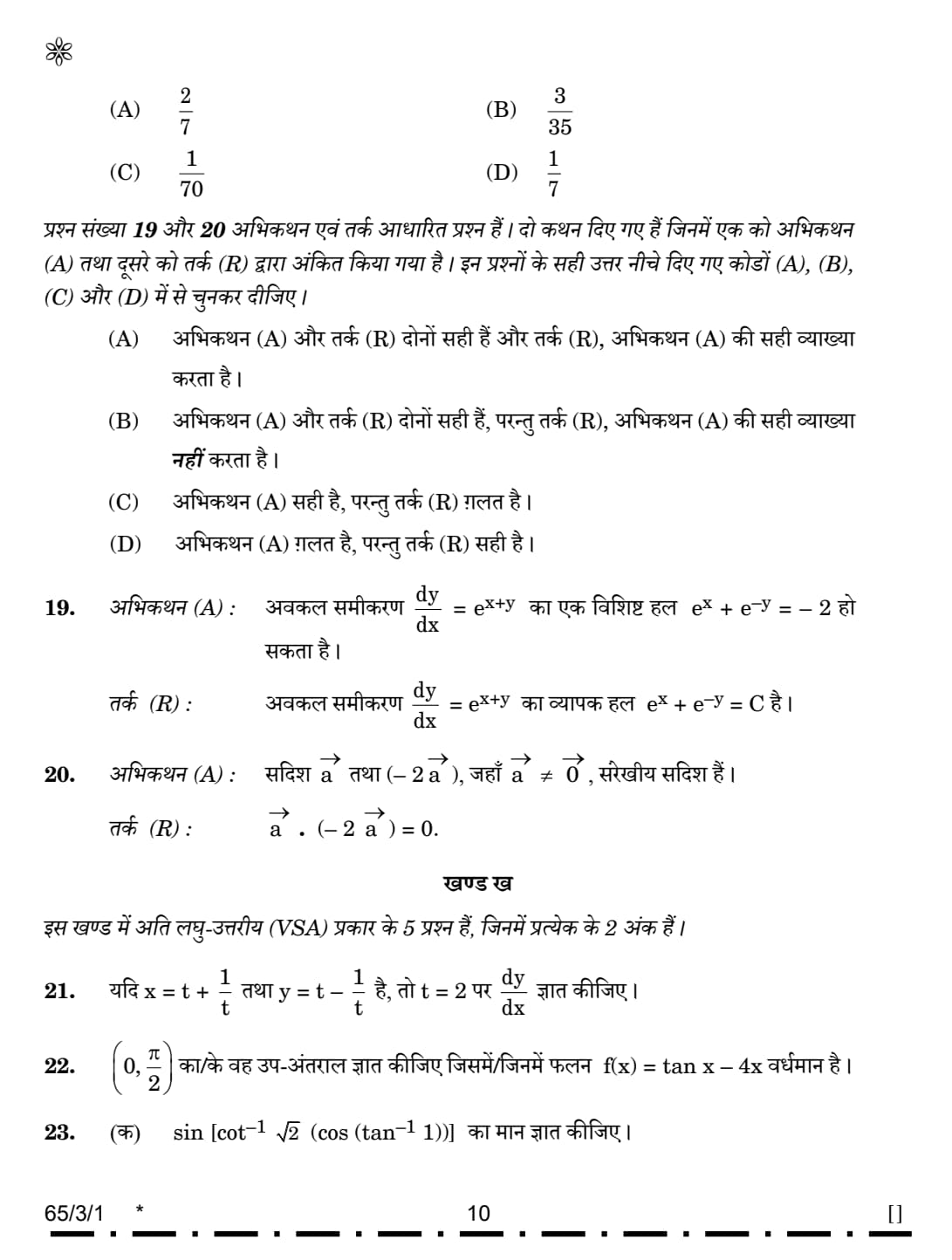
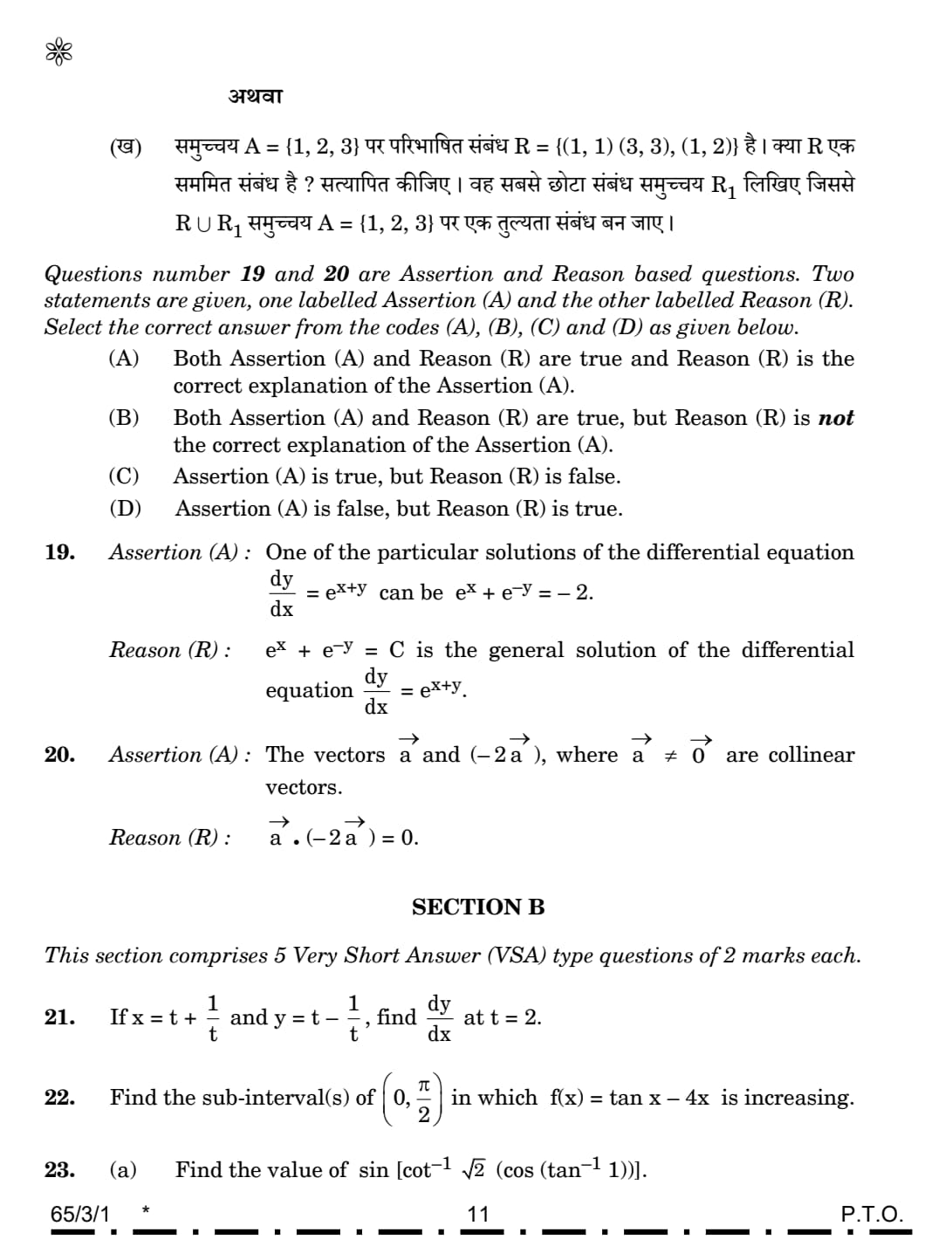
Assertion (A) : One of the particular solutions of the differential equation \(\frac{dy}{dx} = e^{x+y}\) can be \(e^x + e^{-y} = -2\).
Reason (R) : \(e^x + e^{-y} = C\) is the general solution of the differential equation \(\frac{dy}{dx} = e^{x+y}\).
Detailed Solution
Concept:
To find the general solution, use the method of variable separable.
Note that \(e^{x+y} = e^x \cdot e^y\).
The domain of exponential functions \(e^u\) is always positive (\(e^u > 0\) for all real \(u\)).
Step 1: {\color{redSolve the differential equation
Given: \[ \frac{dy}{dx} = e^x \cdot e^y \]
Separate the variables: \[ e^{-y} \, dy = e^x \, dx \]
Integrate both sides: \[ \int e^{-y} \, dy = \int e^x \, dx \] \[ -e^{-y} = e^x + C' \] \[ e^x + e^{-y} = -C' \]
Let \(-C' = C\), so the general solution is \(e^x + e^{-y} = C\).
Thus, Reason (R) is true.
Step 2: {\color{redAnalyze the Assertion
The Assertion states that a particular solution can be \(e^x + e^{-y} = -2\).
For any real \(x\) and \(y\), \(e^x > 0\) and \(e^{-y} > 0\).
The sum of two positive numbers must be positive: \[ e^x + e^{-y} > 0 \]
Since \(e^x + e^{-y}\) can never be \(-2\), the Assertion (A) is false. Quick Tip: Always check the range of functions in Assertion-Reason questions. Exponential and squared terms are always non-negative. Even if the algebraic form of a solution matches, it must be mathematically possible within the range of the functions involved.
Assertion (A) : The vectors \(\vec{a}\) and \((-2\vec{a})\), where \(\vec{a} \neq \vec{0}\) are collinear vectors.
Reason (R) : \(\vec{a} \cdot (-2\vec{a}) = 0\).
Detailed Solution
Concept:
Collinear vectors are vectors that act along the same line or are parallel to each other.
Mathematically, two vectors \(\vec{u}\) and \(\vec{v}\) are collinear if \(\vec{u} = \lambda \vec{v}\) for some non-zero scalar \(\lambda\).
The dot product \(\vec{u} \cdot \vec{v} = 0\) implies that the vectors are perpendicular, not collinear (unless one is zero).
Step 1: {\color{redEvaluate the Assertion
Let \(\vec{b} = -2\vec{a}\).
Since \(\vec{b}\) is a scalar multiple of \(\vec{a}\) (where \(\lambda = -2\)), they are parallel/anti-parallel.
Thus, \(\vec{a}\) and \(-2\vec{a}\) are collinear.
Assertion (A) is true.
Step 2: {\color{redEvaluate the Reason
Calculate the dot product:
\[ \vec{a} \cdot (-2\vec{a}) = -2(\vec{a} \cdot \vec{a}) = -2|\vec{a}|^2 \]
Since it is given that \(\vec{a} \neq \vec{0}\), then \(|\vec{a}| > 0\).
This means \(-2|\vec{a}|^2 < 0\), so it can never be \(0\).
Reason (R) is false. Quick Tip: Collinear = Proportional (\(\vec{u} = k\vec{v}\)). Perpendicular = Zero Dot Product (\(\vec{u} \cdot \vec{v} = 0\)). These are mutually exclusive for non-zero vectors.
If \(x = t + \frac{1}{t}\) and \(y = t - \frac{1}{t}\), find \(\frac{dy}{dx}\) at \(t = 2\).
Detailed Solution
Concept:
This is a problem involving parametric differentiation.
If \(x\) and \(y\) are given as functions of a parameter \(t\), then \(\frac{dy}{dx} = \frac{dy/dt}{dx/dt}\).
Differentiation of \(t^n\) is \(n t^{n-1}\).
Step 1: {\color{redDifferentiate \(x\) with respect to \(t\)
Given \(x = t + \frac{1}{t} = t + t^{-1}\).
Differentiating both sides with respect to \(t\): \[ \frac{dx}{dt} = \frac{d}{dt}(t) + \frac{d}{dt}(t^{-1}) \] \[ \frac{dx}{dt} = 1 + (-1)t^{-2} = 1 - \frac{1}{t^2} \]
Simplifying: \[ \frac{dx}{dt} = \frac{t^2 - 1}{t^2} \]
Step 2: {\color{redDifferentiate \(y\) with respect to \(t\)
Given \(y = t - \frac{1}{t} = t - t^{-1}\).
Differentiating both sides with respect to \(t\): \[ \frac{dy}{dt} = \frac{d}{dt}(t) - \frac{d}{dt}(t^{-1}) \] \[ \frac{dy}{dt} = 1 - (-1)t^{-2} = 1 + \frac{1}{t^2} \]
Simplifying: \[ \frac{dy}{dt} = \frac{t^2 + 1}{t^2} \]
Step 3: {\color{redFind the expression for \(\frac{dy}{dx}\)
Using the parametric formula: \[ \frac{dy}{dx} = \frac{dy/dt}{dx/dt} = \frac{\frac{t^2 + 1}{t^2}}{\frac{t^2 - 1}{t^2}} \] \[ \frac{dy}{dx} = \frac{t^2 + 1}{t^2 - 1} \]
Step 4: {\color{redSubstitute \(t = 2\) to find the numerical value
\[ \left( \frac{dy}{dx} \right)_{t=2} = \frac{2^2 + 1}{2^2 - 1} \] \[ \left( \frac{dy}{dx} \right)_{t=2} = \frac{4 + 1}{4 - 1} = \frac{5}{3} \] Quick Tip: Always simplify your derivatives of \(x\) and \(y\) before dividing them to avoid complex fractions. Note that \(\frac{dy}{dx}\) is the slope of the curve at the point defined by the parameter \(t\).
Find the sub-interval(s) of \((0, \frac{\pi}{2})\) in which \(f(x) = \tan x - 4x\) is increasing.
Detailed Solution
Concept:
A function \(f(x)\) is increasing in an interval if its derivative \(f'(x) > 0\) for all \(x\) in that interval.
The derivative of \(\tan x\) is \(\sec^2 x\).
Step 1: {\color{redFind the first derivative of the function
Given \(f(x) = \tan x - 4x\).
Differentiating with respect to \(x\): \[ f'(x) = \frac{d}{dx}(\tan x) - \frac{d}{dx}(4x) \] \[ f'(x) = \sec^2 x - 4 \]
Step 2: {\color{redSet the condition for an increasing function
For \(f(x)\) to be increasing: \[ f'(x) > 0 \] \[ \sec^2 x - 4 > 0 \] \[ \sec^2 x > 4 \]
Step 3: {\color{redSolve the inequality for \(x\)
Since \(\sec^2 x = \frac{1}{\cos^2 x}\): \[ \frac{1}{\cos^2 x} > 4 \]
Taking reciprocal (reverses the inequality): \[ \cos^2 x < \frac{1}{4} \]
In the interval \((0, \frac{\pi}{2})\), \(\cos x\) is positive. Taking the square root: \[ \cos x < \frac{1}{2} \]
Step 4: {\color{redDetermine the interval from the trigonometric condition
We know that \(\cos x = \frac{1}{2}\) at \(x = \frac{\pi}{3}\).
As \(x\) increases from \(0\) to \(\frac{\pi}{2}\), the function \(\cos x\) decreases from \(1\) to \(0\).
Therefore, \(\cos x\) will be less than \(\frac{1}{2}\) for values of \(x\) between \(\frac{\pi}{3}\) and \(\frac{\pi}{2}\).
The required sub-interval is \((\frac{\pi}{3}, \frac{\pi}{2})\). Quick Tip: When dealing with \(\cos x\) in inequalities, remember its graph is decreasing in the first quadrant. A "smaller" value for cosine corresponds to a "larger" value for the angle.
Find the value of \(\sin [\cot^{-1} \sqrt{2} (\cos (\tan^{-1} 1))]\).
Detailed Solution
Concept:
Solve inverse trigonometric expressions from the innermost bracket outward.
Standard values: \(\tan^{-1} 1 = \frac{\pi}{4}\) and \(\cos \frac{\pi}{4} = \frac{1}{\sqrt{2}}\).
Step 1: {\color{redSolve the innermost function
Identify the value of \(\tan^{-1} 1\): \[ \tan^{-1} 1 = \frac{\pi}{4} \]
Now the expression becomes: \[ \sin [\cot^{-1} \sqrt{2} (\cos (\frac{\pi}{4}))] \]
Step 2: {\color{redSolve the next layer
Substitute the value of \(\cos \frac{\pi}{4}\): \[ \cos \frac{\pi}{4} = \frac{1}{\sqrt{2}} \]
The expression simplifies to: \[ \sin [\cot^{-1} (\sqrt{2} \cdot \frac{1}{\sqrt{2}})] \] \[ \sin [\cot^{-1} (1)] \]
Step 3: {\color{redEvaluate the inverse cotangent
Find the angle whose cotangent is \(1\): \[ \cot^{-1} 1 = \frac{\pi}{4} \]
The expression is now: \[ \sin (\frac{\pi}{4}) \]
Step 4: {\color{redCalculate the final sine value
\[ \sin \frac{\pi}{4} = \frac{1}{\sqrt{2}} \] Quick Tip: Composition of inverse functions looks intimidating but is just a series of substitutions. Keep track of the output of one function as the input for the next.
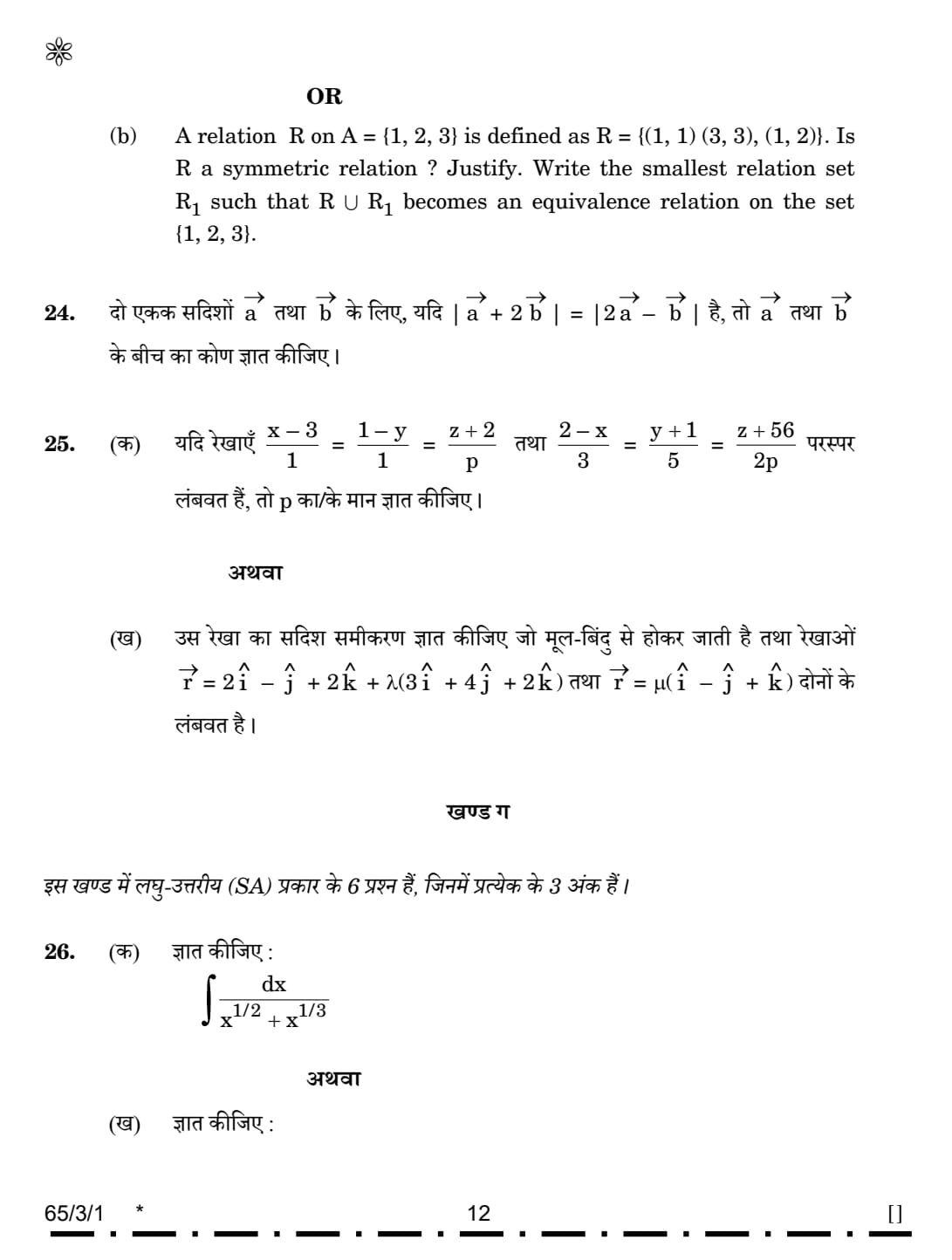
A relation \(R\) on \(A = \{1, 2, 3\}\) is defined as \(R = \{(1, 1), (3, 3), (1, 2)\}\). Is \(R\) a symmetric relation? Justify. Write the smallest relation set \(R_1\) such that \(R \cup R_1\) becomes an equivalence relation on the set \(\{1, 2, 3\}\).
Detailed Solution
Concept:
A relation is symmetric if \((a, b) \in R \implies (b, a) \in R\).
An equivalence relation must be reflexive, symmetric, and transitive.
Step 1: {\color{redCheck for symmetry
In the given relation \(R = \{(1, 1), (3, 3), (1, 2)\}\):
We see that \((1, 2) \in R\), but \((2, 1) \notin R\).
Therefore, \(R\) is not a symmetric relation.
Step 2: {\color{redEnsure reflexivity for the equivalence relation
The set is \(A = \{1, 2, 3\}\). For reflexivity, every element must relate to itself: \((1, 1), (2, 2), (3, 3)\). \(R\) already contains \((1, 1)\) and \((3, 3)\).
We must add \((2, 2)\).
Step 3: {\color{redEnsure symmetry for the equivalence relation
\(R\) contains \((1, 2)\). For symmetry, we must include \((2, 1)\).
Now the set of pairs is \(\{(1, 1), (2, 2), (3, 3), (1, 2), (2, 1)\}\).
Step 4: {\color{redCheck for transitivity
Check all combinations: \((1, 2)\) and \((2, 1)\) are present, and \((1, 1)\) is present.
Also \((2, 1)\) and \((1, 2)\) are present, and \((2, 2)\) is present.
The set \(\{(1, 1), (2, 2), (3, 3), (1, 2), (2, 1)\}\) is already transitive.
Step 5: {\color{redDefine the smallest set \(R_1\)
The elements we needed to add to \(R\) to reach this equivalence relation are \((2, 2)\) and \((2, 1)\).
Thus, \(R_1 = \{(2, 2), (2, 1)\}\). Quick Tip: To turn a relation into an equivalence relation, check the three rules in order: Reflexive, then Symmetric, then Transitive. Transitivity usually requires the most careful verification of "bridge" elements.
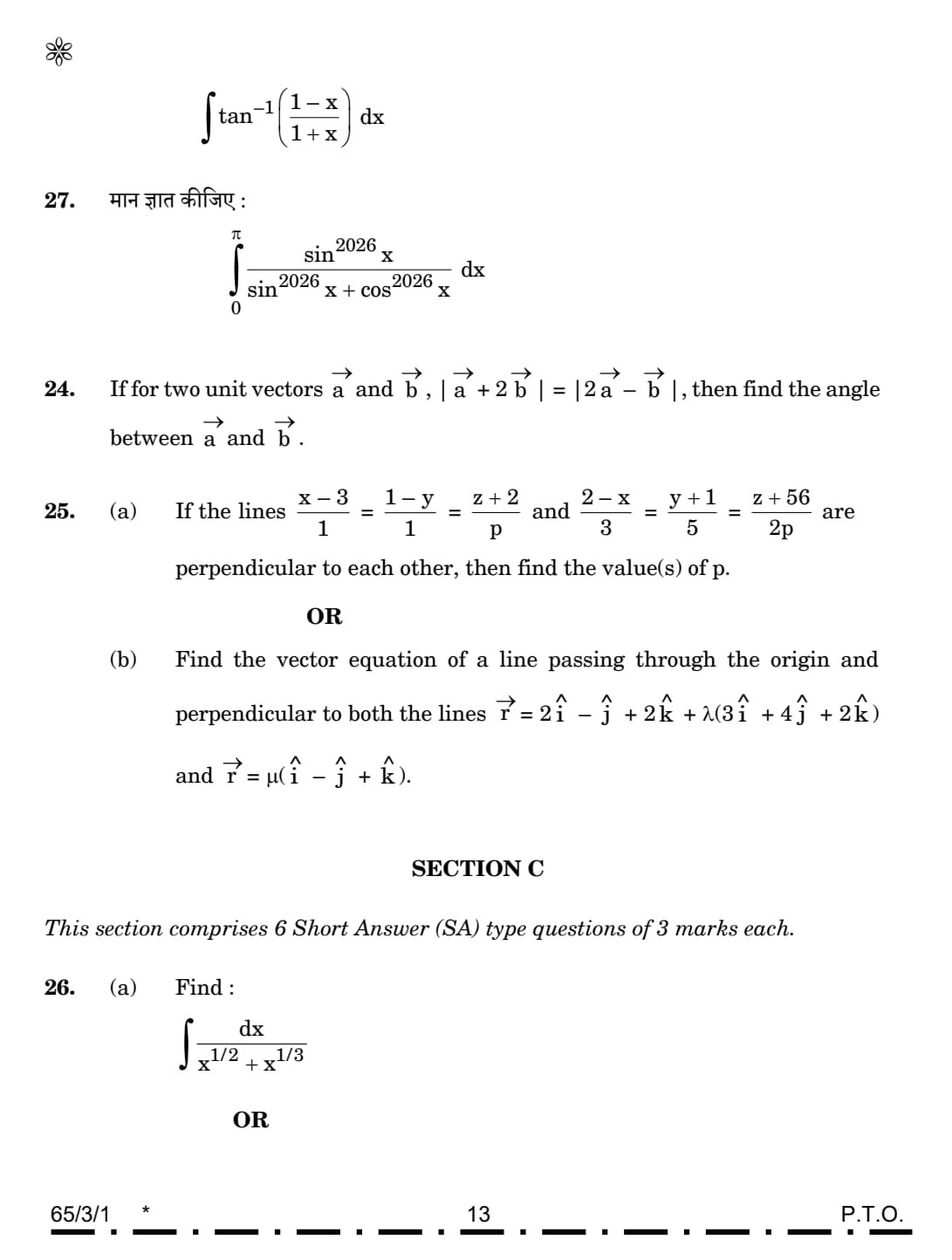
If for two unit vectors \(\vec{a}\) and \(\vec{b}\), \(|\vec{a} + 2\vec{b}| = |2\vec{a} - \vec{b}|\), then find the angle between \(\vec{a}\) and \(\vec{b}\).
Detailed Solution
Concept:
For unit vectors, \(|\vec{a}| = 1\) and \(|\vec{b}| = 1\).
Use the identity \(|\vec{u}|^2 = \vec{u} \cdot \vec{u}\).
Expansion of dot product: \((\vec{u} + \vec{v}) \cdot (\vec{u} + \vec{v}) = |\vec{u}|^2 + |\vec{v}|^2 + 2\vec{u} \cdot \vec{v}\).
Step 1: {\color{redSquare both sides of the equation
Given: \[ |\vec{a} + 2\vec{b}| = |2\vec{a} - \vec{b}| \]
Squaring: \[ |\vec{a} + 2\vec{b}|^2 = |2\vec{a} - \vec{b}|^2 \]
Step 2: {\color{redExpand using dot product properties
LHS expansion: \[ |\vec{a}|^2 + |2\vec{b}|^2 + 2(\vec{a} \cdot 2\vec{b}) = |\vec{a}|^2 + 4|\vec{b}|^2 + 4(\vec{a} \cdot \vec{b}) \]
RHS expansion: \[ |2\vec{a}|^2 + |\vec{b}|^2 - 2(2\vec{a} \cdot \vec{b}) = 4|\vec{a}|^2 + |\vec{b}|^2 - 4(\vec{a} \cdot \vec{b}) \]
Step 3: {\color{redSubstitute unit vector magnitudes
Since \(|\vec{a}| = 1\) and \(|\vec{b}| = 1\): \[ (1)^2 + 4(1)^2 + 4(\vec{a} \cdot \vec{b}) = 4(1)^2 + (1)^2 - 4(\vec{a} \cdot \vec{b}) \] \[ 1 + 4 + 4(\vec{a} \cdot \vec{b}) = 4 + 1 - 4(\vec{a} \cdot \vec{b}) \] \[ 5 + 4(\vec{a} \cdot \vec{b}) = 5 - 4(\vec{a} \cdot \vec{b}) \]
Step 4: {\color{redSolve for the angle
Cancel the \(5\) from both sides: \[ 4(\vec{a} \cdot \vec{b}) = -4(\vec{a} \cdot \vec{b}) \] \[ 8(\vec{a} \cdot \vec{b}) = 0 \] \[ \vec{a} \cdot \vec{b} = 0 \]
Since \(\vec{a} \cdot \vec{b} = |\vec{a}| |\vec{b}| \cos \theta\): \[ (1)(1) \cos \theta = 0 \implies \cos \theta = 0 \]
The angle \(\theta\) is \(\frac{\pi}{2}\) or \(90^\circ\). Quick Tip: Whenever magnitudes of vector sums or differences are involved, squaring is the most common first step. It transforms the absolute magnitude into the dot product, allowing for algebraic manipulation.
If the lines \(\frac{x - 3}{1} = \frac{1 - y}{1} = \frac{z + 2}{p}\) and \(\frac{2 - x}{3} = \frac{y + 1}{5} = \frac{z + 56}{2p}\) are perpendicular to each other, then find the value(s) of \(p\).
Detailed Solution
Concept:
Standard form of a line: \(\frac{x - x_1}{a} = \frac{y - y_1}{b} = \frac{z - z_1}{c}\), where \(\langle a, b, c \rangle\) are direction ratios.
Two lines are perpendicular if the sum of the products of their corresponding direction ratios is zero: \(a_1a_2 + b_1b_2 + c_1c_2 = 0\).
Step 1: {\color{redConvert equations to standard form
Line 1: \(\frac{x - 3}{1} = \frac{y - 1}{-1} = \frac{z + 2}{p}\).
Direction ratios \(\vec{d_1} = \langle 1, -1, p \rangle\).
Line 2: \(\frac{x - 2}{-3} = \frac{y + 1}{5} = \frac{z + 56}{2p}\).
Direction ratios \(\vec{d_2} = \langle -3, 5, 2p \rangle\).
Step 2: {\color{redApply the condition for perpendicularity
\[ a_1a_2 + b_1b_2 + c_1c_2 = 0 \] \[ (1)(-3) + (-1)(5) + (p)(2p) = 0 \]
Step 3: {\color{redSolve the resulting equation
\[ -3 - 5 + 2p^2 = 0 \] \[ -8 + 2p^2 = 0 \] \[ 2p^2 = 8 \] \[ p^2 = 4 \]
Taking the square root: \[ p = \pm 2 \] Quick Tip: The sign of terms like \(1-y\) or \(2-x\) is a common trap. Always re-arrange the numerators to have a positive \(x, y, z\) with coefficient 1 before reading off the direction ratios from the denominators.
Find the vector equation of a line passing through the origin and perpendicular to both the lines \(\vec{r} = 2\hat{i} - \hat{j} + 2\hat{k} + \lambda(3\hat{i} + 4\hat{j} + 2\hat{k})\) and \(\vec{r} = \mu(\hat{i} - \hat{j} + \hat{k})\).
Detailed Solution
Concept:
A line perpendicular to two given lines has a direction parallel to the cross product of their direction vectors.
Vector equation of a line passing through point \(\vec{a}\) with direction \(\vec{n}\) is \(\vec{r} = \vec{a} + k\vec{n}\).
Step 1: {\color{redExtract direction vectors from given lines
Direction of line 1: \(\vec{b_1} = 3\hat{i} + 4\hat{j} + 2\hat{k}\).
Direction of line 2: \(\vec{b_2} = \hat{i} - \hat{j} + \hat{k}\).
Step 2: {\color{redFind the direction of the required line
The direction \(\vec{n}\) is the cross product of \(\vec{b_1}\) and \(\vec{b_2}\): \[ \vec{n} = \vec{b_1} \times \vec{b_2} = \begin{vmatrix} \hat{i} & \hat{j} & \hat{k}
3 & 4 & 2
1 & -1 & 1 \end{vmatrix} \] \[ \vec{n} = \hat{i}(4 - (-2)) - \hat{j}(3 - 2) + \hat{k}(-3 - 4) \] \[ \vec{n} = 6\hat{i} - \hat{j} - 7\hat{k} \]
Step 3: {\color{redFormulate the line equation
The line passes through the origin, so \(\vec{a} = 0\hat{i} + 0\hat{j} + 0\hat{k}\).
The vector equation is: \[ \vec{r} = \vec{0} + \lambda'(6\hat{i} - \hat{j} - 7\hat{k}) \] \[ \vec{r} = \lambda'(6\hat{i} - \hat{j} - 7\hat{k}) \] Quick Tip: Cross product is the go-to tool when a question mentions being "perpendicular to both" two existing directions. If the question asked for Cartesian form, the origin point \((0,0,0)\) makes the denominators simple: \(x/6 = y/-1 = z/-7\).
Find : \( \int \frac{dx}{x^{1/2} + x^{1/3}} \)
Detailed Solution
Concept:
When an integrand involves different fractional powers of \(x\), we use a substitution \(x = t^n\) where \(n\) is the least common multiple (LCM) of the denominators of the fractional powers.
Here, the powers are \(1/2\) and \(1/3\). The LCM of 2 and 3 is 6.
After substitution, the integral typically converts into a rational function which can be solved by division or partial fractions.
Step 1: {\color{redApply substitution to rationalize the denominator
Let \(x = t^6\).
Then, differentiate both sides: \[ dx = 6t^5 \, dt \]
Substitute \(x\), \(x^{1/2}\), \(x^{1/3}\), and \(dx\) into the integral: \[ x^{1/2} = (t^6)^{1/2} = t^3 \] \[ x^{1/3} = (t^6)^{1/3} = t^2 \]
The integral becomes: \[ I = \int \frac{6t^5}{t^3 + t^2} \, dt \]
Step 2: {\color{redSimplify the rational expression
Factor out \(t^2\) from the denominator: \[ I = \int \frac{6t^5}{t^2(t + 1)} \, dt \] \[ I = 6 \int \frac{t^3}{t + 1} \, dt \]
Step 3: {\color{redPerform polynomial division
Since the degree of the numerator is greater than the denominator, we divide \(t^3\) by \(t+1\).
Recall that \(t^3 + 1 = (t+1)(t^2 - t + 1)\). Thus: \[ t^3 = (t^3 + 1) - 1 = (t+1)(t^2 - t + 1) - 1 \]
Dividing by \(t+1\): \[ \frac{t^3}{t+1} = (t^2 - t + 1) - \frac{1}{t+1} \]
Step 4: {\color{redIntegrate the simplified terms
\[ I = 6 \int \left( t^2 - t + 1 - \frac{1}{t+1} \right) \, dt \] \[ I = 6 \left[ \frac{t^3}{3} - \frac{t^2}{2} + t - \log|t + 1| \right] + C \] \[ I = 2t^3 - 3t^2 + 6t - 6\log|t + 1| + C \]
Step 5: {\color{redBack-substitute for \(x\)
Since \(x = t^6\), then \(t = x^{1/6}\). \[ t^3 = (x^{1/6})^3 = x^{1/2} = \sqrt{x} \] \[ t^2 = (x^{1/6})^2 = x^{1/3} \]
The final answer is: \[ I = 2\sqrt{x} - 3x^{1/3} + 6x^{1/6} - 6\log|x^{1/6} + 1| + C \] Quick Tip: Always use the LCM of the roots for substitution to clear all radical signs at once. Polynomial long division is essential when the numerator's power is equal to or higher than the denominator's power.
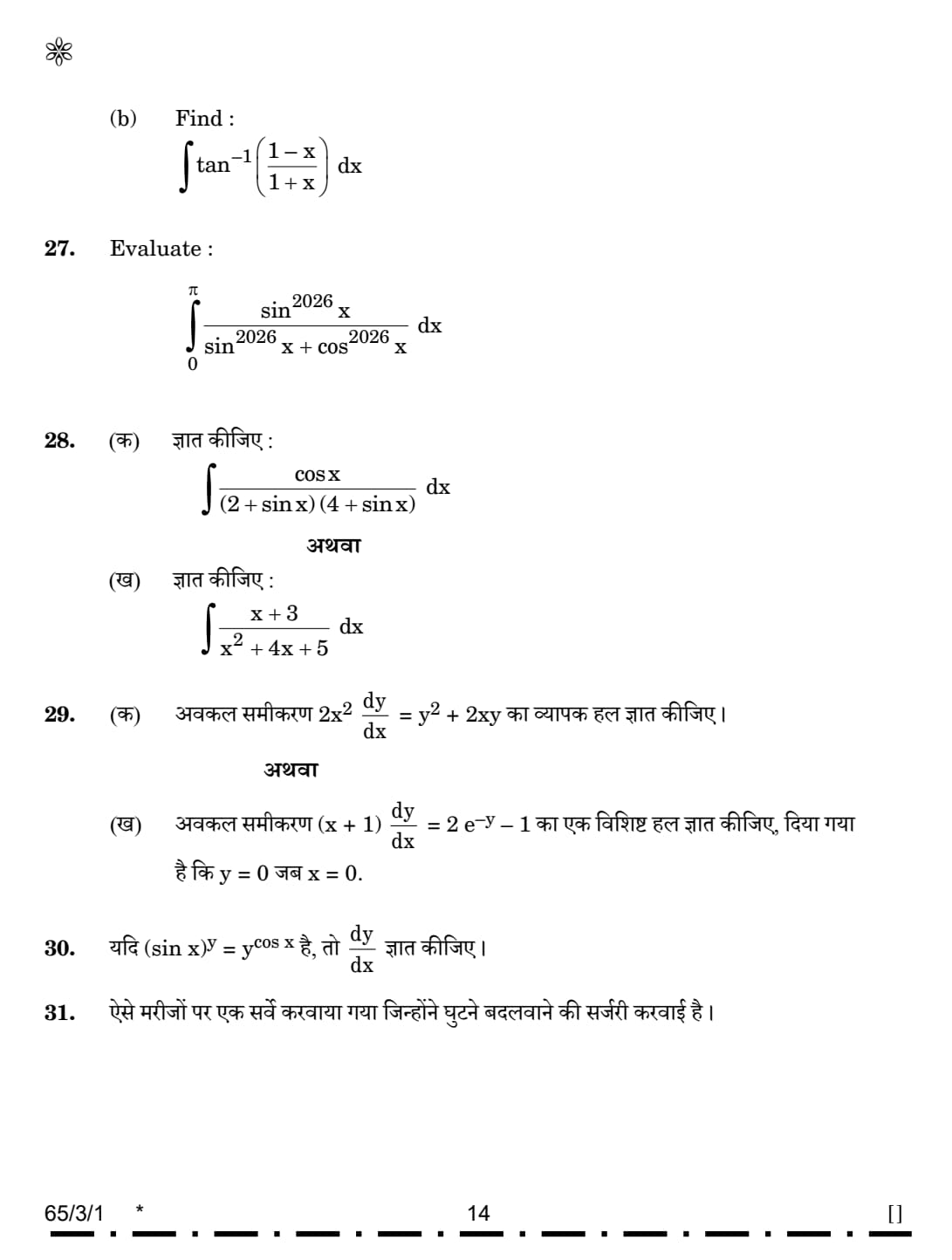
Find : \( \int \tan^{-1} \left( \sqrt{\frac{1-x}{1+x}} \right) \, dx \)
Detailed Solution
Concept:
Trigonometric substitution is effective for expressions like \(\sqrt{\frac{1-x}{1+x}}\). Letting \(x = \cos \theta\) is ideal.
Use half-angle formulas: \(1 - \cos \theta = 2\sin^2(\theta/2)\) and \(1 + \cos \theta = 2\cos^2(\theta/2)\).
Integration by parts: \( \int u \, dv = uv - \int v \, du \).
Step 1: {\color{redSubstitute to simplify the inverse trigonometric function
Let \(x = \cos \theta\), then \(dx = -\sin \theta \, d\theta\).
Also, \(\theta = \cos^{-1} x\). \[ \sqrt{\frac{1 - \cos \theta}{1 + \cos \theta}} = \sqrt{\frac{2\sin^2(\theta/2)}{2\cos^2(\theta/2)}} = \sqrt{\tan^2(\theta/2)} = \tan(\theta/2) \]
The integral becomes: \[ I = \int \tan^{-1}(\tan(\theta/2)) \cdot (-\sin \theta) \, d\theta \] \[ I = -\frac{1}{2} \int \theta \sin \theta \, d\theta \]
Step 2: {\color{redIntegrate by parts
Let \(u = \theta\) and \(dv = \sin \theta \, d\theta\).
Then \(du = d\theta\) and \(v = -\cos \theta\). \[ I = -\frac{1}{2} \left[ \theta(-\cos \theta) - \int (-\cos \theta) \, d\theta \right] \] \[ I = -\frac{1}{2} [-\theta \cos \theta + \sin \theta] + C \] \[ I = \frac{1}{2} \theta \cos \theta - \frac{1}{2} \sin \theta + C \]
Step 3: {\color{redBack-substitute in terms of \(x\)
We have \(x = \cos \theta\), \(\theta = \cos^{-1} x\), and \(\sin \theta = \sqrt{1 - \cos^2 \theta} = \sqrt{1 - x^2}\). \[ I = \frac{1}{2} x \cos^{-1} x - \frac{1}{2} \sqrt{1 - x^2} + C \] Quick Tip: The substitution \(x = \cos \theta\) simplifies many algebraic fractional roots inside inverse trig functions. Always verify the range of the parameter when performing substitutions involving square roots and trig functions.
Evaluate : \( \int_{0}^{\pi} \frac{\sin^{2026} x}{\sin^{2026} x + \cos^{2026} x} \, dx \)
Detailed Solution
Concept:
Use the definite integral property \( \int_0^a f(x) \, dx = \int_0^a f(a - x) \, dx \).
Use the property \( \int_0^{2a} f(x) \, dx = 2\int_0^a f(x) \, dx \) if \( f(2a - x) = f(x) \).
Note that \(\sin(\pi - x) = \sin x\) and \(\cos(\pi - x) = -\cos x\).
Step 1: {\color{redTest the symmetry of the integrand
Let \(f(x) = \frac{\sin^{2026} x}{\sin^{2026} x + \cos^{2026} x}\). \[ f(\pi - x) = \frac{\sin^{2026} (\pi - x)}{\sin^{2026} (\pi - x) + \cos^{2026} (\pi - x)} \] \[ f(\pi - x) = \frac{(\sin x)^{2026}}{(\sin x)^{2026} + (-\cos x)^{2026}} = \frac{\sin^{2026} x}{\sin^{2026} x + \cos^{2026} x} = f(x) \]
Because \(f(\pi - x) = f(x)\), we can use the property: \[ I = 2 \int_{0}^{\pi/2} \frac{\sin^{2026} x}{\sin^{2026} x + \cos^{2026} x} \, dx \quad \dots(1) \]
Step 2: {\color{redApply the complementary angle property on the new interval
Let \(I' = \int_{0}^{\pi/2} \frac{\sin^{2026} x}{\sin^{2026} x + \cos^{2026} x} \, dx\).
Using \( \int_0^a f(x) \, dx = \int_0^a f(a - x) \, dx \): \[ I' = \int_{0}^{\pi/2} \frac{\sin^{2026} (\pi/2 - x)}{\sin^{2026} (\pi/2 - x) + \cos^{2026} (\pi/2 - x)} \, dx \]
Since \(\sin(\pi/2 - x) = \cos x\) and \(\cos(\pi/2 - x) = \sin x\): \[ I' = \int_{0}^{\pi/2} \frac{\cos^{2026} x}{\cos^{2026} x + \sin^{2026} x} \, dx \quad \dots(2) \]
Step 3: {\color{redSum the two forms of the integral
Adding \(I'\) from Step 2 and its original definition: \[ 2I' = \int_{0}^{\pi/2} \frac{\sin^{2026} x + \cos^{2026} x}{\sin^{2026} x + \cos^{2026} x} \, dx \] \[ 2I' = \int_{0}^{\pi/2} 1 \, dx = [x]_0^{\pi/2} = \pi/2 \] \[ I' = \pi/4 \]
Step 4: {\color{redCalculate final answer \(I\)
From Step 1, \(I = 2I'\): \[ I = 2 \times \frac{\pi}{4} = \frac{\pi}{2} \] Quick Tip: For integrals like \( \int_0^{\pi/2} \frac{\sin^n x}{\sin^n x + \cos^n x} \, dx \), the result is always half the upper limit (\(\pi/4\)). Be careful with the limits; here the limit was \(\pi\), requiring an extra symmetry step before applying the standard shortcut.
Find : \( \int \frac{\cos x}{(2 + \sin x)(4 + \sin x)} \, dx \)
Detailed Solution
Concept:
This is an integration problem solvable by substitution followed by partial fraction decomposition.
The presence of \(\cos x\) in the numerator suggests substituting \(t = \sin x\).
Step 1: {\color{redApply substitution
Let \(t = \sin x\). Then, \(dt = \cos x \, dx\).
The integral becomes: \[ I = \int \frac{1}{(2 + t)(4 + t)} \, dt \]
Step 2: {\color{redApply partial fractions
Let \(\frac{1}{(2 + t)(4 + t)} = \frac{A}{t + 2} + \frac{B}{t + 4}\).
Multiplying through: \[ 1 = A(t + 4) + B(t + 2) \]
To find \(A\), set \(t = -2\): \(1 = 2A \implies A = 1/2\).
To find \(B\), set \(t = -4\): \(1 = -2B \implies B = -1/2\).
So: \[ \frac{1}{(t + 2)(t + 4)} = \frac{1}{2(t + 2)} - \frac{1}{2(t + 4)} \]
Step 3: {\color{redIntegrate
\[ I = \frac{1}{2} \int \frac{1}{t + 2} \, dt - \frac{1}{2} \int \frac{1}{t + 4} \, dt \] \[ I = \frac{1}{2} \log|t + 2| - \frac{1}{2} \log|t + 4| + C \]
Using log properties: \[ I = \frac{1}{2} \log \left| \frac{t + 2}{t + 4} \right| + C \]
Step 4: {\color{redBack-substitute for \(x\)
\[ I = \frac{1}{2} \log \left| \frac{\sin x + 2}{\sin x + 4} \right| + C \] Quick Tip: Look for a derivative pair (like \(\sin x\) and \(\cos x\)) to simplify the integral into a rational form. Partial fraction decomposition is the standard tool for integrating rational functions with factorable denominators.
Find : \( \int \frac{x + 3}{x^2 + 4x + 5} \, dx \)
Detailed Solution
Concept:
For integrals of the form \( \int \frac{px + q}{ax^2 + bx + c} \, dx \), we express the numerator as \( A \cdot \frac{d}{dx}(denominator) + B \).
This splits the integral into a log term and a term involving completing the square.
Step 1: {\color{redDecompose the numerator
The derivative of the denominator is \(\frac{d}{dx}(x^2 + 4x + 5) = 2x + 4\).
Let \(x + 3 = A(2x + 4) + B\).
Comparing coefficients of \(x\): \(2A = 1 \implies A = 1/2\).
Comparing constants: \(4A + B = 3 \implies 4(1/2) + B = 3 \implies 2 + B = 3 \implies B = 1\).
So, \(x + 3 = \frac{1}{2}(2x + 4) + 1\).
Step 2: {\color{redSplit the integral
\[ I = \int \frac{\frac{1}{2}(2x + 4) + 1}{x^2 + 4x + 5} \, dx \] \[ I = \frac{1}{2} \int \frac{2x + 4}{x^2 + 4x + 5} \, dx + \int \frac{1}{x^2 + 4x + 5} \, dx \]
Step 3: {\color{redEvaluate each part
Part 1 is a direct log form: \[ I_1 = \frac{1}{2} \log|x^2 + 4x + 5| \]
For Part 2, complete the square: \(x^2 + 4x + 5 = (x + 2)^2 + 1\). \[ I_2 = \int \frac{dx}{(x + 2)^2 + 1} = \tan^{-1}(x + 2) \]
Step 4: {\color{redCombine the results
\[ I = \frac{1}{2} \log|x^2 + 4x + 5| + \tan^{-1}(x + 2) + C \] Quick Tip: Splitting the numerator allows you to handle the "linear" part as a derivative and the "constant" part using completing the square. The result usually contains both a natural log and an inverse tangent function.
Find the general solution of the differential equation \( 2x^2 \frac{dy}{dx} = y^2 + 2xy \).
Detailed Solution
Concept:
A differential equation \( M(x,y)dx + N(x,y)dy = 0 \) is homogeneous if both functions are of the same degree.
For homogeneous equations, use the substitution \( y = vx \), which implies \( \frac{dy}{dx} = v + x\frac{dv}{dx} \).
Step 1: {\color{redRearrange and verify homogeneity
\[ \frac{dy}{dx} = \frac{y^2 + 2xy}{2x^2} = \frac{y^2}{2x^2} + \frac{2xy}{2x^2} = \frac{1}{2} \left( \frac{y}{x} \right)^2 + \frac{y}{x} \]
Since the RHS is a function of \(y/x\), the equation is homogeneous.
Step 2: {\color{redSubstitute and separate variables
Let \(y = vx\). Then \( \frac{dy}{dx} = v + x\frac{dv}{dx} \).
Substitute into the equation: \[ v + x\frac{dv}{dx} = \frac{1}{2}v^2 + v \]
Subtract \(v\) from both sides: \[ x\frac{dv}{dx} = \frac{v^2}{2} \]
Separate variables: \[ \frac{2}{v^2} \, dv = \frac{dx}{x} \]
Step 3: {\color{redIntegrate both sides
\[ 2 \int v^{-2} \, dv = \int \frac{1}{x} \, dx \] \[ 2 \left( \frac{v^{-1}}{-1} \right) = \log|x| + C \] \[ -\frac{2}{v} = \log|x| + C \]
Step 4: {\color{redSubstitute back for \(y\)
Since \(v = y/x\), then \(1/v = x/y\). \[ -\frac{2x}{y} = \log|x| + C \]
Or, expressed for \(y\): \[ y = \frac{-2x}{\log|x| + C} \] Quick Tip: Always confirm an equation is homogeneous by checking if the total degree of every term is the same. The substitution \(y=vx\) always transforms a homogeneous equation into a variable-separable one.
Find a particular solution of the differential equation \( (x + 1) \frac{dy}{dx} = 2 e^{-y} - 1 \), given that \( y = 0 \) when \( x = 0 \).
Detailed Solution
Concept:
This is a variable-separable differential equation.
A particular solution is found by first finding the general solution and then using the boundary conditions to find the constant of integration \(C\).
Step 1: {\color{redSeparate the variables
\[ \frac{dy}{2e^{-y} - 1} = \frac{dx}{x + 1} \]
Multiply numerator and denominator of LHS by \(e^y\): \[ \frac{e^y \, dy}{2 - e^y} = \frac{dx}{x + 1} \]
Step 2: {\color{redIntegrate both sides
Let \(u = 2 - e^y\), then \(du = -e^y \, dy\). \[ \int \frac{-du}{u} = \int \frac{dx}{x + 1} \] \[ -\log|2 - e^y| = \log|x + 1| + \log C \] \[ \log|x + 1| + \log|2 - e^y| = \log K \]
Taking exponents: \[ (x + 1)(2 - e^y) = K \]
Step 3: {\color{redApply the initial condition
Given \(y = 0\) when \(x = 0\). \[ (0 + 1)(2 - e^0) = K \] \[ 1 \cdot (2 - 1) = K \implies K = 1 \]
Step 4: {\color{redWrite the final particular solution
\[ (x + 1)(2 - e^y) = 1 \]
This can be simplified: \[ 2 - e^y = \frac{1}{x + 1} \implies e^y = 2 - \frac{1}{x + 1} = \frac{2x + 1}{x + 1} \] \[ y = \log \left| \frac{2x + 1}{x + 1} \right| \] Quick Tip: When an integrand has \(e^{-y}\), multiply by \(e^y\) to make it simpler to handle. Always use initial values to evaluate the constant \(C\) immediately after integrating to simplify subsequent steps.
If \( (\sin x)^y = y^{\cos x} \), then find \( \frac{dy}{dx} \).
Detailed Solution
Concept:
For equations of the form \( f(x)^{g(y)} = h(y)^{k(x)} \), take the natural logarithm on both sides to bring the powers down. This is called logarithmic differentiation.
Use the product rule: \( \frac{d}{dx}(uv) = u'v + uv' \).
Chain rule is essential for terms involving \(y\).
Step 1: {\color{redTake the natural log of both sides
\[ \log(\sin x)^y = \log(y^{\cos x}) \]
Using properties of logs: \[ y \log(\sin x) = \cos x \log y \]
Step 2: {\color{redDifferentiate both sides with respect to \(x\)
Differentiate LHS using product rule: \[ \frac{dy}{dx} \log(\sin x) + y \cdot \frac{d}{dx}(\log(\sin x)) = \frac{dy}{dx} \log(\sin x) + y \cdot \frac{1}{\sin x} \cdot \cos x \] \[ LHS = \frac{dy}{dx} \log(\sin x) + y \cot x \]
Differentiate RHS using product rule: \[ -\sin x \log y + \cos x \cdot \frac{d}{dx}(\log y) = -\sin x \log y + \cos x \cdot \frac{1}{y} \cdot \frac{dy}{dx} \] \[ RHS = -\sin x \log y + \frac{\cos x}{y} \frac{dy}{dx} \]
Step 3: {\color{redGroup terms containing \(dy/dx\)
\[ \frac{dy}{dx} \log(\sin x) - \frac{\cos x}{y} \frac{dy}{dx} = -\sin x \log y - y \cot x \] \[ \frac{dy}{dx} \left( \log(\sin x) - \frac{\cos x}{y} \right) = -(\sin x \log y + y \cot x) \]
Step 4: {\color{redIsolate \(dy/dx\)
Multiply the left side bracket by \(y/y\): \[ \frac{dy}{dx} \left( \frac{y \log(\sin x) - \cos x}{y} \right) = -(\sin x \log y + y \cot x) \] \[ \frac{dy}{dx} = \frac{-y(\sin x \log y + y \cot x)}{y \log(\sin x) - \cos x} \] Quick Tip: Logarithmic differentiation is the only way to differentiate "variable to the power variable" functions. Be extremely careful with signs when moving terms from one side of the equation to the other.
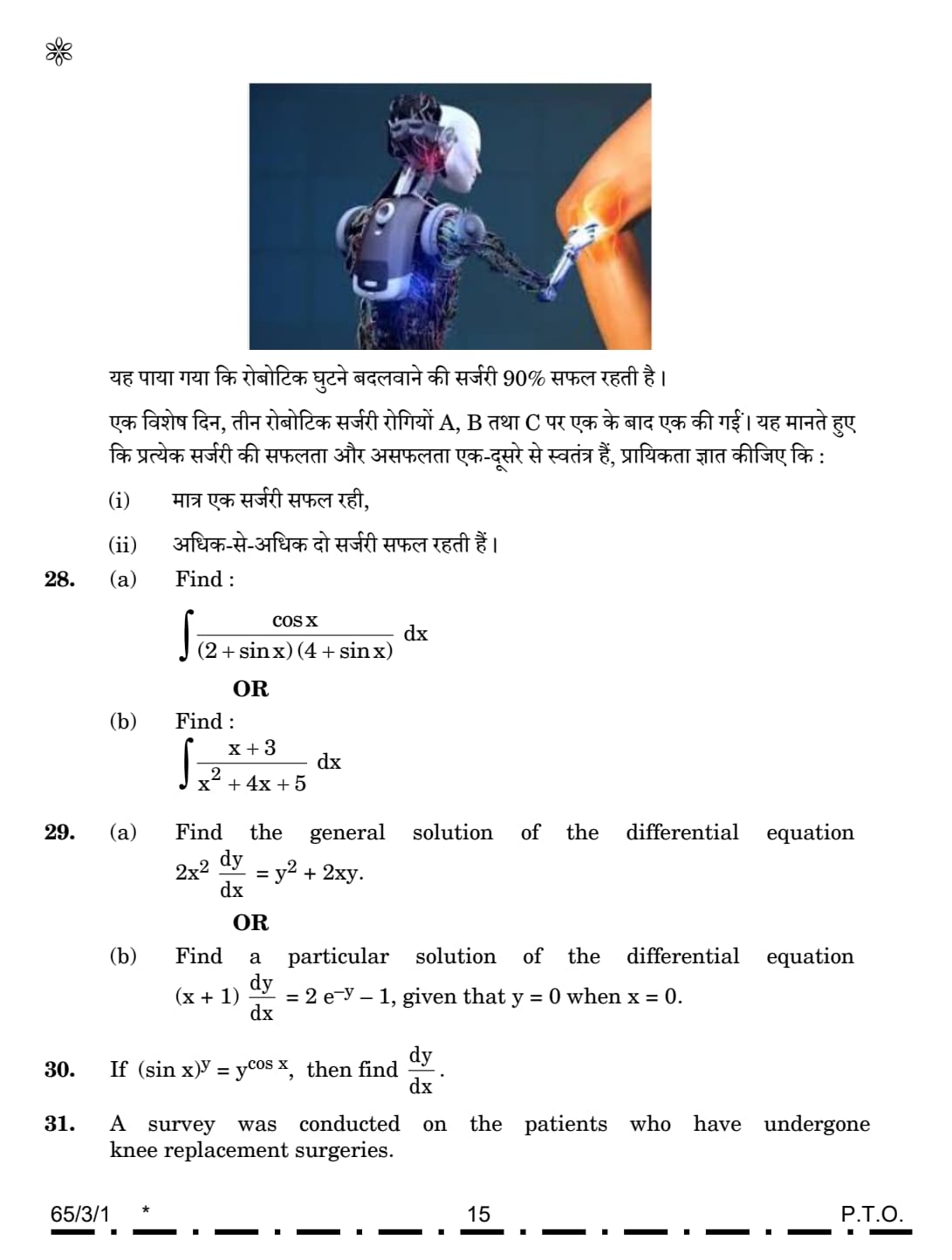
A survey was conducted on the patients who have undergone knee replacement surgeries. It was found that, Robotic Knee replacement surgeries have a 90% success rate. On a particular day, robotic surgery was performed on three patients, A, B and C, one after the other. Assuming that the success and failure of each surgery is independent of each other, find the probability that

exactly one surgery is successful.
Detailed Solution
Concept:
This is a case of independent trials following a Binomial distribution, where \(n=3\).
Probability of success \(P(S) = p = 0.9\).
Probability of failure \(P(F) = q = 1 - p = 0.1\).
The probability of exactly \(k\) successes is given by \(P(X=k) = \binom{n}{k} p^k q^{n-k}\).
Step 1: {\color{redIdentify the parameters
Number of patients (trials), \(n = 3\).
Success rate, \(p = 90% = 0.9\).
Failure rate, \(q = 1 - 0.9 = 0.1\).
Step 2: {\color{redSet up the formula for exactly one success
We want to find \(P(X=1)\): \[ P(X=1) = \binom{3}{1} (p)^1 (q)^{3-1} \]
Step 3: {\color{redCalculate the numerical value
\[ P(X=1) = 3 \times (0.9) \times (0.1)^2 \] \[ P(X=1) = 3 \times 0.9 \times 0.01 \] \[ P(X=1) = 0.027 \] Quick Tip: For small \(n\), you can also think of the outcomes: \(SFF, FSF, FFS\). Each has probability \(0.9 \times 0.1 \times 0.1 = 0.009\). Since there are 3 such outcomes, the total is \(3 \times 0.009 = 0.027\).
From the same data as above, find the probability that at most two surgeries are successful.
Detailed Solution
Concept:
"At most two" means \(X \leq 2\), which includes \(X=0, X=1,\) and \(X=2\).
It is easier to use the complement rule: \(P(X \leq 2) = 1 - P(X=3)\).
Step 1: {\color{redCalculate the probability of all three surgeries being successful
\[ P(X=3) = p^3 = (0.9)^3 \] \[ P(X=3) = 0.9 \times 0.9 \times 0.9 = 0.729 \]
Step 2: {\color{redUse the complement rule
The total probability is 1. The probability of at most two successes is: \[ P(X \leq 2) = 1 - P(X=3) \] \[ P(X \leq 2) = 1 - 0.729 \] \[ P(X \leq 2) = 0.271 \] Quick Tip: "At most \(n-1\)" successes for \(n\) trials is always \(1 - P(all successes)\). This shortcut saves you from calculating and summing multiple individual binomial terms.
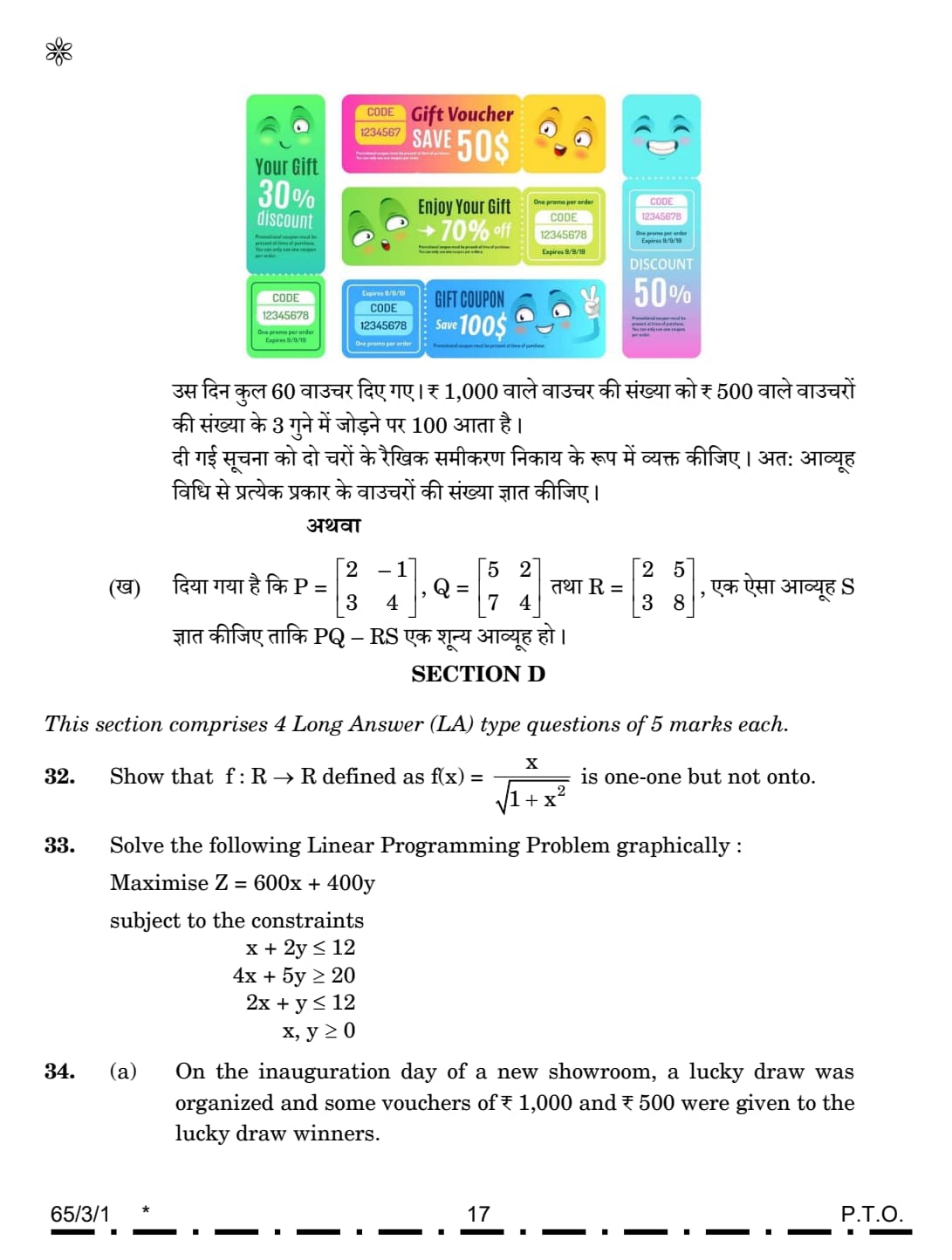
Show that \(f : \mathbb{R} \to \mathbb{R}\) defined as \(f(x) = \frac{x}{\sqrt{1+x^2}}\) is one-one but not onto.
Detailed Solution
Concept:
A function is one-one (injective) if \(f(x_1) = f(x_2) \implies x_1 = x_2\).
A function is onto (surjective) if for every \(y\) in the codomain, there exists an \(x\) in the domain such that \(f(x) = y\).
Step 1: {\color{redTest for One-One property
Let \(x_1, x_2 \in \mathbb{R}\) such that \(f(x_1) = f(x_2)\): \[ \frac{x_1}{\sqrt{1+x_1^2}} = \frac{x_2}{\sqrt{1+x_2^2}} \]
Squaring both sides: \[ \frac{x_1^2}{1+x_1^2} = \frac{x_2^2}{1+x_2^2} \] \[ x_1^2(1+x_2^2) = x_2^2(1+x_1^2) \] \[ x_1^2 + x_1^2x_2^2 = x_2^2 + x_2^2x_1^2 \] \[ x_1^2 = x_2^2 \implies |x_1| = |x_2| \]
Since \(f(x)\) has the same sign as \(x\), for the equality to hold, \(x_1\) and \(x_2\) must have the same sign.
Thus, \(x_1 = x_2\). The function is one-one.
Step 2: {\color{redTest for Onto property
Let \(y = \frac{x}{\sqrt{1+x^2}}\).
Notice that for any \(x \in \mathbb{R}\), \(x^2 < 1 + x^2\), which implies \(\sqrt{x^2} < \sqrt{1 + x^2}\), so \(|x| < \sqrt{1+x^2}\).
This means \(|f(x)| < 1\) for all \(x\).
The range of the function is the interval \((-1, 1)\).
Step 3: {\color{redConclude based on codomain
The codomain is given as \(\mathbb{R}\).
Since the range \((-1, 1) \neq \mathbb{R}\), there are values in the codomain (like \(y=2\)) that have no corresponding \(x\).
Thus, the function is not onto. Quick Tip: To show a function is not onto, it's enough to find its range. If the range is a bounded subset of an infinite codomain, it's definitely not onto. For one-one, if the derivative \(f'(x)\) is strictly positive or strictly negative throughout the domain, the function is injective.
Solve the following Linear Programming Problem graphically :
Maximise \(Z = 600x + 400y\)
subject to the constraints
\(x + 2y \leq 12\)
\(4x + 5y \geq 20\)
\(2x + y \leq 12\)
\(x, y \geq 0\)
Detailed Solution
Concept:
The graphical method involves plotting the constraint lines on a graph and identifying the feasible region.
The optimal value occurs at one of the corner points (vertices) of the bounded feasible region.
Step 1: {\color{redFind intercepts for each constraint line
Line \(L_1: x + 2y = 12\). Intercepts: \((12, 0)\) and \((0, 6)\).
Line \(L_2: 4x + 5y = 20\). Intercepts: \((5, 0)\) and \((0, 4)\).
Line \(L_3: 2x + y = 12\). Intercepts: \((6, 0)\) and \((0, 12)\).
Step 2: {\color{redDetermine the feasible region
Test \((0,0)\) in the inequalities:
\(0 + 0 \leq 12\) (True, region towards origin for \(L_1\))
\(0 + 0 \geq 20\) (False, region away from origin for \(L_2\))
\(0 + 0 \leq 12\) (True, region towards origin for \(L_3\))
The overlapping region is a polygon in the first quadrant.
Step 3: {\color{redIdentify the corner points
Solving intersections:
\(L_1 \cap L_3: x + 2y = 12\) and \(2x + y = 12 \implies (4, 4)\).
\(L_3 \cap x-axis: (6, 0)\).
\(L_2 \cap x-axis: (5, 0)\).
\(L_2 \cap y-axis: (0, 4)\).
\(L_1 \cap y-axis: (0, 6)\).
Step 4: {\color{redCalculate \(Z\) at each vertex
\(A(0, 4): Z = 600(0) + 400(4) = 1600\)
\(B(0, 6): Z = 600(0) + 400(6) = 2400\)
\(C(4, 4): Z = 600(4) + 400(4) = 2400 + 1600 = 4000\)
\(D(6, 0): Z = 600(6) + 400(0) = 3600\)
\(E(5, 0): Z = 600(5) + 400(0) = 3000\)
Step 5: {\color{redConclusion
The maximum value of \(Z\) is 4000, which occurs at the point \((4, 4)\). Quick Tip: Always double-check the intersection points by substituting them back into the original equations. For "Maximize" problems, points further from the origin usually yield higher values if the objective coefficients are positive.
On the inauguration day of a new showroom, a lucky draw was organized and some vouchers of Rs 1,000 and Rs 500 were given to the lucky draw winners.

A total of 60 vouchers were given on the day. The number of Rs 1,000 vouchers added to 3 times the number of Rs 500 vouchers, gives 100. Express the given information as a system of linear equations in two variables. Hence, find the number of vouchers of each type by matrix method.
Detailed Solution
Concept:
Let \(x\) be the number of Rs 1,000 vouchers and \(y\) be the number of Rs 500 vouchers.
Formulate equations and write them in the form \(AX = B\).
Solve using \(X = A^{-1}B\), where \(A^{-1} = \frac{1}{|A|} adj A\).
Step 1: {\color{redFormulate the equations
Total vouchers: \(x + y = 60\)
Weighted sum: \(x + 3y = 100\)
Step 2: {\color{redRepresent in matrix form \(AX = B\)
\[ \begin{bmatrix} 1 & 1
1 & 3 \end{bmatrix} \begin{bmatrix} x
y \end{bmatrix} = \begin{bmatrix} 60
100 \end{bmatrix} \]
Step 3: {\color{redFind the inverse of matrix \(A\)
\(|A| = (1 \times 3) - (1 \times 1) = 2\).
\(adj A = \begin{bmatrix} 3 & -1
-1 & 1 \end{bmatrix}\).
\(A^{-1} = \frac{1}{2} \begin{bmatrix} 3 & -1
-1 & 1 \end{bmatrix}\).
Step 4: {\color{redSolve for \(X\)
\[ \begin{bmatrix} x
y \end{bmatrix} = \frac{1}{2} \begin{bmatrix} 3 & -1
-1 & 1 \end{bmatrix} \begin{bmatrix} 60
100 \end{bmatrix} \] \[ \begin{bmatrix} x
y \end{bmatrix} = \frac{1}{2} \begin{bmatrix} 180 - 100
-60 + 100 \end{bmatrix} = \frac{1}{2} \begin{bmatrix} 80
40 \end{bmatrix} \] \[ x = 40, y = 20 \]
So, there are 40 vouchers of Rs 1,000 and 20 vouchers of Rs 500. Quick Tip: For a \(2 \times 2\) matrix \(\begin{bmatrix} a & b
c & d \end{bmatrix}\), the adjoint is simply \(\begin{bmatrix} d & -b
-c & a \end{bmatrix}\). Matrix method is mandatory here even if simple substitution works; you will lose marks if you don't use matrices.
Given that \(P = \begin{bmatrix} 2 & -1 \\
3 & 4 \end{bmatrix}\), \(Q = \begin{bmatrix} 5 & 2 \\
7 & 4 \end{bmatrix}\) and \(R = \begin{bmatrix} 2 & 5 \\
3 & 8 \end{bmatrix}\), find a matrix \(S\) such that \(PQ - RS\) is a null matrix.
Detailed Solution
Concept:
Given \(PQ - RS = O\), which implies \(RS = PQ\).
Pre-multiply both sides by \(R^{-1}\) to isolate \(S\): \(S = R^{-1}(PQ)\).
Step 1: {\color{redCalculate the product \(PQ\)
\[ PQ = \begin{bmatrix} 2 & -1
3 & 4 \end{bmatrix} \begin{bmatrix} 5 & 2
7 & 4 \end{bmatrix} = \begin{bmatrix} 10-7 & 4-4
15+28 & 6+16 \end{bmatrix} = \begin{bmatrix} 3 & 0
43 & 22 \end{bmatrix} \]
Step 2: {\color{redFind the inverse of matrix \(R\)
\(|R| = (2 \times 8) - (3 \times 5) = 16 - 15 = 1\).
\(R^{-1} = \frac{1}{1} \begin{bmatrix} 8 & -5
-3 & 2 \end{bmatrix} = \begin{bmatrix} 8 & -5
-3 & 2 \end{bmatrix}\).
Step 3: {\color{redCalculate matrix \(S\)
\(S = R^{-1}(PQ)\)
\[ S = \begin{bmatrix} 8 & -5
-3 & 2 \end{bmatrix} \begin{bmatrix} 3 & 0
43 & 22 \end{bmatrix} \] \[ S = \begin{bmatrix} 24 - 215 & 0 - 110
-9 + 86 & 0 + 44 \end{bmatrix} \] \[ S = \begin{bmatrix} -191 & -110
77 & 44 \end{bmatrix} \] Quick Tip: When solving matrix equations of the form \(RS = T\), remember that multiplication is not commutative. You must pre-multiply by \(R^{-1}\) on both sides. If the equation was \(SR = T\), you would post-multiply by \(R^{-1}\) on both sides.
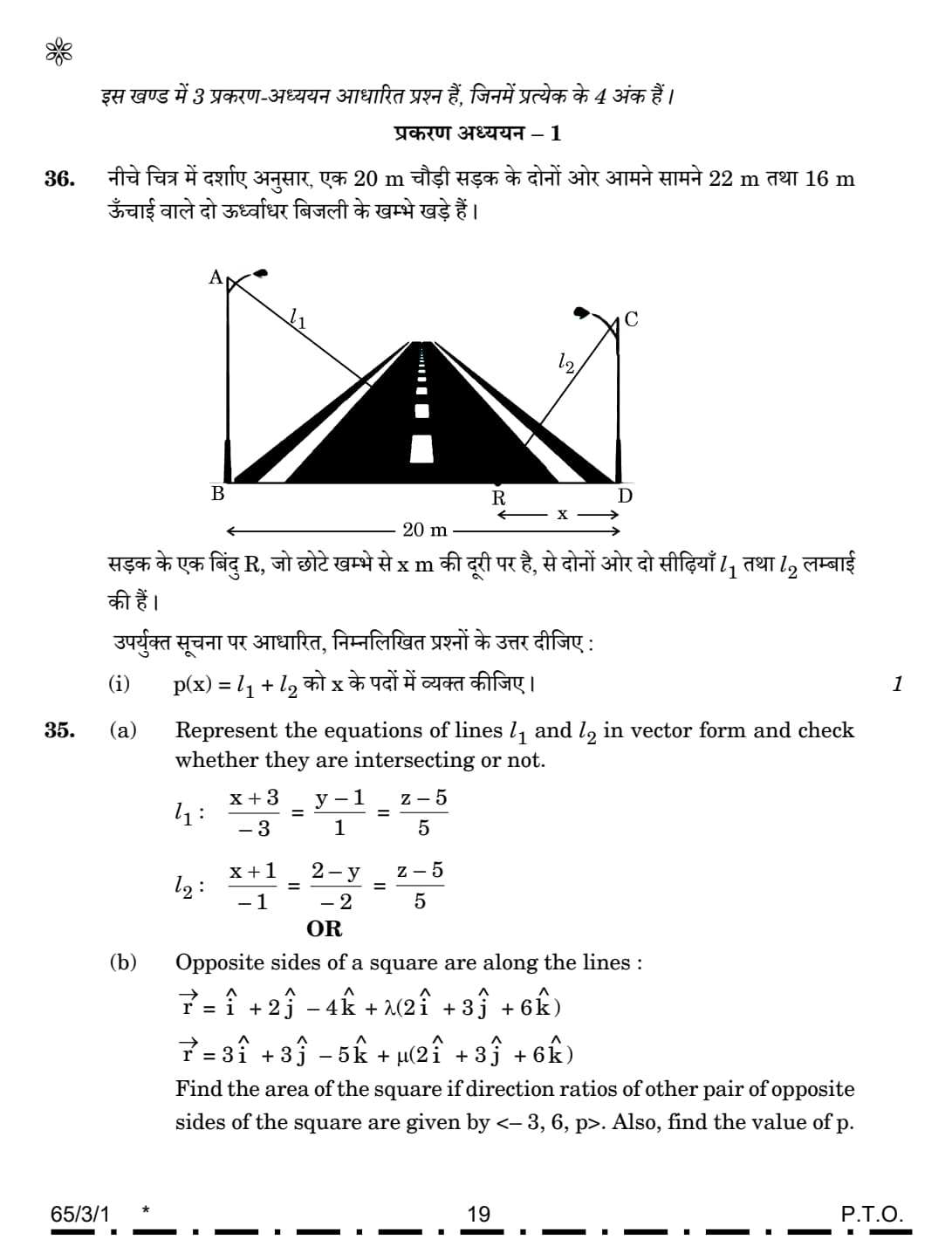
Represent the equations of lines \(l_1\) and \(l_2\) in vector form and check whether they are intersecting or not.
\(l_1 : \frac{x+3}{-3} = \frac{y-1}{1} = \frac{z-5}{5}\)
\(l_2 : \frac{x+1}{-1} = \frac{2-y}{-2} = \frac{z-5}{5}\)
Detailed Solution
Concept:
Vector form: \(\vec{r} = \vec{a} + \lambda \vec{b}\), where \(\vec{a}\) is a point on the line and \(\vec{b}\) is the direction vector.
Lines intersect if there exist \(\lambda, \mu\) such that \(\vec{a_1} + \lambda \vec{b_1} = \vec{a_2} + \mu \vec{b_2}\).
Step 1: {\color{redWrite lines in standard vector form
For \(l_1\): point is \((-3, 1, 5)\), direction is \(\langle -3, 1, 5 \rangle\).
\(\vec{r} = (-3\hat{i} + \hat{j} + 5\hat{k}) + \lambda(-3\hat{i} + \hat{j} + 5\hat{k})\).
For \(l_2\): point is \((-1, 2, 5)\), direction is \(\langle -1, 2, 5 \rangle\) (note \(\frac{y-2}{2}\) conversion).
\(\vec{r} = (-\hat{i} + 2\hat{j} + 5\hat{k}) + \mu(-\hat{i} + 2\hat{j} + 5\hat{k})\).
Step 2: {\color{redSet up the intersection equations
\(-3 - 3\lambda = -1 - \mu \implies \mu - 3\lambda = 2 \quad \dots(1)\)
\(1 + \lambda = 2 + 2\mu \implies \lambda - 2\mu = 1 \quad \dots(2)\)
\(5 + 5\lambda = 5 + 5\mu \implies \lambda = \mu \quad \dots(3)\)
Step 3: {\color{redSolve the system
From (3), substitute \(\mu = \lambda\) into (1):
\(\lambda - 3\lambda = 2 \implies -2\lambda = 2 \implies \lambda = -1, \mu = -1\).
Check in (2): \(-1 - 2(-1) = -1 + 2 = 1\). (True)
Since a common pair exists, the lines intersect.
Step 4: {\color{redFind the intersection point
Substitute \(\lambda = -1\) into \(l_1\):
\(x = -3 - 3(-1) = 0\)
\(y = 1 + (-1) = 0\)
\(z = 5 + 5(-1) = 0\)
The lines intersect at the origin \((0, 0, 0)\). Quick Tip: Always standardize the equations first (check the coefficient of \(y\) in \(l_2\)). If the three equations for \(\lambda\) and \(\mu\) are inconsistent, the lines are skew; if they have a common solution, they intersect.
Opposite sides of a square are along the lines :
\(\vec{r} = \hat{i} + 2\hat{j} - 4\hat{k} + \lambda(2\hat{i} + 3\hat{j} + 6\hat{k})\)
\(\vec{r} = 3\hat{i} + 3\hat{j} - 5\hat{k} + \mu(2\hat{i} + 3\hat{j} + 6\hat{k})\)
Find the area of the square if direction ratios of other pair of opposite sides of the square are given by \(\langle -3, 6, p \rangle\). Also, find the value of \(p\).
Detailed Solution
Concept:
The two lines are parallel (same direction vector). The distance between them equals the side length of the square.
Area = (Side length)\(^2\).
Adjacent sides of a square are perpendicular, so the dot product of their direction vectors must be zero.
Step 1: {\color{redCalculate the side length (distance between parallel lines)
Distance \(d = \frac{|(\vec{a_2} - \vec{a_1}) \times \vec{b}|}{|\vec{b}|}\).
\(\vec{a_2} - \vec{a_1} = (3-1)\hat{i} + (3-2)\hat{j} + (-5+4)\hat{k} = 2\hat{i} + \hat{j} - \hat{k}\).
\(\vec{b} = 2\hat{i} + 3\hat{j} + 6\hat{k}\).
\((\vec{a_2} - \vec{a_1}) \times \vec{b} = \begin{vmatrix} \hat{i} & \hat{j} & \hat{k}
2 & 1 & -1
2 & 3 & 6 \end{vmatrix} = 9\hat{i} - 14\hat{j} + 4\hat{k}\).
\(|\vec{b}| = \sqrt{2^2 + 3^2 + 6^2} = 7\).
Distance \(d = \frac{\sqrt{9^2 + (-14)^2 + 4^2}}{7} = \frac{\sqrt{81 + 196 + 16}}{7} = \frac{\sqrt{293}}{7}\).
Side length \(s = \frac{\sqrt{293}}{7}\).
Step 2: {\color{redCalculate the area
Area = \(s^2 = \frac{293}{49}\) sq. units.
Step 3: {\color{redFind the value of \(p\)
The direction of the first pair is \(\langle 2, 3, 6 \rangle\). The direction of the second pair is \(\langle -3, 6, p \rangle\).
Since adjacent sides are perpendicular:
\(2(-3) + 3(6) + 6(p) = 0\)
\(-6 + 18 + 6p = 0\)
\(12 + 6p = 0 \implies p = -2\). Quick Tip: For distance between parallel lines, you can also use the projection formula or pick a point on one line and find its perpendicular distance to the other. The orthogonality condition (\(\vec{b_1} \cdot \vec{b_2} = 0\)) is the fastest way to find missing parameters in geometry problems.
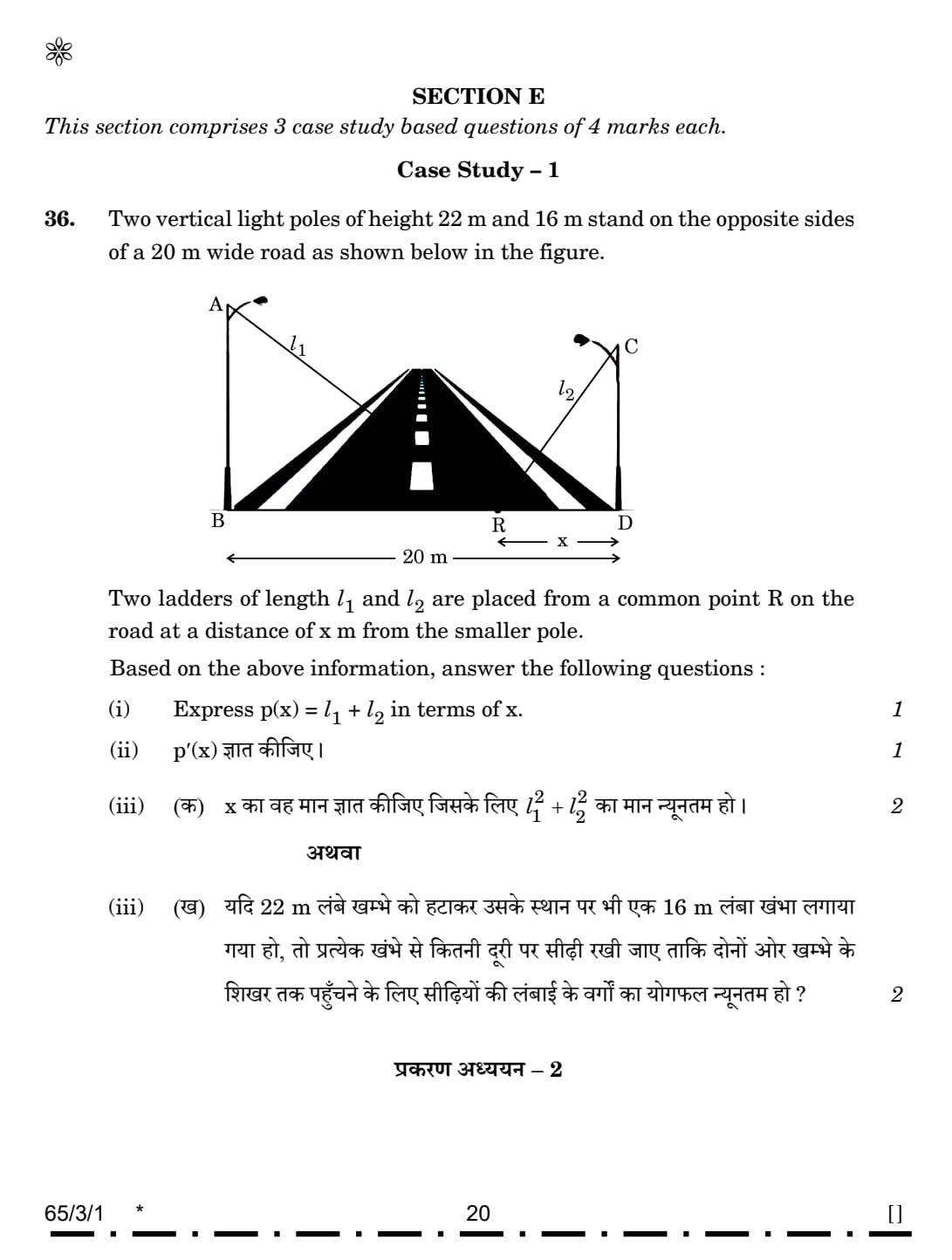
Two vertical light poles of height \(22 m\) and \(16 m\) stand on the opposite sides of a \(20 m\) wide road.
Two ladders of length \(l_1\) and \(l_2\) are placed from a common point \(R\) on the road at a distance of \(x m\) from the smaller pole.

Based on the above information,
Express \(p(x) = l_1 + l_2\) in terms of \(x\).
Detailed Solution
Concept:
Use the Pythagorean theorem for right-angled triangles to find the length of the hypotenuse.
If a point \(R\) divides a road of width \(W\) into two segments \(x\) and \(W-x\), the distance from \(R\) to the top of a pole of height \(h\) is \(\sqrt{h^2 + segment^2}\).
Step 1: {\color{redIdentify the dimensions for ladder \(l_2\)
Ladder \(l_2\) connects point \(R\) to the top of the smaller pole (height \(16 m\)).
The horizontal distance is given as \(x\).
Using Pythagoras theorem: \[ l_2 = \sqrt{16^2 + x^2} = \sqrt{256 + x^2} \]
Step 2: {\color{redIdentify the dimensions for ladder \(l_1\)
Ladder \(l_1\) connects point \(R\) to the top of the larger pole (height \(22 m\)).
The total road width is \(20 m\).
Since \(R\) is \(x m\) from the smaller pole, its distance from the larger pole is \((20 - x) m\).
Using Pythagoras theorem: \[ l_1 = \sqrt{22^2 + (20 - x)^2} = \sqrt{484 + (20 - x)^2} \]
Step 3: {\color{redCombine the expressions to find \(p(x)\)
The total length function is the sum of the two ladder lengths: \[ p(x) = \sqrt{484 + (20 - x)^2} + \sqrt{256 + x^2} \] Quick Tip: When a point is placed between two objects, always express the two segments as \(x\) and \((Total - x)\). This ensures the function is expressed in terms of a single variable, making it ready for differentiation.
Find \(p'(x)\).
Detailed Solution
Concept:
Use the chain rule for differentiation: \(\frac{d}{dx}[\sqrt{u}] = \frac{1}{2\sqrt{u}} \cdot \frac{du}{dx}\).
Apply the power rule and sum rule where necessary.
Step 1: {\color{redDifferentiate the first term
Let \(u = 484 + (20 - x)^2\).
Then \(\frac{du}{dx} = 0 + 2(20 - x)(-1) = -2(20 - x)\).
Derivative of the first term:
\[ \frac{d}{dx} \sqrt{484 + (20 - x)^2} = \frac{-2(20 - x)}{2\sqrt{484 + (20 - x)^2}} = \frac{-(20 - x)}{\sqrt{484 + (20 - x)^2}} \]
Step 2: {\color{redDifferentiate the second term
Let \(v = 256 + x^2\).
Then \(\frac{dv}{dx} = 2x\).
Derivative of the second term:
\[ \frac{d}{dx} \sqrt{256 + x^2} = \frac{2x}{2\sqrt{256 + x^2}} = \frac{x}{\sqrt{256 + x^2}} \]
Step 3: {\color{redCombine the results
\[ p'(x) = \frac{x}{\sqrt{256 + x^2}} - \frac{20 - x}{\sqrt{484 + (20 - x)^2}} \] Quick Tip: Be careful with the internal derivative of \((20-x)^2\); the negative sign from the coefficient of \(x\) must be accounted for. Simplifying the fractions by cancelling the factor of 2 makes the expression easier to work with.
Find the value of \(x\) for which \(l_1^2 + l_2^2\), is minimum.
Detailed Solution
Concept:
To minimize a function \(S(x)\), find its derivative \(S'(x)\), set it to zero, and solve for \(x\).
Use the second derivative test \(S''(x) > 0\) to confirm a local minimum.
Step 1: {\color{redDefine the function \(S(x)\)
From part (i), we have \(l_1^2 = 484 + (20 - x)^2\) and \(l_2^2 = 256 + x^2\). \[ S(x) = l_1^2 + l_2^2 = [484 + (20 - x)^2] + [256 + x^2] \] \[ S(x) = 484 + 400 - 40x + x^2 + 256 + x^2 \] \[ S(x) = 2x^2 - 40x + 1140 \]
Step 2: {\color{redFind the derivative and critical point
Differentiate \(S(x)\) with respect to \(x\): \[ S'(x) = 4x - 40 \]
Set \(S'(x) = 0\) for the minimum value: \[ 4x - 40 = 0 \implies 4x = 40 \implies x = 10 \]
Step 3: {\color{redVerify minimum using second derivative
Find \(S''(x)\): \[ S''(x) = 4 \]
Since \(S''(10) = 4 > 0\), the function has a local minimum at \(x = 10 m\). Quick Tip: Minimizing the sum of squares is often much simpler than minimizing the sum itself because it eliminates square root symbols. Always check the second derivative to ensure the critical point is a minimum.
If the \(22 m\) long pole is also replaced by a \(16 m\) long pole, at what distance from either pole should the ladders be kept so that the sum of squares of lengths of ladders needed to reach the top of the pole is minimum?
Detailed Solution
Concept:
When both poles are of equal height, the problem becomes symmetrical.
Minimize the sum of squared lengths using the same differentiation procedure as before.
Step 1: {\color{redDefine the new function \(S_{new}(x)\)
Both heights are now \(16 m\). \[ l_1^2 = 16^2 + (20 - x)^2 = 256 + (20 - x)^2 \] \[ l_2^2 = 16^2 + x^2 = 256 + x^2 \] \[ S_{new}(x) = 256 + 400 - 40x + x^2 + 256 + x^2 \] \[ S_{new}(x) = 2x^2 - 40x + 912 \]
Step 2: {\color{redFind the critical point
\[ S'_{new}(x) = 4x - 40 \]
Setting the derivative to zero: \[ 4x - 40 = 0 \implies x = 10 \]
Step 3: {\color{redInterpret the result
The ladders should be placed at the midpoint of the road (\(10 m\) from either pole) to minimize the sum of the squares of their lengths. Quick Tip: In symmetric optimization problems where the coefficients of the quadratic terms are the same, the minimum usually occurs exactly at the midpoint of the interval.
A survey was conducted to find out the success rate of students who qualified the entrance examination by dropping a year after class XII.

As per the data collected, 40% students appearing in the examination were dropouts and the remaining students were regular students of class XII.
Of the dropouts, 5% qualify the examination while 10% of the regular
students qualify the examination.
Based on the above information, answer the following questions.
Find the probability that a student selected at random is a regular student.
Detailed Solution
Concept:
The sum of the probabilities of all mutually exclusive and exhaustive events is 1.
If an event \(D\) (dropouts) has a probability \(P(D)\), then its complement \(R\) (regular students) has probability \(P(R) = 1 - P(D)\).
Step 1: {\color{redIdentify the given dropout percentage
Given that the percentage of dropout students is \(40%\).
So, \(P(Dropout) = \frac{40}{100} = 0.4\).
Step 2: {\color{redCalculate the probability of regular students
The remaining students are regular students: \[ P(Regular) = 1 - P(Dropout) \] \[ P(Regular) = 1 - 0.4 = 0.6 \]
Alternatively, this is \(60%\). Quick Tip: Always identify the primary categories in a probability problem. Here, "Dropout" and "Regular" cover 100% of the appearing students.
A student is selected at random from a group of dropout students. What is the probability that the student will not qualify the examination?
Detailed Solution
Concept:
Conditional probability \(P(F|D)\) is the probability of failure given the student is a dropout.
\(P(Qualify) + P(Not Qualify) = 1\) for any specific group.
Step 1: {\color{redIdentify the success rate for dropouts
Given that for the dropout group, the qualifying rate (success rate) is \(5%\).
\[ P(Qualify|Dropout) = 0.05 \]
Step 2: {\color{redCalculate the non-qualifying probability
The probability of not qualifying is the complement:
\[ P(Not Qualify|Dropout) = 1 - 0.05 \] \[ P(Not Qualify|Dropout) = 0.95 \] Quick Tip: "Selected from a group" indicates a conditional probability where the denominator is already restricted to that group.
A student selected at random qualified the examination. Find the probability that student is not a dropout.
Detailed Solution
Concept:
Use Bayes' Theorem to find the probability of a cause given an effect.
\(P(Regular|Qualify) = \frac{P(Qualify|Regular) \cdot P(Regular)}{P(Total Qualify)}\).
Total Probability \(P(Q) = P(Q|D)P(D) + P(Q|R)P(R)\).
Step 1: {\color{redCalculate the total probability of qualifying
Let \(Q\) be qualifying, \(D\) be dropout, \(R\) be regular. \(P(D) = 0.4, P(R) = 0.6\) \(P(Q|D) = 0.05, P(Q|R) = 0.10\) \[ P(Q) = (0.05)(0.4) + (0.10)(0.6) \] \[ P(Q) = 0.02 + 0.06 = 0.08 \]
Step 2: {\color{redApply Bayes' Theorem
The student is "not a dropout", meaning they are a regular student. We need \(P(R|Q)\): \[ P(R|Q) = \frac{P(Q|R)P(R)}{P(Q)} \] \[ P(R|Q) = \frac{0.10 \times 0.6}{0.08} = \frac{0.06}{0.08} \]
Step 3: {\color{redSimplify the final value
\[ P(R|Q) = \frac{6}{8} = \frac{3}{4} = 0.75 \] Quick Tip: Bayes' Theorem problems are easiest when solved in two stages: find the denominator (Total Probability) first, then find the specific numerator.
A student selected at random did not qualify the examination. Find the probability that the student was a regular student.
Detailed Solution
Concept:
This is also a Bayes' Theorem application based on failure probabilities.
Total Failure Probability \(P(F) = 1 - P(Q)\).
Step 1: {\color{redCalculate the failure probabilities for each group
Let \(F\) be failure (not qualifying).
\(P(F|D) = 1 - 0.05 = 0.95\) \(P(F|R) = 1 - 0.10 = 0.90\)
Step 2: {\color{redFind the total probability of failure
Using the result from the previous part \(P(Q) = 0.08\):
\[ P(F) = 1 - 0.08 = 0.92 \]
Step 3: {\color{redApply Bayes' Theorem for \(P(R|F)\)
\[ P(R|F) = \frac{P(F|R)P(R)}{P(F)} \] \[ P(R|F) = \frac{0.90 \times 0.6}{0.92} = \frac{0.54}{0.92} \]
Step 4: {\color{redSimplify the fraction
\[ P(R|F) = \frac{54}{92} = \frac{27}{46} \] Quick Tip: When asked for probability of a category given a non-event (failure), ensure you use the complement of the success probabilities.
There is a triangular park \(ABC\) in the society. The park is divided into two sections as shown in the figure.

In the region OAC, children are allowed to play games like cricket, football,
while in the region AOB, activities which involve running are not allowed.
The vertices of the triangular park that is ABC are \(A(0, 4), B(-2, 0)\) and \(C(3, 0)\).
Based on the above information, answer the following questions :
Write the equation of the boundary line \(AB\) of the park.
Detailed Solution
Concept:
Use the two-point form of a line: \(y - y_1 = m(x - x_1)\).
Slope \(m = \frac{y_2 - y_1}{x_2 - x_1}\).
Step 1: {\color{redFind the slope of \(AB\)
Vertices: \(A(0, 4)\) and \(B(-2, 0)\). \[ m_{AB} = \frac{4 - 0}{0 - (-2)} = \frac{4}{2} = 2 \]
Step 2: {\color{redFormulate the equation
Using the slope \(m = 2\) and intercept \(A(0, 4)\): \[ y - 4 = 2(x - 0) \] \[ y = 2x + 4 \] Quick Tip: If one point is on the y-axis, like \(A(0,4)\), the y-intercept \(c\) is immediately known, and the equation is simply \(y = mx + c\).
Write the equation of the boundary line \(AC\) of the park .
Detailed Solution
Concept:
Use the intercept form of a line: \(\frac{x}{a} + \frac{y}{b} = 1\), where \(a\) is the x-intercept and \(b\) is the y-intercept.
Step 1: {\color{redIdentify the intercepts
For line \(AC\), it passes through \(A(0, 4)\) and \(C(3, 0)\).
x-intercept \(a = 3\).
y-intercept \(b = 4\).
Step 2: {\color{redFormulate the equation
\[ \frac{x}{3} + \frac{y}{4} = 1 \]
Multiplying by \(12\):
\[ 4x + 3y = 12 \]
Alternatively, in terms of \(y\): \(y = -\frac{4}{3}x + 4\). Quick Tip: Intercept form is the fastest way to write a line equation when points on both axes are given.
Using integration, find the area of region OAC, in which
children are allowed to play cricket, football.
Detailed Solution
Concept:
The area under a curve \(y = f(x)\) from \(x = a\) to \(x = b\) is given by \(\int_a^b f(x) \, dx\).
Here, the region is bounded by the y-axis (\(x=0\)), the x-axis (\(y=0\)), and line \(AC\).
Step 1: {\color{redIdentify the limits and the function
The region \(OAC\) starts at \(x = 0\) (origin \(O\)) and ends at \(x = 3\) (point \(C\)).
The upper boundary is line \(AC\): \(y = -\frac{4}{3}x + 4\).
Step 2: {\color{redSet up the integral
\[ Area(OAC) = \int_0^3 \left( -\frac{4}{3}x + 4 \right) \, dx \]
Step 3: {\color{redEvaluate the integration
\[ Area(OAC) = \left[ -\frac{4}{3} \cdot \frac{x^2}{2} + 4x \right]_0^3 \] \[ Area(OAC) = \left[ -\frac{2}{3}x^2 + 4x \right]_0^3 \] \[ Area(OAC) = \left( -\frac{2}{3}(9) + 4(3) \right) - 0 \] \[ Area(OAC) = -6 + 12 = 6 sq. units \] Quick Tip: For simple shapes like a triangle, you can check your answer using \(\frac{1}{2} \times base \times height\). For \(OAC\), \(\frac{1}{2} \times 3 \times 4 = 6\), which matches our integration result.
Using integration, find the area of region AOB.
Detailed Solution
Concept:
Area in the second quadrant can be found by integrating with absolute values or by correctly defining the boundary.
Area = \(\int_{x_1}^{x_2} y \, dx\).
Step 1: {\color{redIdentify limits and function
The region \(AOB\) is bounded between \(x = -2\) (point \(B\)) and \(x = 0\) (point \(O\)).
The upper boundary is line \(AB\): \(y = 2x + 4\).
Step 2: {\color{redSet up the integral
\[ Area(AOB) = \int_{-2}^0 (2x + 4) \, dx \]
Step 3: {\color{redEvaluate the integration
\[ Area(AOB) = [x^2 + 4x]_{-2}^0 \] \[ Area(AOB) = (0 + 0) - ((-2)^2 + 4(-2)) \] \[ Area(AOB) = 0 - (4 - 8) \] \[ Area(AOB) = -(-4) = 4 sq. units \] Quick Tip: Area must always be positive. If your definite integral comes out negative (due to a line below the x-axis or incorrect direction), take the absolute value. In this case, the line \(y = 2x + 4\) is above the x-axis for the chosen limits, so the result is naturally positive.
CBSE Class 12 Mathematics Chapter-Wise Weightage
| S.No | Units | Marks |
|---|---|---|
| I | Relations and Functions | 08 |
| II | Algebra | 10 |
| III | Calculus | 35 |
| IV | Vectors and Three-Dimensional Geometry | 14 |
| V | Linear Programming | 05 |
| VI | Probability | 08 |
| Total (Theory) | 80 | |
| Internal Assessment | 20 |



Comments