




CBSE Class 12 Physics Compartment Set 3 - (55/7/3) Question Paper 2026 is available for download here. CBSE conducted the Class 12 Physics Compartment (supplementary) examination on July 28, 2026, from 10:30 AM to 1:30 PM. The Physics paper is of 70 marks and the time allowed is 3 hours. This paper carries the Q.P. code 55/7/3 and is of Set 3. The question paper was handed out at 10:15 AM, and the first 15 minutes were given for reading it.
Also Check: CBSE Class 12 Question Paper 2026 (All Subjects)
The paper has 33 questions in five sections, A to E, and all questions are compulsory:
- Section A: 16 multiple choice questions
- Section B: 5 very short answer questions
- Section C: 7 short answer questions
- Section D: 2 case study-based questions
- Section E: 3 long answer questions
- There is no overall choice, but internal choice is given in a few questions of Sections B to E
- The use of calculators is not allowed
You can also check the solved questions of the Physics Compartment paper on the CBSE Class 12 Physics Compartment Question Paper 2026 with solutions page.
CBSE Class 12 Physics Compartment Set 3 - (55/7/3) Question Paper 2026 PDF
| CBSE Official PDF | CD PDF | CD PDF with Solutions |
|---|---|---|
| Download official PDF 0.63 MB | Download Collegedunia PDF 1.01 MB | – |
CBSE Class 12 Physics Compartment 2026 Set 3 (55/7/3) Questions with Solutions
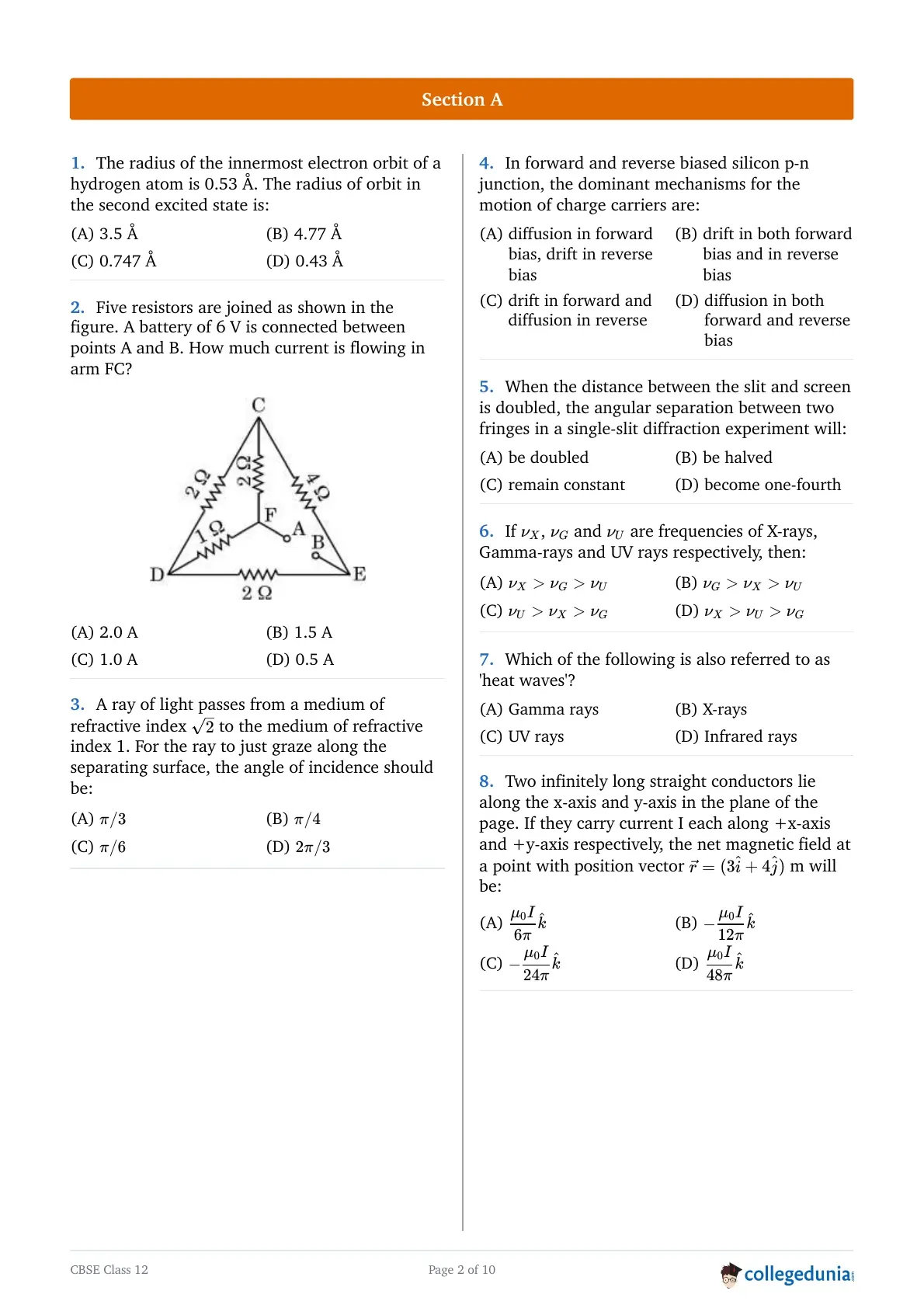
The radius of the innermost electron orbit of a hydrogen atom is \(0.53\,\text{\AA}\). The radius of orbit in the second excited state is:
Five resistors are joined as shown in the figure. Between the points A and B, a battery of 6 V is connected. How much current is flowing in arm FC?

A ray of light passes from a medium of refractive index \(\sqrt{2}\) to the medium of refractive index \(1\). For the ray to just graze along the surface of separation, the angle of incidence should be:
In forward and reverse biased silicon p-n junction, the dominant mechanisms for the motion of charge carriers are:
When the distance between the slit and screen is doubled, the angular separation between two fringes in single-slit diffraction experiment will:
If \(\nu_X\), \(\nu_G\) and \(\nu_U\) are frequencies of X-rays, Gamma-rays and UV rays respectively, then:
Two infinitely long straight conductors lie along the x-axis and y-axis in the plane of the page. If they carry current \(I\) each along \(+x\)-axis and \(+y\)-axis respectively, the net magnetic field at a point with position vector \(\vec{r} = (3\hat{i} + 4\hat{j})\) m will be:
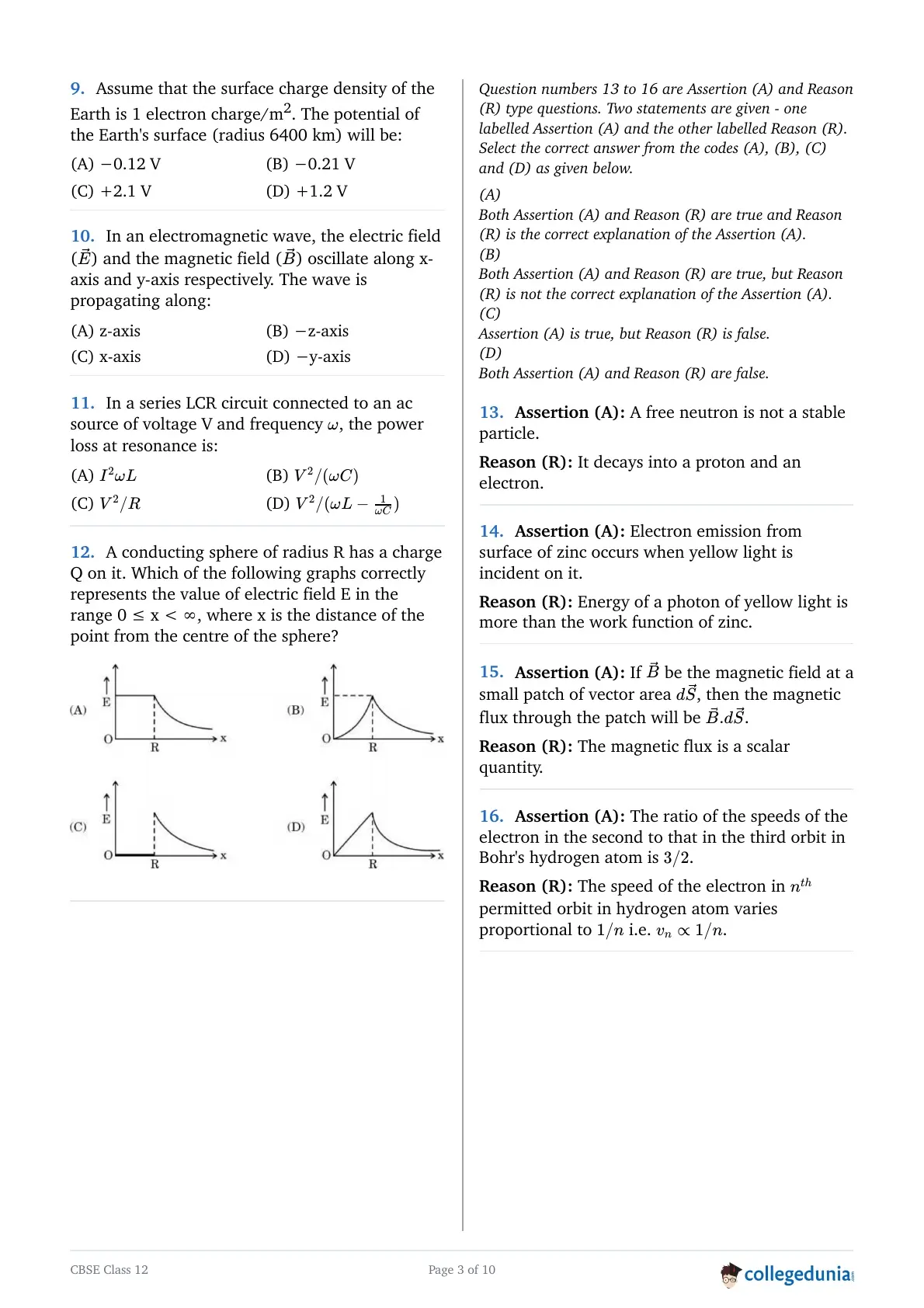
Assume that the surface charge density of the Earth is 1 electron charge/m2. The potential of the Earth's surface (radius 6400 km) will be:
In an electromagnetic wave, the electric field (\(\vec{E}\)) and the magnetic field (\(\vec{B}\)) oscillate along x-axis and y-axis respectively. The wave is propagating along:
In a series LCR circuit connected to an ac source of voltage \(V\) and frequency \(\omega\), the power loss at resonance is:
A conducting sphere of radius \(R\) has a charge \(Q\) on it. Which of the following graphs correctly represents the value of electric field \(E\) in the range \(0 \le x < \infty\), where \(x\) is the distance of the point from the centre of the sphere?

Assertion (A) : A free neutron is not a stable particle.
Reason (R) : It decays into a proton and an electron.
Assertion (A) : Electron emission from surface of zinc occurs when yellow light is incident on it.
Reason (R) : Energy of a photon of yellow light is more than the work function of zinc.
Assertion (A): If \(\vec{B}\) be the magnetic field at a small patch of vector area \(d\vec{S}\), then the magnetic flux through the patch will be \(\vec{B}\cdot d\vec{S}\).
Reason (R): The magnetic flux is a scalar quantity.
Assertion (A): The ratio of the speeds of the electron in the second to that in the third orbit in Bohr's hydrogen atom is \(\dfrac{3}{2}\).
Reason (R): The speed of the electron in \(n^{th}\) permitted orbit in hydrogen atom varies proportional to \(\dfrac{1}{n}\) i.e. \(v_n \propto \dfrac{1}{n}\).
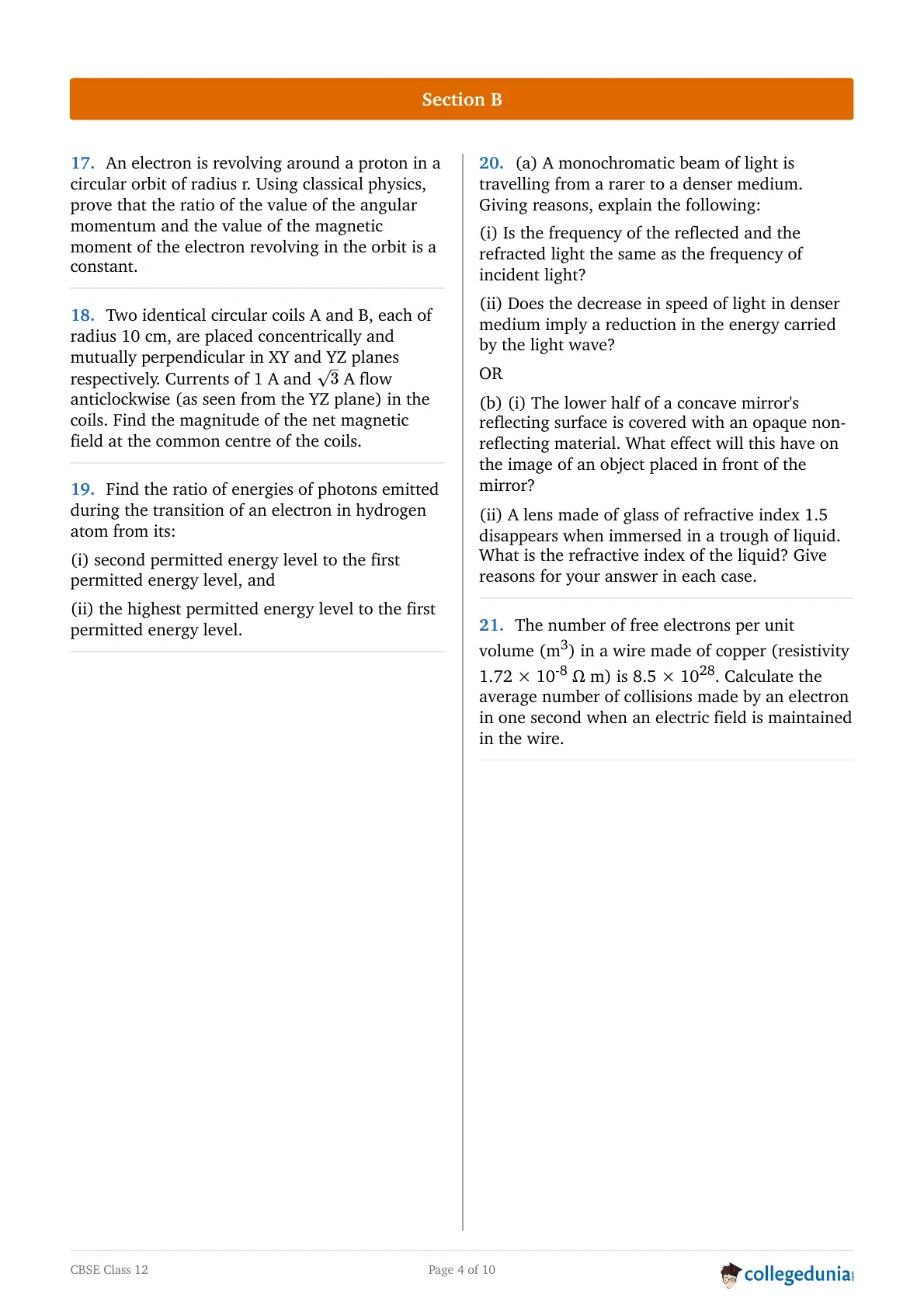
An electron is revolving around a proton in a circular orbit of radius \(r\). Using classical physics, prove that the ratio of value of the angular momentum and the value of magnetic moment of electron revolving in the orbit is a constant.
Two identical circular coils A and B of radius \(10\) cm each are placed concentrically and mutually perpendicular in XY and YZ planes respectively. Currents of \(1\) A and \(\sqrt{3}\) A flow anticlockwise in the coils as seen from YZ plane. Find the magnitude of the net magnetic field at the common centre of the coils.
Find the ratio of energies of photons emitted during the transition of an electron in hydrogen atom from its:
(i) second permitted energy level to the first permitted energy level, and
(ii) the highest permitted energy level to the first permitted energy level.
A monochromatic beam of light is travelling from a rarer to a denser medium. Giving reasons, explain the following :
(i) Is the frequency of the reflected and the refracted light the same as the frequency of incident light ?
(ii) Does the decrease in speed of light in denser medium imply a reduction in the energy carried by the light wave ?
(i) The lower half of a concave mirror's reflecting surface is covered with an opaque non-reflecting material. What effect will this have on the image of an object placed in front of the mirror ?
(ii) A lens made of glass of refractive index \(1.5\) disappears, when immersed in a trough of liquid. What is the refractive index of the liquid ?
Give reasons for your answer in each case.
The number of free electrons per unit volume (\(\text{m}^3\)) in a wire made of copper (resistivity \(1.72 \times 10^{-8}\,\Omega\,\text{m}\)) is \(8.5 \times 10^{28}\). Calculate the average number of collisions made by an electron in one second when an electric field is maintained in the wire.
Draw a circuit diagram of a full-wave rectifier using p-n junction diodes. Explain its working and show the input-output waveforms.
Four point charges \(+q\), \(-q\), \(+q\) and \(-q\) are to be arranged respectively at the four corners of a square ABCD of the sides \(l\). Calculate the amount of:
(i) work done to obtain this arrangement.
(ii) extra work done to bring a point charge \(q_0\) at the centre of the square when the charges at the corners are kept fixed.
Two thin converging lenses of focal lengths \(f_1\) and \(f_2\) are placed coaxially in contact with each other. Draw a ray diagram to show the image formation by the combination. Hence, derive the expression for the focal length of the combination.
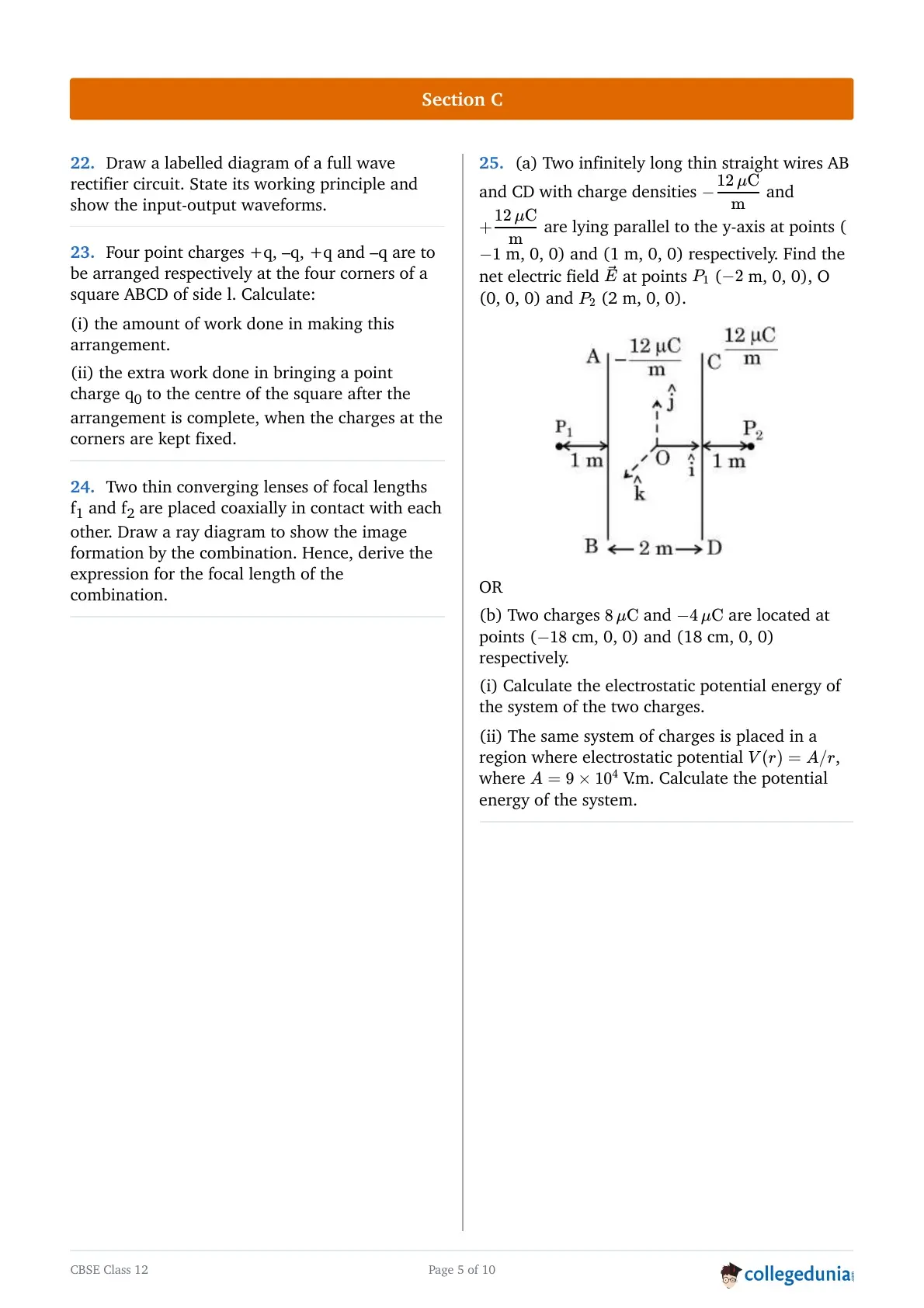
Two infinitely long thin straight wires AB and CD with charge densities \(-\dfrac{12\,\mu\text{C}}{\text{m}}\) and \(+\dfrac{12\,\mu\text{C}}{\text{m}}\) are lying parallel to the y-axis at points \((-1\ \text{m}, 0, 0)\) and \((1\ \text{m}, 0, 0)\) respectively, as shown in the figure. Find the net electric field \(\vec{E}\) at points \(P_1\) \((-2\ \text{m}, 0, 0)\), O \((0, 0, 0)\) and \(P_2\) \((2\ \text{m}, 0, 0)\).

Two charges of \(8\,\mu\text{C}\) and \(-4\,\mu\text{C}\) are located at points \((-18\ \text{cm}, 0, 0)\) and \((18\ \text{cm}, 0, 0)\) respectively.
(i) Calculate the electrostatic potential energy of the system of the two charges.
(ii) The same system of charges is placed in a region where electrostatic potential \(V(r) = \dfrac{A}{r}\), where \(A = 9 \times 10^4\) V.m. Calculate the potential energy of the system.
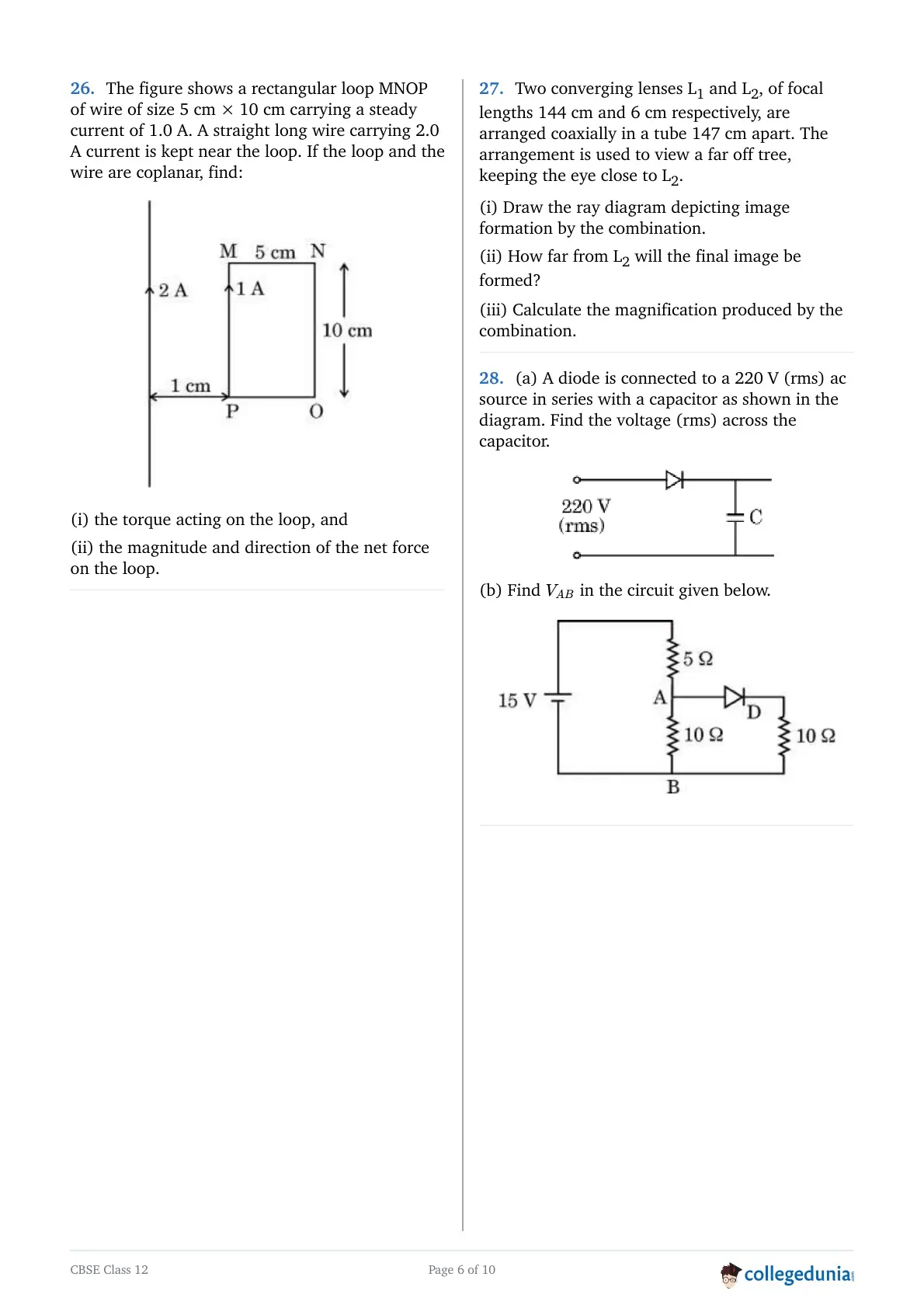
The figure shows rectangular loop MNOP of wire of size \(5\,\text{cm} \times 10\,\text{cm}\) carrying a steady current of \(1.0\,\text{A}\). A straight long wire carrying \(2.0\,\text{A}\) current is kept near the loop. If the loop and the wire are coplanar, find:
(i) the torque acting on the loop, and
(ii) the magnitude and direction of the net force on the loop.

Two converging lenses \(L_1\) and \(L_2\), of focal lengths \(144\,\text{cm}\) and \(6\,\text{cm}\) respectively, are arranged coaxially in a tube \(147\,\text{cm}\) apart. The arrangement is used to view a far off tree, keeping the eye close to \(L_2\).
(i) Draw the ray diagram depicting image formation by the combination.
(ii) How far from \(L_2\) will the final image be formed?
(iii) Calculate the magnification produced by the combination.
A diode is connected to a \(220\) V (rms) ac source in series with a capacitor as shown in the diagram. Find the voltage (rms) across the capacitor.


Comprehension:
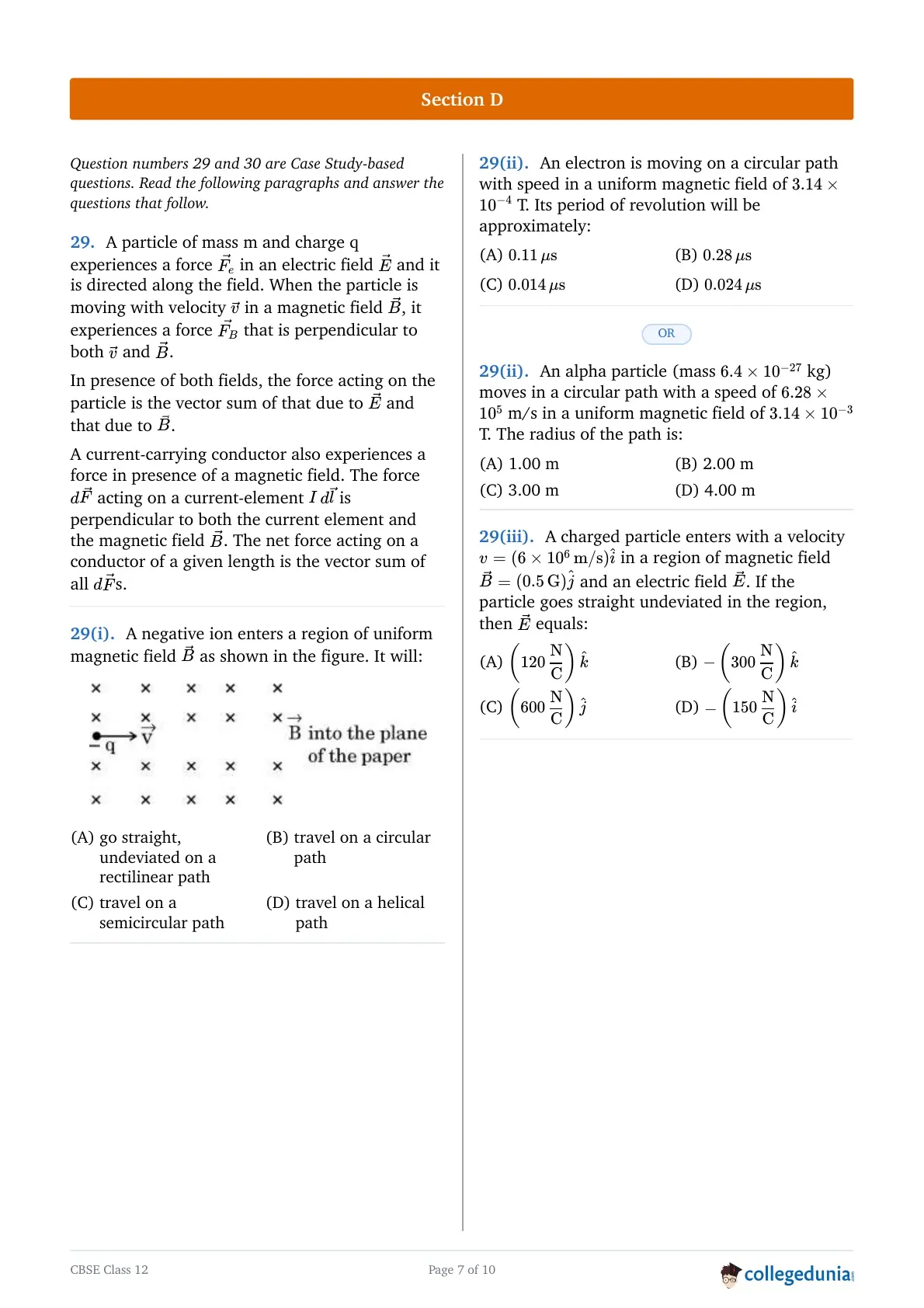
A particle of mass m and charge q experiences a force \(\vec{F}_e\) in an electric field \(\vec{E}\) and it is directed along the field. When the particle is moving with velocity \(\vec{v}\) in a magnetic field \(\vec{B}\), it experiences a force \(\vec{F}_B\), that is perpendicular to both \(\vec{v}\) and \(\vec{B}\).
In presence of both fields, the force acting on the particle is the vector
Read More
sum of that due to \(\vec{E}\) and that due to \(\vec{B}\).A current-carrying conductor also experiences a force in presence of a magnetic field. The force \(d\vec{F}\) acting on a current-element \(I\,d\vec{l}\) is perpendicular to both the current element, and the magnetic field \(\vec{B}\). The net force acting on a conductor of a given length is the vector sum of all \(d\vec{F}\)s.
A particle of mass m and charge q experiences a force \(\vec{F}_e\) in an electric field \(\vec{E}\) and it is directed along the field. When the particle is moving with velocity \(\vec{v}\) in a magnetic field \(\vec{B}\), it experiences a force \(\vec{F}_B\), that is perpendicular to both \(\vec{v}\) and \(\vec{B}\).
In presence of both fields, the force acting on the particle is the vector sum of that due to \(\vec{E}\) and that due to \(\vec{B}\).
A current-carrying conductor also experiences a force in presence of a magnetic field. The force \(d\vec{F}\) acting on a current-element \(I\,d\vec{l}\) is perpendicular to both the current element, and the magnetic field \(\vec{B}\). The net force acting on a conductor of a given length is the vector sum of all \(d\vec{F}\)s.
Comprehension:
When radiation of suitable frequency is incident on a metal surface, electrons are emitted from the surface. This phenomenon is called photoelectric effect. Einstein explained
Read More
this phenomenon considering the particle nature of radiation and using the law of conservation of energy. Wave theory of light could not explain this phenomenon.When radiation of suitable frequency is incident on a metal surface, electrons are emitted from the surface. This phenomenon is called photoelectric effect. Einstein explained this phenomenon considering the particle nature of radiation and using the law of conservation of energy. Wave theory of light could not explain this phenomenon.
When radiation of suitable frequency is incident on a metal surface, electrons are emitted from the surface. This phenomenon is called photoelectric effect. Einstein explained this phenomenon considering the particle nature of radiation and using the law of conservation of energy. Wave theory of light could not explain this phenomenon.
When radiation of suitable frequency is incident on a metal surface, electrons are emitted from the surface. This phenomenon is called photoelectric effect. Einstein explained this phenomenon considering the particle nature of radiation and using the law of conservation of energy. Wave theory of light could not explain this phenomenon.
When radiation of suitable frequency is incident on a metal surface, electrons are emitted from the surface. This phenomenon is called photoelectric effect. Einstein explained this phenomenon considering the particle nature of radiation and using the law of conservation of energy. Wave theory of light could not explain this phenomenon.
When radiation of suitable frequency is incident on a metal surface, electrons are emitted from the surface. This phenomenon is called photoelectric effect. Einstein explained this phenomenon considering the particle nature of radiation and using the law of conservation of energy. Wave theory of light could not explain this phenomenon.
A small bulb is placed at the bottom of a tank containing water to a depth of \(1.00\,\text{m}\). Find the area of the surface of water through which light from the bulb can emerge from. The refractive index of water is \((4/3)\).
An object is placed at a distance of \(15\,\text{cm}\) from a convex lens of focal length \(10\,\text{cm}\). On the other side of the lens, a convex mirror is placed coaxially at a distance of \(10\,\text{cm}\) from the lens. If the image formed by this combination coincides with the object itself, draw the ray diagram and find the focal length of the convex mirror.
Differentiate between interference and diffraction of light.
Two coherent light waves, each of intensity \(I_0\) produce interference pattern on a screen. Find the intensity at a point at which the path difference between them is (i) \(\dfrac{\lambda}{3}\), and (ii) \(\dfrac{\lambda}{4}\).
In a Young's double-slit experiment, fringes are obtained on a screen placed at a distance \(D\) from the slits. It is observed that if the screen is moved \(5\,\text{cm}\) towards the slits, the fringe width changes by \(0.03\,\text{mm}\). If the distance between the slits is \(1\,\text{mm}\), calculate the wavelength of the light used.
A potential difference \(V\) is applied across the ends of a cylindrical conductor of length \(l\), area of cross-section \(A\) and resistance \(R\). It is gradually stretched till its length is tripled. How will (i) the drift speed of electrons in the conductor, and (ii) the resistance of the conductor be affected? Justify your answers.
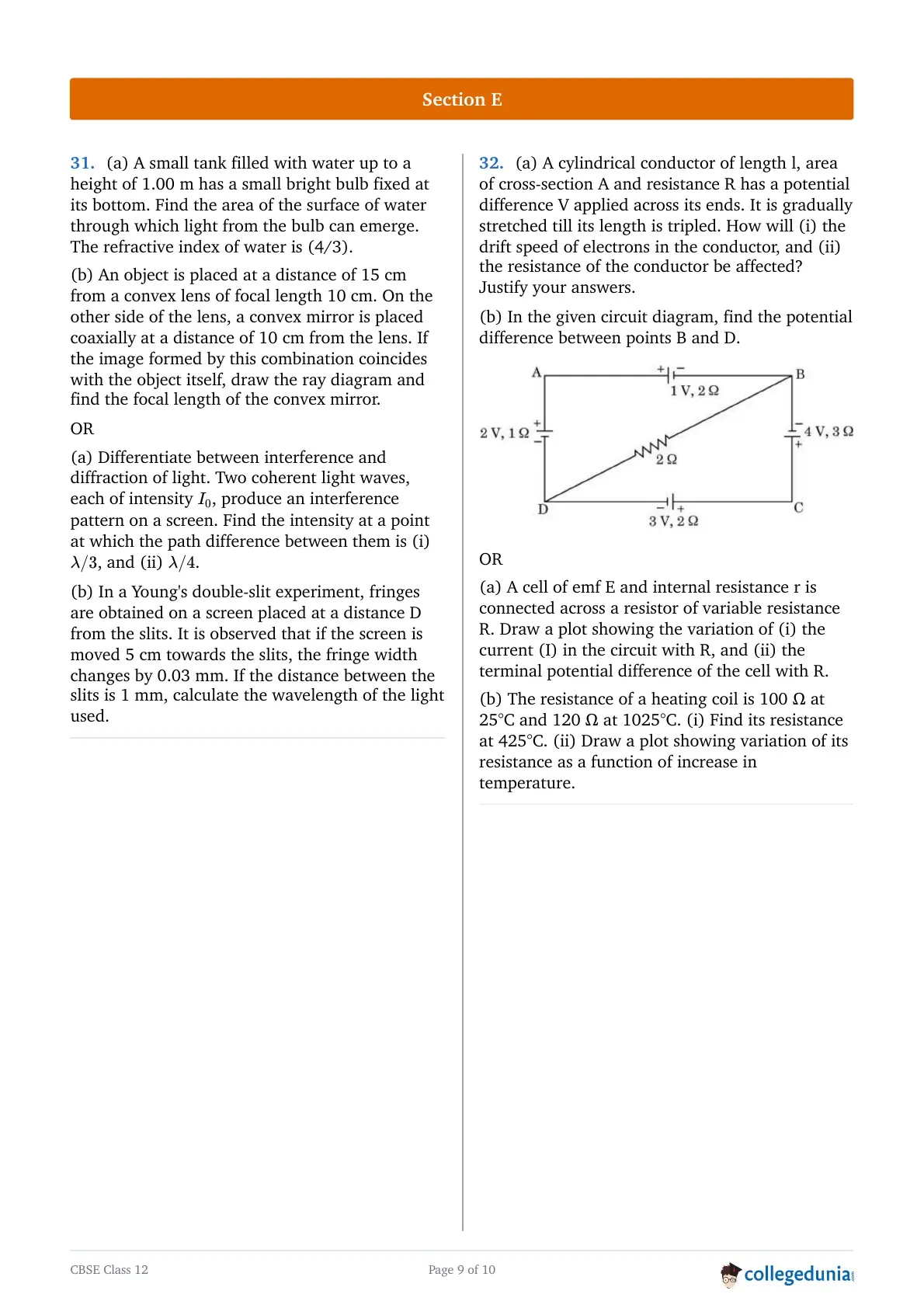
In the given circuit diagram, find the potential difference between points B and D.

A cell of emf \(E\) and internal resistance \(r\) is connected across a resistor of variable resistance \(R\). Draw a plot showing the variation of (i) the current (\(I\)) in the circuit with \(R\), and (ii) the terminal potential difference of the cell with \(R\).
The resistance of a heating coil is \(100\,\Omega\) at \(25^\circ\text{C}\) and \(120\,\Omega\) at \(1025^\circ\text{C}\). (i) Find its resistance at \(425^\circ\text{C}\). (ii) Draw a plot showing variation of its resistance as a function of increase in temperature.
Using a phasor diagram, derive an expression for the impedance of a series LCR circuit connected to an ac source. What is meant by resonance in this circuit? Obtain expression for the resonant frequency of this circuit.
Write two disadvantages of transmitting ac over long distances at low voltage and high current.
An ac generator consists of a coil of 500 turns and size \(25\,\text{cm} \times 100\,\text{cm}\). It is rotated at an angular speed of \(60\,\text{rad/s}\) in a uniform magnetic field \(B = 0.4\,\text{T}\) between two fixed pole pieces. If the resistance of the circuit, including that of the coil, is \(250\,\Omega\), calculate:
(I) the maximum current drawn from the generator
(II) the flux through the coil when the current is zero
Give two examples of commercial generators. How is rotation of armature achieved in them? Explain briefly.
CBSE Class 12 Physics Compartment 2026 Set 3 - (55/7/3) Exam Pattern and Marking Scheme
| Section | Questions | Question Type | Marks per Question | Marks |
|---|---|---|---|---|
| A | Q1 - Q16 | Multiple choice questions | 1 | 16 |
| B | Q17 - Q21 | Very short answer questions | 2 | 10 |
| C | Q22 - Q28 | Short answer questions | 3 | 21 |
| D | Q29 - Q30 | Case study-based questions | 4 | 8 |
| E | Q31 - Q33 | Long answer questions | 5 | 15 |
| Total | 33 questions | 70 |
CBSE Class 12 Physics Compartment 2026 Set 3 - (55/7/3) Question Paper FAQs
Ques. How many questions are there in the CBSE Class 12 Physics Compartment 2026 question paper (Set 3 - 55/7/3)?
Ans. The paper has 33 questions in five sections (A to E) and all of them are compulsory.
Ques. How are the marks divided in the CBSE Class 12 Physics Compartment 2026 paper?
Ans. Section A (16 MCQs) carries 16 marks, Section B (5 questions) 10 marks, Section C (7 questions) 21 marks, Section D (2 case studies) 8 marks and Section E (3 long answer questions) 15 marks, for a total of 70 marks.
Ques. Is there any internal choice in the paper?
Ans. There is no overall choice. An internal choice is given in a few questions of Sections B, C, D and E, but not in Section A.
Ques. Is the use of a calculator allowed?
Ans. No. The general instructions state that the use of calculators is not allowed.
Ques. How much time is given for the CBSE Class 12 Physics Compartment 2026 paper?
Ans. The paper is of 3 hours (10:30 AM to 1:30 PM). The question paper is distributed at 10:15 AM and candidates get 15 minutes to read it before they start writing.
Ques. When was the CBSE Class 12 Physics Compartment 2026 exam held?
Ans. The Class 12 compartment (supplementary) paper of Physics was held on July 28, 2026.
Ques. Where can I get the official CBSE Class 12 Physics Compartment question paper?
Ans. The official question papers are published on the CBSE website, cbse.gov.in. You can also download the official PDF from the table above.



Comments