




CBSE Class 12 Physics Question Paper 2024 PDF (Set 2- 55/2/2) is available for download here. CBSE conducted the Physics exam on March 4, 2024 from 10:30 AM to 1:30 PM. The total marks for the theory paper are 70. The question paper contains 20% MCQ-based questions, 40% competency-based questions, and 40% short and long answer type questions.
Also Check: CBSE Class 12 Question Paper 2024 (All Subjects)
The Physics question paper includes the following types of questions:
- MCQs: 1 mark each
- Very short-answer questions: 2 marks each
- Short-answer type questions: 3 marks each
- Case-study based questions: 4 marks each
- Long-answer type questions: 5 marks each
CBSE Class 12 Physics Set 2 - (55/2/2) Question Paper 2024 with Solution PDF
| CBSE Official PDF | CD PDF | CD PDF with Solutions |
|---|---|---|
| Download official PDF 1.28 MB | Download Collegedunia PDF 0.75 MB | Download solutions PDF 1.03 MB |

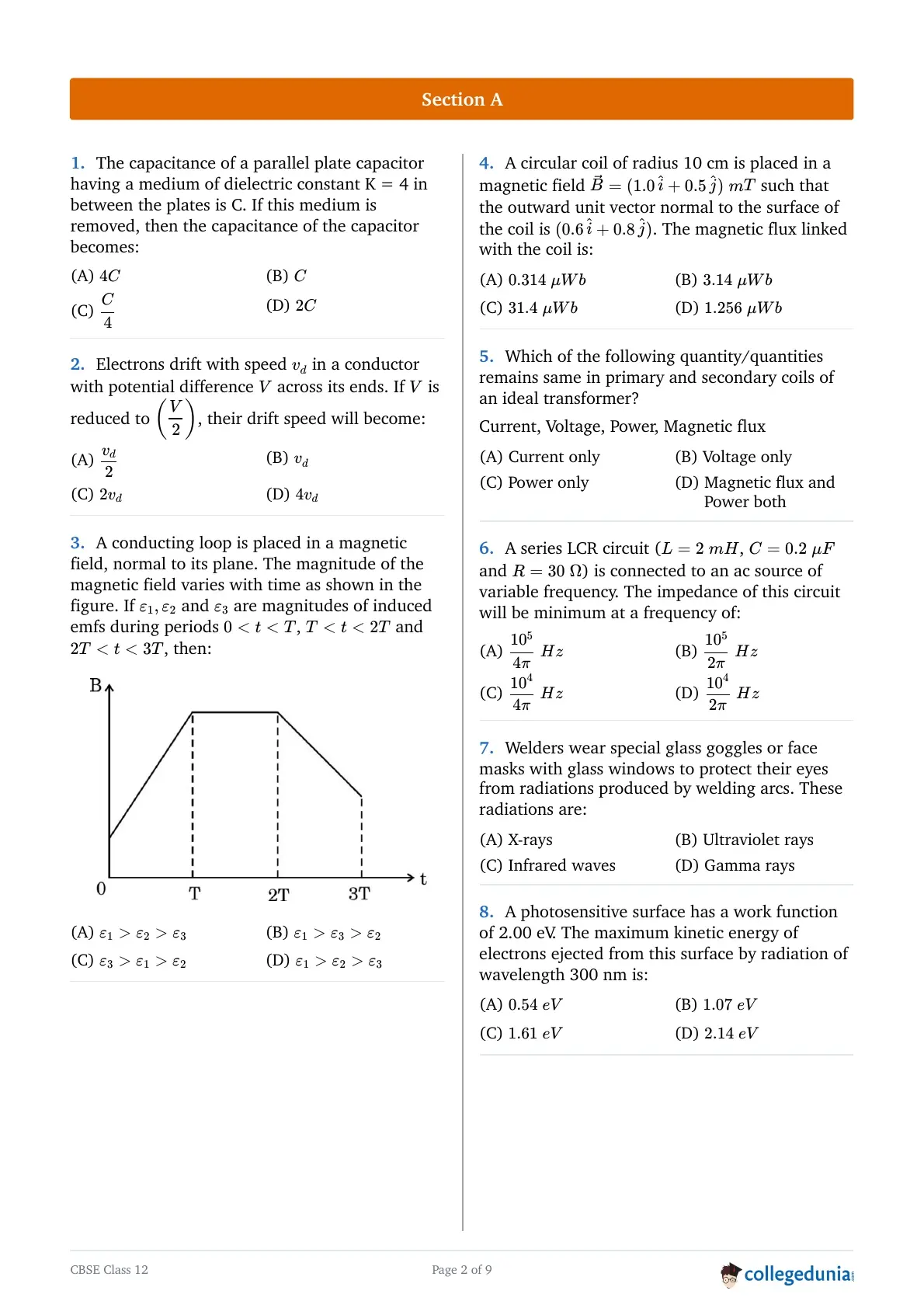


CBSE Class 12 Physics 2024 Set 2 (55/2/2) Questions with Solutions
The capacitance of a parallel plate capacitor having a medium of dielectric constant K = 4 in between the plates is C. If this medium is removed, then the capacitance of the capacitor becomes:
Electrons drift with speed \(v_d\) in a conductor with potential difference \(V\) across its ends. If \(V\) is reduced to \(\left(\dfrac{V}{2}\right)\), their drift speed will become:
A conducting loop is placed in a magnetic field, normal to its plane. The magnitude of the magnetic field varies with time as shown in the figure. If \(\varepsilon_1, \varepsilon_2\) and \(\varepsilon_3\) are magnitudes of induced emfs during periods \(0 \le t \le T\), \(T \le t \le 2T\) and \(2T \le t \le 3T\), then:

A circular coil of radius 10 cm is placed in a magnetic field \(\vec B=(1.0\,\hat i+0.5\,\hat j)\;mT\) such that the outward unit vector normal to the surface of the coil is \((0.6\,\hat i+0.8\,\hat j)\). The magnetic flux linked with the coil is:
Which of the following quantity/quantities remains same in primary and secondary coils of an ideal transformer?
Current, Voltage, Power, Magnetic flux
A series LCR circuit (\(L = 2\,\text{mH}\), \(C = 0.2\,\mu\text{F}\) and \(R = 30\,\Omega\)) is connected to an ac source of variable frequency. The impedance of this circuit will be minimum at a frequency of:
Welders wear special glass goggles or face masks with glass windows to protect their eyes from radiations produced by welding arcs. These radiations are:
A photosensitive surface has a work function of 2.00 eV. The maximum kinetic energy of electrons ejected from this surface by radiation of wavelength 300 nm is:
Energy levels A, B and C of an atom correspond to increasing values of energy i.e. \(E_A\lt E_B\lt E_C\). Let \(\lambda_1,\lambda_2\) and \(\lambda_3\) be the wavelengths of radiation corresponding to the transitions C to B, B to A and C to A, respectively. The correct relation between \(\lambda_1,\lambda_2\) and \(\lambda_3\) is:
An alpha particle approaches a gold nucleus in Geiger-Marsden experiment with kinetic energy K. It momentarily stops at a distance d from the nucleus and reverses its direction. Then d is proportional to:
An n-type semiconducting Si is obtained by doping intrinsic Si with:
When a p-n junction diode is subjected to reverse biasing:
Assertion (A): The magnifying power of a compound microscope is negative.
Reason (R): The final image formed is erect with respect to the object.
Assertion (A): An electron and a proton enter with the same momentum \(\vec p\) in a magnetic field \(\vec B\) such that \(\vec p\perp\vec B\). Then both describe a circular path of the same radius.
Reason (R): The radius of the circular path described by the charged particle (charge q, mass m) moving in the magnetic field \(\vec B\) is given by \(r=\dfrac{mv}{qB}\).
Assertion (A): Lenz's law is a consequence of the law of conservation of energy.
Reason (R): There is no power loss in an ideal inductor.
Assertion (A): Photoelectric current increases with an increase in intensity of incident radiation, for a given frequency of incident radiation and the accelerating potential.
Reason (R): Increase in the intensity of incident radiation results in an increase in the number of photoelectrons emitted per second and hence an increase in the photocurrent.
(a) "The electron drift speed is only a few mm/s for currents in the range of a few amperes for a given conductor." How then is current established almost the instant a circuit is closed? Explain.
(b) "\(V=IR\) is a statement of Ohm's Law" is not true. Explain.
A convex lens (n = 1.52) has a focal length of 15.0 cm in air. Find its focal length when it is immersed in liquid of refractive index 1.65. What will be the nature of the lens?
Two waves, each of amplitude 'a' and frequency '\(\omega\)' emanating from two coherent sources of light superpose at a point. If the phase difference between the two waves is \(\phi\), obtain an expression for the resultant intensity at that point.
What is the effect on the interference pattern in Young's double-slit experiment when (i) the source slit is moved closer to the plane of the slits, and (ii) the separation between the two slits is increased? Justify your answers.
Calculate the energy released/absorbed in the following nuclear reaction:
\( {}_{6}^{12}\text{C} + {}_{6}^{12}\text{C} \longrightarrow {}_{10}^{20}\text{Ne} + {}_{2}^{4}\text{He} \)
Given: \( m({}_{6}^{12}\text{C}) = 12.000000\ \text{u} \), \( m({}_{10}^{20}\text{Ne}) = 19.992439\ \text{u} \), \( m({}_{2}^{4}\text{He}) = 4.002603\ \text{u} \), \( 1\ \text{u} = 931\ \text{MeV}/c^2 \)
How does the energy gap of an intrinsic semiconductor effectively change when doped with a (a) trivalent impurity, and (b) pentavalent impurity? Justify your answer in each case.
(a) On what factors does the speed of an electromagnetic wave in a medium depend?
(b) How is an electromagnetic wave produced?
(c) Sketch a schematic diagram depicting the electric and magnetic fields for an electromagnetic wave propagating along z-axis.
The figure shows a circuit with three ideal batteries. Find the magnitude and direction of currents in the branches AG, BF and CD.
A rectangular loop of sides 10 cm \(\times\) 20 cm is kept outside a region of uniform magnetic field \(|\vec B|=5\;mT\) as shown in the figure. The loop is moved with the velocity of 5 cm/s till it goes completely out of the magnetic field.
(a) Plot a graph showing variation of the magnetic flux \(\phi\) with \(x\;(0\leq x\leq100\;cm)\).
(b) Find the maximum value of magnetic flux linked with the loop.
(c) Will an external work be required to be done to move the loop through the magnetic field?

Two long, straight, parallel conductors carry steady currents in opposite directions. Explain the nature of the force of interaction between them. Obtain an expression for the magnitude of the force between the two conductors. Hence define one ampere.
Obtain an expression for the torque \(\vec\tau\) acting on a current carrying loop in a uniform magnetic field \(\vec B\). Draw the necessary diagram.
(a) Briefly explain de Broglie hypothesis for wave nature of matter.
(b) Find the ratio of de Broglie wavelength associated with a proton and an alpha particle when both are
(i) accelerated from rest through the same potential difference, and
(ii) moving with the same kinetic energy.
Plot a graph depicting potential energy of a pair of nucleons in a nucleus as a function of their separation.
(b) Identify the regions where the nuclear force is (i) attractive, and (ii) repulsive. Justify your answer.
With the help of a circuit diagram, explain the working of a p-n junction diode as a full wave rectifier. Draw its input and output waveforms.
Comprehension:
When a ray of light propagates from a denser medium to a rarer medium, it bends away from the normal. When the incident angle is increased, the refracted ray deviates more from the normal. For a particular
Read More
angle of incidence in the denser medium, the refracted ray just grazes the interface of the two surfaces. This angle of incidence is called the critical angle for the pair of media involved.For a ray incident at the critical angle, the angle of reflection is:
A ray of light of wavelength 600 nm is incident in water (\( n = \frac{4}{3} \)) on the water-air interface at an angle less than the critical angle. The wavelength associated with the refracted ray is:
The interface AB between the two media A and B is shown in the figure. In the denser medium A, the incident ray PQ makes an angle of \( 30^\circ \) with the horizontal. The refracted ray is parallel to the interface. The refractive index of medium B w.r.t. medium A is:

Two media A and B are separated by a plane boundary. The speed of light in medium A and B is \( 2 \times 10^8 \, \text{ms}^{-1} \) and \( 2.5 \times 10^8 \, \text{ms}^{-1} \), respectively. The critical angle for a ray of light going from medium A to medium B is:
The figure shows the path of a light ray through a triangular prism. In this phenomenon, the angle \( \theta \) is given by:

Comprehension:
When the terminals of a cell are connected to a conductor of resistance R, an electric current flows through the circuit. The electrolyte of the cell also offers some resistance in the path of the current, like the conductor. This resistance offered by the electrolyte is called internal resistance of the cell (r). It depends upon the nature of the electrolyte, the area of the electrodes immersed in the electrolyte
Read More
and the temperature. Due to internal resistance, a part of the energy supplied by the cell is wasted in the form of heat.When no current is drawn from the cell, the potential difference between the two electrodes is known as emf of the cell (\(\varepsilon\)). With a current drawn from the cell, the potential difference between the two electrodes is termed as terminal potential difference (V).
Choose the correct statement:
Two cells of emfs \( 2.0\ \text{V} \) and \( 6.0\ \text{V} \) and internal resistances \( 0.1\ \Omega \) and \( 0.4\ \Omega \) respectively, are connected in parallel. The equivalent emf of the combination will be:
Dipped in the solution, the electrode exchanges charges with the electrolyte. The positive electrode develops a potential \( V_+ \) (\( V_+ > 0 \)), and the negative electrode develops a potential \( -(V_-) \) (\( V_- \geq 0 \)), relative to the electrolyte adjacent to it. When no current is drawn from the cell, then:
Five identical cells, each of emf 2 V and internal resistance 0.1 \( \Omega \), are connected in parallel. This combination in turn is connected to an external resistor of 9.98 \( \Omega \). The current flowing through the resistor is:
Potential difference across a cell in the open circuit is 6 V. It becomes 4 V when a current of 2 A is drawn from it. The internal resistance of the cell is:
(i) Give any two differences between the interference pattern obtained in Young's double-slit experiment and a diffraction pattern due to a single slit.
(ii) Draw an intensity distribution graph in case of a double-slit interference pattern.
(iii) In Young's double-slit experiment using monochromatic light of wavelength \(\lambda\), the intensity of light at a point on the screen, where path difference is \(\lambda\), is K units. Find the intensity of light at a point on the screen where the path difference is \(\dfrac{\lambda}{3}\).
(i) Draw a labelled ray diagram of a compound microscope showing image formation at least distance of distinct vision. Derive an expression for its magnifying power.
(ii) A telescope consists of two lenses of focal length 100 cm and 5 cm. Find the magnifying power when the final image is formed at infinity.
(i) Obtain an expression for the electric potential due to a small dipole of dipole moment \(\vec p\), at a point \(\vec r\) from its centre, for much larger distances compared to the size of the dipole.
(ii) Three point charges q, 2q and nq are placed at the vertices of an equilateral triangle. If the potential energy of the system is zero, find the value of n.
(i) State Gauss's Law in electrostatics. Apply this to obtain the electric field \(\vec E\) at a point near a uniformly charged infinite plane sheet.
(ii) Two long straight wires 1 and 2 are kept as shown in the figure. The linear charge density of the two wires are \(\lambda_1=10\;\mu C/m\) and \(\lambda_2=-20\;\mu C/m\). Find the net force \(\vec F\) experienced by an electron held at point P.
(i) A particle of mass m and charge q is moving with a velocity \(\vec v\) in a magnetic field \(\vec B\) as shown in the figure. Show that it follows a helical path. Hence, obtain its frequency of revolution.
(ii) In a hydrogen atom, the electron moves in an orbit of radius \(2\;\overset{\circ}{A}\) making \(8\times10^{14}\) revolutions per second. Find the magnetic moment associated with the orbital motion of the electron.
(i) What is current sensitivity of a galvanometer? Show how the current sensitivity of a galvanometer may be increased. "Increasing the current sensitivity of a galvanometer may not necessarily increase its voltage sensitivity." Explain.
(ii) A moving coil galvanometer has a resistance \(15\;\Omega\) and takes 20 mA to produce full scale deflection. How can this galvanometer be converted into a voltmeter of range 0 to 100 V?
CBSE Class 12 Physics Question Paper Pattern 2024
The CBSE Class 12 Physics 2024 question paper is of 70 marks and has 33 questions in five sections, A to E, all compulsory, with internal choice in some questions of Sections B to E. The time allowed is 3 hours, with 15 minutes of extra reading time. The table below gives the section-wise paper pattern from the official CBSE question paper.
| Section | Questions | Question Type | Marks per Question | Marks |
|---|---|---|---|---|
| A | Q1 - Q16 | Multiple choice questions | 1 | 16 |
| B | Q17 - Q21 | Very short answer questions | 2 | 10 |
| C | Q22 - Q28 | Short answer questions | 3 | 21 |
| D | Q29 - Q30 | Case study-based questions | 4 | 8 |
| E | Q31 - Q33 | Long answer questions | 5 | 15 |
| Total | 33 questions | 70 |
CBSE Class 12 Physics Unit-Wise Topics with Marks Distribution
| Unit No. | Unit Name | Chapters | Allotted Marks |
|---|---|---|---|
| Unit 1 | Electrostatics | Electric Charges and Fields | 16 |
| Electrostatic Potential and Capacitance | |||
| Unit 2 | Current Electricity | Current Electricity | |
| Unit 3 | Magnetic Effects of Current and Magnetism | Moving Charges and Magnetism | 17 |
| Magnetism and Matter | |||
| Unit 4 | Electromagnetic Induction and Alternating Current | Electromagnetic Induction | |
| Alternating Current | |||
| Unit 5 | Electromagnetic Waves | Electromagnetic Waves | 18 |
| Unit 6 | Optics | Ray Optics and Optical Instruments | |
| Wave Optics | |||
| Unit 7 | Dual Nature of Radiation and Matter | Dual Nature of Radiation and Matter | 12 |
| Unit 8 | Atoms and Nuclei | Atoms | |
| Nuclei | |||
| Unit 9 | Electronic Devices | Semiconductor Electronics: Materials, Devices, and Simple Circuits | 07 |
| Total | 70 | ||



Comments