




The MAT 2026 September session application process was conducted online through the official AIMA website at mat.aima.in. Candidates could apply for the Paper-Based Test (PBT) until September 7, 2026, while the last date to register for the Computer-Based Test (CBT) was September 14, 2026.
The MAT September 2026 PBT was held on September 13, while the CBT was conducted on September 20, 2026. Candidates who appeared for the exams can check their results and download their scorecards through the official MAT website.
- The registration fee for the MAT 2026 Exam is Rs 2,300 for one mode and Rs 4,000 for both PBT and CBT in the same session.
- The MAT September 2026 admit card for PBT is expected around September 10, 2026.
- The CBT admit card will be released on September 17, 2026.
- MAT September 2026 PBT is on September 13, 2026, and CBT is on September 20, 2026.
- The exam has 150 MCQs across 5 sections to be solved in 120 minutes, with +1 for correct and -0.25 for wrong answers.
- The MAT September 2026 result is expected in October 2026.

Related Links:
What is MAT 2026?
MAT stands for Management Aptitude Test. AIMA — All India Management Association — has been conducting it since 1988, making it one of the most established MBA entrance tests in India.
- The Government of India, through the Ministry of Education, recognises MAT as a national-level entrance test for MBA and allied management programmes.
- AIMA holds MAT four times a year — February, May, September, and December.
- Candidates can appear in one or more sessions in a year, and colleges typically consider the best score within the one-year validity window.
- This multi-session format gives you more chances to improve your score than a single-window exam like CAT.
- More than 800 MBA colleges across India accept MAT scores.
- These range from well-known private B-schools like BIMTECH, XIME, and Rajagiri to state university programmes.
- Colleges use MAT scores to shortlist candidates for MBA and PGDM admissions in specialisations like Finance, Marketing, HR, Operations, and Business Analytics.
In 2026, MAT is available in two modes: Paper-Based Test (PBT) and Computer-Based Test (CBT). The Internet-Based Test (IBT) mode was discontinued by AIMA in 2025 and is not offered in 2026. Candidates can choose one or both available modes in the same session.
MAT 2026 Overview
| Particulars | Details |
|---|---|
| Full Name | Management Aptitude Test |
| Short Form | MAT |
| Conducting Body | All India Management Association (AIMA) |
| Recognised By | Ministry of Education, Government of India |
| Exam Level | National Level |
| Sessions Per Year | 4 (February, May, September, December) |
| Available Modes (2026) | PBT (Paper-Based Test), CBT (Computer-Based Test) |
| Total Questions | 150 MCQs |
| Total Sections | 5 |
| Duration | 120 minutes (2 hours) |
| Marking Scheme | +1 (correct), -0.25 (wrong), 0 (unattempted) |
| Composite Score Range | 199 to 801 (based on 4 sections; GK section excluded) |
| Score Validity | 1 year from exam date |
| Colleges Accepting MAT Score | 800+ MBA and PGDM colleges across India |
| Application Fee | Rs 2,300 (one mode); Rs 4,000 (both modes) |
| Official Website | mat.aima.in |
Source: AIMA Official Website
MAT 2026 Important Dates (All Sessions)
AIMA conducts four MAT sessions in 2026. As of July 29, 2026, the February and May sessions are over and results are declared. The September 2026 session registration is currently open. December 2026 session dates are yet to be announced. Upcoming events appear first in the table below, followed by past events in the order they occurred.
| Event | Session | Date |
|---|---|---|
| Registration Last Date — PBT | September 2026 | September 7, 2026 |
| Admit Card Release — PBT | September 2026 | Around September 10, 2026 |
| PBT Exam Date | September 2026 | September 13, 2026 |
| Registration Last Date — CBT | September 2026 | September 14, 2026 |
| Admit Card Release — CBT | September 2026 | September 17, 2026 |
| CBT Exam Date | September 2026 | September 20, 2026 |
| Result Declaration | September 2026 | Expected October 2026 |
| December Session (PBT & CBT) | December 2026 | Dates to be announced (Expected December 2026) |
| PBT Exam Date | February 2026 | March 1, 2026 (Over) |
| CBT Exam Date | February 2026 | March 8, 2026 (Over) |
| Result Declaration | February 2026 | Last week of March 2026 (Over) |
| PBT Exam Date | May 2026 | May 31, 2026 (Over) |
| CBT Exam Date | May 2026 | June 14, 2026 (Over) |
| Result Declaration | May 2026 | June 22, 2026 (Out) |
MAT 2026 Eligibility Criteria
AIMA has kept the MAT 2026 eligibility criteria simple and broad. Both fresh graduates and working professionals can apply. Here is what you need:
| Parameter | Details |
| Educational Qualification | Bachelor’s degree in any discipline from a recognized university |
| Final-Year Students | Eligible (provisional admission until degree completion is confirmed) |
| Professional Degrees | CA, CS, ICWA/CMA holders also eligible |
| Minimum Marks (for Exam) | No minimum percentage set by AIMA |
| College-Level Requirement | Most institutes expect 50% (General) / 45% (SC/ST/PwD) in graduation |
| Age Limit | No minimum or maximum age restriction |
| Work Experience | Not required |
| Number of Attempts | Unlimited |
| Nationality | Indian citizens, NRIs, OCIs, PIOs, and foreign nationals eligible |
Also Read: MAT September 2026 Eligibility Criteria: Qualification, Work Experience and Attempt Limit
MAT 2026: September Registration Dates, Fee and Process
MAT September 2026 registration is currently open at mat.aima.in.
- If candidates want to appear in the PBT mode, they must register before September 7, 2026.
- For CBT mode, the last date is September 14, 2026.
Note: If any candidate plans to appear in both PBT and CBT modes in the September 2026 session, register before September 7, 2026, as the PBT window closes first. Missing the PBT deadline means you can only choose CBT in this session.
How to Register for MAT September 2026
- Go to mat.aima.in and click "New Registration" or log in with your existing account
- Fill in personal details — name, date of birth, email ID, and mobile number
- Choose your exam mode (PBT, CBT, or both) and preferred test city
- Upload your passport-size photograph and signature in the required format
- Pay the registration fee online through net banking, debit or credit card, or UPI
- Download and save the registration confirmation receipt

MAT 2026: September Registration Fee
| Mode | Registration Fee |
|---|---|
| PBT Only | Rs 2,300 |
| CBT Only | Rs 2,300 |
| Both PBT and CBT (Same Session) | Rs 4,000 |
The registration fee is non-refundable once paid. Check all details carefully before you submit payment. AIMA does not allow corrections to personal information after payment in most cases.

MAT 2026 Application Process: How to Apply
The MAT 2026 application is fully online at mat.aima.in. The same process applies for all four sessions in the year. You must complete registration separately for each session you want to appear in.
Step-by-Step Application Guide
- Step 1 — New Registration: Visit mat.aima.in and click "New Registration." Enter your email ID and mobile number. AIMA sends OTP verification to both
- Step 2 — Fill the Form: Log in and complete the application form with all personal, contact, and academic details. Double-check every entry before proceeding
- Step 3 — Choose Mode and City: Select your preferred test mode — PBT, CBT, or both — and choose your exam city from the available list. City choices are subject to availability
- Step 4 — Upload Documents: Upload a recent passport-size photo and your signature. Both should be in JPEG format within the size limits AIMA specifies
- Step 5 — Pay the Fee: Pay online through net banking, debit or credit card, or UPI. Fee is Rs 2,300 for one mode and Rs 4,000 for both PBT and CBT in the same session
- Step 6 — Download Confirmation: After successful payment, download your registration confirmation slip. This is your proof of registration until your admit card is available
Document Upload Specifications
- The photo should be a recent colour photograph with a white or light-coloured background.
- The signature should be on a white background in black or blue ink.
- Do not upload blurry, old, or pencil-signed images — they may cause your registration to be rejected.
| Document | Format | Size |
|---|---|---|
| Passport-size Photograph | JPEG / JPG | 20 KB to 100 KB |
| Signature | JPEG / JPG | 10 KB to 50 KB |

MAT 2026: Exam Pattern and Marking Scheme
The MAT 2026 exam pattern is the same for PBT and CBT modes.
- The exam has 150 multiple-choice questions across 5 sections, to be completed in 120 minutes.
- There is no separate time limit for individual sections.
- Candidates can divide the full 120 minutes across sections as they prefer.
Section-wise Question Distribution
| Section No. | Section Name | Questions | Marks | Counted in Composite Score? |
|---|---|---|---|---|
| 1 | Language Comprehension | 30 | 30 | Yes |
| 2 | Intelligence and Critical Reasoning | 30 | 30 | Yes |
| 3 | Data Analysis and Sufficiency | 30 | 30 | Yes |
| 4 | Mathematical Skills | 30 | 30 | Yes |
| 5 | Indian and Global Environment (GK) | 30 | 30 | No — reported separately |
| Total | 150 | 150 | — | |
Remember: The Indian and Global Environment section (Section 5 / GK) score is shown on your scorecard but is NOT counted in the composite scaled score or percentile calculation. Only Sections 1 to 4 determine your MAT percentile used by colleges for shortlisting.
MAT 2026 Marking Scheme
| Answer Type | Marks |
|---|---|
| Correct Answer | +1 |
| Wrong Answer | -0.25 (negative marking) |
| Unattempted | 0 (no penalty) |
How the MAT Composite Score is Calculated?
- Raw marks from Sections 1 to 4 are totalled (GK section excluded)
- AIMA converts these raw marks to a composite scaled score between 199 and 801 through a normalisation process
- Your MAT percentile is then calculated based on this composite scaled score relative to all candidates in that session
- Normalisation ensures fair comparison between PBT and CBT candidates across the same session, regardless of any variation in paper difficulty
MAT 2026: PBT vs CBT: Key Differences
| Feature | PBT (Paper-Based) | CBT (Computer-Based) |
|---|---|---|
| Answer Mode | OMR sheet (pen on paper) | On-screen selection (mouse click) |
| September 2026 Date | September 13, 2026 | September 20, 2026 |
| Exam Pattern | Same as CBT | Same as PBT |
| Rough Work | On question booklet | On provided rough sheets |
| Composite Score Calculation | Same method as CBT | Same method as PBT |
MAT 2026 Syllabus: Section-wise Topics
The MAT 2026 syllabus covers five areas. You should focus your preparation time on Sections 1 to 4, as they form the composite percentile. The GK section requires ongoing current affairs reading rather than structured textbook study.
Section 1: Language Comprehension
- Reading comprehension — 3 to 4 passages with 5 to 6 questions each (fact-based and inference-based)
- Vocabulary: synonyms, antonyms, analogies, fill in the blanks
- Grammar: sentence correction, error spotting, subject-verb agreement
- Para-jumbles: rearranging sentences into a coherent paragraph
- Idioms, phrases, and one-word substitutions
Section 2: Intelligence and Critical Reasoning
- Logical puzzles and seating arrangements (linear and circular)
- Blood relations, direction sense, and coding-decoding
- Number series and letter series
- Syllogisms: statements and conclusions
- Critical reasoning: assumptions, inferences, and argument strengthening/weakening
- Clocks and calendars
Section 3: Data Analysis and Sufficiency
- Data interpretation sets: bar graphs, pie charts, line graphs, tables, and mixed charts
- Caselets — data embedded within a paragraph with multiple sub-questions
- Data sufficiency: judge whether given information is enough to answer the question — without necessarily solving it fully
- Comparative data analysis across multiple graphs or tables
Section 4: Mathematical Skills
- Arithmetic: Percentages, profit and loss, simple and compound interest, ratio and proportion, time and work, time-speed-distance, averages, mixtures and alligation
- Number System: HCF, LCM, divisibility rules, remainders
- Algebra: Linear and quadratic equations, polynomials
- Geometry and Mensuration: Areas, volumes, triangles, circles, coordinate geometry
- Permutation, Combination, and Probability
Section 5: Indian and Global Environment (GK)
- Current events in Indian and global business, economy, and finance (last 6 to 12 months)
- Union Budget — key fiscal allocations and major policy changes
- Monetary policy — RBI repo rate decisions, inflation, CPI data
- Major corporate events: mergers, acquisitions, IPOs, new appointments at top companies
- International trade, world economy, and geopolitical developments
- Static GK: Indian geography, science and technology achievements, sports, national and international awards
Since Section 5 does not count in your composite percentile, limit daily preparation to 15–20 minutes. However, do not ignore it entirely — some colleges evaluate GK scores separately, and the knowledge is also useful during the GD/PI admission rounds.
Also Read:
- MAT Syllabus 2026: Subject-Wise Topics, Section-Wise Weightage and PDF Download
- MAT Syllabus 2026: Section-Wise Topics, Subject-Wise Weightage and PDF Download
- MAT Syllabus 2026: Topic-Wise Syllabus, Section-Wise Topics, Weightage and PDF Download
MAT 2026 Preparation Tips: Section-wise Strategy
With about 45 days left before the MAT September 2026 PBT (September 13), this is the time to shift from concept building to intensive practice. Here is a practical, section-wise preparation guide.
| Section | What to Focus On | Preparation Strategy |
| Language Comprehension | Reading Comprehension, Vocabulary, Grammar | Read newspapers and editorials daily, improve vocabulary with word lists, practice grammar rules, and solve RC passages regularly. |
| Intelligence & Critical Reasoning | Logical reasoning, Analytical reasoning, Arrangements, Series | Practice different reasoning question types daily, focus on accuracy, and learn shortcut techniques for puzzles and logical sets. |
| Mathematical Skills | Arithmetic, Algebra, Geometry, Modern Math, Number System | Strengthen basic concepts first, memorize formulas, solve sectional quizzes, and practice calculations to improve speed. |
| Data Analysis & Sufficiency | Data Interpretation, Charts, Tables, Graphs, Data Sufficiency | Practice interpreting graphs and tables quickly, learn approximation techniques, and solve timed DI sets regularly. |
| Indian & Global Environment | Current Affairs, Business, Economy, Awards, Sports, Government Schemes | Read monthly current affairs, revise important events from the last 6–12 months, and practice GK quizzes regularly. |
| Overall Preparation | Time Management & Mock Tests | Attempt 1–2 full-length mock tests every week, analyze mistakes, revise weak areas, and improve speed and accuracy through consistent practice. |
Also Read:
- MAT September 2026: Section-Wise Strategy to Score 90+ Percentile
- MAT September 2026 PBT 60-Day Study Plan: Daily Schedule for All 5 Sections
- MAT September 2026 Revision Strategy: 8-Week Section-Wise Priority Plan
How can Working Professionals Prepare for MAT 2026?
Preparing for MAT 2026 while managing a full-time job requires consistency rather than long study hours.
- Work regularly with daily practice, weekly mocks, and revision to achieve a competitive MAT percentile.
- Focus on strengthening weak areas first and make use of short study sessions during weekdays.
| Preparation Strategy | Details |
| Create a Realistic Study Plan | Dedicate 1–2 hours on weekdays and 3–4 hours on weekends. Divide time equally among all five sections. |
| Focus on High-Weightage Topics | Prioritize Arithmetic, Algebra, Data Interpretation, Logical Reasoning, Reading Comprehension, Vocabulary, and Current Affairs. |
| Solve Previous Year Papers | Practice MAT previous year question papers to understand the exam pattern, question difficulty, and frequently asked topics. |
| Take Weekly Mock Tests | Attempt at least one full-length mock test every week and gradually increase the frequency to two per week in the final month. |
| Analyze Every Mock | Review incorrect answers, identify weak topics, and revise concepts before taking the next mock test. |
| Improve Speed and Accuracy | Practice timed sectional quizzes daily to enhance calculation speed and reduce errors. |
| Read Daily | Spend 20–30 minutes reading newspapers or business magazines to improve Reading Comprehension and General Awareness. |
| Revise Regularly | Reserve one day every week for revision of formulas, vocabulary, shortcuts, and important concepts. |
| Use Short Study Sessions | Utilize commute time or lunch breaks to revise vocabulary, formulas, or solve quick aptitude questions using mobile apps. |
| Maintain Consistency | Avoid studying only on weekends. Daily practice, even for a short duration, is more effective than irregular long sessions. |
Also Read:
- MAT 2026 Intelligence and Critical Reasoning Chapter Weightage: High-Yield Topics to Focus On
- Best Books for MAT 2026 Preparation: Section-Wise Recommendations
MAT 2026 Admit Card
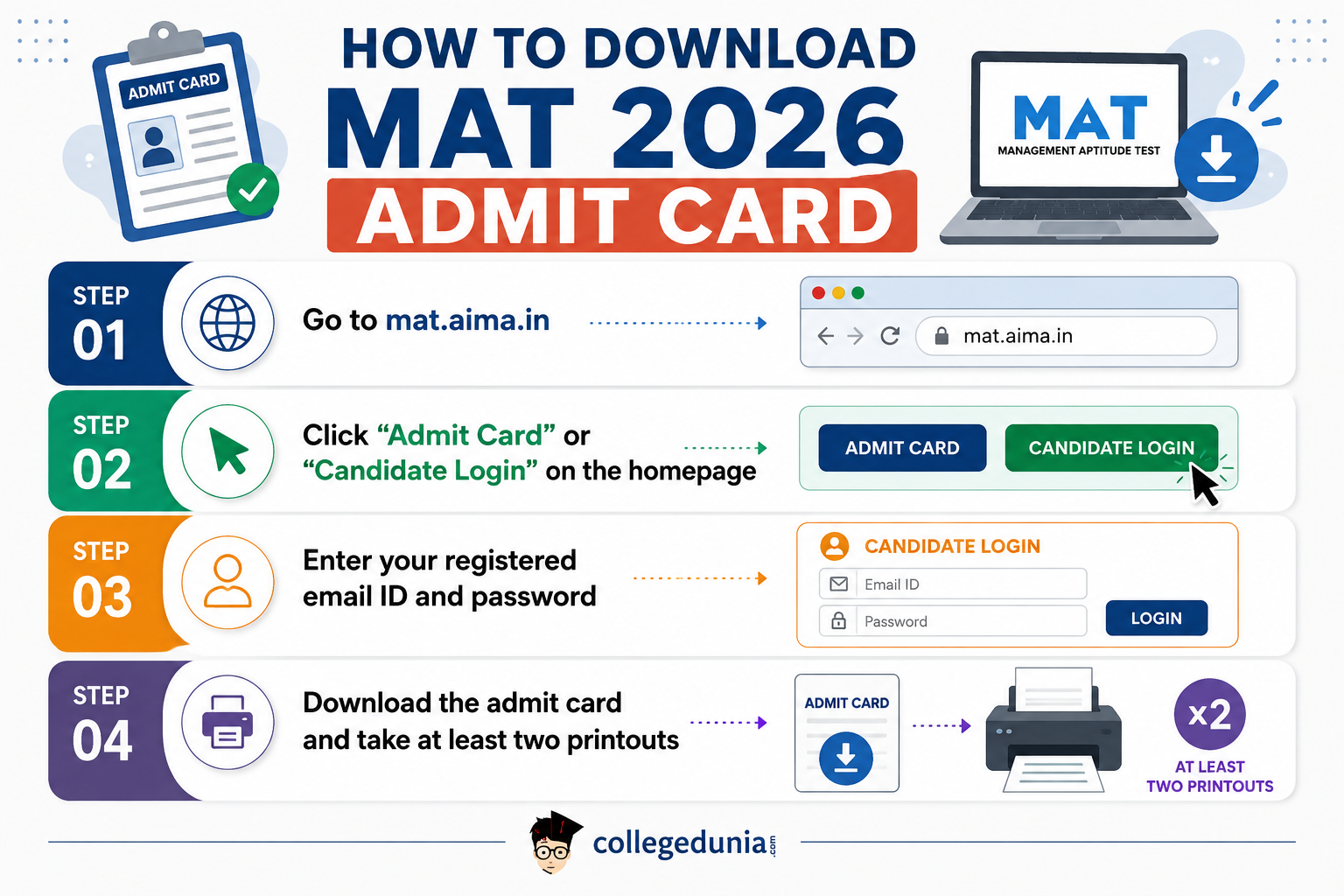
AIMA releases the MAT admit card separately for each mode within each session. You can download it by logging into mat.aima.in using your registered email ID and password. AIMA does not send the admit card by post or email — you must download and print it yourself.
MAT September 2026 Admit Card Dates
| Mode | Expected Admit Card Date | Exam Date |
|---|---|---|
| PBT | Around September 10, 2026 | September 13, 2026 |
| CBT | September 17, 2026 | September 20, 2026 |
How to Download MAT 2026 Admit Card?
Documents to Carry on MAT 2026 Exam Day

MAT 2026 Result and Scorecard
AIMA declares the MAT result in the form of a scorecard on the official candidate portal at mat.aima.in.
- The scorecard is the official result document — AIMA does not issue a separate result list or rank card.
- The May 2026 result was declared on June 22, 2026, for both PBT (May 31) and CBT (June 14) modes.
- The September 2026 result is expected in October 2026, following a similar 3–4 week window after the CBT exam date.
MAT 2026 Session-wise Result Status
| Session | Exam Date | Result Date | Status |
|---|---|---|---|
| September 2026 — PBT | September 13, 2026 | Expected October 2026 | Upcoming |
| September 2026 — CBT | September 20, 2026 | Expected October 2026 | Upcoming |
| December 2026 | TBA | TBA | Dates Awaited |
| February 2026 — PBT | March 1, 2026 | Last week of March 2026 | (Out) |
| February 2026 — CBT | March 8, 2026 | Last week of March 2026 | (Out) |
| May 2026 — PBT | May 31, 2026 | June 22, 2026 | (Out) |
| May 2026 — CBT | June 14, 2026 | June 22, 2026 | (Out) |
What the MAT Scorecard Shows
- Candidate name, photograph, and registration number
- Exam session, mode, and date
- Section-wise scaled scores for all 5 sections
- Composite scaled score (from 4 sections — GK section excluded)
- Overall percentile based on the composite score
How to Download MAT 2026 Scorecard

MAT 2026 Score vs Percentile: What to Expect
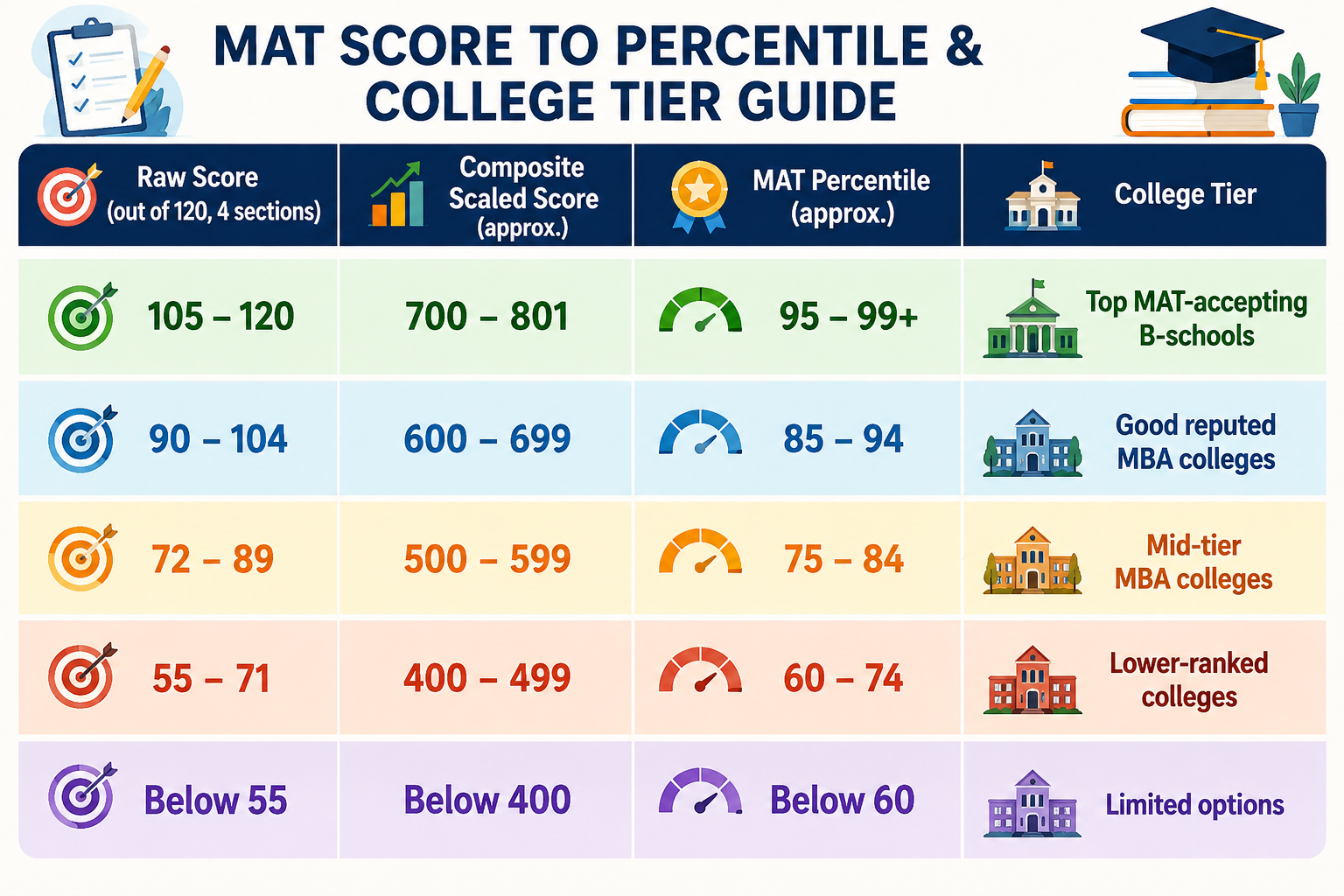
Your MAT percentile shows where you stand among all candidates who appeared in that session. The same raw score can give different percentiles across sessions — the outcome depends on the number of test-takers and the difficulty level of that particular paper. The table below gives indicative score-to-percentile ranges based on previous MAT session trends.
| Raw Score (out of 120, 4 sections) | Composite Scaled Score (approx.) | MAT Percentile (approx.) | College Tier |
|---|---|---|---|
| 105 – 120 | 700 – 801 | 95 – 99+ | Top MAT-accepting B-schools |
| 90 – 104 | 600 – 699 | 85 – 94 | Good reputed MBA colleges |
| 72 – 89 | 500 – 599 | 75 – 84 | Mid-tier MBA colleges |
| 55 – 71 | 400 – 499 | 60 – 74 | Lower-ranked colleges |
| Below 55 | Below 400 | Below 60 | Limited options |
What is a Good MAT 2026 Score?
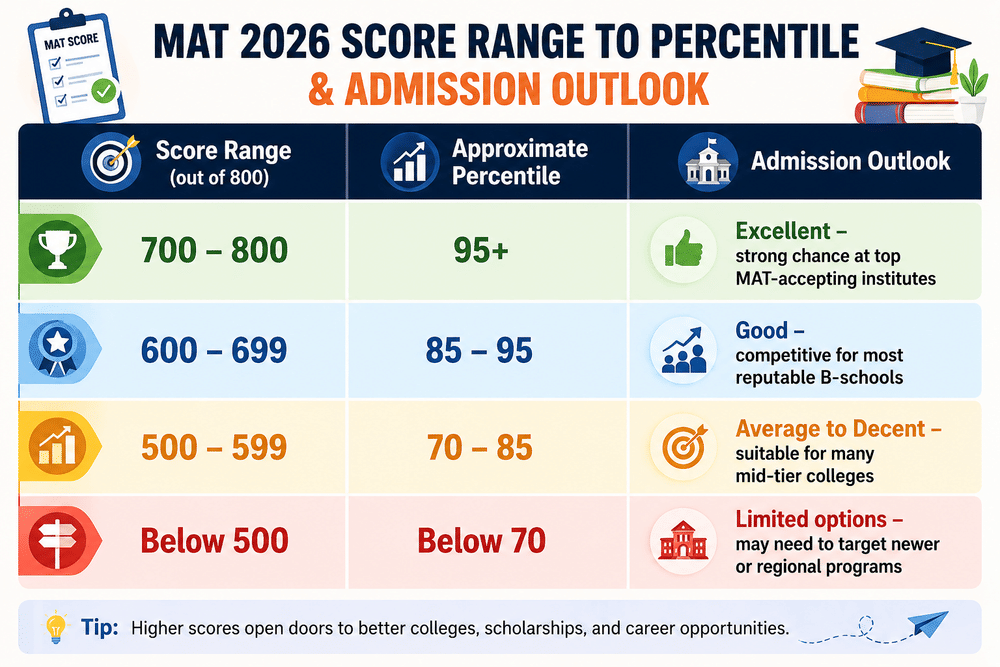
A composite score of 600+ out of 800 typically ranks as strong and opens doors to many solid MBA programs.
- A percentile above 85–90 is widely viewed as competitive for mid-to-top B-schools accepting MAT scores.
- Scores in the 500–599 range remain acceptable for several regional and newer institutes with decent placements.
- Aiming higher than the previous year’s cut-offs for your target colleges improves admission chances significantly.
| Score Range (out of 800) | Approximate Percentile | Admission Outlook |
| 700 – 800 | 95+ | Excellent – strong chance at top MAT-accepting institutes |
| 600 – 699 | 85 – 95 | Good – competitive for most reputable B-schools |
| 500 – 599 | 70 – 85 | Average to Decent – suitable for many mid-tier colleges |
| Below 500 | Below 70 | Limited options – may need to target newer or regional programs |
MAT 2026 Cutoff for Top MBA Colleges
MAT does not have a single centralised cutoff. Each college sets its own MAT percentile threshold for shortlisting candidates. The cutoffs below are based on 2025 session data and are expected to remain broadly similar in 2026. Final 2026 cutoffs will be set by individual colleges after each session’s results are declared.
| College | Location | Expected MAT 2026 Cutoff (Percentile) | Programme |
|---|---|---|---|
| BIMTECH (Birla Institute of Management Technology) | Greater Noida | 90+ | PGDM |
| XIME (Xavier Institute of Management & Entrepreneurship) | Bangalore / Chennai | 85+ | PGDM |
| Christ University (School of Business) | Bangalore | 85+ | MBA |
| Amity Business School | Noida | 85+ | MBA |
| SOIL Institute of Management | Gurgaon | 85+ | PGDM |
| JAGSOM (Jain Global School of Management) | Bangalore | 80+ | PGDM |
| IPE Hyderabad (Institute of Public Enterprise) | Hyderabad | 80+ | MBA |
| IMS Ghaziabad | Ghaziabad | 80+ | MBA |
| Rajagiri Business School | Kochi | 75+ | MBA |
| Jaipuria Institute of Management | Noida / Jaipur / Lucknow | 70+ | PGDM |
MAT 2026 Counselling Process
MAT does not have a centralised counselling or seat-allotment process. Unlike JEE or NEET, there is no single body that allocates seats. Each college using MAT scores runs its own independent admission process, and you must apply separately to every college where you want admission.
Step-by-Step Counselling Process After MAT

Typical Selection Criteria Weightage
| Component | Typical Weightage Range |
|---|---|
| MAT Score / Percentile | 40 – 60% |
| Personal Interview (PI) | 20 – 30% |
| Group Discussion / WAT | 10 – 20% |
| Academic Record (10th, 12th, Graduation) | 10 – 20% |
| Work Experience | 0 – 10% |
Weightages vary significantly across colleges. Always check the official admission brochure of each college before applying.
Documents Typically Required for MAT 2026 MBA Admission
- MAT 2026 scorecard (downloaded from mat.aima.in)
- Class 10 and Class 12 marksheets and passing certificates
- All semester or year-wise graduation marksheets and degree certificate
- Work experience certificates (adds value in shortlisting and PI rounds)
- Government-issued photo ID — Aadhaar, PAN, or passport
- Category certificate for SC/ST/OBC/PwD candidates claiming reservation
- Recent passport-size photographs
FAQs on MAT 2026
Ques. When is the MAT September 2026 exam?
Ans. MAT September 2026 PBT is on September 13, 2026 and CBT is on September 20, 2026. Registration is currently open at mat.aima.in. The last date to register for PBT is September 7, 2026 and for CBT is September 14, 2026. The registration fee is Rs 2,300 for one mode and Rs 4,000 for both modes in the same session.
Ques. How many times is MAT conducted in 2026?
Ans. AIMA conducts MAT four times a year — February, May, September, and December. In 2026, the February and May sessions are over and results are out. The September 2026 session registration is currently open. December 2026 dates are yet to be announced. You can appear in multiple sessions and use your best score for college applications.
Ques. Is the MAT May 2026 result out?
Ans. Yes. MAT May 2026 result was declared on June 22, 2026, covering both PBT (May 31) and CBT (June 14) modes. Candidates can log in to mat.aima.in with their registered email ID and password to download their scorecard. The scorecard shows section-wise scaled scores and the composite percentile.
Ques. What is a good MAT 2026 score for top MBA colleges?
Ans. A composite scaled score of 600+ or 85+ percentile is considered good for well-known MAT-accepting B-schools. For top colleges like BIMTECH, XIME, and Christ University, aim for 90+ percentile. A score of 91+ percentile puts you in a strong shortlisting position at most reputed MAT colleges. Mid-tier colleges typically shortlist at 70–85 percentile.
Ques. What is the MAT 2026 eligibility criteria?
Ans. You need a bachelor’s degree in any discipline from a recognised university. Final-year students can also apply. AIMA does not prescribe any minimum percentage or age limit. CA, CS, and CMA qualification holders are eligible without a conventional degree. Colleges may set their own percentage cutoffs independently of AIMA.
Ques. What is the MAT 2026 exam pattern?
Ans. MAT 2026 has 150 MCQs across 5 sections — Language Comprehension, Intelligence and Critical Reasoning, Data Analysis and Sufficiency, Mathematical Skills, and Indian and Global Environment — each with 30 questions. Duration is 120 minutes. Marking: +1 for correct, -0.25 for wrong, 0 for unattempted. The Indian and Global Environment (GK) section score is shown on the scorecard but not counted in the composite percentile.
Ques. Is IBT mode available in MAT 2026?
Ans. No. AIMA discontinued the IBT (Internet-Based Test) mode in 2025. From 2026, MAT is available only in PBT (Paper-Based Test) and CBT (Computer-Based Test) modes. Both require you to appear at an AIMA-designated exam centre. You can choose one or both modes within the same session.
Ques. How is the MAT composite score calculated?
Ans. The MAT composite score is calculated from the first four sections only — Language Comprehension, Intelligence and Critical Reasoning, Data Analysis and Sufficiency, and Mathematical Skills. The GK (Indian and Global Environment) section is excluded. AIMA converts your raw marks from these four sections into a composite scaled score ranging from 199 to 801 through a normalisation process. Your percentile is then based on this composite scaled score relative to all candidates in that session.
Ques. How many colleges accept MAT 2026 scores for MBA admission?
Ans. More than 800 MBA and PGDM colleges across India accept MAT scores. These colleges are spread across all major cities and states. Since there is no centralised counselling, you must apply separately to each college using your MAT scorecard. The AIMA official website carries the complete list of participating institutions.
Ques. Is there negative marking in MAT 2026?
Ans. Yes. MAT 2026 carries negative marking. You get +1 for each correct answer and lose 0.25 marks for each wrong answer. Questions left blank carry no marks and no penalty. Avoid random guessing — if you are not confident about a question, skipping it is safer than risking a -0.25 deduction. This discipline matters most in the Mathematical Skills and Data Analysis sections.
Ques. Can I appear in more than one MAT 2026 session?
Ans. Yes. AIMA places no restriction on the number of sessions you appear in. You can appear in the September 2026 and December 2026 sessions, and within each session, you can choose both PBT and CBT. Colleges consider your best score from within the one-year validity window. Appearing in multiple sessions gives you more chances to improve your score and maximise your college options.
Disclaimer: The information in this article is based on official AIMA notifications and verified sources available as of July 2026. MAT 2026 dates, fees, cutoffs, and eligibility details may change. Candidates should always verify the latest information directly from the official MAT website at mat.aima.in before making any registration or admission decisions.




Comments
Found 27 Comments
A MAT composite score of 460.5, which is your scaled score rather than your percentile, is on the lower side. You have two main options: apply immediately to Tier-3 management institutes that accept this range, or retake the exam in September or December 2026 to target better business schools.
Admission based on the MAT (Management Aptitude Test) score is available in many MBA colleges across India. First, appear for the MAT exam conducted by the All India Management Association. After the results, apply to MBA colleges accepting MAT scores, fill their application forms, attend counselling or interviews, and secure admission based on your MAT score and eligibility criteria.
You can check here for the MAT Syllabus. You can check here for the MAT Question Paper: Download MAT Previous Year Question Paper PDFs
The last date to register for the Paper-Based Test (PBT) is 7 December 2025, the admit card will be released on 10 December 2025, and the exam date is 13 December 2025. For the Computer-Based Test (CBT), the registration will close on 15 December 2025, with the admit card release on 18 December 2025, exam date on 21 December 2025.
The last date to fill the application form for the MAT (Management Aptitude Test) depends on the mode of exam. For the December 2025 session:
The MAT exam 2026 (conducted by All India Management Association, AIMA) is held four times a year, in February, May, September, and December. For the 2026 cycle, one session is expected around March 2026 (Paper-Based Test mid-March, Computer-Based Test late-March). You can check here for the List of Top Colleges in India Accepting MAT Based on 2025 Ranking
The MAT is divided into 5 sections, each with 30 questions with 20% weightage: Language Comprehension, Data Analysis and Sufficiency, Mathematical Skills, Economic and Business Environment, and Intelligence & Critical Reasoning. The MAT syllabus is designed to test your aptitude, quantitative ability, language skills, and general awareness.
No, it has not yet started, the tentative dates are mentioned below:
You can check here for the MAT Question Paper: Download MAT Previous Year Question Paper PDFs and Mock Tests
The All India Management Association, or AIMA, administers the national entrance exam known as MAT 2025. Held four times annually, it evaluates skills in language comprehension, reasoning, quantitative aptitude, data analysis, and general awareness. Students wishing to enroll in MBA programs and other management courses at different Indian business colleges take the exam.
The AIMA has announced the MAT December 2025 exam dates. The MAT exam will be held in 2 sessions: Paper-Based Test (PBT) and Computer-Based Test (CBT). Scores are valid for one year and accepted by top institutes like Christ University, XIME Bangalore, and Jaipuria Institutes.
You can check here for the MAT Question Paper: Download MAT Previous Year Question Paper PDFs and Mock Tests
You can check here for the MAT Question Paper: Download MAT Previous Year Question Paper PDFs and Mock Tests
You can check here for the MAT Question Paper: Download MAT Previous Year Question Paper PDFs and Mock Tests
You can check here for the MAT Question Paper: Download MAT Previous Year Question Paper PDFs and Mock Tests
Collegedunia has model question papers and previous year's papers that have been created using in-depth MAT analysis and professional guidance. These exam papers will undoubtedly aid candidates in their exam preparation. The links to the MAT sample papers and question papers from previous years are provided below. These are available for free download. To ace the MAT exam, practice them frequently. Download MAT Previous Year Question Paper PDFs and Mock Tests
The dates of the MAT 2024 exams in both PBT and CBT formats are February 25, 2024, and March 10, 2024, respectively. Exam dates for the MAT 2024 February session IBT mode are set for February 24, March 3, and February 8, 2024.
The conducting body will soon confirm the November 24, 2024, date of the CAT exam. The date of the CAT exam registration is still unknown, but you can anticipate that it will open by the first week of August 2024. By the final week of July 2024, CAT notification will be made available prior to registration.
MAT scores are accepted by about 104 government MBA programs in India. With first-rate facilities, these MBA schools provide excellent placement opportunities. The best public MBA schools that accept MAT scores are listed in the table below along with the most recent cut-off percentile. You can check the colleges in which your MAT score will be eligible by clicking the link here.
AIMA will not have a centralized MAT counseling process by 2024. Nonetheless, the counseling process is carried out by each participating institute. Each participating institute has a different counseling schedule as well.