



Education Journalist | Study Abroad Lead
Alkaloids are secondary metabolites produced by plants and also some animals. It is a chemical compound that is important for both plants and animal species.
- Alkaloids are organic compounds and are named after the word alkali.
- It has an alkali-like nature and at least one nitrogen group in its structure.
- Alkaloids has many biological, medical and pharmacological applications.
| Table of Content |
Key terms: Secondary metabolites, Plants, Nicotine, Caffeine, Quinine, Anticancer, Antifungal, Antimicrobial, Medicinal drugs.
Read Also: Difference Between Adolescence and Puberty
What are Alkaloids?
[Click Here for Sample Questions]
Alkaloids have been known since ages as secondary metabolites produced by plants and also they are present in some animal species. Among many classes of organic compounds like proteins, carbohydrates, lipids, steroids and amino acids, alkaloids are little special as they are derived from amino acids and can be synthesized by plants. Some key features and importance of alkaloids are as follows.
- The name alkaloids is given as this organic compound has alkali-like nature and it has at least one nitrogen group present in its structure.
- Various alkaloids or secondary metabolites are very important for human beings as they have many biological and pharmacological properties.
- Alkaloids show antimicrobial, anti inflammatory, anticancer, antifungal, pain-relief etc activity and it makes them very useful compounds for medicinal drug formulations.
- Many alkaloids are being tested for its medicinal properties to use in drug production.
- Apart from the drugs, alkaloids are a common part of diet. It is present in food and drinks.
- Alkaloids in plants play an important role as it protects the plant from any destructive activity by insects.
- When in pure form, alkaloids are colorless (sometimes yellowish liquid), odorless, crystalline solids. They react with acids and form salt.
- There are more than 3000 alkaloids known till now over the 4000 plant specieses. For example, Opium poppy and Ergot fungus possess 30 different types of alkaloids. Morphine is the first derived alkaloid from opium poppy plants.
- In animals, alkaloids can be found in some species such as Frogs, New World Beaver and Lizards.
- Some other examples of alkaloids includes caffeine, nicotine, morphine, quinine, atropine and berberine.
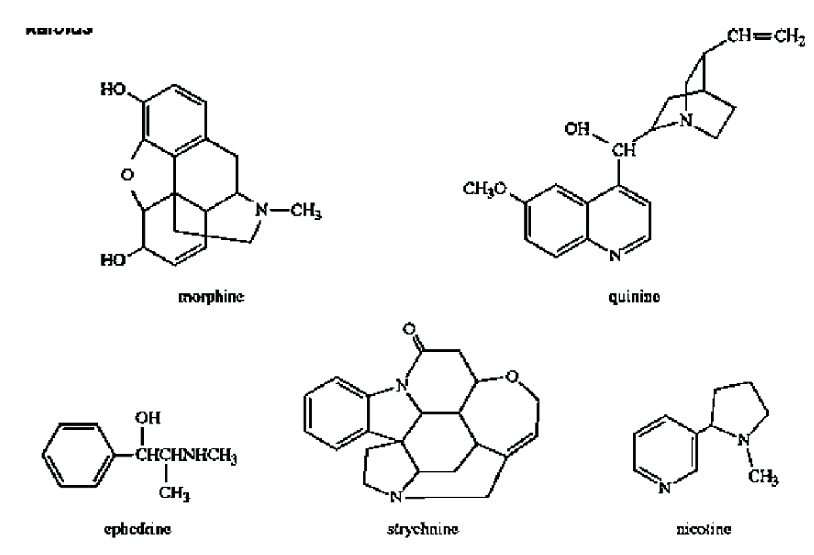
Structure of some commonly known alkaloids
Also Read:
| Related Articles | ||
|---|---|---|
| Applications of Enzymes | Enzyme Properties | Malonic Acid |
| Catalysis | Receptors | Metabolites |
Importance of Alkaloids
[Click Here for Sample Questions]
Alkaloids or secondary metabolites have biological and medical importance due to the role they play in plants and humans as well as the properties they have. Some of them are explained below.
In plant
- Protection against predators-alkaloids acts as toxic to the predatory insect.
- Plant growth regulators-alkaloids regulate the growth of plants.
- Nitrogen reservoir- alkaloids synthesized in plants remain stored in parts of the plant such as in root, leaf, stem etc. and serve as nitrogen source when needed.
In human
- Alkaloids are crucial for humans as they have certain clinical applications.
- Some well known alkaloids like morphine, quinine, ephedrine and nicotine are used in clinical settings.
- Some natural alkaloids can be preventative and curative agents in case of endocrine diseases like diabetes. It also can be helpful to discover new anti-diabetic agents.
- Some alkaloids are already in use for chemotherapeutic drug production that cure cancer.
Examples and applications of alkaloids
[Click Here for Sample Questions]
Most common examples of alkaloids are Nicotine, Morphine, Quinine and Caffeine. These alkaloids have certain specific properties due to which they are widely applicable for human benefits.
Nicotine
Nicotine is obtained from tobacco plant. It is the major ingredient of tobacco containing products.
- The common use of nicotine is in making cigarettes.
- It is the most addictive ingredient agent of tobacco smoked in cigarettes and pipes.
- Other use of nicotine is as a stimulant and anxiolytic.
- It creates a feeling of relaxation and increases heart rate along with the amount of oxygen that the heart uses.
- When consumed, it increases the level of endorphin and dopamine.
- Release of dopamine results in pleasure and relaxed feelings that further reinforce the person to consume nicotine.
Caffeine
Caffeine is the chief ingredient present in coffee and chocolates. It is an alkaloid obtained from fruits, leaves and beans of coffee.
- It increases the activity of the brain and nervous system.
- caffeine is added as a supplement to food and drugs as it gives a temporary boost in energy and also improves mood.
- It is a part of tea, coffee, chocolates and some soft drinks.
Quinine
Quinine is used either alone or in combination with other medications to treat malaria and that is why it belongs to a class of drugs known as antimalarials.
It increases the risk of bleeding and heart rhythm disturbance. Therefore it is strictly approved for use in malaria treatment only.
Also Read:
| Related Articles | ||
|---|---|---|
| Antidepressant drugs | Chemical Tranquilizers | Antihistamine |
| Recycling of paper | Squamous | Difference Between Xylem And Phloem |
Things to Remember
- Alkaloids are organic compounds and known as secondary metabolites synthesized by plants and some animals.
- It has a wide application in the medical field.
- It has an important role in plant growth regulation, protection against predators and acts as a nitrogen reservoir.
- In humans, alkaloids are useful due to the important biological and pharmacological properties such as anti-tumor, anti-inflammation, anti-allergic etc.
- The commonly known examples of alkaloids are morphin, nicotine, caffeine and quinine.
Sample Questions
Ques. Which of the following is a direct example of alkaloids? (1 mark)
(a) Paracetamol
(b) Antacids
(c) Nicotine
(d) Morphin
(e) All of the above
(f) None of the above
(g) Only c and d
Ans. g. Only c and d
Ques. What is the other name of alkaloids? (1 mark)
(a) Medicines
(b) Chemical compounds
(c) Secondary metabolites
(d) Primary metabolites
Ans. c. Secondary metabolites
Ques. Define alkaloids with one example and application in human benefits (4 marks)
Ans. Alkaloids or secondary metabolites are organic compounds having alkali-like nature and at least one nitrogen group in structure. These metabolites are synthesized by plants and some animals. Alkaloids in their pure form are colorless, odorless, crystalline solids that react with acid and form salts.
- Some commonly known alkaloids are quinine, nicotine, caffeine and morphine.
- These all have an important role in medications.
- Quinine is an FDA-approved drug for treatment of malaria.
Ques. What is the role of alkaloids in plants? (2 marks)
Ans. Alkaloids are mainly synthesized in plants and remain stored in it.
- It provides protection to plants against predators. It acts as toxins for the pathogens and the plant against such destructive activity of insects.
- It serves as a nitrogen reservoir for plants.
- It also regulates the growth of plants.
Ques. Select the odd one out from the following properties of alkaloids (1 mark)
(a) Antitumor
(b) Anti Inflammatory
(c) Antimicrobial
(d) Antifungal
(e) Antimalarial
(f) Anti-tuberculosis
Ans. f. Anti-tuberculosis
Ques. Give 3 example of alkaloids and discuss its medicinal applications (5 marks)
Ans.
- Nicotine
Nicotine is extracted from the tobacco plant and it is applicable in medicines for several reasons.
- It increases the rate of heart function and amount of oxygen it utilizes.
- Nicotine releases the dopamine and endorphins which stimulates the feeling of relaxation.
- Another use of nicotine is that it can be used as a stimulant and anxiolytic.
- Caffeine
Caffeine is widely used as an ingredient to food and drink as it can boost energy level and activate the brain and nervous system.
It also improves the mood
- Quinine
Quinine belongs to a class of drugs known as antimalarials as it is used to treat malaria, either alone or in combination with other medications.
Quinine is an FDA-approved drug strictly for the treatment of malaria as it can disturb the heart rhythm and increase the risk of bleeding.
Ques. Which was the first derived alkaloids from plant opium poppy? (1 mark)
(a) Cocaine
(b) Caffeine
(c) Nicotine
(d) Morphine
(e) Endorphine
(f) Dopamine
(g) Quinine
Ans. d. Morphine
Ques. Secondary metabolites of plant is called alkaloids because… (1 mark)
(a) It is chemical compound
(b) It is organic compound
(c) It is derived from amino acids
(d) It reacts with acids
(e) It has an alkali-like nature
Ans. e. It has an alkali-like nature.
For Latest Updates on Upcoming Board Exams, Click Here: https://t.me/class_10_12_board_updates
Also Check:



Comments