



Education Journalist | Study Abroad Lead
Enzymes are very specific biomolecules. All metabolic processes of our body need enzymes to catalyze the reaction faster. In this article, we will be covering various Enzyme Properties, structure, and classification. Enzymes are naturally produced by living cells, unlike catalysts. The activity of the enzyme decreases considerably at high temperatures. Most of the enzymes are globular proteins while some molecules are RNA. Enzymes are larger than substrates. The enzymes are located in the protoplasm in the form of hydrophilic colloids.
| Table of Content |
Keyterms: Enzymes, Biomolecules, RNA, cells, catalysts, proteins, protoplasm, hydrophilic colloids, globular proteins
Read More: Reverberatory Furnace
What are Enzymes?
[Click Here for Sample Questions]
Enzymes are found in all tissues and fluids in the body. Catalysis of all reactions that take place in metabolic pathways is performed by intracellular enzymes. Enzymes in the plasma membrane regulate catalysis in cells in response to cellular signals, and enzymes in the circulatory system regulate blood clotting. Most critical life processes are based on the functions of enzymes.
Also Read:
| Related Articles | ||
|---|---|---|
| Metallic Bonds | Bravais Lattices | Close Packing in One,Two and Three Dimensions |
| Tetrahedral and Octahedral voids | Avogadro constant | Point defects |
Enzyme Structure
[Click Here for Sample Questions]
Enzymes are the linear chain of amino acids and then gives rise to a three-dimensional structure. The sequence of amino acids will specify the structure and in turn, identify the catalytic nature of the enzyme. When heated the enzyme gets denatured and loses its activity that is associated with temperature.
Most of the enzymes are globular proteins but some are RNA molecules. Enzymes are larger than substrates.
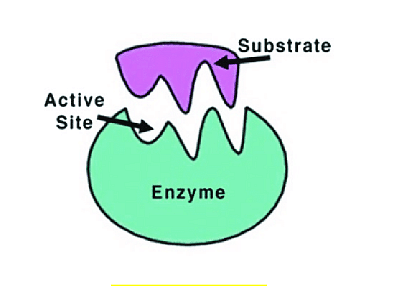
Enzyme Structure
Enzymes are generally named after the compound or class of compounds upon which they work. For example, the enzyme that catalyses the hydrolysis of maltose into glucose is named maltase. 12 22 11 6 12 6 Maltase Maltose Glucose C H O → 2 C H O Sometimes enzymes are also named after the reaction, where they are used. For example, the enzymes which catalyse the oxidation of one substrate with simultaneous reduction of another substrate are named oxidoreductase enzymes. The ending of the name of an enzyme is -ase.
Read More: Boiling points
Enzyme as Biocatalyst
[Click Here for Sample Questions]
- Enzymes accelerate the reaction rate by reducing the transition time between substrate and product.
- Enzymes as catalysts control reaction specificity and ensure that only specified substrates bind to an enzyme’s active site resulting in product production.
- As catalysts, enzymes take part in biochemical reactions without altering the state of the reaction.
- Enzymes also initiate the biochemical reactions by decreasing activation energy and increasing transition energy
Read More: Red Phosphorus
Properties of Enzymes
[Click Here for Sample Questions]
Physical Properties
- Enzymes act as colloids or high molecular weight substance
- At temperatures below the boiling point of water, enzymes are destroyed or inactivated
- Enzymes at 60 degrees celsius are inactivated when in a liquid medium.
- Dried enzyme extracts may withstand temperatures ranging from 100 to 120 degrees Celsius, and even higher.
- Enzymes have a temperature range, usually between 25 and 45 degrees celsius. At 37 degrees celsius, the enzyme reaction is maximum and once the temperature reaches 60 it becomes inactive.
Chemical Properties
- Enzymes have a great capability of converting large amounts of substrate into substance. And a huge amount of compounds can be catalyzed by a small number of enzymes
- A specific enzyme can catalyze a specific reaction that is called enzyme specificity.
- Enzymes improve the reaction rate and stay unaffected during the reaction
General Properties
- Enzymes initiate and speed up the reaction
- The enzyme’s activity is ph dependent
- Enzymes have the capacity to forward and reverse the reaction but do not decide the direction of the biochemical pathway
- An enzyme has a particular area on which the substrate interacts to produce the desired product
- Enzyme becomes unstable at varying ph, high heat and temperature
- Enzymes have protein like characteristics
- Substrates can be catalyzed with a small number of enzymes
- Enzyme activity represents absolute, relative, group and stereo specificities
- Some enzymes perform regulatory function
- Enzymes minimise activation energy
- The enzymes remain unaffected before and after the product formation and can be reused
- Enzymes are soluble both in water and NaCl
Read More: Examples of Weak Acid
Mechanism of Enzyme Action
[Click Here for Sample Questions]
The mechanism of enzyme action is dependent on the parameters such as temperature, pH and concentration of enzyme and substrate. At an ideal temperature of 37 degrees celsius and pH of 7.2, the enzymes are most active. The enzymatic reaction will be slowed down by the small concentration of enzyme and substrate.
Also, the high concentration of enzymes will speed up the enzyme activity. This is because more substrates will interact with the enzyme’s active site for the formation of a product. When the reaction activity reaches a maximum level, there will be no changes in the enzymatic reaction even after the addition of the enzyme and substrate.
Similar to the action of chemical catalysts, enzymes are said to reduce the magnitude of activation energy. For example, the activation energy for acid hydrolysis of sucrose is 6.22 kJ mol–1, while the activation energy is only 2.15 kJ mol–1 when hydrolysed by the enzyme, sucrase.

Mechanism of Enzymes
Read More: Difference Between Accuracy and Precision
Classification of Enzymes
[Click Here for Sample Questions]
Enzymes are classified on the basis of the action it performs:

Classification of Enzymes
- Oxidoreductases- oxidation-reduction reactions
- Transferases- transfer of the functional group
- Hydrolases- hydrolysis reactions
- Isomerases- isomerization reaction
- Lyases- addition to double bonds
- Ligases- formation of bonds with ATP cleavage
Read More: Zone Refining
Things to Remember
- Enzymes are biological catalysts that drive chemical reactions and are required only in a small amount. They are capable of catalysing the conversion of substrate into product
- Enzymes are specific catalysts and are classified into 6 classes namely Oxidoreductases, Transferases, Hydrolases, Isomerases, Lyases, Ligases.
- Enzymes increase the reaction rate
- Enzymes form complexes with their substrates
- Enzymes are affected by Ph and temperature
- Enzymes are sensitive to inhibitors
- Enzymes can be intracellular or extracellular
Also Read:
Sample Questions
Ques. Give some examples for enzymes. (2 Marks)
Ans. Beverages- Alcoholic beverages that are produced by fermentation. The fermented products differ depending on the type of plant product used and the enzyme used.
Food products- bread is the simplest and daily life example of fermentation.
Drug action- the usage of medicines that tend to function near the active areas of enzyme can increase enzyme reaction.
Ques. How are enzymes sensitive to ph? (2 Marks)
Ans. Enzymes are very specific to their ph requirements. The optimum ph of the enzyme is 7.2.
Optimum ph values of some common enzymes are:
Pepsin- 1.5-2.0
Sucrase- 6.2
Amylase- 6.7-7.0
Urease- 7.0
Ques. What is enzyme regulation? (2 Marks)
Ans. The process by which a cell can turn on, turn off or modulate the activities of various metabolic pathways by regulating the activity of enzymes. Enzymes have great catalytic power. The enzymes can increase the chemical reaction by a thousandfold. Methods of enzyme regulation are Allosteric regulation, feedback regulation, regulation by isoenzymes, reversible covalent modification and proteolytic regulation.
Ques. Explain the colloidal nature of the enzyme. (2 Marks)
Ans. The colloidal nature of the enzyme is the physical property of the enzyme. Due to the large size or high molecular weight enzymes act as colloids. As a result, the enzymes are less likely to dialyze or pass the semipermeable membrane.
Ques. How do enzymes act as potent catalysts? (2 Marks)
Ans. The enzyme catalyst activity can be represented as Kcat and is referred to by turnover rate, turnover frequency and turnover number. Kcat is defined as the number of substrate molecules that can be converted to product by a single enzyme molecule per unit of time. (Unit time can be per minute or per second).
Ques. Briefly explain enzyme kinetics. (2 Marks)
Ans. The study of factors that influence the pace of enzyme-catalytic processes is known as enzyme kinetics. It makes use of various mathematical equations. The theory of kinetics, on the other hand, is both rational and straightforward, and it is important to master it in order to recognise the role of enzymes in metabolism and biotechnology.
Ques. What are the most important properties of an enzyme? (3 Marks)
Ans. The most important properties of enzymes are catalytic property, specificity, reversibility, sensitivity to heat and temperature and specific to hydrogen ion concentration.
- The enzyme specificity, high degree of specificity for their substrates.
- Catalytic property- a small number of enzymes are very active
- Enzyme catalytic reactions are reversible.
- Enzymes are active at optimum temperature and become inactive at low temperature
Ques. Draw a graph showing the effect of temperature and pH on enzyme activity. (4 Marks)
Ans.

For Latest Updates on Upcoming Board Exams, Click Here: https://t.me/class_10_12_board_updates
Check-Out:



Comments