



Content Curator
Bakelite is a polymer that is made up of monomers like phenol and formaldehyde. It is one of the commercially manufactured polymers that we use in everyday life. Bakelite is hard, stable, and chemically resistant. It has numerous applications in everyday life, from being used in a switch to complex machinery and equipment.
What is Bakelite?
[Click Here for Previous years Questions]
Bakelite, chemically known as Polyoxybenzylmethylenglycolanhydride, is a thermosetting phenol-formaldehyde resin. It is the first synthetic plastic.
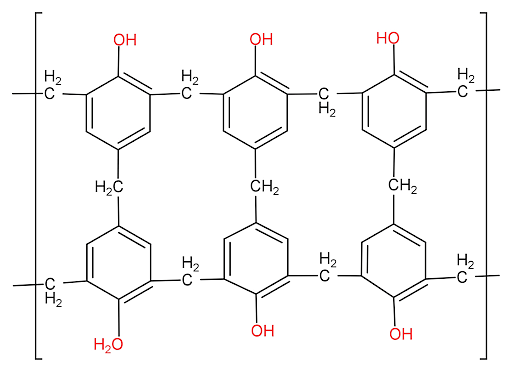
Bakelite Structure
Bakelite is a good example of thermosetting plastics. On cooling, these plastics become hard and rigid and are capable of retaining their shapes.
Also Read: Thermosetting and Thermoplastic Polymer
How is Bakelite Prepared?
[Click Here for Sample Questions]
Bakelite is formed as a result of the condensation reaction between phenol and formaldehyde. Therefore, it is also known as condensation polymer or phenolic resin. The preparation of Bakelite involves several complex stages. It is prepared using two monomers – phenol and formaldehyde. However, on the basis of application, various substitutes of these monomers can also be used to prepare Bakelite. The steps followed for the preparation of Bakelite are as follows:
- Firstly two monomers are combined – phenol and formaldehyde in the presence of an acidic (Hydrochloric Acid and Zinc Chloride) or basic (Ammonia) catalyst. This results in the formation of ortho-hydroxy benzyl and para-hydroxy benzyl alcohols and their derivatives. These products further react to form compounds that are joined to -CH2 groups by rings.
- If the formaldehyde to phenol molar ratio is less than one, i.e., phenol is taken in excess, then, acidic catalysts like Hydrochloric Acid (HCl) and Zinc Chloride (ZnCl2) are used.
- The condensation product formed is called Novolac.
- On the other hand, if the formaldehyde to phenol molar ratio is more than one, i.e., formaldehyde is taken in excess, then, basic catalysts like Ammonia (NH3) are utilized. The condensation product formed, in this case, is called Resolve.
- When Novolac is repeatedly heated and undergoes cross-linking with another cross-linking agent, commonly hexamethylenetetramine or excess formaldehyde, the polymer, Bakelite – (C6H6O-CH2OH)n – is produced. This process is known as polymerization.
- This reaction is highly exothermic in nature and needs to be conducted under pressure so that the product is hard, rigid, and dense.
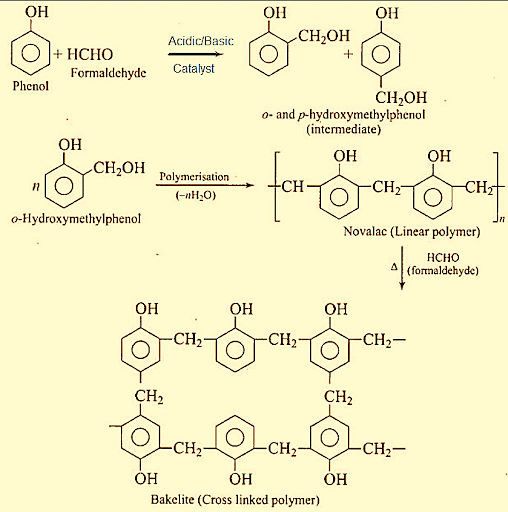
Backelite Preparation
Properties of Bakelite
[Click Here for Previous years Questions]
Some of the important properties of Bakelite are as follows:
- Bakelite is a thermoset or thermosetting plastic. Therefore, when heated, this polymer is malleable and liquefiable. However, when it is cooled, it becomes permanently hard and rigid.
- It is a non-conductor of electricity, having a dielectric constant of 4.4 to 5.4.
- It is heat-resistant and therefore, non-flammable. Thus, it functions as a good insulator.
- Bakelite is also resistant to any kind of chemical action and hence, is non-destructive.
- It can be very easily and quickly molded.
- The moldings of Bakelite are fairly scratch-resistant.
- Usually, it has a brown or amber color. However, it can be found in a variety of colors.
- Bakelite has a distinctive sickly-sweet or fishy odor.
Also Read: Synthetic polymers
Uses of Bakelite
[Click Here for Sample Questions]
Bakelite, commercially known as phenol formaldehyde resin, is widely used in the production of various products. Hence, it is rightly known as ‘material of thousand use’. Some of the important applications of Bakelite are as follows:
- It acts as a good insulator. Therefore, it is widely used in making several electrical devices like sockets, automobile distribution caps, switches, insulation wire, etc. It is also used in making the non-conducting parts of radios and telephones.
- Bakelite can be very easily molded. Thus, it can be used for making a variety of daily-use commodities like clocks, toys (dominoes, chess, poker chips, mah-jong sets), washing machine impellers, buttons, kitchenware, etc.
- Since Bakelite is available in a variety of colors, it is also utilized for making artificial jewelry like bangles, earrings, and bracelets.
- It is also widely used as adhesives or binding agents and as varnishes or protective coating.
- It is also used in making musical instruments like saxophone, whistle, and electric guitar.
Check Out:
| Topic Related Concepts | ||
|---|---|---|
| Catalysis | Melting and Boiling Points | Aldehyde |
| Organic Compounds | Alcohol, Phenol, and Ether | Condensation Polymerization |
Previous Year Questions
- Which one of the following is amorphous… [VITEEE 2006]
- Nylon 66 is formed by… [UPSEE 2019]
- In Buna-S, the symbol ′Bu’ stands… [KCET 2013]
- The monomer used in Novolac, a polymer used in paints… [KCET 2017]
- The monomer of polystyrene is… [KEAM]
- Among the following, the branched-chain polymer is… [KCET 2018]
- Cis-1, 4-polyisoprene is called… [KCET 2019]
- The monomers of Buna… [KCET 2008]
- Poly-β-hydroxybutyrate-co-β hydroxyvalerate… [JEE 2019]
Things to Remember
- Bakelite is a polymer that is made from two monomers – phenol and formaldehyde.
- Bakelite is a thermosetting plastic that becomes hard and rigid upon cooling.
- Bakelite is formed due to a condensation reaction and is, therefore, also known as a condensation polymer.
- Bakelite is resistant to heat, electricity, and chemical action. It can be very easily molded.
- Bakelite is used as an insulator in electrical devices like sockets, telephones, automobiles, etc. It is also used in making jewelry, toys, adhesives, kitchenware, etc.
Also Read:
| Chapter Related Concepts | ||
|---|---|---|
| Cis-Trans Isomers | Versatile Nature of Carbon | Polyamides |
| Teflon | Cycloalkanes | Unsaturated Hydrocarbons |
Sample Questions
Ques. Name the monomers used for obtaining Bakelite polymer. (1 mark)
Ans. The monomers, phenol (C6H5OH), and formaldehyde (HCHO) are used for getting the Bakelite polymer.
Ques. Give an example of a condensation polymer. (1 mark)
Ans. Bakelite – (C6H6O-CH2OH)n – is a good example of a condensation polymer.
Ques. Write two important uses of Bakelite. (2 marks)
Ans. The important uses of Bakelite are as follows:
- It is used in making several electrical devices like sockets, automobile distribution caps, switches, insulation wire, etc.
- It is utilized for making artificial jewelry like bangles, earrings, and bracelets.
Ques. Write the names and structure of the monomers used in the preparation of Bakelite. (1 mark)
Ans. The two monomers used in the preparation of Bakelite are:
- Phenol (C6H5OH)
- Formaldehyde (HCHO)
Ques. State the differences between thermoplastic and thermosetting polymers with suitable examples. (5 marks)
Ans. There are two types of polymers, thermosetting and thermoplastic. A brief difference between both is given below-
| Thermoplastic Polymer | Thermosetting Polymer |
|---|---|
| The elastomers and fibers have the intermolecular force of attraction. | These are semi-fluid substances characterized by low molecular masses. When heated, they transform into a hard, infusible, and insoluble mass. |
| It can be easily molded or re-molded into any shape. | It cannot be re-molded into any shape. |
| It is formed as a result of addition polymerization. | It is formed due to condensation polymerization. |
| It tends to deform at high temperatures. | It is capable of retaining its shape even at high temperatures. |
| They have a linear or slightly branched arrangement. | They exhibit extensive cross-linking patterns and have a 3-D structure. |
| They are soft and viscous on heating. | They remain hard even when heated. |
| They can readily dissolve in organic solvents. | They are incapable of dissolving in organic solvents. |
| They are characterized by low tensile strength and low melting point. | They are characterized by high tensile strength and high melting points. |
| They are expensive and can be recycled. | They are cheap and non-recyclable. |
| Example: Polythene, PVC, Nylon, Teflon | Example: Vulcanized Rubber, Bakelite, Melamine |
For Latest Updates on Upcoming Board Exams, Click Here: https://t.me/class_10_12_board_updates
Check Out:



Comments