



Education Journalist | Study Abroad Lead
Brewster's law was proposed by the Scottish physicist Sir David Brewster in 1811. It is a relationship of light waves, which helps us understand how polarized reflection varies with angle. As per Brewster’s Law, the maximum polarization occurs when the angle between the reflected ray and refracted ray is 90 degrees. This article discusses in detail the Brewster's Law, Brewster’s law formula, its derivation along with the derivation of Brewster's angle and some fun facts about this law.
| Table of Contents |
Key Takeaways: Principle of interference of light, young double slit experiment, matter and energy, pinhole camera, laser light, light, Reflection, Angle, Brewster's Law
Brewster’s Law
[Click Here for Sample Questions]
It is well known that all of the reflected light isn’t polarized. How huge the impact is going to be depends on the angle at which you shine your light on the medium. When the light is in the plane of reflection, that is, when the refracted ray makes an angle of 90° with the reflected ray, maximum polarization is experienced.
Brewster law helps us understand how we can obtain the highest order of polarization of light by allowing the rays to come in contact with the surface of a transparent medium. A relationship develops between the polarizing angle* ‘iP’ which is the specific value of the angle of incidence at which the light gets completely polarized and the refractive index.
*The polarizing angle is also known as Brewster’s angle.
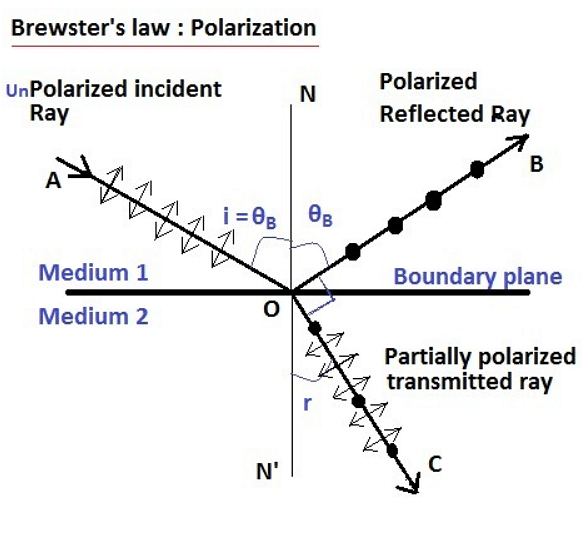
Brewster’s Law
Also Read:
| Related Articles | ||
|---|---|---|
| Some natural phenomena due to sunlight | Huygens Principle | Wave Particle Duality |
| Diffraction | Chapter 10 Wave Optics | Braggs Law |
Brewster’s Formula
[Click Here for Previous Year Questions]
Brewster’s law, as we just read states, the polarizing angle tangent is equal numerically to the refractive index of the medium.
The polarizing angle iP depends on the refractive index μ of the transparent material.
The relation is defined as μ = tan ip
This equation reflects the polarization by angle.
μ = refractive index of the transparent material
iP is the polarizing angle of incidence
Rays of light are vertical to each other when the unpolarized light is incident on a transparent medium at any polarizing angle.
Also,
μ = sin ip /sin r
tan iP = sin ipsin r
Proof of Brewster’s Formula
[Click Here for Sample Questions]

Brewster’s Formula
μ = tan ip
Here, μ = Refractive index
ip = Polarization angle.
From Snell’s Law:
μ = sin ipsin r ………… (1)
From Brewster’s Law
μ = tan ip = sin ipcos ip…………. (2)
Comparing both formulas: 1 and 2
Cos i=sin r= (cos 2 – r)
I = 2 – r, or I + r = 2
As, i + r = 2 < ABC this is also equal to.
Hence, we can prove that the reflected and the refracted rays are at right angles to each other.
Brewster’s Angle
[Click Here for Previous Year Questions]
Brewster’s angle is also known as the angle of polarization which is defined as the angle of incidence at which light with a specific polarization is perfectly transmitted without any reflection through a transparent dielectric surface or the light incident at this angle when reflected back, is perfectly polarized.
It is symbolized with iP.
Derivation
[Click Here for Sample Questions]
Unpolarised light ray is incident on the boundary between two media to enable the electric field component to undergo vibrations on the surface of the plane. The wave pass through the boundary on reaching the surface and refract at an angle r, some part of this gets reflected back in the same medium. For a particular angle of incidence, the waves which are reflected will have vibrations in a direction that is perpendicular to the plane of incidence and the reflected and refracted rays move at right angles to each other. This angle of incidence is called the angle of polarization or Brewster’s angle.
By using Snell’s law at the point of incidence, and using the condition for the angle of polarization p. Brewster in his experiment found the reflected and refracted rays to be orthogonal to each other.
We can write this mathematically, as;
ip+ 900 + r =1800
r = 900 - ip
From Snell's law, =μ
Sin ip/sin(90−ip) =μ
Or,
μ = tan ip
hence proved that the tangent of the polarizing angle is numerically equal to the refractive index of the medium.
*For air-glass interface, Brewster’s angle ip is found to be 56o19’. Thus, the angle of polarization is the angle of incidence for which the reflected light is plane-polarized.
Real-Life Uses
[Click Here for Previous Year Questions]
Some of the real-life uses of Brewster’s law are:
- Most hikers take polarized sunglasses with them. Therefore, when the weather is sunny, one can’t help but notice the crystal-clear reflection on a lake. These are polarized reflections. However, when seen with sunglasses, you notice these reflections are gone. This happens because your sunglasses are polarized. Only polarized light passes through them.
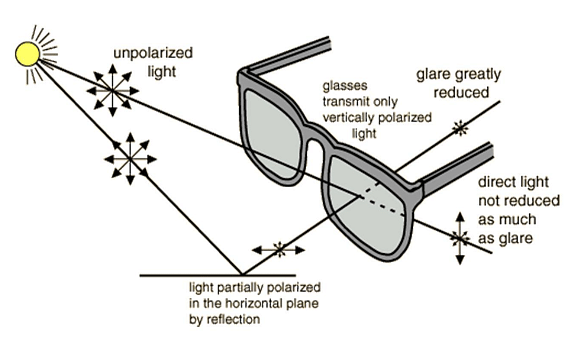
Polarized Sunglasses
- You will find polarizers present in Monitors and TV screens also to reduce the glare on sunny days.
- Photographers also use the same law to reduce the reflection from reflective surfaces by using a polarizing filter for the lens in their camera.
- Brewster windows, here both Brewster's law as well as Brewster's angles are used. This type of glass allows the windows to transmit light 100%. Brewster’s law application is also found in gas lasers as well as solid-state lasers. In the solid-state lasers, the end of the laser medium is cut to Brewster's angle to make a Brewster window.
Things to Remember
- According to Brewster's law maximum polarization of the reflected light wave is attained when the light ray falls on a transparent medium in such a way that the reflected light and refracted light form a right angle.
- Brewster’s angle is also known as the angle of polarization which is defined as the angle of incidence at which light with a specific polarization is perfectly transmitted without any reflection through a transparent dielectric surface or the light incident at this angle when reflected back, is perfectly polarized.
- μ = tan ip. The tangent of the polarizing angle is numerically equal to the refractive index of the medium.
- The Brewster’s angle for the air-glass interface is 56o19’.
- Applications of Brewster’s law are present in polarized sunglasses, televisions, monitors, windows and photography.
Also Read:
Previous Year Questions
- Light of wavelength 550nm falls normally on a slit of width 22.0×10⁻⁵cm. The angular position…? [JEE Mains 2018]
- In an interference experiment, the ratio of amplitudes of coherent waves is…? [JEE Mains 2019]
- Diameter of the objective lens of a telescope is 250cm. For light of wavelength 600nm…? [JEE Mains 2019]
- An observer is moving with half the speed of light towards a stationary microwave source…? [JEE Mains 2017]
- A plane polarized light is incident on a polariser with its pass axis making angle ‘a’ with x-axis…? [JEE Mains 2018]
- Two light sources are said to be coherent if they are obtained from … [VITEEE 2010]
- The Brewsters angle … [NEET 2020]
- A linear aperture whose width is … [NEET 2016]
- At the first minimum adjacent to the central maximum of single-slit diffraction … [NEET 2015]
- In a diffraction pattern due to a single slit of width 'a' … [NEET 2016]
- In a Young' double slit experiment … [NEET 2019]
- In the Young's double slit experiment, the intensity of light … [NEET 2014]
- In Young's double slit experiment, the slits are 2mm apart … [NEET 2013]
- Young's double slit experment is first performed in air … [NEET 2017]
- When the angle of incidence on a material is 60∘ … [KEAM]
- The ratio of the intensities of two waves is 16 : 9 … [KEAM]
- A monochromatic source of wavelength 60nm … [KEAM]
- A narrow slit of width 2mm … [KEAM]
- A slit of width a is illuminated by red light of wavelength … [KEAM]
Sample Questions
Ques. Where is the Brewster’s Law used? (3 Marks)
Ans. The uses of Brewster’s Law are:
- Polarized Sunglasses = The light which is reflected from roads or water surfaces is reduced because of the polarized sunglasses. The Polaroid present in the sunglasses is responsible for blocking the polarized rays which are a result of reflections from flat surfaces such as water, ground, glass, smooth or concrete roads. The rays which enter the sunglasses from the Sun are not affected much with polarization whereas the light that is reflected from any surface, gets polarized partially and its intensity reduces.
- Photography = The Brewster’s angle is important for photography as well. The reflections from the surfaces are removed, specifically, in hologram recording, the light is made to fall at an angle that is equal to Brewster’s angle ip, to reduce the effect of interference between the reflected, refracted or incident waves.
- Television and Monitor Screens = Polarizers are also present in computer monitors and television screens to reduce glare, since glare is nothing more than a reflection, and those reflections are polarized.
- Windows = Brewster windows, here both Brewster's law as well as Brewster's angles are used. This type of glass allows the windows to transmit light 100%. Brewster’s law application is also found in gas lasers as well as solid-state lasers. In the solid-state lasers, the end of the laser medium is cut to Brewster's angle to make a Brewster window.
Ques. What is Brewster’s angle of light travelling through water (n = 1.33) into the air? (3 Marks)
Ans. According to the question, our n1 = 1.33. Therefore, when we apply the formula of Brewster’s Law we get
Brewster’s angle = tan−1(n2/n1)
Brewster’s angle = tan−1(1.5/1.33)
Therefore, Brewster’s angle = 48.4°
Ques. The given refractive index of a polarizer is 1.9218. Find out the polarization angle and angle of refraction? (5 Marks)
Ans. According to the question, we have the refractive index of the polarizer, that is, μ=1.9218.
For finding Brewster’s angle and angle of refraction, we have to apply Brewster’s law:
μ = tan ip
Or, ip = tan−1tan−1 (1.9128)
Or, ip = 62o 24’
Angle of refraction:
We know that, ip + ir = 90o
Therefore, angle of refraction or ir = 90 – 62o 24’
So, angle of refraction= 27.6o
Ques. State and prove Brewster’s law. (5 marks)
Ans. Brewster law helps us understand how we can obtain the highest order of polarization of light by allowing the rays to come in contact with the surface of a transparent medium. A relationship develops between the polarizing angle* ‘ip’ is the specific value of angle of incidence at which the light gets completely polarized and the refractive index.
Proof

Brewster’s law
μ=tan ip
Where,
μ = Refractive index of the medium.
ip = Polarization angle.
From Snell’s Law:
μ = sinip/sin r ………… (1)
From Brewster’s Law
μ = tan ip …sin ipcos ip…………. (2)
Comparing both formulas: 1 and 2
Cos i =sin r= (cos π/2 – r)
i = π/2 – r, or I + r = π/2
As, i + r = π/2 <ABC this is also equal to.
Ques. Find out Brewster’s angle for air to glass transition? (Hint: Refractive index of glass = 1.5). (5 marks)
Ans. Refractive index of glass, μ=1.5
Brewster angle = ip
Relation between Brewster’s angle and refractive index:
tan ip =μ
ip =tan-1(1.5) =56.310
Therefore, the Brewster angle for air to glass transition = 56.31°.
For Latest Updates on Upcoming Board Exams, Click Here: https://t.me/class_10_12_board_updates
Check-Out:



Comments