



Content Curator
MCQs on the Difference between ammeter and voltmeter are covered in this article with a detailed explanation. The main difference between ammeter and voltmeter is that an ammeter measures the current while a voltmeter measures the voltage applied across the circuit. An ammeter offers very low resistance to the current while the resistance offered by a voltmeter is high. In a circuit, an ammeter is always connected in series but a voltmeter is connected in parallel.
Current flow in a circuit can also be measured with another device called a galvanometer. A galvanometer can be converted into an ammeter and voltmeter by doing some changes in the way it is connected to the circuit.
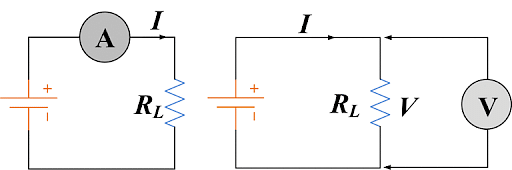
Connection of Ammeter and Voltmeter in a Circuit
Important MCQs on Ammeter and Voltmeter
Ques 1. In a circuit, an ammeter is always connected in:
- Parallel
- Series
- Both parallel and series
- None of the above
Click here for the answer
Ans. (b). Series
Explanation: An ammeter is always connected in series in a circuit because when a device is connected in series, the current remains the same. An ideal ammeter has very low resistance to ensure that it allows all the current to pass through it and measures the accurate value of current.
Ques 2. A moving coil galvanometer can be converted into an ammeter by connecting it with a:
- low resistance in series
- low resistance in parallel
- high resistance in parallel
- high resistance in series
Click here for the answer
Ans. (b). low resistance in parallel
Explanation: To convert a galvanometer into an ammeter, a shunt resistance is connected to it in parallel. This shunt resistance has negligible resistance and thus this combination can be used to measure the current flowing through the circuit.
Ques 3. A 24 V potential difference is applied across a parallel combination of four 6Ω resistors. The current in each resistor is:
- 1 A
- 4 A
- 16 A
- 36 A
Click here for the answer
Ans. (b). 4 A
Explanation: When the resistors are connected in parallel, the voltage across each resistor is the same i.e. 24 V. So, the current in each resistor will be,
I = V/R
I = 24/6 = 4 A
Ques 4. The resistance of an ideal ammeter is:
- Zero
- Very small
- Very large
- Infinite
Click here for the answer
Ans. (a). Zero
Explanation: The resistance of an ideal ammeter is zero. This is because an ammeter is a device used to measure the current flowing in a circuit. If its resistance is high, it will stop the current from flowing and will not give accurate readings. However, the resistance of an ammeter is always kept low, ideally zero, to allow all the current to pass through.
Ques 5. The resistance of an ideal voltmeter is:
- Zero
- Greater than zero but finite value
- 5000
- Infinite
Click here for the answer
Ans. (d). Infinite
Explanation: A voltmeter is a device used to measure the voltage applied across the terminals of a circuit. The resistance of a voltmeter is very high (or infinite) so that no current can pass through it.
Read More:
Ques 6. Assertion: The resistance of an ideal voltmeter should be infinite.
Reason: Lower resistance of voltmeters gives a reading lower than the actual potential difference present across the terminals.
- Both assertion and reason are true and reason is the correct explanation for the assertion
- Both assertion and reason are true but reason is not the correct explanation for the assertion
- Assertion is true but reason is not true
- Assertion is not true but reason is true
Click here for the answer
Ans. (a). Both assertion and reason are true and reason is the correct explanation for the assertion
Explanation: The resistance of a voltmeter is always high i.e. infinite, so that no current can pass through it and accurate readings of the applied voltage can be obtained. If the resistance of the voltmeter is kept low, it will draw some current from the circuit and will measure a lower than actual value of potential difference.
Ques 7. In an ammeter, 0.2% of main current passes through the galvanometer. If the resistance of galvanometer is G, the resistance of ammeter will be:
- 1/499 G
- 499/500 G
- 1/500 G
- 500/499 G
Click here for the answer
Ans. (c). 1/500 G
Explanation: Galvanometer and the shunt are in parallel, so
igRg = isRs
(i/500)G = (499/500) i S
S = G/499
Equivalent resistance of the ammeter,
1/Req = 1/G + 1/(G/499)
Req = G/500
Ques 8. An electric lamp whose resistance is 10 and a conductor of 2 resistance is connected in series with a 6V battery. The total current through the circuit and the potential difference across the electric lamp are:
- 3.6 A and 6 V
- 0.5 A and 5 V
- 2 A and 0.2 V
- 0.3 A and 3 V
Click here for the answer
Ans. (b). 0.5 A and 5 V
Explanation: In series,
Req = 10 + 2 = 12
V = IR
I = V/R
I = 6/12
I = 0.5 A
Potential difference across the electric lamp,
= 10 0.5
= 5 V
Ques 9. Two batteries one of emf 18 V and internal resistance 2 and the other of emf 12 V and internal resistance 1 are connected in parallel. The voltmeter V will record a reading of:
- 18 V
- 14 V
- 15 V
- 30 V
Click here for the answer
Ans. (b). 14 Volt
Explanation: The batteries are connected in parallel, so
V = E1r2 + E2r1 / r1 + r2
V = 18 1 + 12 2 / 1 + 2
V = 14 Volt
Ques 10. Two cells of emf 4V and 2V and internal resistance 2 and 1 respectively are connected in parallel so as to send the current in the same direction through an external resistance of 10. The potential difference across 10 resistor is:
- 2.5 V
- 4 V
- 6 V
- 3.2 V
Click here for the answer
Ans. (a). 2.5 V
Explanation: In parallel connection, the equivalent resistance is
req = r1r2 / r1 + r2
req = 1 2 / 1 + 2 = ⅔
Equivalent emf in parallel connection,
Eeq = [E1/r1 + E2/r2] req
Eeq = [2/1 + 4/2] ⅔ = 8/3 V
Potential difference across 10 resistor, E = (R / R + req) Eeq
E = (10 / 10 + ⅔ ) 8/3 = 2.5 V
Check Also:



Comments