



Content Writer
Difference Between Starch and Cellulose is that Starch comprises alpha glucose while Cellulose comprises beta glucose. Starch and Cellulose both come under the category of Polysaccharides. Starch is soluble in water while cellulose is insoluble in water. Humans cannot digest cellulose easily while they can digest starch easily. Starch helps the plants to store energy whereas cellulose helps the plants to provide stiffness.
| Table of Content |
Key Terms: Starch, Cellulose, Monosaccharides, Plant, Cell Wall, Energy, Glucose
What is Starch?
[Click Here for Sample Questions]
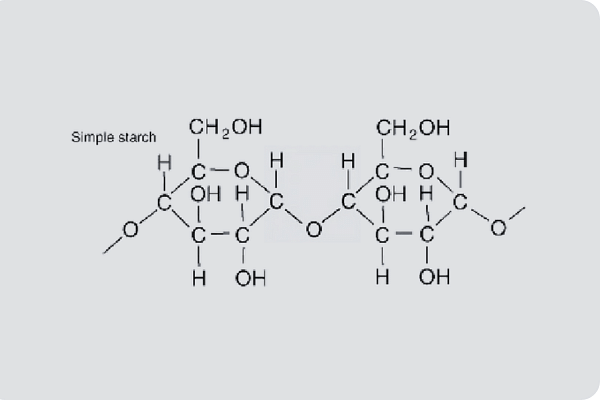
Starch is a form of polysaccharide that is found abundantly in nature. It is a complex chemical composition that is one of the by-products of photosynthesis. Thus, it is known to be produced by plants.
Starch
| Important Facts About Starch
|
Also Read:
| Related Articles | ||
|---|---|---|
| Denaturation of Proteins and Causes | Maltase | Oligosaccharide |
| Hormones | Complex Carbohydrates | Difference Between Fats and Oils |
Structure of Starch
[Click Here for Sample Questions]
The structure of starch follows a chain of α-glucose monomers and is made up of sugar glucose. Additionally, a molecule of glucose, that is, C6H12O6 is made up of carbon (C), hydrogen (H), and oxygen (O).
Starch is a polysaccharide that itself is formed from a group of monomers. The reaction of condensation helps in the formation of the glycosidic bonds that are present in its linkage. The by-product, thus, produced is water.
What is Cellulose?
[Click Here for Sample Questions]
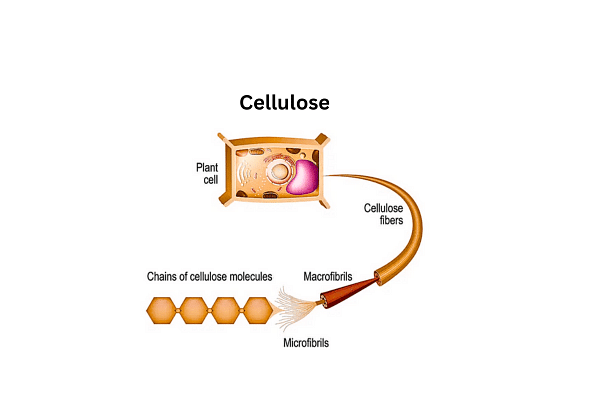
Cellulose is a glucose polymer and a complex carbohydrate. Its structure is mainly made up of hundreds or thousands of glucose units.
Cellulose
| Important Facts About Cellulose
|
Structure of Cellulose
[Click Here for Sample Questions]
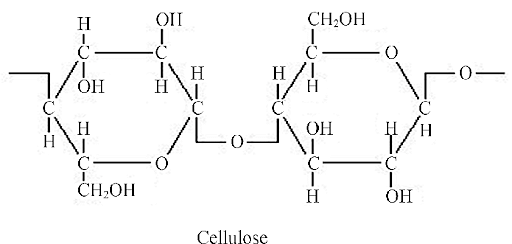
The general formula used for cellulose is (C6H10O5). The structure of cellulose is obtained when the successive unit of glucose monomer. It is present in the structure of starch is rotated 180° around the polymer backbone chain’s axis.
Simultaneously, this cellulose can be broken down into glucose (C6H12O6) under high temperatures. This mainly happens due to its treatment with concentrated mineral acids.
Structural Differences Between Cellulose and Starch
[Click Here for Sample Questions]
Both starch and cellulose are made up of groups of monomers and both represent the characteristics of the glucose polymers. However, both vary immensely in terms of their differences, such as, in starch, the repeat units of glucose are linked together in such a manner that they all lie in the same orientation.
Whereas, in the case of cellulose, the repeat units of glucose are linked together in a way so that the alternating molecules are rotated 180 degrees from each other in order to attain the structure of cellulose.
Cellulose is mainly a straight-chain-shaped polysaccharide of β – D – glucose units. These units are joined by C1 - C4 glycosidic linkage (β-link). Follow the diagram for a better understanding.
Structure of Cellulose
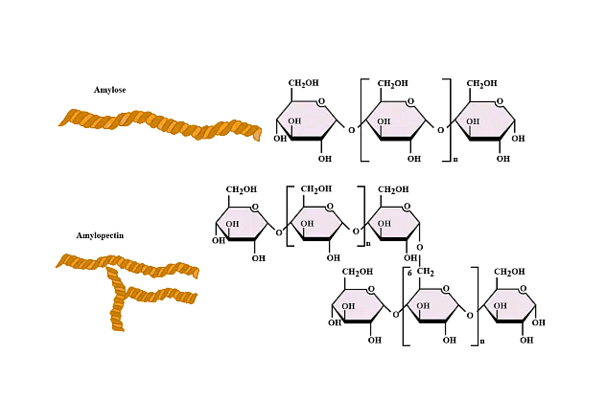
Starch is made up of two elements, such as
Amylose - this is made up of ∝-D- glucose units, in a linear chain. These units are linked to each other by C1 - C4 glycosidic linkage.
Amylopectin - this is also made up of ∝-D-glucose units, a linear chain. These units are linked to each other by C1 - C4 glycosidic linkage and then branching also progressively takes place by C1-C6 glycosidic linkage.
Amylose and Amylopectin
Other Differences Between Starch and Cellulose
[Click Here for Sample Questions]
Here are a few other differences between starch and cellulose:
| Attributes | Starch | Cellulose |
|---|---|---|
| Alpha / Beta | 2 types of alpha glucose are involved | 1 type of beta glucose is involved |
| Connection | Through alpha linkage | Through beta linkage |
| Digestion | Easily digested | Difficult to digest by humans |
| Found In | Plants | Only in Plants specifically in the cell wall. |
| Solubility | Dissolves in warm water | Does not dissolve in water |
| Strength | Weaker than cellulose | Comparatively stronger |
| Crystalline | Less crystalline in nature | More crystalline than starch |
| Consumption | Can be consumed by humans | Cannot be consumed by humans |
| Linkage | Starch has alpha 1,4 linkage | Cellulose has beta 1,4 linkage |
| Significance | Plants use starch to store energy | Plants use cellulose to support structure |
Things to Remember
- Cellulose becomes difficult to digested by humans because of its complex nature but on the other hand, it takes a few minutes for the herbivores like cows to consume it.
- Both cellulose and starch are a form of polysaccharides that are formed by a group of monomers. However, the structure of these monomers varies which also creates variations in their appearances and characteristics.
- Starch performs other functions as well except that of health benefits, such as, it is used as a thickening agent in baking cakes and pastries, and a bulking agent in dairy items.
- Starch is also known to work as a binding agent in soups and sauces, and its properties also allow it to act as a sweetening agent in beverages.
- The most significant property of both cellulose and starch is that both perform the function of acting as a storehouse of energy.
Also Read:
| Related Articles | ||
|---|---|---|
| Zwitterion | Peptide Bond or Peptide Linkage | Transfer RNA (t-RNA) |
| Glutamic Acid | Histidine | Asparagine Amino Acid |
| Carbohydrates | Proteins | Sucrose |
| Enzymes | Vitamins | Nucleic Acids |
Sample Questions
Ques. How do you identify starch? (3 Marks)
Ans. Starch follows a specific structure such as, it involves a chain of α-glucose monomers and is entirely made up of sugar glucose. Starch is a polysaccharide and is formed from a group of monomers. Glycosidic bonds are formed through the reaction of condensation and these are known to be present in its linkage.
Ques. Explain the structure of cellulose. (3 Marks)
Ans. The structure of cellulose is known to have obtained when the successive unit of glucose monomer are rotated 180° around the polymer backbone chain’s axis. These glucose monomers are taken from the structure of starch and simultaneously, this cellulose can be broken down into glucose (C6H12O6) under high temperatures due to its treatment with concentrated minerals acids.
Ques. What makes cellulose stronger than starch? (3 Marks)
Ans. Cellulose and starch both are made up of a group of monomers but their structure varies slightly. Cellulose is formed in a linear expression when molecules join each other in a way that opposite molecules are rotated at 180 degrees from one another. Moreover, cellulose also has more hydrogen bonds in between the glucose units. Thus, it becomes tough as compared to starch and glucose.
Ques. What is Cellulose? (3 Marks)
Ans. Cellulose is a glucose polymer and a complex carbohydrate made up of hundreds or thousands of glucose units. It is found in the cell walls of the plants and is known for performing essential functions like it helps the plants to stay firm. On contrary to starch, cellulose is insoluble in water, thus, cannot be digested by plants and humans.
Ques. Explain the differences between cellulose and starch. (3 Marks)
Ans. Starch mainly involves 2 types of alpha glucose whereas on the other hand cellulose involves 1 type of beta glucose. In starch, the repeat units of glucose are linked together in such a manner that they all lie in the same orientation. While in cellulose, the repeat units of glucose are linked together in a way so that the alternating molecules are rotated 180 degrees from each other. This also makes the structure of cellulose tougher and stronger as compared to the starch. Another major difference between the both is that starch is easily digestible by humans as well as plants and is known for imparting a large amount of energy whereas, cellulose has an extremely complex structure which makes it difficult to be consumed by plants and humans.
Ques. Explain the differences between the structures of Amylose and Amylopectin? (3 Marks)
Ans. Amylose is made up of ∝-D- glucose units, in a linear chain. Whereas the amylopectin is also made up of ∝-D-glucose units and that too in a linear chain. In the case of amylose, these units are linked to each other by C1 - C4 glycosidic linkage. Whereas in amylopectin, the units are linked to each other by C1 - C4 glycosidic linkage, and then branching also progressively takes place by C1-C6 glycosidic linkage.
Ques. Mention two different uses of starch except for the health benefits. (3 Marks)
Ans. Starch has multiple uses except that of health benefits, such as being used as a thickening agent in baking cakes and pastries, and a bulking agent in dairy items. It is also known to play an important role as a binding agent in soups and sauces, and its properties also allow it to act as a sweetening agent in beverages
Ques. Mention a few similarities between starch and cellulose. (3 Marks)
Ans. Both starch and cellulose are formed out of the group of monomers. They are different forms of polysaccharides that are formed by the collection of tens of thousands of monosaccharides. Both these chemical elements are known for being the storehouse of energy. In fact, the structure of their formation also develops in a linear form, however, the latter placements of molecules vary immensely.
Previous Year Questions Based on Starch and Cellulose
|
For Latest Updates on Upcoming Board Exams, Click Here: https://t.me/class_10_12_board_updates
Do Check Out:



Comments