



Education Journalist | Study Abroad Lead
Maltase is an enzyme that catalyzes the conversion of maltose, a disaccharide, to glucose, a simple sugar. The enzyme is present in yeast, plants, and bacteria and is considered to be produced by cells of the mucous membrane in the lining of the intestinal wall in humans and other vertebrates. During digestion, pancreatic or salivary enzymes called amylases convert starch to maltose, which is then converted to glucose by maltase released by the colon. The glucose produced is either used by the organism or stored as glycogen in the liver (animal starch).
| Table of Content |
Key Terms: Maltase, Enzymes, Maltose, Amino Acids, Glucose, Pancreatic Enzyme, Yeast, Acid, Alpha-Glucosidase
Maltase
[Click Here for Sample Questions]
For the digestion of starch, six digestive enzymes are required. Two of these enzymes are alpha-amylases, which are luminal endo-glucosidases. The remaining 4 enzymes are various maltases, exo-glucosidases linked to the luminal membrane of enterocytes. Sucrase-isomaltase was linked to two of these maltase activities (maltase Ib, maltase Ia). Maltase-glucoamylase was the name given to the other two maltases that had no differentiating properties (maltases II and III). As they all digest linear starch oligosaccharides to glucose, these four maltases are also known as alpha-glucosidase.
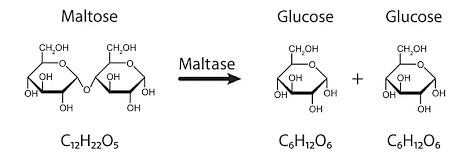
Maltose to Glucose
Structure of Maltase
[Click Here for Sample Questions]
Maltase belongs to the Family GH13 (Glycoside hydrolase family 13) of intestinal enzymes that are responsible for breaking down the -glucosidase connections of complex carbohydrates into simple glucose molecules to make use of them. Cells would then utilise the glucose molecules as "food" to make energy (Adenosine triphosphate) during cellular respiration. Maltase can be coded for by the genes as below:
- The GAA gene coded for acid alpha-glucosidase is required for the breakdown of complex sugars, glycogen into glucose.
- Maltase-glucoamylase, encoded by the MGAM gene, is involved in starch digestion. Starches of plant origin can be digested in humans due to this enzyme.
- Sucrase-isomaltase that is coded on the SI gene is required for the digestion of carbohydrates such as starch, sucrose, and isomaltose.
- Alpha-amylase 1, encoded by the AMY1A gene is responsible for cleaving -glucosidase links in oligosaccharides and polysaccharides to produce starches and glycogen for the previous enzymes to catalyse. The presence of this gene in the brain in higher quantities has been linked to a lower risk of Alzheimer's disease.

Structure of Maltase
Mechanism of Maltase
[Click Here for Sample Questions]
The mechanism of all Family GH13 enzymes is to hydrolyze -glucosidase bond and hence break it. Maltase targets α-(1->4) bond in maltose, a disaccharide that serves as a connection between two units of glucose. The size of the substrate (carbohydrate size) determines the rate of hydrolysis.
Maltase Deficiency
[Click Here for Sample Questions]
Pompes disease, commonly known as Acid Maltase Deficiency (AMD), is a genetically inherited condition that affects muscle function. Patients with AMD have a deficiency, or mutation, in the Acid Alpha-Glucosidase (GAA) gene, which controls muscle function. Patients with AMD have a chemical called glycogen build up in their muscles as a result of this genetic abnormality. Glycogen is a type of carbohydrate that is utilised to store energy in the short term. Glycogen build-up in the muscles of people with AMD promotes muscle degeneration, which leads to increased muscle weakness. The heart and respiratory muscles may be weakened as a result of this glycogen build-up.
The most common cause of mortality in AMD patients is cardiac or respiratory failure. One in every 40,000 to 100,000 babies is thought to be affected by AMD. The start of AMD varies from patient to patient, and it might strike newborns, children, or adults. The most severe form is newborn onset, which usually results in mortality within a year.
In general, the later AMD appears, the slower it progresses and the less severe the symptoms become. When children and adults are diagnosed with AMD, their life expectancy ranges from 10 to 20 years after symptoms develop.
Production of Maltase Enzyme
[Click Here for Sample Questions]
During digestion, salivary or pancreatic enzymes known as amylases (amylase maltase) partially convert starch to maltose; maltase is released by the colon and then transforms maltose to glucose. The glucose produced is either used by the organism or stored as glycogen in the liver (or called animal starch).
Industrial Applications
[Click Here for Sample Questions]
As alpha-amylase plays a crucial role in the breakdown of starches, it is widely employed in the baking business. It is generally used as a taste enhancer to improve the quality of bread. Yeast would be unable to ferment without alpha-amylase. Maltose-glucoamylase is a typical fermentation source because it can break down starch into maltose, which may then be utilised to brew beers and sake. Maltose glucoamylase has been explored outside of brewing by adding particular inhibitors that prevent the hydrolysis of the -glucosidase links.
Difference between Maltose and Maltase
[Click Here for Sample Questions]
Maltose is a carbohydrate that is generated when amylase digests starch and is transformed to glucose by maltase. It is also an isomer of trehalose. Maltase is a maltose-to-glucose hydrolase enzyme that is frequently confused with amylase.
- Maltose, also known as maltobiose and malt sugar, is a crystalline disaccharide (C12H22O11) produced from starch by the action of malt diastase and the amylolytic ferment of saliva and pancreatic juice. Its chemical formula is 4-O-. It's white crystalline sugar that forms when carbs are digested.
- Maltase is an enzyme that catalyses the breakdown of maltose and other carbohydrates into glucose and is found in saliva and pancreatic juice.

Maltase
Amino Acids in Maltase
[Click Here for Sample Questions]
The following amino acids are found in maltase:
- Alanine
- Arginine
- Aspartic Acid
- Glutamic Acid
- Glycine
- Isoleucine
- Leucine
- Lysine
- Methionine
- Phenylalanine
- Proline
- Serine
- Threonine
- Tyrosine
- Valine
Maltase Use in Yeast and its Mechanism
[Click Here for Sample Questions]
The enzyme maltase, which converts maltose to glucose, is found in the yeast used in bread production.
- A maltose molecule is initially taken by the yeast cell, after which maltase binds to it and splits it in half.
- Invertase is a sucrose-breaking enzyme found in yeast cells, just like sucrose.
- This enzyme breaks down the little quantity of sugar in flour.
- Invertase and maltase are two enzymes that are responsible for producing a major amount of the glucose required for yeast to ferment and make the final product, bread.
Things to Remember
[Click Here for Sample Questions]
- Maltase is an alpha-glucosidase enzyme that breaks down disaccharides like maltose into individual glucose molecules.
- Pompes disease, also known as Acid Maltase Deficiency (AMD), is a genetically inherited muscle-function disorder.
- The Acid Alpha-Glucosidase (GAA) gene, which governs muscle function, is deficient or mutated in AMD patients.
- Maltose, also known as maltobiose and malt sugar, is a crystalline disaccharide (C12H22O11) produced from starch by malt diastase and the amylolytic fermentation of saliva and pancreatic juice.
- Maltase is a member of the GH13 (Glycoside hydrolase family 13) of intestinal enzymes that break down the -glucosidase linkages of complicated carbohydrates into easy-to-use glucose molecules.
| Chemistry Related Links: | ||
|---|---|---|
| Amylose and Amylopectin | Structure of Glucose and Fructose | Dehydration of Alcohols |
| Hydrogen Bonds | Proteins | Amino Acids |
Sample Questions
Ques. What would happen in the absence of maltase? (2 marks)
Ans. The enzyme maltase lessens the strain of digestion on the pancreas and small intestine. Without this enzyme, sugars and carbohydrates are much more difficult to digest in the small intestine. Maltase helps the entire digestive system run smoothly in this way.
Ques. At what temperature does Maltase work best? (3 marks)
Ans. For the partially purified maltase, the optimal pH is 6.5, the optimum temperature is 48 to 50 degrees C.
- The pH stability range is 5.0 to 7.0.
- The temperature stability range is 0 to 50 degrees C.
- The isoelectric point was pH 5.2, and the molecular weight is 52,000.
Ques. What is the link between the structure and function of maltase? (3 marks)
Ans. Maltase is a member of the GH13 (Glycoside hydrolase family 13) group of intestinal enzymes that transform glucosidase linkages in complex carbohydrates into simple glucose molecules for ingestion. Cells then employ the glucose molecules as a form of "meal" to produce energy (Adenosine triphosphate) during cellular respiration.
Ques. What is the other name for maltase? (2 marks)
Ans. The MGAM gene, which is located on chromosome 7q34, encodes the protein Maltase-Glucoamylase.
Glucan 1, 4-alpha-glycosidase is another name for Maltase-Glucoamylase.
Ques. Describe what kind of enzyme is Maltase. (1 mark)
Ans. Maltase is an alpha-glucosidase enzyme that converts maltose and other disaccharides into individual glucose molecules.
Ques. Explain the function of Maltase. (3 marks)
Ans. When starch is digested into maltose utilising pancreatic or salivary enzymes like amylase, maltase plays the most significant role in the human digestive system (also known as maltase digestive enzyme) (amylase maltase).
These maltase enzymes convert the glucose once the amylase has finished breaking it down. This procedure is critical for the digestive system's and body's overall wellness. Once glucose is present in the body, it can be stored as an animal or glycogen starch in the liver or utilised for energy.
Ques. What type of biomolecule does each enzyme belong to? (3 marks)
Ans. Enzymes are commonly referred to as proteins. However, RNA can create a variety of tertiary structures, some of which are termed Ribozymes and include catalytic functions. They rarely contain deoxyzymes, which are extremely scarce, and their capacity to create various tertiary structures is limited by their double helix structure.
Ques. What are LDH Enzymes? How do they Work? (3 marks)
Ans: LDH stands for Lactate Dehydrogenase in most cases. A tetramer with four subunits is what it is called. It's possible that the components are H or M polypeptide chains. When these four components are combined in varying quantities, they generate five isoenzymes: H4 (which is written as HHHH), H3M1 (as HHHM), H2M2 (as HHMM), H1M3 (as HMMM), and M4 (as MMMM).
Ques. How was Maltase discovered? (5 marks)
Ans. Maltase was first discovered in 1806 when Napoleon Bonaparte issued the "Berlin edict," which declared a continental blockade. In 1833, two French chemists, Anselm Payen and Jean-Francois Persoz developed malt extract, which turned starch into glucose and was dubbed diastase at the time. Mucosal maltase activity was discovered in 1880 by H.T. Brown, who distinguished it from diastase, which is now known as amylase.
In the 1960s, Arne Dahlqvist and Giorgio Semenza were able to fractionate and analyse the activity of tiny intestinal maltase, which led to additional advances in protein chemistry. Both groups discovered that maltase activity was present in four different percentages in two different peptide configurations, sucrase-isomaltase and maltase-glucoamylase.
For Latest Updates on Upcoming Board Exams, Click Here: https://t.me/class_10_12_board_updates
Check-Out:



Comments