



Education Journalist | Study Abroad Lead
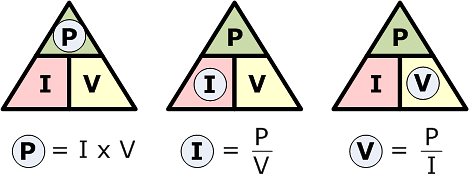
Electric Power measures the rate of electrical energy that is transferred by an electric circuit per unit of time. It is commonly produced by electric generators or supplied by electric batteries. Power is denoted by ‘P’ and its SI unit is Watt. The electric power can be calculated by the electric power formula P = VI.
| Table of Contents |
Key Terms:- Electric Power, Ohm’s Law, Electrical energy, Watt, Voltage, Charge, Resistance.
Electric Power Formula
[Click Here for Sample Questions]
The formula for electrical power has been derived from Ohm’s Law. It connects time, voltage, and charge. The formula for electric power is:
P = IV
By Ohm’s Law, it can also be written as:
P = I2R
Or
P = V2/R
Where,
- P = Electric Power
- I = Electric current
- R = Resistance
- V = Voltage or Potential difference
Electric Power: Solved ExamplesQues. Calculate the electric power of the circuit whose current is 3 Ampere and voltage is given as 10 volts. Ans. Here, Current flowing in the circuit = I = 3 Amp Potential difference along the circuit = V = 10 volts By the formula of electric power, P = IV P = 3 * 10 P = 30 watts Hence, the power consumed in the circuit is 30 watts. Ques. A radio battery needs 12 V to operate normally. The owner plays a song on it that requires an additional 0.9 Amp current. Find out the power consumed in this regard. Ans. Here, Current flowing in the circuit = I = 0.9 Amp Potential difference along the circuit = V = 12 volts By the formula of electric power, P = IV P = 0.9 * 12 P = 10.8 watts Hence, the power consumed in the radio battery is 10.8 watts. Ques. In a resistor that resists heat, the potential difference of 24 volts is applied. The rate of production of thermal energy is 16 watts. What would be the value of resistance? Ans. Here, Potential difference along the circuit = V = 24 volts Power consumed in the resistor = P = 16 watts By the formula of electric power, P = V2/R -> R = V2/P R = 24 * 24 / 16 R = 36 ohm Hence, resistance in the resistor is 36 ohm |
Power Energy Formula
[Click Here for Sample Questions]
Power is the rate of consumption of energy. The electric circuit element is positive and negative periodically over some interval of time, depending upon the sign of the power integral. If the power is constant over the time interval, power consumption can be expressed as:
E = Pt
P = \(E \over t\)
Where,
- E = Energy Produced
- P = Power Consumption
- T = Time period
Electric Power
Also Read:
Derivation of Electric Power
[Click Here for Sample Questions]
Power is the rate of doing work and similar is the electric power that corresponds to the rate of transfer of electric energy. Electric energy is derived from the kinetic energy of charged particles or potential energy.

Derivation of Electric Power
- Electrolytic battery has two terminals namely an anode and cathode, the positive and negative terminal.
- The potential difference which is developed across two terminals due to the flow of electrons is called emf (electromotive force) or voltage in simple words.
- Suppose an electrolytic battery with two terminals A and B has V1 and V2 voltage at terminals A and B respectively.
- The potential difference between both terminals is: V = abs (V1-V2)
As this is the arithmetic difference between voltages, it is always the positive quantity greater than zero.

Derivation of Electric Power
The electric current is the flow of electrons or the electric charges. Electric current is nothing but the rate of flow of electrical charges in a particular cross-sectional area. The kinetic energy of the particle which is conserved is stored in the form of potential energy. Let the potential energy of charge ‘q's at terminal A be qV1 and the potential energy of charge ‘q’ at terminal B will be qV2. Thus, is:

Total change in energy of the system
ΔU = final potential energy - initial potential energy
ΔU = Δq (V2 – V1)
ΔU = -IΔt V ( since, I = Δq/Δt)
If the total kinetic energy of the system is taken into account, then it will change if charges inside any conductor move without collision. This is basically to conserve the total energy of the system. By the law of conservation of energy, we can say:
- U = Kinetic Energy
- Kinetic Energy = -IVΔt > 0
Thus, when charges move freely across any conductor in an electric field, gradual energy in Kinetic Energy is observed.
When there is a collision in the charges, the total energy gained is shared among all the atoms. This gained energy increases the vibration of atoms within the conductor, and this heats the conductor. Hence, in this process, some energy is dissipated from the conductor in the form of heat.
Also Read:
Things to Remember
- Electric power is the rate at which electrical energy is transferred through an electric circuit.
- It is denoted by P.
- The SI unit of power is Watt.
- The formulas for Power can be defined as: P = IV Or P = I2R Or P = V2/R
- One watt of power is said to be consumed if one joule of electric energy flows in one second time.
- The Commercial unit for power is Kwh.
- The electrical power conversion is 1 kwh = 36 x 105 Ws or Joules
Sample Questions
Ques. What is the easiest way to calculate the electric power of a circuit? (2 marks)
Ans. Electric power is nothing but the rate of transfer of electrical energy in an electric circuit per unit of time. Electric power can be easily calculated by the formula P = IV. where P is the power consumed, I is the current flowing through the circuit and V is the applied potential difference.
Ques. What is the electric power formula? (2 marks)
Ans. Electric power can be calculated through P = VI where P denotes the power, V is the potential difference, and I is the electric current.
Ques. Does resistance affect power consumed? (2 marks)
Ans. The formula of electric power is P = V2/R. If the resistance in a circuit is more, more energy will be wasted in the form of heat, and power produced will be less. Power is inversely proportional to resistance. More the resistance, the less will be the useful power.
Ques. Does the internal resistance have anything to do with electric power? (2 marks)
Ans. Lesser will be internal resistance for an applied voltage, more current and more power will be produced by the source. Hence, power is inversely proportional to the internal resistance.
Ques. What is the use of electric power in real life? (2 marks)
Ans. Electric power is the reason behind a running generator, an operating TV, refrigerator, and all other electric appliances. Hence, electric power is the main reason behind the world of electricity.
Ques. What is a power generator? (2 marks)
Ans. The power generator is a device that converts mechanical energy to electric power that can be used in any electric circuit. They are used in water turbines, to convert hydropower into electricity in power stations.
Ques. In an electric circuit, a current of 2.5 Amp is applied and a potential difference is 10 volts. Calculate the electric power generated. (3 marks)
Ans. Here,
Current flowing in the circuit = I = 2.5 Amp
Potential difference along the circuit = V = 10 volts
By the formula of electric power,
P = IV
P = 2.5 * 10
P = 25 watts
Hence, power consumed in the circuit is 25 watts.
Ques. Find the power consumed by a battery with internal resistance 3 ohm and a current of 4 Amp is passed. (3 marks)
Ans. Here,
Resistance of battery = R = 3 ohm
Current flowing in the circuit = I = 4 Amp
By formula of electric power,
P = I2R
P = 4 * 4* 3
P = 48 watts.
Hence, power consumed in an electric circuit is 48 watts.
Also Read:



Comments