



Education Journalist | Study Abroad Lead
Ohm’s Law is a formula that establishes a relation between current (I), voltage (V), and resistance (R) in an electrical circuit. In 1826, Georg Simon Ohm formed Ohm’s law through an experiment. He observed that the current flowing through a circuit is directly proportional to the voltage and inversely proportional to the resistance if the temperature remains constant.
Ohm’s law states that potential difference across the ends of a conductor is directly proportional to the current flowing in the conductor, provided all physical conditions, especially the temperature remains constant.
V ∝ I
- The formula of Ohm’s Law, Voltage (V) = Current (I) × Resistance (R), helps to find the missing value of the 3rd variable when any 2 values of voltage, current, or resistance are known.
- It is one of the most basic laws of electricity to calculate the power, current, efficiency, voltage, and resistance of an element of an electrical circuit.
- Ohm’s law is used in our daily life – in electrical fuses to protect the circuits by controlling current or to control the speed of the fan by varying resistance.
Click here to read Ohm’s law in Hindi
Key Terms: Ohm’s Law, Voltage, Current, Resistance, Potential Difference, Rheostat, Circuit Diagram, Conductor
What is Ohm’s Law?
[Click Here for Sample Questions]
Ohm’s Law states that the potential difference across the ends of a metallic wire is directly proportional to the current flowing through it, provided all physical conditions and temperature remain constant.
- Ohm’s Law gives the relationship between the current (I) and the potential difference (V) across the terminals of a conductor.
- Ohms Law is used in all branches of electrical to calculate the value of resistors required in electrical circuits.
- It can also be used to determine the current flowing in a circuit where the voltage can be measured across a known resistor easily.
- Ohm’s law is not a universal law. It is applicable to ohmic conductors but not to non-ohmic conductors like semiconductors.

Ohmic and Non-Ohmic Conductors
- Ohm’s law only holds true if other physical factors and the temperature remain constant.
- In certain cases, increasing the current raises the temperature.
- For example, in the filament of a light bulb, the temperature rises as the current is increased. In this case, Ohm’s law can not be applied in this scenario. The lightbulb filament thus violates Ohm’s Law.
Ohms Law Explained
Ohms law video
Download Ohm’s Law PDF
Ohm’s Law Formula
As current and potential difference are both scalar quantities, Ohm’s law is represented in scalar form. Mathematically, the equation for Ohm’s law in scalar form is represented as:
ΔV = IR
The three basic components of Ohm’s law formula are current, voltage, and resistance –
- Current (I) is the flow of charge from a positive source to a negative charge source.
- Voltage or potential difference (V) is the electromotive force that pushes free electrons from one atom to another in the same direction.
- Resistance (R) is a measure of the opposition to the flow of current.
R or the constant of proportionality is known as Resistance. It is represented in Ohms, with the symbol Ω. R is constant for ohmic conductors that follow Ohm’s law. Ohm’s formula can be rewritten to calculate the resistance and current respectively as follows:

ExampleIf we apply 10 V across one end of a conductor and 0 across the other end, a current of 1A flows through it. Now, if we increase the potential difference at one end from 10 to 20 V while keeping the other 0, what will happen to the current in the conductor? Solution: Let us demonstrate this through a diagram
Due to potential difference, electrons flow from one end of the conductor to the other which causes current to flow in the conductor. So according to Ohm’s law as the current is proportional to the potential difference. So if the potential difference is doubled, the current will also be doubled. So, the current across the conductor now becomes 2A. |

Ohm’s Law Units
The units of elements of Ohm’s law are as follows –
| Element | Symbol | Units |
|---|---|---|
| Current | I | Ampere |
| Voltage | V | Volts |
| Resistance | R | Ohms |
Click here to read Ohm's Law in Bengali
Ohm’s Law Physics Previous Year QuestionsOver the last 15 years, 25 questions related to Ohm’s law have been asked for generally 2 to 3 marks. Some of the important previous year's questions of Ohm’s law in entrance exams are –
|
Vector Form of Ohms Law
The vector form of Ohms law is used in material science and electromagnetics. Ohm’s Law in vector form is represented as,
\(\overrightarrow{J} = \sigma \overrightarrow{ E} \)
- Where, \(\overrightarrow{J}\) is current density which is the vector equivalent of current
- \(\overrightarrow{E}\) is electric field which is the vector equivalent of potential difference
- and σ is conductivity which is reciprocal of resistivity \(\rho\) which is the vector equivalent of resistance
The microscopic form of Ohm's law is given as J = σE, where σ represents electrical conductivity, E is the electric field and J is the current density
State Ohm’s LawOhm’s law states that the voltage or potential difference across a conductor is directly proportional to the current that flows through it, provided all physical conditions and temperature, remain constant. Ohm’s Law EquationThe equation for Ohm’s law is V = IR, where V denotes the voltage across the conductor, I denotes the current flowing, and R refers to the resistance provided by the conductor to the flow of current. |
Read More:
Applications of Ohm’s Law
[Click Here for Important Questions on Ohm’s Law]
The applications of Ohm’s Law are as follows:
- Ohm’s Law is used to find the value of voltage, resistance, or current of an electric circuit.
- It is used to maintain the desired-voltage drop across the electronic components.
- Ohm’s Law is used in DC ammeter and other DC shunts to divert the current.
- It is used to calculate the value of power consumption.
Ohm's law and Kirchhoff's lawOhm’s law and Kirchhoff’s Laws are important laws to explain the functioning of electrical circuits. The equations of an electrical circuit are determined using Ohm's Law.
|
Relationship between Voltage, Current, and Resistance
[Click Here for Sample Questions]
According to Ohm’s Law, the relation between voltage and current is given as V ∝ I or V/I = Constant = R
V = IR

Relation between Voltage, Current, and Resistance
Through the relation, we notice that doubling and tripling the voltage leads to doubling and tripling the current in the circuit. Similarly, we notice that doubling the total resistance halves the current in the circuit.
Ohm’s Law Magic Triangle
To find out the variables V, I, and R, we can use a magic triangle by which we can find the values easily. The three forms of Ohm’s law represented through the Magic Triangle is given below:
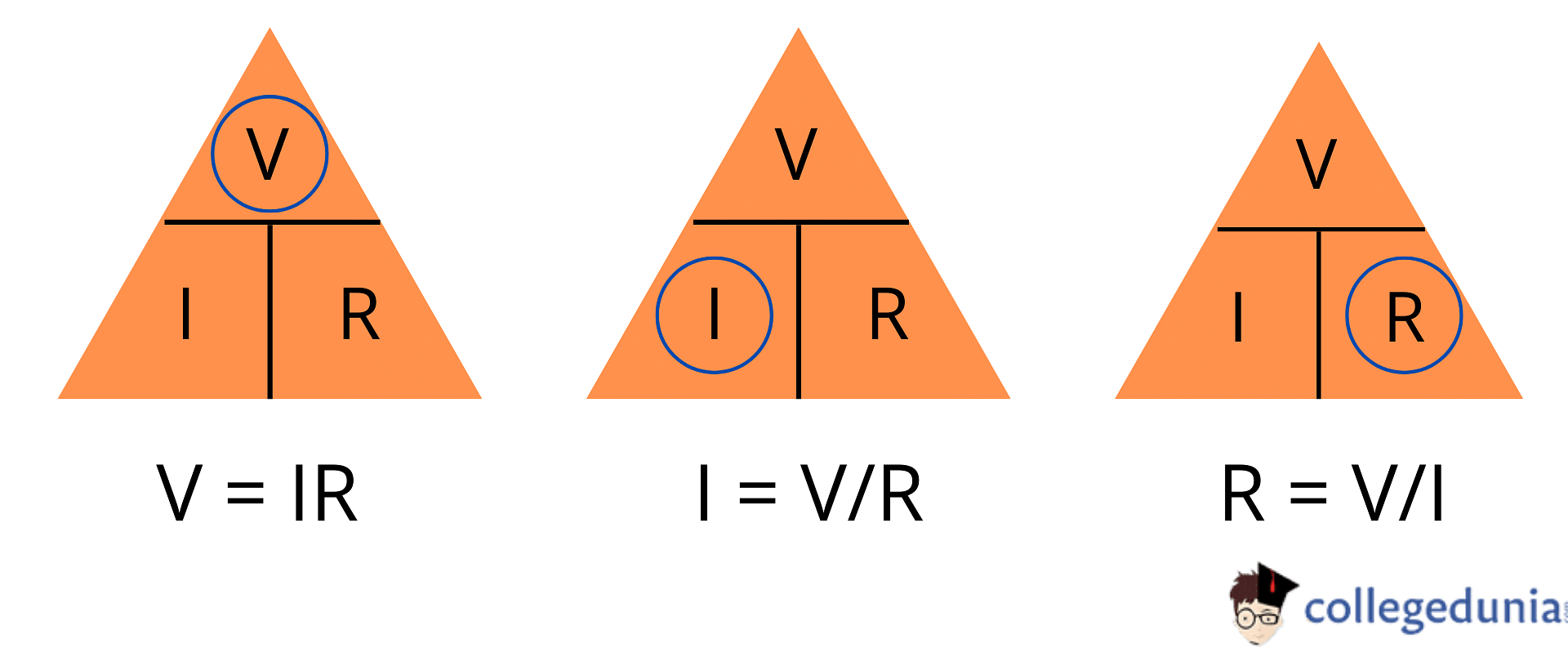
Ohm’s Law Magic Triangle
If the voltage value is asked and the values of the current and resistance are provided, we can determine it by I × R.
\(I = {V \over R}\)
\(R = {V \over I}\)
Ohm's Law ExamplesExample 1: How much current will an electric bulb draw from a 300V source, if the resistance of the bulb filament is 900Ω? Solution: We are given V = 220V and R = 1200Ω. Now, we have the current, I = V.R I = 220V x 1200Ω I = 0.18 A Example 2: An 8 V EMF source is connected to a light bulb. A 2A electric current flows through it. Considering the conducting wires to be resistance-free, calculate the resistance by the electrical appliance. Solution: To determine the value of resistance when voltage and current are provided, we cover the R in the magic triangle. This leaves us with V and I value, and the formula V ÷ I. Substituting the values in the Ohm’s law equation, we get R = V ÷ I R = 8 V ÷ 2 A R = 4 Ω |
Water Pipe Analogy for Ohm’s Law
[Click Here for Important Questions on Ohm’s Law]
Ohm’s Law describes the flow of current through a resistance when different voltages are applied at the end of each resistance. Since we can not see electrons, the water-pipe analogy of Ohm’s law helps us understand the electric circuits in a better manner.

Ohm’s Law Water Pipe Analogy
- The water flowing through pipes is a mechanical system that can be analogous to an electrical circuit.
- The voltage applied is analogous to water pressure, the current can be taken as the amount of water flowing through the pipe, and the resistance can be understood as the size of the pipe.
- More water or current will flow through the pipe when more pressure or voltage is applied and the bigger the pipe, the lower the resistance.
Ohm’s Law Handwritten Notes
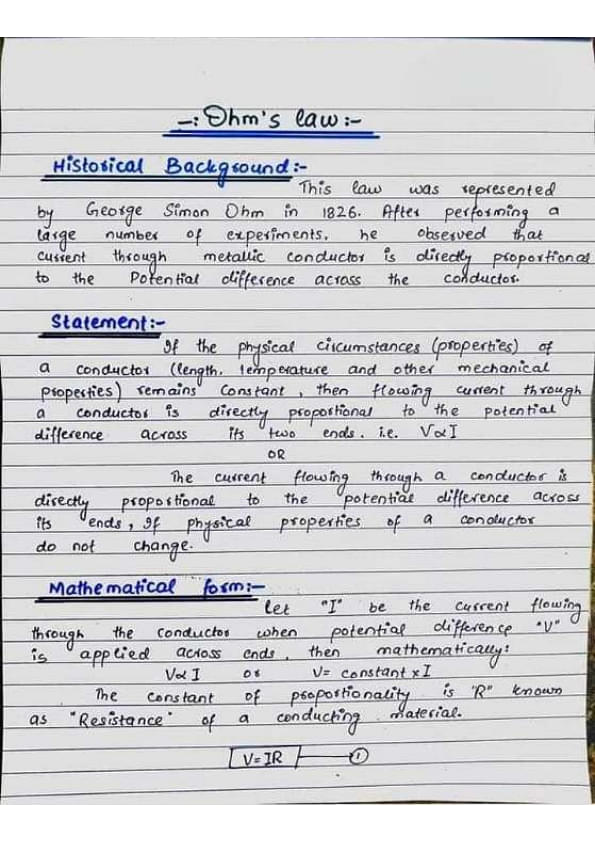


Ohm’s Law PDF – Handwritten Notes
Experimental Verification of Ohm’s Law
[Click Here for Sample Questions]
Ohm’s Law can be verified through the following Ohm’s law experiment:
Material Required: Resistor, Ammeter, Battery, Voltmeter, Rheostat, Plug Key
Ohm’s Law Circuit Diagram: The circuit diagram for verifying Ohm’s law experiment is as given below –

Ohm’s Law Circuit
Procedure:
- The key K is closed initially and the rheostat is adjusted in order to get the minimum reading in ammeter (A) and voltmeter (V).
- The current in the circuit is gradually increased by moving the sliding terminal of the rheostat.
- During this process, the current flow in the circuit and the corresponding potential difference value across the resistance wire are recorded.
- Different values of voltage and current are obtained in this way.
- For each set of V and I values, the V/I ratio is calculated.
- When you calculate V/I for each case, you will identify that it is almost the same. So V/I = R, which is a constant.
- Plot a graph of the current against the potential difference. The graph will be a straight line.
- Hence, the current is proportional to the potential difference.
Ohm’s Law Graph: Therefore we get a straight V-I line graph verifying Ohm’s law. Here, the slope of the graph = \(\Delta\)V/I = R (resistance)

Ohm’s Law ExampleExample: Consider a 1 Ohm resistor in a circuit with a voltage drop from 100V to 10V across its terminals. What is the current through the resistor? Solution: Voltage current resistance formula is given by Ohm’s law as: I = VR = (100 – 10).1 = 90 |
Calculating Electric Power using Ohm’s Law
[Click Here for Important Questions on Ohm’s Law]
Electric Power is the rate at which the electrical energy is converted to another form of energy like Heat, Magnetic or Mechanical Energy. We can find the value of Electrical Power using Ohm’s Law. It is measured in Watts. The formulas to find Power through Ohm’s Power Law are:
- P = VI, when the values for voltage and current are given.
- P = V2/R, when the values for voltage and resistance are given.
- P = I2R, when the values for current and resistance are given.

Power Triangle
Limitations of Ohm’s Law
[Click Here for Sample Questions]
The limitations of Ohm’s Law are as follows:
- Ohm’s law fails and is non-applicable on Unilateral Electrical Elements (Networks allowing the flow of current in one direction only such as diodes and transistors).
- For Non-Ohmic Conductors, Conductors at high current don’t follow Ohm’s Law.
- Ohm’s Law is not applicable for non-linear electric elements with parameters like capacitance, resistance, etc. as the ratio of voltage and current would not be constant with respect to time.
- For gases, Ohm’s law is not followed – resistance can be negative

Ohm's Law Graph for Gases
Ohm’s Law ProofAs we know, i = vdenA
vd = eV\(\tau \)/ml
Therefore i = \({ne^2 \tau A \over ml} V\) \({V \over I} = {ml \over ne^2 \tau A}\)
Therefore, V/I = constant if the temperature is constant which is Ohm’s law. Hence proved. |
Matrix Table of Ohm’s Law
[Click Here for Important Questions on Ohm’s Law]
Ohm’s Law Calculation can be condensed in a matrix form which is as given below:
| Known Values | Resistance (R) | Current (I) | Voltage (V) | Power (P) |
|---|---|---|---|---|
| Current & Resistance | - | - | R = I X R | P = I2 X R |
| Voltage & Current | R = V/I | - | - | P = V X I |
| Power & Current | R = P/I2 | - | V = P/I | - |
| Voltage & Resistance | - | I = V/R | - | P = V2/R |
| Power & Resistance | - | I = √P/R | V = √Z X R | - |
| Voltage & Power | R = V2/P | I = P/V | - | - |
Read More:
Ohm’s Law Pie Chart
The relation between various parameters of Ohm’s Law can be understood using the Ohm’s law pie chart or Ohm’s law wheel which is as follows –

Things to Remember
- Ohm’s law states the relationship between electric current and potential difference in an electric circuit.
- As per Ohm’s Law formula, V = IR.
- Ohm’s law is non-applicable on Unilateral Electrical Elements such as diodes and transistors.
- It can be used to maintain the desired-voltage drop across the electronic components.
- The relationship between Voltage, Current, and Resistance can be identified through Ohm’s law pie chart, matrix, or magic triangle.
Sample Questions
Ques 1: State microscopic form of ohms law. What is the potential difference in Ohm’s Law? (1 mark)
Ans: The microscopic form of Ohms law is J = σE.
Difference between the amount of energy that carriers charge between two points in a circuit. These are the electrons along the conductors which is generated by a cell across its terminals.
It is denoted by V where, V = Work Done(W)/Charge(Q).
Ques 2: Is Ohm’s Law universally applicable? (2 marks)
Ans: No, Ohm’s law is not universally applicable because it is only applicable to ohmic conductors such as iron and copper but is not applicable to non-ohmic conductors.
Ohm’s law doesn’t apply to semiconducting devices because they are nonlinear devices which means that the ratio of voltage to current doesn’t remain constant for variations in the voltage.
Ques 3: Are there any methods by which we can find values of V, I, R, and P using Ohm’s Law? (1 mark)
Ans: Yes, there are some methods such as OHM’s Law Magic Triangle, Power Triangle, OHM’s Law Pie Chart, and Ohm’s Law Matrix Table by which we can find the values of V, I, R, and P easily.
Ques 4. The potential difference between the terminals of an electric heater is 120 V when it draws a current of 8 A from the source. If the potential difference is increased by 240V, then the current drawn by the heater is? (5 marks)
Ans. We are given, potential difference V = 120 V, current I = 8 A.
According to Ohm’s law,
R = VI
Ohm's law calculation
= 120V x 8A
= 15Ω
When the potential difference is increased to 240 V, the current is given by
Current = VR
= 240V x 15Ω
=16 A
The current through the heater becomes 16 A.
Ques 5. There are 2 resistors R1 and R2 which are in series and have resistances of 10 Ω and 20 Ω, respectively. The voltage across resistor R1 equals 4V. Find the current passing through resistor R2 and the voltage across the same resistor. (5 marks)
Solution: We use Ohm's law to find the current I1 passing through R1:
V = RI gets 4 = 10.I1
Now, Solve for I1
I1 = 4/10 = 0.4A
The same current passes through them since the two resistors are in series. Hence the current I2 through R2 equals 0.4A (as I1 = I2).
Use Ohm's law to find the voltage V2 across resistor R2.
V2 = R2 I2
= 20(0.4)
= 50V
Ques 6. If the resistance of an electric iron is 50 Ω and a current of 3.2 A flows through it. Find the voltage between two points. (5 marks)
Ans. Using the magic triangle, to calculate the value of voltage with the value of current and resistance, we cover V in the triangle.
Now, we have I × R.
Therefore, to calculate V:
V = I × R
Substituting the values in the equation, we get
V = 3.2 × 50
V = 160V
Ques 7. If a voltage of 10 volts is placed across a 500-ohm resistor what is the amount of current that will flow? (3 marks)
Ans. As we know that I = V/R = 10/500
= 0.02 A
= 20 mA
Therefore, the amount of current that will flow across the 500-ohm resistor is 20 mA.
Ques 8. Calculate the resistance of a circuit with a voltage of 10 volts and a current of 0.1 A. (3 marks)
Ans. By Ohm’s law, R=V/I
R = 10/0.1
= 100Ω
Ques 9. What is the value of 1 ohm? (1 mark)
Ans. One ohm is equivalent to one-kilogram meter squared per second cubed per ampere squared (1 kg m2 s -3 A -2 . Ohm is also equivalent to a volt per ampere (V/A).
Ques 10. State and explain ohm's law. What is the importance of Ohm's law? (2 marks)
Ans. Ohm's law definition – Ohm’s law states that current through a circuit is directly proportional to the voltage and inversely proportional to the resistance in a circuit. Ohm’s law is important as –
- It helps us in determining either voltage, resistance, or current in an electric circuit when the other two quantities are known.
- It makes the power calculation simpler.
Ques 11. Calculate the resistance of an electrical circuit with a voltage supply of 10 Volts and a current of 5mA. (3 marks)
Ans. Given: V = 10 V,
I = 5 mA = 0.005 A
R = V/I
= 10 V/0.005 A
= 2000 Ω
= 2 kΩ
Ques 12. Why is Ohm’s law not applicable to semiconductors? (2 marks)
Ans. Ohm’s law does not apply to semiconductors as they are nonlinear devices. Hence, the ratio of voltage to current does not remain constant for voltage variations.
Ques 13. When does Ohm’s law fail? (2 marks)
Ans. Ohm’s law fails to explain the behaviour of unilateral devices like diodes and semiconductors. Ohm’s law also may fail if the physical conditions such as pressure and temperature are not kept constant.
Ques 14. Why ohm's law is not applicable for electrolytes and vacuum tubes? (3 marks)
Ans. Ohm's Law only applies to a limited range of conductors. For Ohm's Law to be applied, the ratio of voltage to current must be constant for voltage variations. If the ratio varies, then Ohm's Law fails to apply. Materials for which Ohm's Law applies are known as 'linear' or 'ohmic' devices; those for which it doesn't apply are known as 'non-linear' or 'non-ohmic' devices. Therefore, ohm's law is not applicable to electrolytes and vacuum tubes.
Ques 15. Find the current I passing through a resistor of 2 Ω resistance if the voltage across the resistor is 6 V. (3 marks)
Ans. Putting the values of R and V in Ohm's law formula V = R I.
6 = 2 I
Solve for I
I = 6 / 2
= 3 A
Ques 16. The current passing through a resistor is 0.01 A when the voltage is 5 V. What amount of current passes through it when the voltage across it is 7.5 V? (3 marks)
Ans. Use Ohm's law V = RI to find the resistor R in this circuit.
5 = R (0.01)
Solve for R
R = 5 / 0.01
= 500 Ω
Using Ohm's law definition, V = RI to find the current when the voltage is 7.5.
7.5 = 500 I
Solve for I
I = 7.5 / 500
= 0.015 A
Ques 17. Who discovered ohm's law? (1 mark)
Ans. Ohm's Law was developed by Georg Simon Ohm.
Ques 18. What is the value of 1 Ohm? (1 mark)
Ans. When reduced to base units, 1 Ohm is equivalent to one-kilogram meter squared per second cubed per ampere squared.
Ques 19. Can a voltage be negative? (1 mark)
Ans. The magnitude of a voltage can be either positive or negative.
Ques 20. What are the 3 forms of Ohm's law? (2 marks)
Ans. Ohm’s law formula can be denoted in 3 forms –
- ΔV = IR
- R = V/I
- I = V/R
Ques 21. Prove the vector form of Ohm’s Law. (5 marks)
As we know, i = vdenA
Where, i = current, vd = drift velocity, e = charge on electron, n = free electrons per unit volume and A = cross sectional area
Now drift velocity, vd = eV\(\tau \)/ml
Where V = potential difference across ends of the conductor, m = mass of the electron, l = length of the conductor, and \(\tau\)= average relaxation time
Therefore i = \({ne^2 \tau A \over ml} V\)
\({V \over l} = {m \over ne^2 \tau} \times {i \over A}\)
- Where, V/I = electric field = \(\overrightarrow{E}\)
- \({m \over ne^2 \tau}\) = resistivity or \(\rho\)
- and I/A = current density
Therefore \(\overrightarrow{ E} = \rho \overrightarrow{J}\)
or \(\overrightarrow{J} = \sigma \overrightarrow{ E} \)
as Conductivity \(\sigma\) is the reciprocal of resistivity.
Do Check Out:



Comments