



Education Journalist | Study Abroad Lead
Electro osmosis can be defined as a responsive motion of the solution when an electric field is applied throughout a conduit such as capillary tube, membrane, microchannel or porous material. Solution is an electrically neutral substance. As a result, the medium has a charge that is equivalent to but opposite to that of the scattered particles. When solution particles are unable to travel, the medium moves in the opposite direction of the sol particles under the influence of an electric field. Electro osmosis is the movement of a dispersion media under the influence of an electric potential.
| Table of Content |
Key terms: Electro osmosis, Liquid, Coulomb force, Phenomeon of Electro-osmosis, Electric field, Colloidal particles, Water, Membrane, Electric charge, Solution
Electro Osmosis
[Click Here for Sample Questions]
Electro osmosis is a phenomenon in which molecules in a dispersion medium are allowed to move under the influence of an electric field but colloidal particles are not. Water (and whatever else is in it) migrates through a porous membrane as a result of a potential difference created by the movement of electric charge through the membrane.
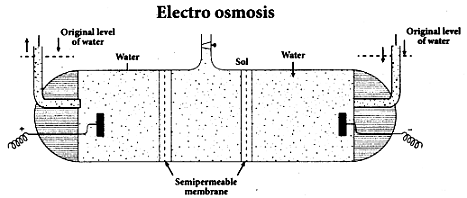
Electro Osmosis
The pace of liquid movement is determined by:
- The characteristics of liquids
- The characteristics of solids
- The potential that is used
When electro osmosis is used correctly, it provides two advantages:
- Most types of soil provide consistent pore water circulation. It doesn't matter how big the pore is. The rate of electro-osmotic flow is mostly determined by the applied voltage.
- The heating of the soil is caused by the application of electricity to it. Warming the soil increases both the mobilization of volatile organics and the electro-osmotic permeability of the pore water by lowering its viscosity.
When an alkaline liquid flows electro-osmotically to a specific sodium carbonate solution, such as concrete, it aids in the repassivation of the steel and induces the realkalisation of carbonated concrete.
Chemical analysis, soil analysis and processing, and microfluidic devices all use electro osmosis procedures. All of these applications involve highly charged surfaces, which are frequently oxides. Chemicals are sorted according to their electrophoretic mobility in capillary electrophoresis, which is another application of electro-osmosis.
Also Read:
The Phenomenon of Electro Osmosis
[Click Here for Sample Questions]
A schematic depicting the dispersion of ions near a charged surface is shown below. There is a high density of counter-ions with a charge opposing that of the surface near the surface. The ion distribution advances toward charge balance as one moves away from the surface, and the electrostatic potential observed at a specified point in the solution decays exponentially according to the Poisson-Boltzmann equation. The double-layer is the area where there is a counter-ion imbalance.

Fig 1: The distribution of counterions near a charged surface is seen in this diagram.
When an electric field is applied over the length of a capillary, counter-ions at the charged surface migrate toward opposite-charge poles. Water is drawn along with the counter ion as it goes toward the pole of opposite charge because the ions are solvated. Counter-ions from the core of the cell replenish counter-ions at the capillary surface at the "same sign" pole as they deplete. This circular movement of counter-ions causes a circular fluid flow in the capillary (see Fig 2), and it is this fluid flow that is important for electrophoretic studies in capillary cells, such as electrophoretic light scattering.
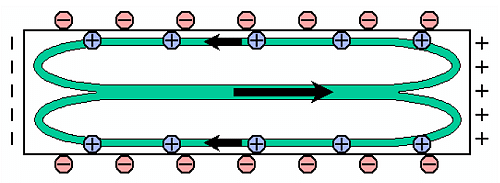
Fig 2: The effects of electroosmosis on the solvent flow within a surface-charged capillary are depicted in this diagram.
Fig 3 depicts a three-dimensional picture of the solvent flow within a surface-charged capillary after an electric field is applied. There is a point, a little distance away from the capillary surface, where the fluid flow is balanced, as shown in this diagram. This is known as the "stationary layer," and it is at this point that electroosmosis' effects are mitigated or balanced. The stationary layer is also where classical electrophoretic light scattering measurements are collected due to the lack of a net electroosmotic flow. The location of the stationary layer is reliant on both the magnitude of the capillary surface charge and the concentration of supporting electrolytes, which is a limitation to this strategy.

Fig 3: Electroosmotic flow in a charged capillary after an electric field is applied in three dimensions.
Modern electrophoretic light scattering instruments, such as the Zetasizer Nanosystem, take advantage of the fact that the creation of electroosmotic flow is a delayed effect rather than an instantaneous response to the introduction of an electric field. In the absence of electroosmotic effects, the electrophoretic mobility of the analyte can be determined at any distance from the capillary surface if the applied field oscillates during the measurement. This phase of the zeta potential measurement is known as the Fast Field Reversal (FFR) phase in the Zetasizer Nano product line, and it produces absolute electrophoretic mobility. Figure 4 depicts a three-dimensional picture of solvent flow within a surface-charged capillary after an electric field is applied during the FFR phase of an electrophoretic mobility measurement with a Zetasizer Nano.

Fig 4: Electroosmotic flow in a charged capillary after an electric field is applied during the FFR phase of an electrophoretic mobility measurement using the Zetasizer Nano system.
Things to Remember
- The Coulomb force is responsible for electro osmotic flow.
- Microfluidic devices, soil analysis and processing, and chemical analysis all involve electro osmotic flow.
- Protons passing through a proton exchange membrane (PEM) in fuel cells cause water molecules to be dragged from one side (anode) to the other through electro-osmosis (cathode).
- Electro-osmosis is also employed in vascular plant biology as an alternate explanation for the flow of polar liquids through the phloem.
Also Read:
Sample Questions
Ques 1. What happens in electro osmosis? (1 mark)
Ans. An applied voltage causes a flow of neutral water in electroosmosis, i.e., the ion movement and water flow are linked. When a solution is driven through a membrane having charged holes under hydrostatic pressure, the reciprocal process occurs.
Ques 2. What are electro osmosis and its advantages? (2 marks)
Ans. The movement of liquid in a porous substance caused by an applied electric field is known as electro osmosis. When it comes to treating soil that is heterogeneous, silty, or clay-rich, electro-osmosis is a powerful tool. Organics can be removed by electro-osmosis. The use of specialized electrodes is reduced.
Ques 3. How is electroosmotic flow generated? (1 mark)
Ans. When an applied driving voltage interacts with the net charge in the electrical double layer near the liquid/solid boundary, a local net body force is created, which produces bulk liquid motion.
Ques 4. Why does electroosmotic flow occur? (1 mark)
Ans. Because the walls of the capillary tubing are electrically charged, electroosmotic flow occurs. A silica capillary's surface has a large number of silanol groups (–SiOH). The silanol groups ionize to create negatively charged silanate ions at pH levels greater than 2 or 3.
Ques 5. What increases in the electro osmosis method of dewatering? (1 mark)
Ans. The electric double layer on tiny grained particles explains the electro-osmosis theory. The electrodes are arranged in such a way that the natural direction of water flow is reversed away from the excavation, enhancing the soil's strength.
Ques 6. Does electro osmosis work? (1 mark)
Ans. Because the clear involvement of electro-osmosis in the dehumidification process of real buildings is contentious and not well-documented, the scientific community is skeptical about the methods' reliability.
Ques 7. What is electro osmosis in construction? (1 mark)
Ans. To force excess moisture down the wall and back into the ground, a damp proofing course uses a sequence of platinum-coated anodes, commercially pure titanium connecting wire, a copper coated cathode and a regulated power source.
Ques 8. How do you control electro osmotic flow? (1 mark)
Ans. Electroosmotic flow (EOF) can be greatly reduced or abolished in aqueous capillary electrophoresis by coating the capillary surface silanols by either buffer additive adsorption or chemical modification.
Ques 9. How can electro osmotic flow be reduced? (1 mark)
Ans. By coating the capillary with a substance that prevents the ionization of the silanol groups, such as polyacrylamide or methylcellulose, electroosmotic flow can be inhibited.
Ques 10. How does pH affect electro osmotic flow? (1 mark)
Ans. A pH increase was seen when a high-concentration solution displaced a lower-concentration solution, while a pH decrease was recorded when the flow was reversed. The zeta potential and flow velocity are both affected by this impact.
Ques 11. What is Electroosmotic force? (1 mark)
Ans. Electroosmosis is a basic electrokinetic phenomenon that involves the movement of a charged solid surface against a bulk solution under the influence of an electric field.
For Latest Updates on Upcoming Board Exams, Click Here: https://t.me/class_10_12_board_updates
Check-Out:



Comments