



Education Content Expert
Epiphysis is the rounded end of a long bone. It is a small, round, knob-like projection on the end of a bone, opposite the bone's joint.
- Its main function is to create joints by joining nearby bones.
- Diaphysis or Shaft is the other important region in a long bone.
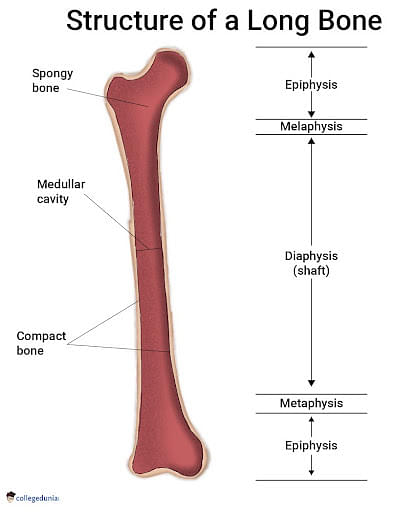
- Metaphysis is the region between the diaphysis and the epiphysis of the long bone.
- The epiphyseal plate, or growth plate, is located in the metaphysis.
- Epiphysis is covered by articular cartilage at the joint.
- Subchondral Bone is the bone present underneath the articular cartilage and its development plate.
Read More: NCERT Solutions For Class 11 Biology Locomotion and Movement
Key Terms: Epiphysis, Diaphysis, Bones, Femur, Long Bones, Bone Marrow, Metaphysis, Growth Plate, Pressure Epiphysis
What is Epiphysis?
[Click Here for Sample Questions]
Epiphysis is the expanded or rounded end portion of a long bone.
- Epiphysis is filled with red bone marrow that produces red blood cells.
- It is made up of spongy cancellous bone covered by a thin layer of compact bone.
- Epiphysis is connected to the bone shaft by the epiphyseal cartilage or growth plate.
- Epiphyseal Cartilage helps in the growth of bone length and is eventually replaced by bone.
- It ossifies separately from the bone shaft but becomes fixed to the shaft upon attaining full growth.
- The primary function of the epiphysis is to join together nearby bones to create joints.
- The osteoblasts that cover the epiphysis are also responsible for changing spongy bone into compact bone.
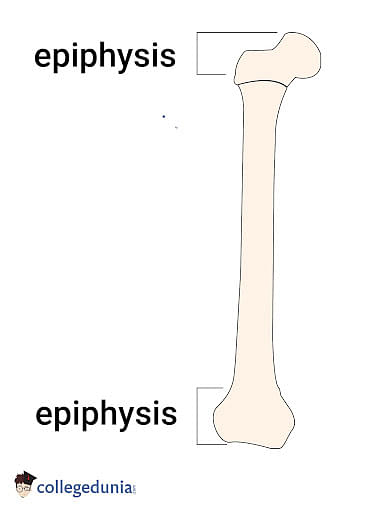
Epiphysis
Types of Bones
[Click Here for Previous Year Questions]
Bones can be found in the human body in many different sizes and shapes. Despite their variations in appearance, all bones have the same function, i.e. to support the body.
- Sesamoid bones are bones that are wrapped by a tendon such as a patella (knee cap) and a few very small bones in the hands and feet.
- The upper jaw bone (maxilla), lower jaw bone (mandible), and vertebrae (bones in the spine) are examples of irregular bones that lack a distinct shape.
- Flat bones shield the internal organs. For instance, Scapula and Cranium (shoulder blade).
- Long bones, such as the femur (thigh bone), humerus (upper arm bone), and tibia (shin bone), are the longest bones in the body.
- Short bones, like in the palm of the hand and the middle of the foot, provide support and movement.
Read More:
Types of Epiphysis
[Click Here for Sample Questions]
The different types of Epiphysis of bones are described below:
Pressure Epiphysis
- The region of the long bone that forms the joints is known as the pressure epiphysis.
- The head of the femur and the part of the hip joint complex are a few examples.
- They are the parts of the bone that experience pressure during locomotion and movement.
- They help to convey the weight of the human body.
- A pressure epiphysis can also be seen at the head of the humerus, which is a member of the shoulder complex.
- The condyles, femur, and tibia are all part of the pressure epiphysis.
Read More: Locomotion and Movement
Traction Epiphysis
- Traction Epiphysis are the parts of the long bone that are non-articular and do not contribute to joint development.
- These regions do not help with weight transmission, in contrast to pressure epiphysis.
- Due to their proximity to the location of the pressure epiphysis, the supporting ligaments and tendons attach to these parts of the bone.
- Traction epiphysis ossifies a second after pressure epiphysis.
- Examples of traction epiphysis include the trochanters of the femur and the larger and lesser tubercles of the humerus.
![Structure of a Long Bone]()
Structure of a Long Bone
Atavistic Epiphysis
- Atavistic Epiphysis is a bone that merges with another phylogenetically distinct bone.
- An example of atavistic fused bones is the coracoid process of the scapula, which has been fused in humans but is separate in four-legged animals.
- The os trigonum is another example of an atavistic epiphysis (posterior tubercle of the talus).
Aberrant Epiphysis
- Aberrant Epiphysis diverges from the norm and is not always present.
- Examples include the epiphysis at the base of other metacarpal bones and the epiphysis at the top of the first metacarpal bone.
Pseudo-Epiphysis
- A pseudo-epiphysis is an end of a bone that doesn’t have an epiphysis.
- Instead, it is a transverse notch that resembles a growth plate.
- They have little effect on longitudinal bone formation because they lack the typical cell columns present in typical growth plates.
Bones with Epiphysis
[Click Here for Previous Year Questions]
Given below are the bones that contain an Epiphysis:
- Humerus: It is located between the shoulder and the elbow.
- Radius: Its anatomical position is the radius lateral to the ulna, and it is one of two bones that are situated between the hand and the elbow.
- Ulna: The ulna is anatomically positioned medial to the radius and is one of two bones that are situated between the hand and the elbow.
- Metacarpal: These are the hand’s bones, which are located close to the phalanges.
- Phalanges: Phalanges are the bones in the fingers and toes, the metacarpals in the hand, and the metatarsals in the foot are distal to them.
- Femur: Between the hip and the knee in the thigh, it is the longest bone in the human body.
- Fibula: This bone, one of two in the lower leg, is smaller and located laterally to the tibia.
- Tibia: This bone, one of two in the lower leg, is medial to the fibula and performs the majority of the body’s weight-bearing functions.
- Metatarsal: The first metatarsal medial cuneiform and the other four metatarsal phalanges are located close to the bones of the foot.
Read More: Locomotion and Movement Important Questions
Similarities between Epiphysis and Diaphysis
[Click Here for Sample Questions]
Epiphysis and Diaphysis are the two components of a long bone. There are a lot of similarities between both of them which are as follows:
- Both of these bones are made up of bone tissues.
- Their main function is to give form and support to the skeletal system of an animal.
- They contain osteoblasts that are necessary for bone resorption.
- Both of them contain bone marrow, blood vessels, and nerves.
- They are protected by membranes like the endosteum, periosteum as well as cartilage.
Check More:
Difference between Epiphysis and Diaphysis
[Click Here for Previous Year Questions]
The key differences between Epiphysis and Diaphysis are as follows:
| Epiphysis | Diaphysis |
|---|---|
| Epiphysis is the end of a long bone that originally develops independently of the shaft. | Diaphysis is the middle or shaft portion of a long bone. |
| It makes up the rounded, and swollen ends of the long bone. | It makes up the long and narrow portion of the long bone. |
| There are two epiphyses at the proximal and distal ends of the long bone. | Each long bone has a single diaphysis. |
| Epiphysis of a bone consists of soft bone. | Cortical bone makes up the diaphysis of the bone. |
| The functional unit of the epiphysis is called Trabeculae. | The functional unit of the diaphysis is called an Osteon. |
| It contains a marrow cavity. | Diaphysis lacks a marrow cavity. |
| It contains red bone marrow. | It contains yellow bone marrow. |
| Epiphysis contains a low quantity of calcium. | Diaphysis contains a higher quantity of calcium. |
| It is more porous. | It is less porous. |
| It is less strong. | It is more strong. |
| Epiphysis articulate with other bones forming joints. | Diaphysis provides sites for the attachment of bones. |
Read More: Locomotion and Movement MCQs
Things to Remember
- Epiphysis is the enlarged or rounded end part of a long bone.
- Trabeculae is the functional unit of the epiphysis.
- Epiphysis contains a marrow cavity and red bone marrow.
- Diaphysis is the middle or shaft portion of a long bone that contains yellow bone marrow.
- Osteon is the functional unit of Diaphysis.
- Aberrant Epiphysis, Traction Epiphysis, Atavistic Epiphysis, and Pressure Epiphysis are the main types of epiphysis.
- Some bones with epiphysis are Humerus, Radius, Ulna, Tibia, Femur, Fibula, Metatarsal, and Phalanges.
Previous Years’ Questions
- Long bones function in… (NEET - 1993)
- Which cartilage is present on the end of long bones… (Rajasthan PMT - 2007)
- The end of a long bone is connected to another by… (UP CPMT - 2000)
- Which one of the following is a sesamoid bone… (AIIMS - 2003)
- Number of bones in the skull is… (MP PMT - 2007)
- Formation of cartilage bones involves… (AIPMT - 1993)
- Three of the following pairs of the human skeletal parts are correctly… (NEET - 2011)
- Scapula is a large triangular flat bone situated in the dorsal… (KEAM - 2011)
- The clavicle articulates with ...... of scapula… (DUET - 2011)
- Yellow bone marrow is found especially in the… (Punjab PMET - 2007)
Sample Questions
Ques. What is Epiphysis? (2 Marks)
Ans. Epiphysis is the rounded end of a long bone. It is also known as the growth plate. Its main function is to connect adjacent bones to form joints. It is made up of spongy cancellous bone covered by a thin layer of compact bone.
Ques. What distinguishes an Epiphysis from a Fiaphysis? (2 Marks)
Ans. The rounded or expanded terminal portion of a long bone is known as the epiphysis. It has red bone marrow-producing erythrocytes. The shaft of a long bone having cortical tissues is called the diaphysis. It contains adipose tissue and yellow bone marrow.
Ques. Is epiphysis present in all bones? (2 Marks)
Ans. Long bones are the only bones in our body that have an epiphysis. It is found in long bones along with Diaphysis and Metaphysis. Diaphysis is the shaft of the long bone. Metaphysis is the slender region that lies between the epiphysis and diaphysis. It includes the growth plate and disappears till adolescence.
Ques. Where is the epiphysis located? (2 Marks)
Ans. The growing plate and the joint at the end of the bone are separated by the epiphysis. Most tubular bones in mice and humans grow an epiphysis at either end. Some bones, such as the metacarpal and metatarsal bones as well as the phalanges, typically create this configuration at just one end.
Ques. What two types of epiphysis are there? (2 Marks)
Ans. Both pressure epiphysis and traction epiphysis ( also known as apophysis), which are the locations of the genesis or insertion of large muscles, are forms of the epiphysis. Pressure epiphysis is located near the ends of long bones (e.g., the greater trochanter of the femur). Between the epiphysis and diaphysis is the metaphysis.
Ques. What function does the epiphysis perform? (2 Marks)
Ans. Epiphysis of a long bone is where the new bone develops. Long bones are created from the inside out. The epiphyseal layer drives new bone outward when the bones need to enlarge. The epiphyseal plate ceases producing cells once the bones have finished developing.
Ques. What role does the distal epiphysis play? (3 Marks)
Ans. Bone having small pores next to lattices, known as spongy bone, make up the distal epiphysis. Connective tissue and bone marrow occupy these spaces. As articular cartilage covers the distal epiphysis as well, bones can move freely in the joints without rubbing against one another.
Epiphysis and distal epiphysis have different functions, and they both facilitate the movement of the bones to the joints. It can easily be damaged and torn. Therefore, it is crucial to preserve the joints' lubricity and muscularity.
Ques. Define Secondary Epiphysis. (2 Marks)
Ans. A secondary ossification center is an area of ossification that develops after the primary ossification center has already been created. Most of these centers appear throughout the postnatal and adolescent years. In most bones, there are several secondary ossification centers. Long bone’s epiphysis has secondary centers.
Ques. Do adults have epiphysis? (2 Marks)
Ans. Diaphysis (primary ossification center shaft), metaphysis (where the bone flares), physis (growth plate), and epiphysis (secondary ossification center) are the four sections of the long bones of a child. Only metaphysis and diaphysis exist in adults.
Ques. What are the types of Epiphysis? (3 Marks)
Ans. There are four types of Epiphysis which are as follows:
- Pressure Epiphysis: It is articular and takes part in joint formation. The head of the humerus and the lower end of the radius are some examples.
- Traction Epiphysis: It provides attachment to the tendons of muscles. For example, trochanters of the femur and tubercles of the humerus.
- Atavistic Epiphysis: They are phylogenetically independent but they become fused in man. The coracoid process of the scapula is an example.
- Aberrant Epiphysis: They are not always present. For instance, the epiphysis at the head or base of the first metacarpal bone.
Check-Out:



Comments