



Education Journalist | Study Abroad Lead
Faraday’s Laws of Electrolysis were given by the English scientist, Michael Faraday in 1833 which was based on electrochemical research. Electrolysis is the process of passing electricity through an electrolyte when the cations move to the cathode to get reduced, and anions move towards the anode to get oxidized. The liquid which conducts electricity is called an electrolyte. Faraday's laws of electrolysis tell us about the relationship between mass and the amount of electrical charge. They are mathematical (quantitative) relationships that describe the magnitudes of electrolytic effects.
| Table of Content |
Key Terms: Faraday’s Laws of Electrolysis, Electrolysis, Electrolytic Cell, Anode, Cathode, Electrochemical Cell, Atomic Mass, Molecular Mass, Electrodes
Electrolysis
[Click Here for Sample Questions]
The process in which the electric current is made to pass through a substance to trigger a chemical change is called electrolysis. When the substance loses or gains an electron, which is known as oxidation or reduction respectively, is called a chemical change.
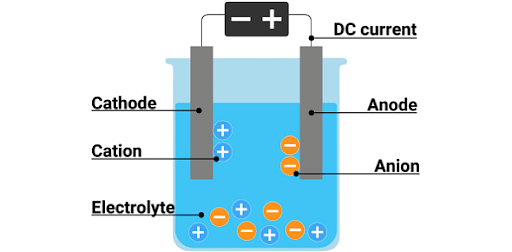
Electrolysis
The process of electrolysis is carried out with the help of an electrolytic cell, which is an apparatus containing positive and negative electrodes which are held apart and dipped into a solution which contains positively and negatively charged ions.
The substance which is to be transformed can constitute the solution, form the electrode or be dissolved in the solution. In electrolysis, we pass the electric current (i.e., electrons) which enter through the negatively charged electrode (cathode) and the positively charged components of the solution travel through this electrode and then combine with the electrons.
They are then transformed into neutral elements or molecules. The negatively charged components of the solution travel to the other electrode (anode) giving up their electrons in the process, and then they are transformed into neutral elements or molecules. The reaction is generally one in which the electrode dissolves by giving up electrons when the substance to be transformed is an electrode.
Also Read:
| Related Articles | ||
|---|---|---|
| Hydrogen Sulphate | Daniell Cell | Fuel Cells |
| Second Order Reactions | Double time formula | Inversion chemical reaction |
Faraday’s First Law of Electrolysis
[Click Here for Sample Questions]
According to Faraday’s First Law of Electrolysis, the mass of the substance (m) which is deposited or being liberated at an electrode is directly proportional to the quantity of electricity or charge (Q) passed. The first law can be represented mathematically as,
\(m ∝ Q \)
When we remove the proportionality sign we add a constant Z which gives us m = ZQ, where m is the mass in grams (g), Q is measured in coulombs, and Z is the proportionality constant in g/C (in grams per coulomb) and it is also known as the electrochemical equivalent, which is the mass of a substance produced at the electrode during electrolysis by the charge of one coulomb. The constant Z for passing the electrochemical equivalent of a substance is generally expressed in terms of milligrams per coulomb or kilogram per coulomb.
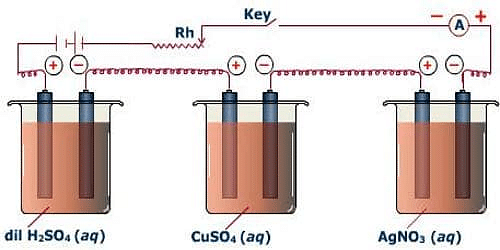
Faraday’s First Law of Electrolysis
Faraday also observed further that 1 Faraday which was 96,485 coulombs of charge can liberate 1 gram equivalent of the substance at the electrodes which means that 1 coulomb is used to liberate one gram equivalent of a substance (96485) which is called the electrochemical equivalent (Z) of the substance.
Thus the relationship between electrochemical equivalent (Z) and equivalent weight or equivalent mass (E) of a substance can be expressed as
Z = Equivalent weight/96,485, or Z = E/96,485
When we Move back to the equation m = ZQ, it can also be written as:
m = Z x I x t (since Q = I x t)
m = E x I x t /96,485 (since Z = E/96,485)
Faraday’s Second Law of Electrolysis
[Click Here for Sample Questions]
Faraday’s second law of electrolysis states that the mass of the substances deposited is proportional to their respective chemical equivalent or equivalent weight when the same quantity of electricity is passed through different cells containing several electrolytes. It can be represented mathematically as,
\(w ∝ E\)
Where
- w = mass of the substance
- E = equivalent weight of the substance
It can also be expressed as – w1/w2=E1/E2
The ratio of its atomic weight and valency is called the equivalent weight or chemical equivalent of a substance.
Equivalent weight=Atomic weight/Valency
We can also explain Faraday’s Second Law of Electrolysis by the following example –
Let us consider three different chemical reactions that occur in three separate electrolytic cells which are all connected in series and the 1st electrolytic cell sodium ion gains electrons and then get converted into sodium.
Na+ + e− → Na
Now in the 2nd electrolytic cell, the following reaction occurs→ Cu+2 + 2e− → Cu. Similarly, In the 3rd electrolytic cell following reaction occurs – Al3++ 3e− → Al
When y moles of electrons are being passed through three cells, then the mass of sodium, aluminium and copper liberated comes out to be 23y grams, 9y grams, and 31.75y grams respectively.
To reduce one mole of ions, we need one mole of electrons. As we know, the charge on one electron is equal to 1.6021×10⁻¹⁹ C and one mole of electrons is equal to 6.023×10²³ electrons.
So, the charge on one mole of electrons is equal to – (6.023×1023) × (1.6021×10-19C) = 96500 C
This charge of 96500 C is called 1 Faraday. When we pass 1 Faraday which is 96500 coulombs of charge in an electrolytic cell, then 1gm of the equivalent weight of the substance will get deposited. We can write this as – w=(Q / 96500)×E
When we combine Faraday’s 1st and 2nd laws, then we get – Z = E / 96500
Things to Remember
- Electrolysis is defined as the use of electric current to stimulate a non-spontaneous chemical reaction.
- An electric current is passed through an electrolytic solution in electrolysis to stimulate the flow of ions to bring about a chemical change.
- Faraday’s Laws of Electrolysis depicts the quantitative relationship between the quantity of electric charge or electricity passed and the substance deposited at electrodes.
- The First Law of Electrolysis by Faraday states that “the mass of a substance deposited at any electrode is directly proportional to the amount of charge passed.”
- The Second Law of Electrolysis by Faraday states that “the mass of a substance deposited at any electrode on passing a certain amount of charge is directly proportional to its chemical equivalent weight.”
Also Read:
Sample Questions
Ques. What amount of copper metal (in moles) can be generated when 300 C of electricity is supplied. (3 Marks)
Ans. Q = 300 C and F = 96,500 C/mol
Let us write the reduction reaction of copper.
Cu+2 + 2e- → Cu
Now let us calculate the moles of electrons:
n = Q / F = 300 / 96500 = 0.0031 mol
Next, we determine the moles of copper from the balanced chemical equation.
1 mol electrons = 0.5 mol Cu
0.0031 moles / 2 = 0.00155 mol Cu
Therefore, 0.00155 moles of copper are generated.
Ques. Calculate the time needed to deposit 25 g of silver from a solution of silver nitrate when 2 A of current is supplied to it. (5 Marks)
Ans. Mass of Ag = 25 g, I = 2 A, F = 96,500 C/mol and molar mass of silver = 107.9 g/mol
Firstly, we calculate the moles of silver: Moles of Ag = 25 / 107.9 = 0.232 mol
Then we write the reduction reaction for silver: Ag+ + e- → Ag (s)
The electrons and silver are deposited in a ratio of 1:1.
Moles of electrons = 0.232 mol
Now we calculate the electricity needed, Q = n × F
=> Q = 0.232 × 96,500 = 22,388 C
Finally, we calculate the time needed.
Q = I × t
=> 22,388 = 2 × t
=> t = 11,194 seconds
=> 11,194 / 60 = 186.56 min
=> 186.56 / 60 = 3.1 hrs
The time needed is 3.1 hours.
Ques. A 4A of current was passed during the electrolysis of molten sodium chloride, through the electrodes for about 1 hour. Find out the mass of sodium which was produced during this time. (3 Marks)
Ans. According to question, I = 4A, t = 1 x 60 x 60 = 3,600s,
E of sodium is 23/1 = 23g
Therefore, Mass of sodium produced = E x I x t/96,485
=> (23 x 4 x 3,600)/96,485
=> 3.43g
Ques. The electrolysis of molten MgCl2 is the last step in the production of magnesium from seawater. If we assume that 45.6 g of Mg metal is formed, calculate the moles of electrons that are required? (3 Marks)
Ans. We have electrolysis of MgCl2. Mass of Mg formed is given as 45.6 g
MgCl2→Mg2+ +2Cl−
The half-reaction for Mg2+ reduction is
Mg2++2e−→Mg.
For every mol of Mg formed, we need 2 moles of electrons. The number of moles of Mg produced is (the molar mass of Mg is 24.305 g/mol)
Number of moles of electrons required is as follows:

Ques. How do you prove Faraday’s First and Second law experimentally? (5 Marks)
Ans. We will carry out an experiment to understand Faraday’s law. We have a coil which we have attached to a galvanometer and then with a bar magnet.

Since there is no battery attached to the coil, it does not have any source of current which means that there is no current which is circulating inside the coil. Now, we move the bar magnet close to the coil and start noticing that the galvanometer is showing deflection which indicates the fact that some current has been inducted into the circuit since there was no battery.
Due to the motion of the bar magnet which we moved towards the coil, an electromotive force has been induced in the coil and this process is known as electromagnetic induction. Let us consider that the magnet moves towards the direction of the coil with v velocity. We observed that the galvanometer did not show any deflection till the bar magnet was at rest. After we start moving the bar magnet, it starts to show deflection.
When the value of v becomes 0 again, the galvanometer shows 0 deflections. If v=0 and emf=0, we observe that the greater the velocity, the greater the induced emf. The current moves in the opposite direction when the direction of ”v” is changed as we notice that the galvanometer shows deflection in the opposite direction.
Due to magnetic flux, the bar magnet gets associated with the magnetic flux and the emf gets induced inside the coil.
Ques. How much charge should be passed through the solution to deposit 5x g of copper if x g of copper gets deposited when 1000 C of charge is passed through the CuSO4 solution? (3 Marks)
Ans. According to Faraday’s First Law, W = kQ
Case I: x = k×1000 C
Case II: 5x=k×y, where y is a charge used to deposit 5x g of copper.
Dividing Case I by Case II, we get y=5000 C
Ques. The amount of silver deposited when we pass a certain quantity of electricity through an aqueous solution of AgNO3 and cupric salt solution is 1.08 g when connected in series. What amount of copper is deposited? Given that Atomic wt. of Cu=63.54, Ag=108 g/mole. (3 Marks)
Ans. Given that, the equivalent weight of silver =108 g/eq and the equivalent weight of copper =31.77 g/eq
According to the question, Mass of Ag deposited =1.08 g. We Substitute the above values in the following equation,
=> (Mass of Cu deposited/Mass of Ag deposited) = (Eq.Wt of Cu/Eq. Wt of Ag)
=> Mass of Cu deposited/1.08=31.77/108
=> Mass of Cu deposited=(31.77/108) ×1.08=0.3177 g.
For Latest Updates on Upcoming Board Exams, Click Here: https://t.me/class_10_12_board_updates
Check-Out:



Comments