



Education Journalist | Study Abroad Lead
Ferromagnetic materials are the materials that exhibit the tendency of magnetization for a short time even after the removal of an external magnetic field. They were first discovered by a French physicist Louis Eugene Felix Neel. Among all types of magnetic materials, ferromagnetic materials are strongly attracted to magnetic fields. Such materials have a spontaneous net magnetization at the atomic level, even when no external magnetic field is present. Cobalt, Iron and Nickel are the most commonly used ferromagnetic materials.
| Table of Content |
Key Takeaways: Ferromagnetism, Ferromagnetic materials, Metal, Magnetic field, Magnetic effect, Iron, Alloys, Cobalt, Magnetizing force
Introduction to Ferromagnetism
[Click Here for Sample Questions]
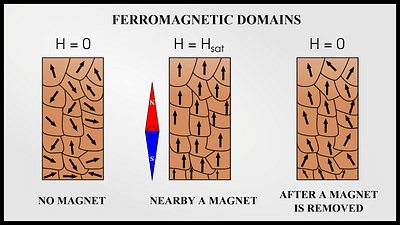
The term ‘Ferromagnetism’ is derived from the word 'Ferrous' which refers to iron, the first metal to be discovered to have magnetic field attracting qualities. It can be described as a magnetic property displayed by some materials such as iron, alloys, cobalt and others. The metal ions of such substances, in solid state, possess the tendency to form small groups together, known as domains, in regions of the metal and act as a tiny magnet. When such substances are placed in a magnetic field, these domains get oriented in the direction of the magnetic field producing a strong magnetic effect.
Ferromagnetism is a phenomenon in which the ferromagnetic materials develop persistent magnetism or attractive properties or it can also be demonstrated as a process in which few electrically uncharged elements attract one another strongly. Ferromagnetism also takes into account the crystalline and microstructure of a material along with its chemical composition.
Also Read:
| Related Articles | ||
|---|---|---|
| Solid State | Amorphous and Crystalline Solids | Crystal Lattices and Unit Cells |
| Packing Efficiency | Imperfections in Solids | Magnetic Properties |
| Paramagnetic | Covalent bonds | Frenkel Defect |
Causes of Ferromagnetism
[Click Here for Sample Questions]
In an unmagnetized ferromagnetic substance, the domains of the material are randomly oriented, thus cancelling the net dipole moment.
Magnetic moments in neighboring domains, on the other hand, are oriented in the other direction. They cancel out, and the material's net magnetic moment is zero. When a magnetic field is provided externally, all of these domains align themselves in the direction of the applied field. The material is strongly magnetized in a direction parallel to the magnetizing field in this manner. Even when there is no external magnetizing force, these domains have a net magnetic moment.

Properties of Ferromagnetic Materials
[Click Here for Sample Questions]
Some of the properties of Ferromagnetic materials:
- Atoms of ferromagnetic compounds have a persistent dipole moment in domains.
- The magnetic dipole moment is large and is present in the direction of the magnetizing field.
- Atomic dipoles in ferromagnetic substances are aligned in the same direction of the external magnetic field.
- The magnetization intensity (M) is very high, positive, and varies linearly with the magnetizing field (H).
- The magnetic susceptibility is extremely high and positive and is represented by Xm= M/H, where H is the strength of the applied magnetic field and M is the magnetization intensity.
- The relative permeability of such substances is quite high and varies linearly with the magnetizing field. The material’s relative permeability is r=1+m.
- The magnetic flux density of the material is extremely high and positive and is represented by B=ε0 (H + M), where H is the applied magnetic field strength, M is magnetization intensity, and ε0 is free space magnetic permittivity.
- Ferromagnetic substances are strongly attracted by the field. As a result, in a nonuniform field, they tend to attach to the poles in the strongest field.
- Because of the higher temperature, the same material loses its ferromagnetic characteristics when liquefied.
Examples
[Click Here for Sample Questions]
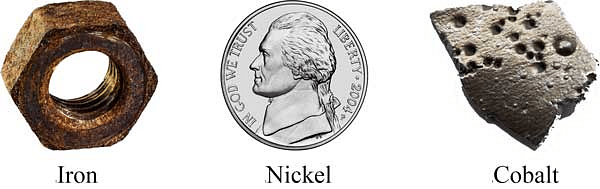
The majority of ferromagnetic materials are metals. Iron, cobalt, nickel and other ferromagnetic metals are common examples. In addition, metallic alloys and rare earth magnets are ferromagnetic materials.
Magnetite is another ferromagnetic substance generated by the oxidation of iron to form an oxide. It has a curie temperature of 580 degrees celsius. It was previously known as a magnetic material. Magnetite has the highest magnetic content of any natural mineral on the earth.
Hysteresis
[Click Here for Sample Questions]
When an external magnetic field is removed, a ferromagnetic material is not completely demagnetized. A magnetic field in the opposite direction must be applied to return the material to zero magnetization. Hysteresis is the property of ferromagnetic materials that allows them to retain their magnetization when an external field is removed.
The magnetization of the substance, measured in magnetic flux density (B), will trace out a loop when plotted against the externally applied magnetic field intensity (H). This is referred to as the hysteresis loop.

Things to Remember
- Ferromagnetic materials exhibit strong magnetism in the direction of the magnetic field.
- Such materials can be converted to permanent magnets with the use of magnetic fields.
- Ferromagnetic materials retain magnetism for a short span even after the removal of external magnetic fields.
- The domains of ferromagnetic materials are randomly oriented in the absence of an external magnetic field.
Also Read:
Sample Questions
Ques. What are Ferromagnetic Materials ? (2 Marks)
Ans. Ferromagnetic materials are those materials which tend to exhibit or display significant magnetism in the direction of the field due to magnetism. The magnetism in these materials is primarily attributable to the alignment patterns in their constituent atoms. These atoms have a tendency to behave like a simple electromagnet.
Ques. What is the Curie Temperature? (2 Marks)
Ans. Ferromagnetic materials are highly dependent on the temperature. Ferromagnetic materials become paramagnetic when heated to a high enough temperature. Curie's temperature is the temperature at which this transition takes place and TC is the symbol for it.
Ques. Explain some of the uses of ferromagnetic materials? (2 Marks)
Ans. Ferromagnetic materials are employed in the coating of magnetic tapes in cassette players and in the development of a memory store in a modern computer. Ferrites are an example (Fe2O, Fe, MnFe2O4, and more). Furthermore, such materials are also used in the core of transformers, magnetic tapes and memory storage devices. They are widely used in devices like an electric motor, generators, transformers, telephone, loudspeakers, magnetic stripe at the back of credit cards.
Ques. At what point does a ferromagnetic material become paramagnetic? (2 Marks)
Ans. The Curie temperature is the temperature at which a material's magnetic properties change. When the temperature rises above the Curie temperature, ferromagnetic material transforms into paramagnetic material. Paramagnetic substances are weakly attracted to the application of magnetic fields.
Ques. What is ferromagnetism domain theory? (2 Marks)
Ans. A virgin specimen of ferromagnetic materials, according to domain theory, consists of a number of regions or domains that are spontaneously magnetised due to the parallel alignment of all magnetic dipoles. The direction of spontaneous magnetisation differs between domains.
For Latest Updates on Upcoming Board Exams, Click Here: https://t.me/class_10_12_board_updates
Check-Out:



Comments