



The fish skeletal system is the arrangement of bones and cartilage that supports the body. Fish belong to Pisces. A fish is a vertebrate animal that lives in water. It has a well-developed skeletal system that helps in the construction of body structure.
- The Hagfish's skeleton is even more simple.
- Sharks and rays have more complex skeletons, although the majority of their bodies are still constructed of cartilage rather than bones.
- The skeletal system serves as the body's framework.
- The primary roles of the skeleton are protection, locomotion, and mechanical support. and serving as a place to store minerals like calcium.
- The vertebral column, jaw, ribs, skull, and intramuscular bones make up the primary components of the fish's skeletal structure.
- Together with the kidneys and spleen, it generates red blood cells.
- Bony fish have craniums, which are solid, hard bones that start at the head.
| Table of Content |
Key Terms: Fsh, skeleton, cartilage, bone, skull, vertebrae, Vertebral column
Read More: Scientific Name of Fish
What is a Fish?
[Click Here for Sample Questions]
Fish are aquatic organisms that fall within the Pisces superclass. Fishes fall within the phylum Chordata of the kingdom Animalia in the taxonomic order.
- They are divided into a variety of classes, such as armored fish, cartilaginous fish, lobe-finned fish, and ray-finned fish..
- The majority of these are cold-blooded, ectothermic creatures.
- They display a variety of bodily structures through the behavior and traits of nature.
- The majority of fish have robust, sturdy skeletons.
What is Skeleton?
[Click Here for Sample Questions]
The skeleton of a specific organism is often a rigid supporting or protective framework. A structure made primarily of bone or cartilage supports and protects a vertebrate's internal organs.
Read More: Fish Production
Fish Skeleton
[Click Here for Sample Questions]
Fish have backbones or vertebrae. The dorsal nerve cord is surrounded by bone or cartilage on the vertebrae that make up the spine.
- A fish's skeleton is made up of cartilage and bones.
- Fish made entirely of bones are referred to as bony fish.
- Fish made entirely of cartilage are referred to as cartilaginous fish.
- Sharks, rays, skates, and ratfishes are some of the fish that are predators and belong to the class Chondrichthyes.
- They have paired fins and jaws.
- Several of them have unique scales covering their skin, and cartilage makes up their skeleton.
Also Read:
| Related Topics | ||
|---|---|---|
| Central Nervous System | Synovial Joints | Hinge Joints |
| Difference Between Cardiac Muscle and Skeletal Muscle | Difference Between Endoskeleton and Exoskeleton | Ligaments and Tendons |
Structure of Fish Skeleton
[Click Here for Sample Questions]
The structure of fish skeleton is as follows -
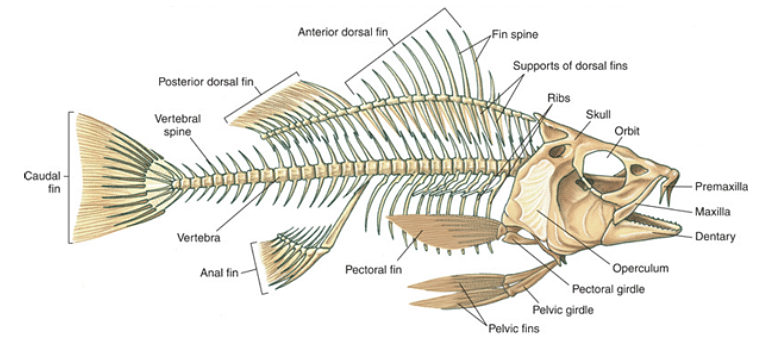
Tilapia fish skeleton
Fish Bones
Bones are composed of tissues that contain blood arteries and nerves. They may heal on their own and even grow stronger than the original bone. A fish's skeleton system is made up of numerous tiny bones. There are about 150 bones in the skeletal system. The connective tissue around the bones is stiffer and thicker.
Vomer
On the roof of the mouth is the vomer midline bone, which typically supports teeth.
Maxillary
These bones are followed by or above paired bones (toothed primitively).
Articular
A pair of paired, angular-shaped bones that are articulated and occupy a piece of the posterior end of the lower jaw together to create a movable joint on the dorsal side.
Retro-auricular
At the lower posterior corner of each articular skeleton, there are paired bones.
Dentary
The front of the lower jaw is formed by two large, paired dental bones that are joined medially (toothed).
Opercle
The majority of the gill cover is made up of flat, paired, and joined hyomandibula bones.
Centrum
The embryonic notochord is blocked during ossification by the centrum, which is the centre, cylindrical portion of each vertebra.
Scapula
These are a pair of flat bones that connect to the coracoids anteriorly and the clethra posteriorly through articulation. The coracoid paired bones and the clethra and scapula articulate. The radials, which are tiny bones that join the fin rays, articulate anteriorly with the scapula and coracoid bones.
Fish Skull
The term "cranium" also applies to the skull. The fish's cranium is two bone "boxes" contained inside of one another, forming a double structure.
- The exterior layer of the skull is made up of dermal bone.
- The skull's interior is made up entirely of endochondral bone.
- There is an operculum on the gill surface.
- The preoperculum comes first, situated above the gills.
- The mouth and premaxilla are somewhat close together.
- The maxillae are located in the mouth next to the Palatine.
- The angular is located between the palatine and the dentary.
- While the dental is at the bottom of the jaw.
- The quadrate is located between the palatine and hyomandibular, and linked with and cranium.
- The palatine is referred to as the mouth roof.

Fish skull
Function of Skull
Fish have craniums (skulls), which shield the brain from damage. The brain is covered by the skull, which shields it from trauma and shock.
Vertebral Column
Many endochondral bones known as vertebrae make up the vertebral column. The vast, spool-shaped core area is the center of one. The vertebral column of the fish is divided into two parts: the trunk and the tail. In the region of the trunk, fish ribs are joined to the spinal column.
Pectoral and Pelvic Girdle
The pectoral girdle connects the pectoral fin to the fish's skeleton. The fish's skeleton and pelvic fin are connected by the pelvic girdle. The pectoral girdle and spinal column are not attached to the free-floating pelvic girdle.
Read More: Respiration in Fish
Types of Skeleton
[Click Here for Sample Questions]
Skeletons can be divided into two categories:
- The exoskeleton, which acts as the dependable external shell of an organism, and
- The internal support system of the body is provided by the endoskeleton.
- The exoskeleton is covered in fish scales.
The endoskeleton, or internal framework, of an animal, is formed of tissue that has undergone mineralization. The endoskeleton forms in deeper body tissues or the skin. A vertebrate's endoskeleton essentially consists of two kinds of tissues (bone and cartilage). Exoskeletons, or exterior skeletons, are built by animals to protect specific body regions.
Parts of the Skeleton
[Click Here for Sample Questions]
Fish are vertebrates, and there are two major types of vertebrate skeletons: axial and appendicular.
- The axial skeleton is made up of the skull, vertebrae, and ribs.
- The bones of the appendages and the pectoral and pelvic girdles make up the appendicular skeleton.
Read More: Fish and Jellyfish Life Cycle
Functions of the Skeleton
[Click Here for Sample Questions]
The soft organs of the body are surrounded by and supported by it, which offers a framework and support. Among the delicate organs that the skeleton guards are the brain, the heart, and the lungs. Muscles employ bones as levers, which help in the movement of the body. The skeleton includes bones, which help to store minerals like calcium and phosphorus. The formation of blood cells is aided by the bone marrow in the bones.
Also Read:
| Related Articles | ||
|---|---|---|
| Difference between bony fish and cartilaginous fish | Difference Between Endoskeleton and Exoskeleton | Taxonomy |
Things to Remember
- Fish are aquatic organisms of Pisces superclass.
- Fishes fall within the phylum Chordata of the kingdom Animalia.
- Fish are divided into two classes, Cartilage and Bony fishes.
- The majority of these are cold-blooded, ectothermic creatures.
- The majority of fish have robust, sturdy skeletons.
- Primary components are vertebral column, jaw, ribs, skull, and intramuscular bones.
- Bony fish have craniums at the head.
- The brain is shielded by the skull..
- Fish without jaws include the hagfish and lamprey.
Sample Questions
Ques 1. What are fish skeletal systems? (2 Marks)
Ans. Fish either have a cartilage or bone skeleton. There are two varieties of skeletal structure: Exoskeleton: An organism's external structure. Endoskeleton: An organism's internal structure.
Ques 2. What are the different parts of the fish skeleton? (2 Marks)
Ans. Fish with bony skeletons are formed of cartilage and bone. A bony fish's skeleton is made up of the vertebral column, the skull, the jaw, the ribs, and intramuscular bones.
Ques 3. How many bones form the fish skeleton? (2 Marks)
Ans. The skeleton system of a fish has many small bones. Approximately 150 bones are present in the skeletal system. The bones are dense, less flexible connective tissue.
Ques 4. What are the different functions of the fish skeleton? (3 Marks)
Ans. The main skeleton helps support and protect the soft parts of the fish's body, such as the organs and muscles. In addition, parts of the fish's skeleton grow within the skin and become the hard spines of the fins and the tiny, hard plates within the fish's scales. It also helps in blood production, and locomotion and gives shape to the fish's body.
Ques 5. Do bony fishes have teeth? (3 Marks)
Ans. Bonefish have amazing sets of pharyngeal teeth, while not having teeth in the traditional sense. They are granular teeth located over the tongue, throat, and upper jaw. After food has been grabbed, they are used to grind and crush it. The predatory fish can grip onto their food and shred it into bite-sized pieces thanks to their 500 pointed teeth, which are arranged in numerous rows. And they lose and replace roughly 20 teeth each day to make sure their chompers are strong enough.
Ques 6. How many ribs are present in fish? What are their functions? (2 Marks)
Ans. The ribs provide support for the trunk musculature as well as protection for the internal organs they contain. Fish have two sets of ribs that unite at the back but are attached to the upper and lower portions of the vertebral arches.
Ques 7. What are the cartilaginous fishes? (2 Marks)
Ans. The earliest jawed vertebrates still alive are cartilaginous fishes (Chondrichthyes), which, as their name implies, have a cartilage-based structure. Sharks, rays, skates (Elasmobranchii), and chimeras are among them (Holocephali).
Ques 8. Why are sharks called cartilaginous fishes? (3 Marks)
Ans. Unlike fishes with bony skeletons, a shark's skeleton is made out of cartilage. This is a flexible but strong connective tissue that's also found throughout the human body, in places like the nose, ears, and joints between bones. The whale shark (Rhincodon typus), found in the world's tropical waters, is the largest living cartilaginous fish of the order Orectolobiformes. Like the greatest whales, it is a peaceful species that filters-feeds on small plankton, making it the largest living thing that is not a cetacean.
Ques 9. What are the parts of the fish skull? (3 Marks)
Ans. The operculum or gill cover, which is lacking in sharks and fish without jaws, and the cheek, which extends from the eye to preopercle, are all parts of a fish's head. The snout, which runs from the eye to the forward-most point of the upper jaw, is also included. The operculum and preopercle can have spines.
Ques 10. What are the differences between bony and cartilaginous fishes? (5 Marks)
Ans: The differences between bony and cartilages are tabulated below.
| BONY FISH | CARTILAGINOUS FISH |
|---|---|
| It belongs to the class Osteichthyes. | It belongs to the class Chondrichthyes. |
| They may be ovoviviparous or viviparous. | They are only viviparous. |
| They are both marine and freshwater. | They are always marine. |
| They have both oral and pharyngeal jaws. | They have only oral jaws. |
| Operculum is absent in bony fishes. | Operculum is present in cartilaginous fishes. |
| Endoskeleton is made up of bone. | Endoskeleton is made up of cartilage. |
| Exoskeleton is made up of cycloid scales. | Exoskeleton is made up of placoid Scales. |
| Example: Hippocampus (Sea horse); Exocetus (Flying fish); Lophius (Angler fish), Labeo rohita (Rohu); Labeo catla (Katla | Example: Great White Shark, Tiger Shark, Giant Manta Ray, Scalloped Hammerhead Shark and Giant Freshwater Stingray |
For Latest Updates on Upcoming Board Exams, Click Here: https://t.me/class_10_12_board_updates
Also Read:



Comments