



Exams Prep Master
A gauss rifle, also known as a coil gun, is a type of mass driver that consists of one or more coils and is used as electromagnets in the configuration of a linear motor. It accelerates a ferromagnetic or conducting projectile to high velocity. The gauss rifle is named after Carl Friedrich Gauss, who formulated mathematical descriptions of the magnetic effect used by magnetic accelerator cannons. Generally, a gauss rifle or coil gun consists of one or more coils arranged along a barrel, as a result of which the path of the accelerating projectile lies along the central axis of the coils. In this article, we will be discussing the working mechanism of a gauss rifle.
| Table of Content |
Key Takeaways: Gauss rifle, Ferromagnetic projectile, Non-Ferromagnetic projectile, Switching, Coilgun, Electromagnet, Solenoid, Accelerator, Velocity, Linear motor
Also check: Potential Energy
History of the Gauss Rifle
[Click Here for Sample Questions]
The oldest electromagnetic gun came in the form of the gauss rifle. The first coilgun was invented by Norwegian scientist Kristian Birkeland, at the University of Oslo. The development started way back in 1845, but the discovery did not receive an official patent until almost 60 years later, in 1904. The coilgun developed by him accelerated a 500-gram projectile to 50m/s.
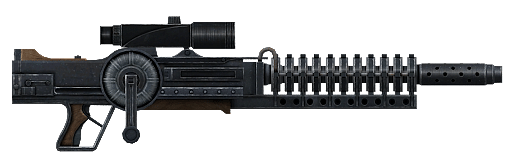
The next coilgun was developed in 1933 by Texan inventor Virgil Rigsby, and it was a stationary coilgun that was designed to be used as a machine gun. It was powered by a large electric motor and generator. However Armed forces have never been interested in producing these henceforth.
Also Read:
| Related Articles | ||
|---|---|---|
| The Bar Magnet | Magnetism and Gauss Law | Potentiometer |
| Ampere | Unit of Voltage | Circuit Diagram |
Ferromagnetic and Non-Ferromagnetic Projectiles
[Click Here for Sample Questions]
For ferromagnetic projectiles, a single-stage coilgun can be made using the coil of a wire. An electromagnet should be used, keeping a ferromagnetic projectile at one of its ends. The coilgun is similar to a solenoid which is used in an electrochemical relay. A large current should be applied through the coil of wire. A strong magnetic field is generated, thus pulling a projectile towards the coil.
Given below are some illustrations for a better understanding of the subject matter.

Illustration of a Solenoid
[Click Here for Sample Questions]
After electromagnets, a single-stage coilgun was used to repeat the same procedure for the progressive acceleration of the projectile in a multi-stage design. Given below is a diagram of a coilgun for better understanding.

A diode is used to protect the polarity-sensitive components from damage because of the inverse-polarity of the voltage after turning off the coil. In some cases, designs for Gauss consist of non-ferromagnetic projectiles. These are made of materials such as aluminum or copper. In such designs, the armature of the projectile serves the purpose of an electromagnet, where the internal current is induced by some pulses of the acceleration coils.
For instance, a quench gun is prepared by successively quenching adjacent coaxial conducting coils. It forms a gun barrel, thus generating a magnetic field gradient, in order to get a more desirable speed.
Also check: Magnetic Properties of Materials
Switching
[Click Here for Sample Questions]
The coilgun design faces one major obstacle, which is, switching of power through its coils. Several common solutions have been implemented. However, the easiest one is the spark gap that releases the stored energy by the coil when the voltage reaches a particular threshold value. Unfortunately, it also happens to be the least effective one.
Given below is a picture of a spark gap.

Another, comparatively more reliable solution is solid-state switches, which include IGBT (Insulated-gate bipolar transistor) or power MOSFET and SCR.
Silicon Controlled Rectifier
[Click Here for Sample Questions]
When we use the flash-tube itself as the switch, it's a quick-and-dirty approach for switching. By connecting it to the coil in series, it can silently and non-destructively allow more current to flow through the coil, allowing a large portion of the energy to be dissipated as heat and light, and, because the tube is a spark-gap, the tube stops conducting when the voltage across it drops sufficiently, leaving some charge on the capacitor. The magnetic circuit, on the other hand, must be designed to provide maximum energy to the projectile for a given energy input in order to reduce component size, weight, durability, and, most critically, cost. The usage of back iron and end iron has helped to address it to some extent.
Preparation of Gauss Rifle
[Click Here for Sample Questions]
A steel ball is rolled towards a magnetic taped plastic rail in this experiment. When the ball strikes the magnet, another one shoots in the opposite direction at a much faster speed. Simple materials such as straight rail, wood, plastic, and others are required to complete this project. Here's a more in-depth look at the project.
Materials Required:
- Wooden Ruler
- Two dowels
- Copper pipes
- Clear adhesive tape
- Glue
- Strong cylindrical magnets
- Nine steel balls
Procedure:
- Place the first magnet at the 2.5-inch mark on the wooden ruler. If you don't have a ruler, you'll need to measure the distance and make sure the magnet is placed where it should be.
- Temporarily tape the ruler to the table to prevent magnets from jumping and attaching.
- Maintain a 2.5-inch space between each of the four magnets on the ruler.
- Place two steel balls on the right-hand side of each magnet. Ensure that the ball does not fall from the ruler.
- It's now time to fire! Place the steel ball on the left-most magnet and roll it to it.
- When the gauss rifle fires, the right-hand ball shoots away from the gun and lands on the target with sustainable force.
Observation:
When you release the first ball, it will land on the magnet on the far left. It slams into it with a lot of power and generates kinetic energy. The ball's energy is transmitted to the magnet, and the ball on the right then releases. The third ball is now traveling with kinetic energy, and the process is repeated until the final ball shoots with increased power.
Also Read:
| Related Articles | ||
|---|---|---|
| Electrical Insulators | Uses of Resistor | Uses of LED |
| The Earth’s Magnetism | Magnetic Poles | Magnetization and Magnetic Intensity |
Things to Remember
- The direction of acceleration in a railgun is at right angles to the central axis of the current loop formed by the conducting rails, but in a coilgun, the direction of acceleration is at right angles to the central axis of the current loop formed by the conducting rails.
- Furthermore, railguns typically require the use of sliding contacts to send a big current through the projectile or sabot, whereas coilguns do not.
- A single-stage coilgun for ferromagnetic projectiles can be made with a coil of wire, an electromagnet, and a ferromagnetic projectile put at one of its ends.
- The coilgun is made in the same way as a solenoid in an electromechanical relay, with a current-carrying coil that draws a ferromagnetic item through its center.
- A quench cannon is a superconducting coilgun that generates a wave of magnetic field gradient traveling at any desired speed by successively quenching a line of neighboring coaxial superconducting coils creating a gun barrel. This wave could be ridden like a surfboard by a moving superconducting coil.
- The coils' electrical resistance and the current source's equivalent series resistance (ESR) consume a lot of energy.
Sample Questions
Ques. Is the Gauss Rifle an energy weapon? (2 marks)
Ans. The gauss rifle is a slugthrower, to be precise. Like a chemical slug thrower, it fires metal slugs at targets. There are no solid projectiles in energy weapons, which include lasers, microwave beamers, and plasma cannons.
Ques. Why are Gauss rifles not used in armies or law enforcement? (3 marks)
Ans. Gauss rifles aren't used because they don't exist right now.
- The lack of a Gauss weapon is due to the following:
- Gauss weapons necessitate a great deal of electricity. At present moment, there are no batteries that can power a Gauss cannon while still fitting into a man-portable weapon.
- Electromagnetic cannons have been tested in a number of countries, but none have yet been deployed. The United States is perhaps the closest to making it operating.
- Electromagnetic cannons are being developed as naval artillery due to power needs.
Ques. How is a Gauss rifle related to Gauss’ law? (2 marks)
Ans. Carl Friedrich Gauss was a physicist and mathematician (1777 - 1855). The electric field generated by a bunch of charges inside a closed surface is described by Gauss' law. The term "gauss rifle" refers to a rail gun that uses induced magnetic force to propel a projectile. Gauss and Weber studied magnetism's physical laws. His name is given to a unit of a magnetic flux measurement. Because of Gauss's relationship to magnetism, the connection between Gauss and the rail gun is shaky.
Ques. Is it possible to create a machine gun from a Gauss rifle? (3 marks)
Ans. It's really likely. Have an open feed port that is not part of the energized portion to feed the projectiles from, and a piston or slide to propel the projectile to where it will engage the magnetic field and be accelerated.
The number of rounds your machine gauss rifle/coilgun can fire is determined by how quickly the projectiles are shot, how quickly the heat from the electrics is dispersed, and how quickly the piston/slide can force the projectiles into the breach.
Because prototypes using BBs have already shown it, it is undoubtedly achievable. And, because the coilguns aren't legal firearms due to the electrical acceleration and/or low energies involved, they're also not legal machine guns.
Ques. What kind of power source is necessary to manufacture functional Gauss rifles? (3 marks)
Ans. An electromagnetic accelerator is referred to as a "gauss gun." The velocity of a bullet is picked up as it passes through a series of magnetic fields. Unless the succession of magnetic fields is extremely long, this is limited to very low velocities. By stringing a very long sequence of magnetic fields up the side of a massive equatorial mountain, this technique may be used to accelerate spaceships into orbit. So it's not so much a question of power supply; electromagnets don't need a lot of it. It's the long time of acceleration that's the problem.
A "rail cannon," on the other hand, works by releasing a vast amount of electricity from gigantic capacitors across "rails" in a single burst. The projectile is carried away by the discharge. This is extremely violent, and it can only be done with anything capable of creating the massive amounts of power required as if it were a navy vessel.
Ques. Regardless of practicality could gauss rifles or rail guns fire high explosive warheads? (2 marks)
Ans. Yes, this would be beneficial in the case of artillery or naval gunfire. However, with a man-portable weapon, it's not very practical. Magnetic rail projectiles would travel at many times the speed of sound, and the shockwave created by the bullet would cause so much internal damage that explosive rounds would be a waste of money, not to mention theoretically in violation of the Geneva and Hague Conventions. There is now an explosive payload round for 50 caliber machine guns and rifles, although it is not a primary weapon system and is employed more often against hard targets rather than civilians in the open.
For Latest Updates on Upcoming Board Exams, Click Here: https://t.me/class_10_12_board_updates
Check-Out:



Comments