


How does a bridge circuit work?

The standard bridge circuit is known as a Wheatstone Bridge.
  • Wheatstone bridge is used to determine an unknown resistance by balancing the two legs of the bridge circuit, of which one leg includes the unknown resistance component.
  • Wheatstone bridge works on the null deflection principle, where the ratio of resistances is equal and no current flows through it.
  • Under normal conditions, the bridge remains unbalanced and the current flows through the galvanometer.
  • In a balanced condition, no current flows through the galvanometer by adjusting the values of the known and variable resistance.
  • When the current through a galvanometer is zero, the following condition exists I1P = I2R.
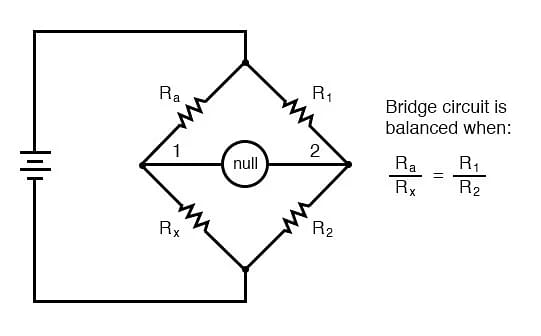
Wheatstone Bridge

To measure unknown resistance, a bridge circuit consists of a resistor with an unknown value and three resistors of known value. Either of the three known resistors is adjusted and then replaced until the bridge is balanced. When the balance has been reached, the unknown resistance can be determined from the ratio of the known resistances.


Related Questions

  1. Meter Bridge or Slide Wire Bridge is a practical form of?
  2. Can you find very high resistance accurately with the help of a Metre bridge?
  3. Why Carey Foster Bridge Is So Sensitive?
  4. Meter bridge works on the principle of?
  5. Why is Wheatstone's bridge more accurate?
  6. Why should we get the null point in the middle of the Metre bridge wire?
  7. How do you solve an unbalanced bridge?
  8. What Is Null Voltage?

Read More:

CBSE CLASS XII Related Questions

  • 1.
    Write the expression for the magnetic field due to a current element in vector form. Consider a 1 cm segment of a wire, centered at the origin, carrying a current of 10 A in positive x-direction. Calculate the magnetic field \( \mathbf{B} \) at a point \( (1 \, \text{m}, 1 \, \text{m}, 0) \).


      • 2.
        If both the number of protons and the neutrons are conserved in each nuclear reaction, in what way is mass converted into energy (or vice versa) in a nuclear reaction? Explain.


          • 3.
            Two parallel plate capacitors X and Y are connected in series to a 6 V battery. They have the same plate area and same plate separation but capacitor X has air between its plates, whereas capacitor Y contains a material of dielectric constant 4. Calculate the capacitances of X and Y, if the equivalent capacitance of the combination of X and Y is \( 4 \, \mu\text{F} \). Calculate the potential difference across the plates of X and Y.


              • 4.
                Two thin lenses of focal length \( f_1 \) and \( f_2 \) are placed in contact with each other coaxially. Prove that the focal length \( f \) of the combination is given by \[ f = \frac{f_1 f_2}{f_1 + f_2}. \]


                  • 5.
                    Suppose a pure Si crystal has \( 5 \times 10^{28} \) atoms per \( \text{m}^3 \). It is doped with \( 5 \times 10^{22} \) atoms per \( \text{m}^3 \) of Arsenic. Calculate majority and minority carrier concentration in the doped silicon. (Given: \( n_i = 1.5 \times 10^{16} \, \text{m}^{-3} \))


                      • 6.
                        Draw the number of scattered particles versus the scattering angle graph for scattering of alpha particles by a thin foil. Write two important conclusions that can be drawn from this plot.

                          CBSE CLASS XII Previous Year Papers

                          Comments


                          No Comments To Show
