



Education Journalist | Study Abroad Lead
Relation Between kVA and kW is kva = kw/power factor. kVA and kW are the units of measuring power under the international system of units. kVA or KiloVolt-Ampere is the measure of apparent power. It refers to the total amount of power present in the system. kW is the measure of the power that is converted into a useful output. So, it is the power that one can work with. The relation between these two units is proportional. To convert between kVA and kW we have to know the electrical efficiency of the system. Electrical efficiency is also known as Power Factor which ranges between 0 to 1. The closer the value of the power factor is to 1, the more efficiently kVA is being converted to kW.
| Table of Content |
Key Terms: kVA, kW, Power factor, kVA-kW conversion, Apparent Power, Electrical Efficiency, Generator, Current, Current Electricity, Volt, Ampere
Kilovolt-Ampere (kVA)
[Click Here for Previous Year Questions]
KiloVolt-Ampere is the measure of the apparent power used in a machine. A kVA simply means 1000 VA. Here, a Volt is an electrical pressure and an amp is the electrical current. Thus, the term called apparent power is equal to the product of a volt and ampere.
kVA is often considered extraneous data as it refers to the apparent power but kVA is equally important when ensuring if the system has the proper wiring capabilities to carry the extra current even when the machine is not using it. Generators often carry their kVA rating so one can determine if it is capable of handling the extra current for reactive loads.
Discover about the Chapter video:
Current Electricity Detailed Video Explanation:
Read More:
Kilowatt(kW)
[Click Here for Sample Questions]
Kilowatt refers to the real power that is actually converted into a useful output. Therefore, kW is also known as actual power or working power. kW is calculated by multiplying voltage and current. As per different units, Kilowatt (kW) can be represented as:
- One kilowatt (kW) = 1000 watts (W):
⇒ 1kW = 1000W
- One kilowatt can be expressed as the energy consumption of 1000 joules for 1 second:
⇒ 1kW = 1000J / 1s
- One kilowatt = 1000000 milliwatts:
⇒ 1kW = 1000000mW
Kilowatt (kW) is a measure of power an electric appliance consumes. It is found equivalent to one thousand watts of electrical power.
Solved Examples of Kilowatt (kW)Ques. Determine power consumption in kW if energy of 30000 joules is released during 10 seconds. (2 marks) Ans. As per the given question, ⇒ P(kW) = 30000J / 10s / 1000 = 3 kW Ques. Convert the Real Power in Watts to Apparent Power in kVA (Kilovolt amps). (3 marks) Ans. S in kilovolt-amps (kVA) (apparent power) is equivalent to the P in watts (W) (real power), divided by 1000 times the PF: Thus, it can be demonstrated as: ⇒ S(kVA) = P(W) / (1000 × PF)W Watts divided by 1000 times the power factor is equivalent to kilovolt-amps. ⇒ kVA = kW / (1000 × PF) Ques. Name the physical quantity measured in: (3 marks)
Ans. The physical quantities measured in:
|
What is Power Factor (Pf)?
[Click Here for Previous Year Questions]
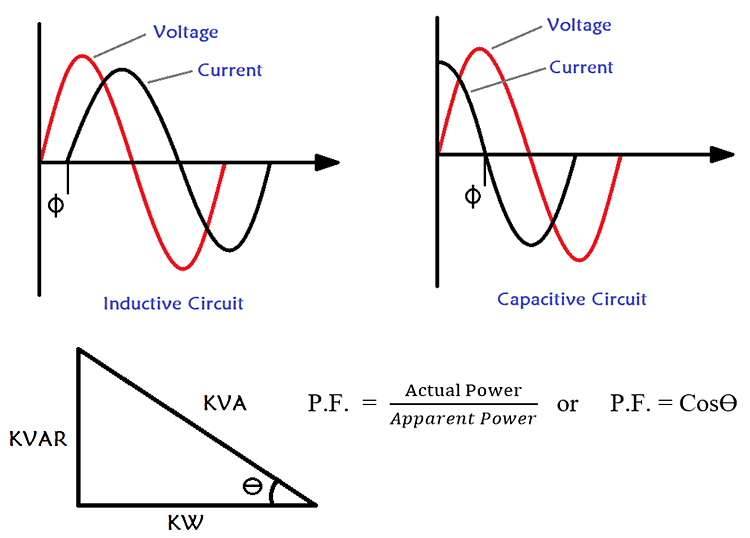
The machines that we use are unable to use all of the power it is provided with and here the question of the efficiency of a machine comes in. This electrical efficiency is also termed as power factor refers to the ratio of the real power absorbed and the apparent power flowing in the circuit.
Power Factor
It determines the proportion of the absorbed power that will be put to use by a machine. Power factor ranges from 0 to 1 where 0 being the least efficient being unable to convert no useful power and 1 being the most efficient where all of the absorbed currents are converted to their useful form.
Important Questions on kVA and kW |
kW to kVA Conversion
[Click Here for Sample Questions]
The formula for conversion of kW to kVA is:
| kW = kVA x PF … i) |
Here,
- kW = Real power put into use by the machine
- kVA = Total amount of apparent power available to the machine
- PF = Power Factor
Rearranging the formula (i), we get,
⇒ kVA = kW/PF
So, from the formula, we can see the kVA and kW have a proportional relationship. It means if there is an increase in kVA, kW will be automatically increased and if kVA is decreased kW will decrease automatically.
Example Based on kW and kVAIf we know that if an apparent power of 100 kVA is applied to a machine and if the power factor of the machine is 0.8, the actual output of the machine will be (100x 0.8)= 80 kW. This is the actual power that can be used by the machine. In Another example, if a system's usable or output power is 200 kW and the system's power factor is 0.7, then the total amount of apparent power will be (200/ 0.7)= 285.71 kVA. This is the total power available to the system. |
kVA and kW Relationship for AC and DC Current
[Click Here for Previous Year Questions]
DC current does not create any difference between kVA and kW. Here, the power factor is mathematically inconsequential, because it is the unity.
Therefore, kW = kVA = Volts X CurrentX1 = Volts \(\times\) Current
However, in AC current circuits, the voltage and current may get out of phase. Therefore, kVA and kW vary depending on the power factor or how much leading or lagging occurs.
| Condition | Power Factor | Formula |
|---|---|---|
| AC Current | Power Factor>1 | kW = kVA \(\times\) PF |
| DC Current | Power Factor = 1 | KW = kVA |
Difference Between kVA and kW
[Click Here for Sample Questions]
The difference between kW and kVA is the power factor. Here, kW refers to the real or usable power and kVA denotes the apparent power. The power factor which is defined and known has an approximate value of 0.8 used in kW to kVA conversions. The kVA value is always greater than the kW value. The
| KVA | KW |
|---|---|
| KVA is used to depict apparent power. | KW is used to depict actual power. |
| Both powers are equal in DC circuits. | Both powers are different in AC circuits. |
| A kVA’s fraction is accessed to do work while the rest is assumed excess in current. | KW displays the actual power that does valid work. |
| The full form of KVA is kilovolt amperes. | The full form of KW is kilowatts. |
In industrial and commercial generators, kW is most commonly mentioned in the US system. The majority of the rest of the world mainly uses kVA. The kW rating is primarily the result of the power output of a generator based on the engine’s horsepower.
kW is often computed by the horsepower rating of an engine 0.746. For instance, if we have a 700-hp engine, it will have a kW rating of 522.2. The kVA is the generator capacity. The generators usually display both the ratings.
Also Check:
Things to Remember
- kVA and kW both are units of the measurement of power.
- kVA or kilovolt ampere simply refers to 1000 VA. It refers to the apparent power available to the system.
- kW or kilowatt refers to the power which has actually been converted to useful power.
- The power factor is the ratio of the real power absorbed and the apparent power flowing in the circuit. It shows the efficiency of the system.
- The power factor ranges from 0 to 1 where 1 represents the most efficient system.
- The formula for conversion of kW to kVA is kW= kVA x Power Factor (PF)
- In the case of DC current, there is no difference between kW and kVA while in the case of AC current kVA and kW vary depending on the power factors.
- The value of kVA is always greater than kW.
Sample Questions
Ques: Convert the Real Power in Watts to Apparent Power expressed in kVA? (2 marks)
Ans: let us assume that S is the apparent power (in kVA) is being converted to real power P (in Watts), divided by 1000 times the Power Factor
S (kVA)= P(W) / (1000.PF)W
So, kVA= kW/ (1000.PF)
Ques: If the power factor is 0.5 and the value of kW is 400, find out the value of kVA. (3 marks)
Ans: As per the formula of the conversion of kVA to kW,
kVA= kW/Power factor
putting the values in the above-mentioned equation we will get-
kVA= 400/0.5=800.
Therefore, the value of kVA is 800.
Ques: If the power factor is 0.8 and the value of kVA is 120, find out the value of kW. (3 marks)
Ans: As per the formula of the conversion of kVA to kW,
kW= kVA x Power factor
putting the values in the above-mentioned equation we will get-
kW= 120X 0.8= 96
So, the value of kW is 96.
Ques: In an AC generator, the apparent power provided was 120 kVA and the output power is 105 kW. Find out the power factor of that generator. (2 marks)
Ans: As per the formula of the conversion of kVA to kW, we know, kW= kVA x Power factor
So, Power factor= kW/kVA= 105/120= 0.875.
Therefore, the power factor of the generator is 0.875.
Ques: What is kW? (2 marks)
Ans: Kilowatt is the real power that is actually converted from kVA into a useful output. kW is computed by multiplying voltage and current.
Ques: what is kVA? (2 marks)
Ans: kVA is the measure of the apparent power in use in a machine. It shows the capability to carry the extra current even when the machine is not using it
Ques: Define power factor. What does it signify? (2 marks)
Ans: The power factor represents the ratio of the real power absorbed and the apparent power flowing in the circuit. It determines the proportion of the absorbed power that will be put in use by a system.
The power factor shows the real efficiency of the machine. The value of the power factor gets closer to 1 the more efficient the machine becomes.
Ques: State the formula of conversion of kVA to kW. (2 marks)
Ans: The formula for conversion of kVA to kW is
kW= kVA x Power factor
kVA= kW/Power factor
Ques: Write the expression to calculate p.u. impedance. Let Vb, be the base voltage, Z is the Actual impedance and kVAb be the base kilovolt amperes. (5 Marks)
Ans: The per-unit value of any quantity is defined as the ratio of actual value in any unit to the base or reference value in the same unit.
Any quantity is converted into per unit quantity by dividing the numeral value by the chosen base value of the same dimension. The per-unit value is dimensionless.
PU Value (PU) = \(\frac{A}{B}\)
Here, A is the actual value in any unit
B is the Base or reference value in the same unit
Consider the base value of voltage is (kVB), the Base value of current is (IB) and the base value of apparent power is (kVAB)
And, Base value of current (IB) = \(\frac{kVA_B}{kV_B}\) .... (1)
Now, the Base value of the impedance (ZB) will be the ratio of the base value of voltage to the current.
⇒ ZB = \(\frac{kV_B}{I_B}\)
From equation (1),
ZB = \(\frac{kV_B}{(kVA_B/kV_B)}=\frac{(kV_B)^2}{kVA_B}\)
Hence, per unit value of impedance can be written as if Z is the actual value of impedance,
ZPU (1000) = \(\frac{Z_A}{Z_B}=Z\times \frac{kVA_B}{(kV_B)^2}\)
Since the above expression is given infraction of 1000 units,
Hence per unit value will be given as,
ZPU = \(Z\times kVA_B\times \frac{1000}{(kV_B)^2}\)
Ques: Calculate the per-unit synchronous reactance on the base value of 200 MVA and 20 kV when a 100 MVA with 20 kV synchronous generator has 1pu synchronous reactance. (5 Marks)
Ans: The relation between new per-unit value & old per unit value of reactance
\({({X_{pu}})_{new}}\; = {({X_{pu}})_{old}} \times {\left( {\frac{{k{V_{base}}}}{{k{V_{new}}}}} \right)^2} \times \;\left( {\frac{{MV{A_{new}}}}{{MV{A_{old}}}}} \right)\)
Also \({X_{pu}} = \frac{{{X_{Actual}}}}{{{X_{base}}}}\)
\({X_{base}} = \frac{{kV_{base}^2}}{{MV{A_{base}}}}\)
Where,
(Xpu)new = New per unit value of reactance
(Xpu)old = Old per unit value of reactance
kVbase = Old base value of voltage
kVnew = New base value of voltage
MVAnew = New base value of power
MVAold = Old base value of power
Given that,
Xd(old) = 1 pu
MVA(new) = 200
MVA(old) = 100
kV(old) = 20
kV(new) = 20
∴ \({X_{d\left( {new} \right)}} = 1 \times \frac{{200}}{{100}} \times {\left( {\frac{{20}}{{20}}} \right)^2} = 2\;pu\)
Ques: On a base of 132 kV, 100 MVA, a transmission line has 0.2 per unit impedance. On a base of 220 kV, 50 MVA, it will have a per unit impedance of: (5 Marks)
Ans: Per unit quantity:
Per unit quantity = Actual quantity in the units / Base (or) reference quantity in the same units
⇒ Per unit impedance Zpu = Zactual / Zbase
⇒ Zpu = ZΩ × MVAb / (kVb)2
Conversion of one per unit impedance into another per unit impedance is given by
\({{\bf{Z}}_{{\bf{pu}}}}\left( {{\bf{new}}} \right) = {{\bf{Z}}_{{\bf{pu}}}}\left( {{\bf{old}}} \right)\left( {\frac{{{\bf{MV}}{{\bf{A}}_{{\bf{new}}}}}}{{{\bf{MV}}{{\bf{A}}_{{\bf{old}}}}}}} \right){\left( {\frac{{{\bf{k}}{{\bf{V}}_{\bf{b}}}_{{\bf{old}}}}}{{{\bf{k}}{{\bf{V}}_{\bf{b}}}_{{\bf{new}}}}}} \right)^2}\)
Calculation:
Zpu old = 0.2
MVAold = 100 MVA
kVb old = 132 kV
MVAnew = 50 MVA
kVb new = 220 kV
\({{\bf{Z}}_{{\bf{pu}}}}\left( {{\bf{new}}} \right) = {{\bf{Z}}_{{\bf{pu}}}}\left( {{\bf{old}}} \right)\left( {\frac{{{\bf{MV}}{{\bf{A}}_{{\bf{new}}}}}}{{{\bf{MV}}{{\bf{A}}_{{\bf{old}}}}}}} \right){\left( {\frac{{{\bf{k}}{{\bf{V}}_{\bf{b}}}_{{\bf{old}}}}}{{{\bf{k}}{{\bf{V}}_{\bf{b}}}_{{\bf{new}}}}}} \right)^2}\)
\(Z_{pu}(new)=0.2*\frac{{50}}{{100}}*{\left( {\frac{{132}}{{220}}} \right)^2}\)
Ques: Give the formula to calculate the base current, Ib, and base impedance of a three-phase system. (3 Marks)
Ans: The equation for base current Ib is:

The equation for base impedance is:

Where,
- Ib = Line value of base current
- kVAb = 3-phase base KVA
- kVb = line to line base kV
- Zb = Base impedance per phase
Ques: Define base impedance and base kilovolt amperes. (2 Marks)
Ans: The base impedance is the impedance that will have a voltage drop across it equal to the base voltage when the current flowing in the impedance is equal to the base value of the current.
\(Z_b = \frac{kV_b)T^2 \times 1000}{kVA_b}\)
The base kilovolt amperes in single-phase systems are the product of base voltage in kilovolts and base current in amperes.
Previous Year Questions
- Which of the following is true with respect to Rogers spiral experiment? [JKCET 2019]
- Two parallel beams of positrons moving in the same direction will...
- A thick current carrying cable of radius ′R′ carries current ′I′ uniformly…
- The resistance between any two terminals is when connected in a triangle is…. [ NEET 1993 ]
- potential drop through 4Ω4Ω resistor is… [ NEET 1993 ]
- The potential difference per unit length of the wire will be… [ NEET 1999 ]
- Value of R for which the power delivered in it is maximum is given by... [ NEET 1992 ]
- In a closed circuit, the current II (in ampere) at an instant of time tt (in second) is given by…? [KEAM]
- Five cells each of emf E and internal resistance r send the same amount of current through…? [KEAM]
- Electrical conductivity is the reciprocal of…? [KEAM]
- Consider a cylindrical conductor of Length L and area of cross section A. The specific conductivity…? [KEAM]
- An ammeter, voltmeter and a resistor are connected in series to a cell and the readings are…? [KEAM]
- A potentiometer wire of length 10m and resistance 20Ω is connected in series with a…? [KEAM]
- A potentiometer wire, 10m long, has a resistance of 40Ω. It is connected in series with a…? [KEAM]
- A given resistor has the following colour code of the various strips on it: Brown, black, green…? [KEAM]
- A galvanometer can be converted into an ammeter by connecting…? [KEAM]
- A copper wire with a cross-section area of 2×10⁻⁶m2 has a free electron density equal…? [KEAM]
- If now we hav.e to change the null point at 9th9th wire, what should we do?… [ DUET 2007 ]
- The electrical permittivity and magnetic permeability of free space are… [ DUET 2003 ]
- Just after key K is pressed to complete the circuit, the reading will be …. [ KEAM 1999 ]
For Latest Updates on Upcoming Board Exams, Click Here: https://t.me/class_10_12_board_updates
Check-Out:



Comments