



Education Journalist | Study Abroad Lead
Current Density Formula is \(j=\rho v\) where j= electric current density, v= velocity of charges, \(\rho\)= charge density. Current density is the rate of current flowing per unit area. Current density is a property that describes current at a specific point of the conductor. Not only the magnitude of current but also the orientation of the area plays an important role in current density. Electric current is studied as a property of a conductor on the whole and not at a specific point on a conductor. Current density is denoted by J. J=I/A, where A=area. Current density is a vector quantity because it has both the magnitude and direction of the flow.
| Table of Content |
Key Terms: Current, Current density, Electricity, Current Electricity, Magnetism, Conductivity, Volage, Resistance, Electric field, Ohm’s law
Introduction to Current Density
[Click Here for Previous Year Questions]
Current density in a conducting material can be defined as the charge flow through any cross-section of the conductor. Electric current is the flow of electrons.
When two ends of a battery or power source are connected using a metal wire, electrons flow from one end of the battery, through the wire into the other end of the battery. The current is generally constant and its direction will always be the same.
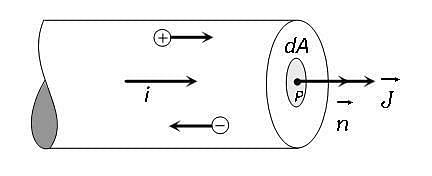
Flow of Current
Discover about the Chapter video:
Current Electricity Detailed Video Explanation:
Read More:
Current Density Symbol and Unit
[Click Here for Sample Questions]
Current density is the amount of electric current (electric charge) flow in amperes per unit area(A) of cross-section (m2). In electromagnetism, the current density and its measurement play an important role. Current Density is represented alphabetically by J.
Current density is a vector quantity because it has both the magnitude and direction of the flow. It is the electric current that passes through has units of charge per unit time(t) per unit area(A). The angle between the cross-section where the current density is measured and the flow of current is 90o. Current density or electric density is represented in ampere per square meter or A/m2 or Am-2.
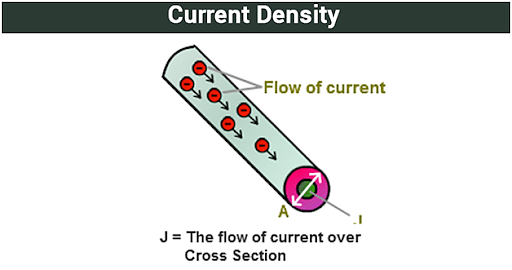
Representation of Current Density
Read More: Current Electricity Important Questions
Current Density formula
[Click Here for Previous Year Questions]
Mathematically:
J=dI/dA [dI/dA=change of current with unit area]
J.dA = dI
J.dAcosθ =dI
When dA is perpendicular to J then, θ =90o, so, cosθ =1
J.dA=dI
I=JA
J=I/A
Here,
J- current density in A/m2,
A-cross-sectional area in m2
I-electric current through the conductor in Amperes (A)
Read More: Electric Current and Circuit
Current Density: Electric Field and Conductivity
[Click Here for Sample Questions]
According to Ohm’s law
V=IR
The voltage drop across two ends of the conductor is directly proportional to the flow of current, where R is resistance, which is proportionality constant and opposes the current flow.
Now, the resistance of the conductor depends on the distance between the two ends of the conductor and the cross-sectional area of the conductor.
If, the distance between two plates is l and the area of the plates is A-
R∝l/A
R=ρl/A
here ρ is Resistivity
Substituting R in ohm’s law
V=Iρl/A
Substituting I/A by J:
V=Jρl
If the electric field across the conductor be E, then the potential difference V can be given as
V=El
Value of V in both above equations equated-
El=Jρl
E=Jρ
Thus, the current density can be given as
J=σE
Read More: Resistance Formula

Relation Between Electric field and Current Density
Hence, current density (J) is directly proportional to the electric field (E).
Also Read: Current Electricity
Things to Remember
- Current is scalar quantity since it has magnitude but no direction, whereas current density is a vector quantity since it has both.
- SI unit of current density - Ampere per meter square (A/m2)
- With the increase in current density (J), conductivity (σ) increases since they are directly proportional.
- With the increase in current density (J), electric fields increase, since they are directly proportional.
Also Read:
Sample Questions
Ques 1. What is the current density passing through a wire whose cross-section area is 15 mm2 and the current flowing through the wire is 5 mA. (2 marks)
Ans. A = 4 square millimetres, I = 6 mA, J =?
Using the formula J= I/A
J = 0.005 / 0.015
J = 0.03 A/m2.
Thus, 0.03 A/m2 is the current density.
Ques 2. Mention the dimensional formula for current density. (2 marks)
Ans. The current density dimensional formula is [M0L-2T0I1]
Here, M is the Mass
I is the Current
L is the Length
T is the Time
Ques 3. The current density in a copper wire is 10 A/cm2 and the electric field in the copper wire is 5 V/cm. If ρ is the resistivity of the copper, and σ is the conductivity of the copper then (in SI units) (3 marks)
(a) ρ = 510-3
(b) ρ = 200
(c) σ = 510-3
(d) σ = 200
Ans. We know that, E = Jρ
So, ρ = E/J
Given, E= 500 V/m and J=105 A/m2
Putting in the equation ρ = E/J
ρ = E/J = [500 V/m] / [105 A/m2]
σ = 105/500 (since σ = 1/ρ)
= 200 units
Thus, option (d) σ = 200 is correct.
Ques 4. Explain how current density (J) and conductivity (σ) are related? (2 marks)
Ans. In electromagnetism, the current density (J) and its attributes play an important role. It refers to the amount of the electric charge flowing through a conducting material in amperes per unit area of cross-section i.e. A/m2. To understand further, suppose that a medium (conductive material) has an electrical conductivity given by σ, then the density of electric current can be related to the electric field (E) by the equation: J=σE
Ques 5. If a copper wire of cross-sectional area of 10-6 m2, carries a current of 2, calculate the current density and average drift velocity taking the number of electrons per cubic meter as 8 × 1028. (3 marks)
Ans. Gn Data:
A = 10-6 m2
I = 2A
n = 8 × 1028
J = ?
vd = ?
Solution:

Ques 6. Given, current density- 500 A/cm2 and number of free electrons - 8.47 1022 per cm3. Find the drift velocity. (3 marks)
Ans. Gn J = 500 A/cm2 = 500 × 104 A/m2,
n = 8.47 × 10²² electrons/cm3 = 8.47 × 1028 electrons/m3,
e = 1.6 × 10⁻¹⁹ C
vd = ?
Solution:

Ques 7. A 5 mm2 copper wire has a current of 5 mA of current flowing through it. Determine the current density. (2 marks)
Ans. Gn: Total Current I is 5 mA
Total Area A is 5 mm2
As we know, Current density (J) = I / A
= 5×10⁻³ / 5×10−3
= 1 A/m2
Ques 8. Determine the current density of if 50 Amperes of current flows through the battery in an area of 10 m2? (2 marks)
Ans. Given:
Current I is 50 A,
Area A is 10 m2
The current density is given by J = 50 A /10m2
J= 5 A/m2.
Ques 9. A carbon resistance thermometer in the shape of a cylinder 1 cm long and 4 mm in diameter is attached to a sample. The thermometer has a resistance of 0.030 Ω. What is the temperature of the sample? (3 marks)
Ans. The resistivity of carbon at 20 °C is
\(\rho\) = 3.519 \(\times\) 10-5 \(\Omega \).m
R=\(\rho\)L/A
\(\rho\)(R)= RA/L

Ques 10. A 15 mm² copper wire has a current of 5 mA, which flows through it. Find out the current density. (3 marks)
Ans. Given:
Total Current, I = 5 mA
Total Area, A = 15 mm²
Current density formula as:
J = I/A
J = 5×10⁻³/15×10−3
J=0.33 A/m²
Thus current density is 0.33 A/m²
Ques 11. Determine the current density of 100 Amperes of current flows through the battery in an area of 10 m²? (3 marks)
Ans. Current I = 100 A,
Area, A = 10 m²
Now, applying the formula,
J = IA
J = 10010
= 10 A/m²
Thus current density is 10 A/m².
Previous Year Questions
- If now we hav.e to change the null point at 9th wire, what should we do?… [ DUET 2007 ]
- The electrical permittivity and magnetic permeability of free space are… [ DUET 2003 ]
- Just after key K is pressed to complete the circuit, the reading will be …. [ KEAM 1999 ]
- The resistance between any two terminals is when connected in a triangle is…. [ NEET 1993 ]
- potential drop through 4Ω resistor is… [ NEET 1993 ]
- The potential difference per unit length of the wire will be… [ NEET 1999 ]
- Value of R for which the power delivered in it is maximum is given by... [ NEET 1992 ]
For Latest Updates on Upcoming Board Exams, Click Here:https://t.me/class_10_12_board_updates
Also check:



Comments