



Education Journalist | Study Abroad Lead
Difference between Air Conditioning and Refrigeration is based on the principle of heat sink. The refrigeration keeps the cold air close, and air conditioning pushes it away. Refrigeration uses coolant alone while air conditioning uses the air from outside. The main motive behind the ideas of air conditioning and refrigeration is to lower the temperature of a particular area compared to its surroundings. Both mechanisms involve gas expansion, properly designed chemicals, and gas-to-liquid conversion.
Read More: Important Questions on Air Conditioning Vs Refrigeration
| Table of Contents |
Key Terms: Air Conditioning, Refrigeration, Cooling, Condenser, Gases, Heat, Evaporation, Temperature, Carnot Cycle, Moisture, Thermal Energy, Heat sink, Gas expansion
Difference Between Air Conditioning and Refrigeration
[Click Here for Sample Questions]
In addition to the evaporator, Air conditioning includes a condenser and a compressor. In the case of a refrigerator, the compressor, condenser, and evaporator all function as one unit. Tabulated below are some important parameters to differentiate between air conditioning and refrigeration.
| Parameter | Air Conditioning | Refrigeration |
|---|---|---|
| Definition | Removes thermal energy from the area to keep the air cooler. | Moves thermal energy to higher temperature locations. |
| Type | Used to cool a large area. | Aids the flow of thermal energy in the opposite direction of the natural flow of heat. |
| Working | Keeps a specific volume of air at a constant temperature while maintaining purity and humidity. | Regulates air temperature, such as cooling and freezing products. |
| Compressor and Condenser | They are independent of the evaporator. | They are combined with an evaporator to form a single unit. |
| Cooling Mechanism | Powered by gas supplied by the tubes. | Internal chemicals, as well as air, are supplied by the environment. |
| Movement of Cold Air | The main unit is pushed away from the cold air. | The main unit is filled with cold air. |
| Fan within Unit | Required | Not Required |
| Power Consumption | More | Comparatively Less |
| Application | Preserving temperature of some air capacity in surroundings | Freezing or cooling of products |
Discover about the Chapter video:
Current Electricity Detailed Video Explanation:
Read More: NCERT Solutions Chapter 3 Current Electricity
What is Air Conditioning?
[Click Here for Previous Year Questions]
- The process of changing the temperature of the air by removing heat and moisture is air conditioning.
- In the summer, the process creates a more comfortable internal environment.
- An air conditioner has both indoor and outdoor units that are linked by a pipe.
- The primary distinction between refrigeration and air conditioning is that air conditioning maintains both humidity and temperature in the surrounding environment.
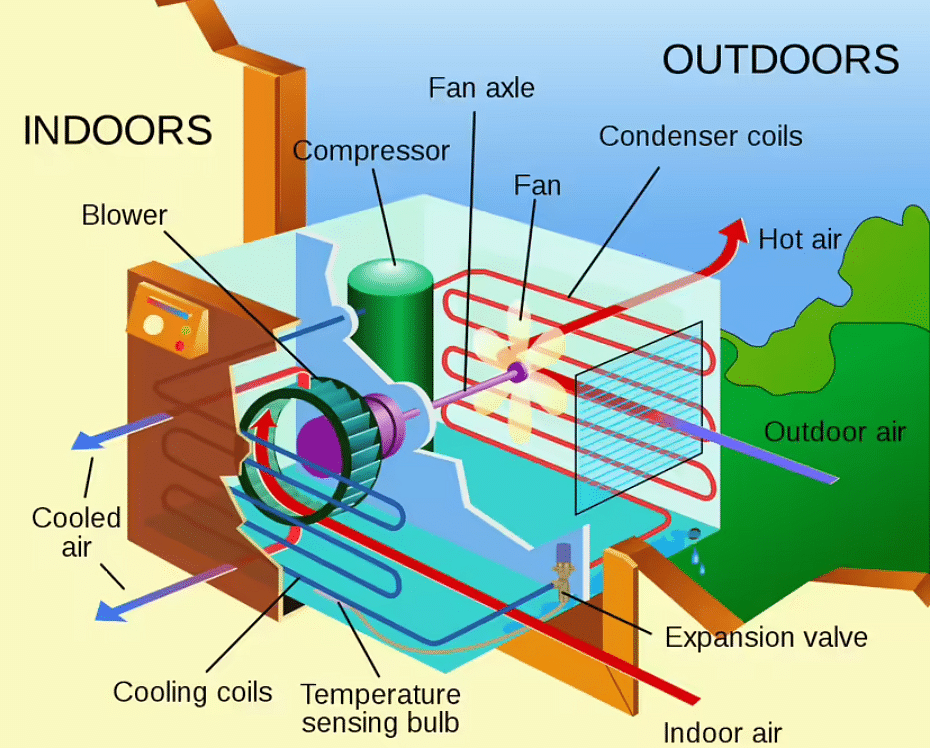
Air Conditioning Working Principle
- The term "air conditioning" refers to the changes the state of air through cleaning, dehumidification, cooling, heating, and ventilation.
- An Air Conditioner has two main components- an evaporator and a condenser, both of which use an exchanger.
- The working substance, i.e. coolant, is circulated throughout the system in various aggregate states such as liquid and gaseous.
- Its cooling process is analogous to the heating process of heat pumps, and both are based on the Carnot cycle.
- The evaporator removes heat from the air, cooling it as well as the surrounding space.
Read More:
What is Refrigeration?
[Click Here for Sample Questions]
- The term refrigeration refers to the process of cooling.
- Refrigeration reduces the body's internal energy by removing heat energy.
- Refrigeration also refers to the process of transferring heat from cold to hot temperatures.
- The apparatus in refrigeration provides thermal energy from cold to high temperatures.

Refrigeration Cycle
- Refrigeration equipment employs liquids that are typically converted to gas at extremely low temperatures.
- As coolants, chlorofluorocarbons, or freons, are commonly used.
- The fridge is made up of a maze of hermetically sealed interconnected tubes, and Freon is constantly circulating within these tubes.
- Without being heated, freon is transferred from the liquid to the gas state and vice versa.
- This liquid Freon absorbs heat and, as the temperature rises, turns into a gas.
- As a result, the temperature of the substances stored within it decreases.
Read More: Current Electricity Important Questions
Things to Remember
- Air Conditioning and Refrigeration are two different processes that are often confused with each other owing to the similar function they perform.
- The primary distinction between refrigeration and air conditioning is that air conditioning maintains both humidity and temperature in the surrounding environment.
- Air conditioning needs the installation of an indoor unit, an outer unit, and a pipe connection.
- The compressor compresses the heated gas into the condenser when in cooling mode.
- It uses the same heating process but in the opposite direction.
- Refrigerators serve chilled goods.
- As the pump pushes air into the compressor, the compressor compresses the steam.
- It then raises the temperature of the steam.
- The hot and compressed air is then passed through the condenser to become a cooled liquid. 4
- This liquid is pumped into the evaporator to be vaporised.
Also Read:
Previous Year Questions
- In a meter bridge experiment, resistances are connected as shown in figure….[KEAM]
- the potential at the junction between the resistors is….[KEAM]
- for a limited range of temperatures, is a straight line for a material like…[KEAM]
- In the circuit shown, the current through the 5Ω resistor is….[KEAM]
- A galvanometer has 30 divisions and a sensitivity...[KEAM]
- In the given circuit, an ideal voltmeter connected across the 10Ω10Ω resistance reads 2V2V. The internal resistance rr, of each cell is :[JEE Main 2019]
- Consider a cylindrical conductor of Length L and area of cross section A. The specific conductivity varies as σ(x)=σ0L√xσ(x)=σ0Lx where x is the distance along the axis of the cylinder from one of its ends. The resistance of the system along the cylindrical axis is...[KEAM]
- Electrical conductivity is the reciprocal of…...[KEAM]
- Five cells each of emf EE and internal resistance rr send the same amount of current through an external resistance RR whether the cells are connected in parallel or in series. Then the ratio (Rr)(Rr) is…..[KEAM]
- In a closed circuit, the current II (in ampere) at an instant of time tt (in second) is given by I=4−0.08tI=4−0.08t . The number of electrons flowing in 50s50s through the cross-section of the conductor is….[KEAM]
- Potometer works on the principle of….[NEET 2005]
- Three equal resistors connected in series across a source of e.m.f. together dissipate 10 watt of power. What will be the power dissipated in watt if the same resistors are connected in parallel across the same source of e.m.f. ?[NEET 1998]
- In the network shown in figure each resistance is 1Ω.1Ω. The effective resistance between A and B is...[NEET 1990]
- A heating coil is labelled 100 W, 220 V. The coil is cut in half and the two pieces are joined in parallel to the same source. The energy now liberated per second is….[NEET 1995]
- A 4μF4μF capacitor is charged to 400 V. If its plates are joined through a resistance of 2kΩ2kΩ, then heat produced in the resistance is...[NEET 1995]
- Column - I gives certain physical terms associated with flow of current through a metallic conductor. Column - II gives some mathematical relations involving electrical quantities. Match Column - I and Column - II with appropriate relations.[NEET 2021]
- If power dissipated in the 9Ω9Ω resistor in the circuit shown is 3636 watt, the potential difference across the 2Ω2Ω resistor is….[NEET 2011]
- Fuse wire is a wire of...[NEET 2003]
- For a cell terminal potential difference is 2.2 V when circuit is open and reduces to 1.8 V when cell is connected to a resistance of R=5ΩR=5Ω. Determine internal resistance of cell (r) is then :-….[NEET 2002]
Read More:
Sample Questions
Ques. What are the primary design distinctions between air conditioning and refrigeration? (3 Marks)
Ans. Refrigerators are made up of a condenser, compressors, and evaporators all in one. AC, on the other hand, is made up of a compressor and a condenser that are separate from the evaporator.
In an air conditioner, the compressor and condenser are independent of the evaporator. However, in a refrigerator, the compressor and condenser are combined with an evaporator to form a single unit.
Ques. What do you understand by Mechanical Refrigeration? (3 Marks)
Ans. To function, mechanical refrigeration necessitates the use of a man-made heat exchange system. This exchange system aids in the removal of heat from a specific location. However, for operations, this exchange system may function differently. It can be either cyclic or non-cyclic, magnetic or thermoelectric.
It is entirely dependent on how you intend to use the refrigeration. When the refrigerant enters the cooling coil, it continuously converts to a vapour state and absorbs heat. CRAC (computer room air conditioner) is an example of mechanical refrigeration in action.
Ques. What is the primary distinction between cooling and refrigeration? (3 Marks)
Ans. The process of lowering the temperature of an object is known as cooling. The refrigeration process, on the other hand, lowers the temperature of the object to that of its surroundings. As a result, it maintains this temperature throughout.
Refrigeration involves cooling down a space/substance/system to lower and/or maintain its temperature below the ambient one. In simpler terms, refrigeration is artificial (human-made) cooling. Cooling refers to the process of removal of heat that results in a lower temperature and/or phase change.
Ques. How do you tell the difference between a refrigerator and an air conditioner? (3 Marks)
Ans. In the case of refrigeration, thermal energy is transferred from one region to another with a higher temperature. The case of an air conditioner, on the other hand, is entirely different because thermal energy is used to cool the air. However, thermal energy transfers from a high-temperature location to a low-temperature location in the natural flow of thermal energy.
As the name implies, an air conditioner is a device that cools down the air by removing heat from a specific location. Refrigeration, on the other hand, refers to the process of releasing hot air.
Ques. Explain the working of a Refrigerator. (5 Marks)
Ans. A refrigerator is made up of four major components that work together to keep it running. Evaporator, Compressor, Condenser, and Expansion Valve are the four components.
An evaporator (generally coil-shaped) is the part of a refrigerator that cools. The evaporator absorbs heat from the area where we want to keep the temperature stable and transfers it to the refrigerant.
After receiving heat from the evaporator, the refrigerant travels to the compressor, where it is compressed and its temperature rises as a result of the compression.
A condenser is similar to an evaporator in appearance. The temperature of the refrigeration fluid reaches the condenser (which may be either water-cooled or air-cooled). Its temperature is reduced to the ambient temperature in this location (heat which is sucked from the room or closed space is given away to the atmosphere at condenser)
After the condenser refrigerant arrives at the expansion valve (which is basically a throttling device). The pressure of the refrigerant is reduced here, lowering the temperature of the refrigerant below the atmospheric temperature. This cooled refrigerant is then supplied to the evaporator, and the cycle continues indefinitely.
Ques. Name the different stages of Refrigeration? (3 Marks)
Ans. There are mainly four stages of refrigeration which are:
- Stage 1: It involves the evaporator coil.
- Stage 2: It involves a compressor.
- Stage 3: It involves a condenser coil.
- Stage 4: It involves an expansion chamber.
Ques. Give the uses or applications of air conditioning and refrigeration? (3 Marks)
Ans. The uses/application of air conditioning and refrigeration are as follows:
- Air Conditioning: Air Conditioning deals with maintaining the temperature of certain air capacity in surroundings and also helps to maintain humidity and purity.
- Refrigeration: Refrigeration deals with regulating the air temperature, it is used in freezing or cooling products.
Ques. A Carnot heat pump works between 27° C and 327°C. What will be its COP? (3 Marks)
Ans. \({\rm{COP\;of\;Carnot\;Heat\;pump}} = \frac{{{T_1}}}{{{T_1} - {T_2}}}\)
Calculation:
Given:
T1 = 327° C = 600 K, T2 = 27° C = 300 K
\(\therefore COP = \frac{{{T_1}}}{{{T_1} - {T_2}}}\)
\(\therefore COP = \frac{{600}}{{600 - 300}} = \frac{{600}}{{300}} = 2\)
<>∴ COP of Carnot heat pump = 2
Ques. If the volume of moist air with 50% RH is isothermally reduced to half its original volume then relative humidity of moist air becomes? (3 Marks)
Ans. Relative humidity is given by
\(ϕ = \frac{{{P_v}}}{{{P_{vs}}}}\)
where P v is pressure of water vapour and Pvs is pressure of water vapour at saturation point.
For isothermal process:
PV = constant
Calculation:
Given:
ϕ1 = 50%, Pv1
Since volume is reduced to half so the pressure has become twice.
Pv2 = 2Pv1
\(\frac{{{ϕ _2}}}{{{ϕ _1}}} = \frac{{{P_{{v_2}}}}}{{{P_{v1\;}}}}\)
\(\frac{{{ϕ _2}}}{{{ϕ _1}}} = 2\)
ϕ2 = 2ϕ1
ϕ2 = 2 × 50 ⇒ 100%.
Ques. Which is the desirable physical property of refrigerant? (2 Marks)
Ans. The characteristics of a good refrigerant should have the following properties
- Low boiling point
- High latent heat value
- Low freezing point
- Non-flammable and non-toxic
- High di-electric strength
- Not affected by moisture
- Non-corrosive to metals
- Mixes well with compressor oil
Ques. Moist air at 35°C and 100% relative humidity is entering a psychometric device and leaving at 25°C and 100% relative humidity. The name of the device is? (3 Marks)
Ans. Wet bulb temperature: Temperature obtained by an accurate thermometer having a wick moistened with distilled water
Dew point temperature: Temperature at which the liquid droplets just appear when the moist air is cooled continuously.
Relative humidity along saturation line is 100%.
Basic Processes in Conditioning of Air:
Sensible heating: Moisture content of air remains constant so specific humidity is constant, temperature increases as it flows over a heating coil
Sensible cooling: Moisture content of air remains constant so specific humidity is constant, but its temperature decreases as it flows over a cooling coil
Cooling and dehumidification: When moist air is cooled below its dew-point by bringing it in contact with a cold surface, some of the water vapour in the air condenses and leaves the air stream as a liquid, as a result, both the temperature and humidity ratio of air decreases.
Heating and Humidification: During winter it is essential to heat and humidify the room air for comfort. It is done by first sensibly heating the air and then adding water vapour to the air stream through steam nozzles, as a result, both the temperature and humidity ratio of air increases.
Cooling & humidification: Air temperature drops and its humidity increases.
Heating and de-humidification: This process can be achieved by using a hygroscopic material, which absorbs the water vapour from the moisture. If this process is thermally isolated, then the enthalpy of air remains constant, as a result, the temperature of air increases.
Inlet (State 1): 35°C and 100% RH
Outlet (State 2): 25°C and 100% RH
Relative humidity is same but as the temperature is decreasing and specific humidity is also decreasing. So the process 1-2 is cooling and dehumidification process.
The name of the device is dehumidifier.
For Latest Updates on Upcoming Board Exams, Click Here: https://t.me/class_10_12_board_updates
Also Read:



Comments