



Content Curator
A transformer is a device that is used to transfer electric energy from one alternating-current circuit to one or more circuits. It transfers electric energy either by increasing (stepping up) or reducing (stepping down) the voltage.
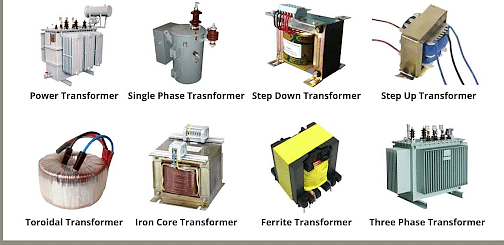
Different Types Of Transformers
The video below explains this:
Transformer Detailed Video Explanation:
Important Questions On Uses Of Transformer
Ques. What is a transformer? (1 Mark)
Ans. An electric transformer is a static device which is utilized to transfer electrical energy with no direct electrical contact from one circuit to another. While transforming electrical energy mutual induction between two windings takes place.
Ques. What are the properties of an ideal transformer? (2 Marks)
Ans. The properties of an ideal transformer are:
- Shouldn’t be any magnetic leakage
- There should be no iron losses
- no winding losses
- infinite permeability of the core
- zero magnetising current
Ques. Define leakage flux in the transformer. (1 Mark)
Ans. In a transformer, the main flux links with the primary and secondary winding. Some portion of the main flux generated by primary winding does not link with the secondary winding and this portion of flux which is not useful in any work is known as leakage flux.
Also Check:
Ques. List a few uses of a transformer. (2 Marks)
Ans. Transformers are used in:
- power generation grid
- distribution sector
- Transmission
- electric energy consumption.
Ques. State the types of transformers. (1.5 Marks)
Ans. The types of transformers are:
- Autotransformers
- Power transformers
- Generator set up transformers
- Auxiliary transformers
Ques. What is the basic principle of transformers? (2 Marks)
Ans. The basic principle of transformers are:
- Any transformer works on the principle of mutual induction.
- Mutual induction is the phenomenon due to which, when the amount of magnetic flux linked with a coil changes.
- An E.M.F. is induced in the neighbouring coil.
- A transformer is made up of a rectangular iron core.
Ques. State three advantages of transformers. (2 Marks)
Ans. The advantages of transformers are:
- The transformer is efficient for the high-frequency range.
- Transformers offer good mechanical strength.
- The transformer is widely used in power transmission
Ques. What are the conditions for maximum efficiency of a transformer? (2 Marks)
Ans. There are two main losses in transformers; copper losses and iron losses.
Iron losses are fixed losses and do not change with any change in load whereas copper losses are variable losses and increase with an increase in load. At no/zero load conditions, copper losses are almost negligible.
As the load on transformers increases their copper losses also increase. So, there will be a load at which copper losses become equal to variable losses and at that condition when the copper losses become equal to the iron loss, the efficiency of the transformer will maximum.
Ques. List three disadvantages of transformers. (2 Marks)
Ans. Three disadvantages of transformers are:
- Noisy
- A transformer will not work with DC voltage under any condition.
- The physical size of the transformer is directly related to the amount of power to be desired.
Ques. Which oils are used in the transformer? (2 Marks)
Ans. Majorly mineral oil and synthetic oil are used in transformer.
Also Check:



Comments